Following the American Civil War Sesquicentennial with day by day writings of the time, currently 1863.

May 2014

by John Beauchamp Jones

            MAY 26TH—Sunshine and showers.

            Senator Henry’s letter was referred to Gen. Bragg, who returned it to-day with the indorsement that the suggested movement had not escaped attention, and a good result might soon be looked for. And sure enough, a dispatch was received from Atlanta to-day, announcing the capture of some 250 of the enemy’s wagons laden with stores!

            It is to be hoped that Gen. Lee has some scheme of a similar character, to relieve Grant of his supply trains. Troops are daily coming hither, infantry and cavalry, whence in one hour and a half the former reach Lee’s army. The great battle still hangs fire, but to be of greater magnitude when it does occur.

            Gen. Bragg did a good thing yesterday, even while Senator Orr was denouncing him. He relieved Gen. Winder from duty here, and assigned him to Goldsborough, N. C. Now if the rogues and cut-throats he persisted in having about him be likewise dismissed, the Republic is safe! Gen. Ransom has now full charge of this department.

            Mr. Secretary Seddon is sick, and Mr. Assistant Secretary Campbell is crabbed—Congress not having passed his Supreme Court bill. And if it were passed, the President would hardly appoint him judge.

            It is said one of our iron-clads is out—the rest to follow immediately. Let Butler beware!
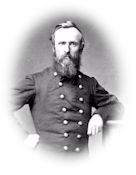
Meadow Bluff, May 26, 1864.

Dear Uncle: — I get two letters from you today. We all believe in General Crook. I am on the best of terms with him. He is the best general I have ever been with, no exceptions. We have all sorts of rumors from Grant, but it is all clear that we shall finish them soon, if our people and leaders do their duty. They are at the end of their means, and failure now is failure for good.

My brigade is all here, or near here, now. We are getting ready to move towards Staunton soon; tomorrow, I think. I have the two best regiments to be found and two others which promise well. Good-bye.

Sincerely,

R. B. Hayes

S. Birchard

[May] 26. Thursday.—. . . Trains arriving; looks like moving on Staunton soon. News from Grant rather favorable.

Meadow Bluff, May 25, 1864.

Dearest: — We are preparing for another move. It will require a week’s time, I conjecture, to get shoes, etc., etc. It looks as if the route would be through Lewisburg, White Sulphur, Covington, Jackson River, etc., to Staunton. The major came up this morning with a few recruits and numbers of the sick, now recovered. They bring a bright new flag which I can see floating in front of [the] Twenty-third headquarters. I suspect it to be your gift. Three hundred more of the Thirty-sixth also came up. The Fifth and Thirteenth are coming, so I shall have my own proper brigade all together soon. . . .

Brigdon carried the brigade flag. It was knocked out of his hands by a ball striking the staff only a few inches from where he held it. It was torn twice also by balls.

I see the papers call this “Averell’s raid.” Very funny! The cavalry part of it was a total failure. General Averell only got to the railroad at points where we had first got in. He was driven back at Saltville and Wytheville. Captain Gilmore is pleased. He says the Second Virginia was the best of any of them! . . .

I am now on most intimate and cordial terms with General Crook. He is a most capital commander. His one fault is a too reckless exposure of himself in action and on the march — not a bad fault in some circumstances.

I shall probably send my valise back to Gallipolis from here to Mr. James Taylor. It will contain a leather case with Roman candles for the boys, a sabre will go with it for one of them, a wooden-soled shoe, such as we destroyed great numbers of at Dublin, and very little else. If it is lost, no matter. . . .

May 26. — Just received your welcome letters of the 6th and 14th. Very glad you are so fortunate. Write to Uncle and Mother when you feel like it.

We shall start soon — perhaps in the morning. We take only one wagon to a regiment. The Fifth is now coming into camp. The general is pleased with Colonel Tomlinson’s conduct and Colonel Tomlinson will remain. The Thirteenth will be here tonight. All my brigade together. The rest of the Thirty-sixth is here, six hundred and fifty in all. We feel well about the future. General Crook is more hopeful than ever before.

You need not believe the big stories of great victories or defeats at Richmond. But I think we shall gradually overcome them.

Good-bye, darling,

R.

Mrs. Hayes.

Wednesday, May 25th.

At seven this morning Kitchings Brigade moved off toward the left, while our Battalion was sent to the right. Lively skirmishing occurred in our front, and at half-past three o’clock there was some artillery firing on our left, but there was very little close fighting. The cavalry came in from a raid, and it was rumored that the Sixth Corps had torn up the railroad track from Hanover Junction to Gordonsville. Towards night we were drawn in and sent out on picket along the North Anna.

Wednesday, 25th—We packed our knapsacks and sent them by rail to Rome, Georgia. The advance of our corps started early this morning for Decatur, Alabama, but our brigade taking up the rear did not leave Huntsville till in the afternoon. From Decatur we are to proceed to Rome, Georgia. We marched through fine farming country with good buildings, but as usual the people are gone and the farms are idle. Such is the effect of war, the citizens being afraid to remain while our armies are marching back and forth.

May 25th.—Started at daylight, marching in direction of Dallas. Marching very hard. Some skirmishing on our right. Formed in line of battle at 2 P. M., near New Hope Church. Our brigade in second line. 6 P. M., Hooker’s Corps made heavy assault just to our left; two regiments of our division engaged. When the Federals began to advance, a whole battalion, sixteen guns, was massed in their front and did terrible execution, causing them to fall back.

Hanover Court House, Va., May 25th, 1864.

I left Fredericksburg on Sunday to rejoin my regiment in order to get my parole papers, as I can do nothing without them. We are now within twenty-six miles of Richmond, and very much nearer to Lee’s army, which I consider vastly more important.

I find that during my absence Grant and Lee have “locked horns” nearly every day, with no decided advantage on either side. Grant is now crossing the North Anna with the hope of finding a more vulnerable point. I find the Seventeenth taken from the brigade and doing provost duty at Wilcox’s headquarters. They were nearly annihilated at Spottsylvania on the 12th inst., and muster but 125 men. I am not doing any duty. The position in which I find myself is annoying, but I bear it patiently as possible, firmly believing I did my duty. I do not seem to have lost friends in the regiment—rather the reverse. I still expect to get home before a great while.

May.—The 4th New York Heavy Artillery is having hard times in the Virginia mud and rain. They are near Culpepper. It is such a change from their snug winter quarters at Fort Ethan Allen. There are 2,800 men in the Regiment and 1,200 are sick. Dr Charles S. Hoyt of the 126th, which is camping close by, has come to the help of these new recruits so kindly as to win every heart, quite in contrast to the heartlessness of their own surgeons. They will always love him for this. It is just like him.

[May 25, written on envelope]

Dear Hannah, — I am glad to inform you that I am safe and sound so far. Had a hard scrimmage yesterday. I came out safely although a bullet went through my coat, etc., and raised a scratch over an inch long. It is the first time that I have ever been wounded or rather touched by a ball. Had my boot torn by a bullet in the Wilderness, which was the nearest I ever came to it.

We go into a real fight every six days. Have been in one the 6th, 12th, 18th and 24th. Next time will be the 30th. I shall be lucky if I get through without being killed. Every one is being killed that I know. We are whipping the rebels well, although it is a work of time.

I see by the papers that we lost our colors. It is a falsehood. We have never lost our colors, and I hope never shall.