24th. At 3 A. M. breakfasted. Column moved out on Meherrin road—our Regt. the rear guard. Reached the station at 4 P. M. On picket. Troops destroyed the track as they advanced. Road made of stringers and bar iron spiked on. Destruction almost complete. Disturbed but little on picket.
June 2014
June 24, Friday. Telegraphed to Wilson directly on reaching Department (and finding no letter from Wilson), directing him to bail the Smiths in sums of $20,000 each.
Have given some examination of the Scofield trial, which is very voluminous, and had Watkins investigate, review, and report. I conclude to approve the finding, though there may be some irregularities and mistakes adverse to the Government. Mr. Bliss, counsel for S., filed a document, excepting to some legal points, yesterday. To-day, after learning my conclusion and looking at the finding, he takes stronger exceptions and declares the finding not conformable to facts and evidence. He wishes me to submit the legal questions to the Attorney-General or some one else. Alluded to Mr. Eames. Wishes Mr. Watkins to examine the evidence. To Eames he says that it is the intention of Scofield and his counsel to prosecute the members of the court individually for false imprisonment. To Watkins, he further says that it is their intention to hold me accountable, and to have me arrested when I am in New York. All this does not induce me to change my conclusion of approving the verdict of the court martial, but I think it may be proper to advise the court that it is in error on the subject of jurisdiction, – that they can take cognizance of open-market purchases as well as others, and though, had they done so, the punishment might have been greater, yet I will still approve the finding. Let him have the benefit of the mistake the court has made.
Fox is much dissatisfied with the verdict. Thinks it inadequate; should have been imprisoned five years and fined one hundred thousand dollars. He wishes me to return the papers for revision, and to state the punishment is inadequate. But this is not advisable, even were it strictly correct and allowable. The ends desired will be accomplished by this punishment. A more severe one, such as he suggests, will endanger a reaction.
The President was in very good spirits at the Cabinet. His journey has done him good, physically, and strengthened him mentally and inspired confidence in the General and army. Chase was not at the Cabinet-meeting. I know not if he is at home, but he latterly makes it a point not to attend. No one was more prompt and punctual than himself until about a year since. As the Presidential contest approached he has ceased in a great measure to come to the meetings. Stanton is but little better, if he comes, it is to whisper to the President, or take the dispatches or the papers from his pocket and go into a corner with the President. When he has no specialty of his own, he withdraws after some five or ten minutes.
Mr. Seward generally attends the Cabinet-meetings, but the questions and matters of his Department he seldom brings forward. These he discusses with the President alone. Some of them he communicates to me, because it is indispensable that I should be informed, but the other members are generally excluded.
by John Beauchamp Jones
JUNE 24TH.—Hot and hazy ; dry.
The news (in the papers) of the cutting of our railroad communications with the South creates fresh apprehension among the croakers.
But at 12 M. we had news of the recovery of the Weldon Road last evening, and the capture of 500 more prisoners.
We have nothing from the south side raiders since their work of destruction at Burkesville, cutting theDanville Road.
Mr. Hunter sheds tears over his losses inEssex, the burning of his mill, etc. But he had been a large gainer by the war.
There is a rumor of fighting atPetersburg to-day.
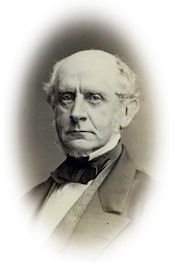
Charles Francis Adams to his son
London, June 24, 1864
General Grant shows one great quality of a commander. He makes himself felt by his enemy as well as by his own troops. This is one of the most important elements of success in warfare. The imagination has a vast power in upholding human force, or in knocking it away. The self reliance of the slaveholding rebel is the secret of the amount of his resistance thus far. He began the war with a full conviction that he was more than a match for half a dozen northern men. And in many instances that conviction acting against a feebler will made him what he thought himself. The progress of the war has done a good deal to correct these impressions. General Grant appears to be setting them right. The moment the rebel becomes convinced he has to do with a will stronger than his own, he will knock under, and not before. I have watched with a great deal of interest the gradual modifications in the tone of the Richmond newspapers since the first of May. Then, it was the most implicit faith in Lee’s power to drive any force of ours, however large, back to Washington. Now, it has got to the suggestion of prayers in their churches for the salvation of their Capital. The only cause of this change of tone is General Grant. If he will go on in the same line for a while longer, there is no telling what may be the state of mind to which he will bring them. Perhaps it might even get to that condition which marked the commander at Vicksburg on or about the early part of last July.
You ask me what has become of my affair. I have already hinted to you the result in a former letter. The party concerned failed from sheer blundering. Instead of abiding by the understanding as distinctly defined before your departure, he rushed into a position decidedly at variance with it, thus compelling a resort to measures on the part of the government which have, for the time at least, put an end to all progress. The party has now returned here without having ever reached his true destination. Events may yet favor the development of his scheme. At present I see no prospect of its turning up.
We are not without stirring events on this side too. The first is the naval conflict between the notorious Alabama and our steamer the Kearsarge. Practically this was a trial of skill between English guns and training, and American. If so, the result tells a singular tale. The Alabama fired more guns and oftener, within very short range. The Kearsarge did less but brought more to pass. Meanwhile our English friends are trying to make a hero of Captain Semmes. The animus of these people is not equivocal. . . .
June 24th. Did not have to hurry up this morning. After breakfast, orders were, we remain here for the day. I started out to find water where I could take a bath. While hunting for such a place I met Sergeant Samuel Lee, Co. A, who was on the same errand. Together we hunted for water through the lots. We were rewarded by finding a small brook with a deep hole, close to the foot of a high mountain. A good clean place. Water enough for a good bath but not for a swim. Remained in the water for a long time. After the bath we visited the springs. Drank freely of its waters. Walked around the grounds and in some of the buildings. The soldiers raised havoc with the place. It was a fine property, badly ruined. At the springs we met our Colonel and Colonel Rodgers, and Maryland. Our Colonel said, “Boys, you ought to find a place for a bath.” We informed him, “We just came out of the water.” “Where?” he asked. We pointed out the place across a lot. Thanking us, they made tracks for the place. We lay down under the fine trees for a rest. This is certainly a beautiful place. On returning to the regiment, orders had been given that we leave in the early evening for an all night’s march. It is done on account of the extreme heat. After a feed of fresh meat and coffee, line was formed and ready for the march.
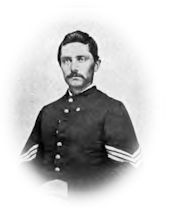
Thursday, 23d—We were up all night throwing up breastworks, finishing them about noon today. The rebels opened up their battery on Little Kenesaw mountain, but did no harm. General Leggett on the right made a demonstration before the rebel lines, but was not engaged and soon fell back again.[1] All is quiet on the right. The Sixteenth Corps was ordered out on an expedition with fifteen days’ rations, but we do not know their destination. We received orders to be ready to march at a moment’s warning, with two days’ rations. William Cross of Company E returned from the hospital after an absence of ten months.
[1] I remember quite distinctly seeing General Sherman with his staff officers riding along our lines, taking in the lay of the country. They had just passed by where I was stationed, when they halted near one of our batteries and began using their field glasses, taking a view of the enemy’s lines. At that same time a Confederate general with his staff rode out of the timber upon an open knoll to take a view of our lines with their glasses. This was too good a chance for our battery, so the gunners, taking good aim, fired five or six shots at the mark, and one of them hit and killed the Confederate general, who the signal corps reported was a General Pope. Our signal corps had learned the signs of the Confederate signal service and at once reported the facts. The Confederates claimed that General Sherman himself had aimed the shot which killed their general, but such is not the case.—A. G. D.
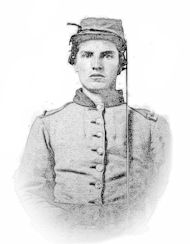
Thursday, 23d.—Yesterday we were moved out and formed in two lines of battle—Cummings’ Brigade in front and Pettus’ in second. About 4:30 P. M., ordered forward. Drove in pickets and went within fifty yards of works, when we were ordered to halt, owing to the line not coming up on our right. After firing a few rounds, were ordered to fall back. Hiram McAbee killed; Cousin Robert Magill seriously wounded in left hip. Good many of brigade killed and wounded. Forty killed and wounded in our regiment. At night fell back one-fourth of a mile. For the next few days it was simply skirmishing, marching, fortifying, listening to the firing of cannons and sharp-shooting.
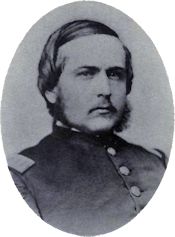
Thursday, June 23d.
At 5 A. M. the regiment was ordered to report to General Gibbon for assignment to a position on his line. On reaching that line I found that the position to be occupied by my company was a very exposed one, being an angle the interior of which was commanded by the opposing rebel lines, and especially by sharpshooters, but by going through a narrow ravine in single file we succeeded in getting into the breastworks with the loss of but one man, Private Sinnot, who was shot through the heart and killed instantly. We found these works little more than a mere rifle-pit pushed out in front of the main line, and we at once went to work to strengthen it. Having accomplished all that we could, the men stretched their shelter tents on poles above them for protection from the sun, and laid down in the ditch or on the bank beside it. I sat with my back against the logs just at the angle, and for some time two sharpshooters, one on each side, amused themselves trying to hit me. Each could from his position look right into the rear of our breastworks, one seeing the logs to the right and the other those to the left of me, but neither
could quite reach my corner. Just as I was beginning to think that my position was the safest on the line, I heard that peculiar “spat” which a bullet makes when it strikes a man or a green tree, and saw that a shot had cut off the stick which a moment before had supported the shelter tent of Corporal Polley, who was lying on the bank near my feet, and on pulling the canvas off of him I saw that the ball had entered his head at the left cheek bone, passed under the skin over the temple, and then out about an inch and a half from where it entered. He was unconscious for a few moments only, and as soon as he revived I directed two men to take him to the rear. Earlier in the day Polley had had the sole of one of his shoes cut by a rifle ball, and had jokingly asked if that wound didn’t entitle him to go to the hospital, and on my replying that I did not think he could march very comfortably in that shoe, he said: “Oh, well! I guess I’ll give the `Johnnies’ another chance.”
In the afternoon we were ordered out of this nasty position, and were sent to build more substantial breastworks farther back and in rear of a piece of woods, where, after throwing up enough of a rifle-pit to protect us, we spent the night. When we withdrew from the advanced position the rebels came in and occupied the line, and one of my men named Blair, who did not know that the company had left during his temporary absence, returned just as the “Johnnies” came swarming over the angle, one of whom raised his rifle and called on the “damned Yankee” to surrender. It required but an instant for Blair to take in the whole situation, and employing a mode of expression quite as complimentary and picturesque as that of his Southern brother, from which it was fairly inferable that he declined the invitation, he dodged a bullet aimed at his head and plunging into the brush, soon joined his comrades.
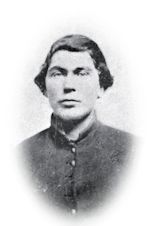
Camp on Paint Rock River, Thursday, June 23. Aroused at 3 A. M. but as we were in the rear of the column, did not move out till 6 A. M. Marched fast, but obliged to halt frequently to let the 2nd Brigade train get out of the way. Our road lay along the railroad, the same that we travelled last winter, but nature’s changes were so great that we could hardly recognize the dismal beech swamp, once a dread to cross. But now the deep foliage afforded a welcome protection from the burning rays of the sun. Camped on Paint Rock 4 P. M. Found our advance having their supper. There was hardly any straggling. Walked all through and feel first rate. Bathed in the evening. Retired early. Disappointed in not receiving mail. .
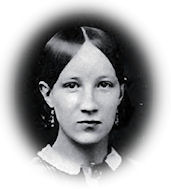
June 23, 1864. — Anna graduated last Thursday, June 16, and was valedictorian of her class. There were eleven girls in the class, Ritie Tyler, Mary Antes, Jennie Robinson, Hattie Paddock, Lillie Masters, Abbie Hills, Miss McNair, Miss Pardee and Miss Palmer, Miss Jasper and Anna. The subject of her essay was “The Last Time.” I will copy an account of the exercises as they appeared in this week’s village paper. Every one thinks it was written by Mr E. M. Morse.

A Word From An Old Man
.
“Mr. Editor :
“Less than a century ago I was traveling through this enchanted region and accidentally heard that it was commencement week at the seminary. I went. My venerable appearance seemed to command respect and I received many attentions. I presented my snowy head and patriarchal beard at the doors of the sacred institution and was admitted. I heard all the classes, primary, secondary, tertiary, et cetera. All went merry as a marriage bell. Thursday was the great day. I made vast preparation. I rose early, dressed with much care. I affectionately pressed the hands of my two landlords and left. When I arrived at the seminary I saw at a glance that it was a place where true merit was appreciated. I was invited to a seat among the dignitaries, but declined. I am a modest man, I always was. I recognized the benign Principals of the school. You can find no better principles in the states than in Ontario Female Seminary. After the report of the committee a very lovely young lady arose and saluted us in Latin. I looked very wise, I always do. So did everybody. We all understood it. As she proceeded, I thought the grand old Roman tongue had never sounded so musically and when she pronounced the decree, “Richmond dilenda est,” we all hoped it might be prophetic. Then followed the essays of the other young ladies and then every one waited anxiously for “The Last Time.” At last it came. The story was beautifully told, the adieux were tenderly spoken. We saw the withered flowers of early years scattered along the academic ways, and the golden fruit of scholarly culture ripening in the gardens of the future. Enchanted by the sorrowful eloquence, bewildered by the melancholy brilliancy, I sent a rosebud to the charming valedictorian and wandered out into the grounds. I went to the concert in the evening and was pleased and delighted. So was everybody. I shall return next year unless the gout carries me off. I hope I shall hear just such beautiful music, see just such beautiful faces and dine at the same excellent hotel.
Senex.”
Anna closed her valedictory with these words:
“May we meet at one gate when all’s over;
The ways they are many and wide,
And seldom are two ways the same;
Side by side may we stand
At the same little door when all’s done.
The ways they are many,
The end it is one.”


