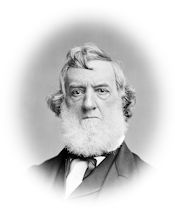
Following the American Civil War Sesquicentennial with day by day writings of the time, currently 1863.

Diary of Gideon Welles

May 2, Saturday. Thick rumors concerning the Army of the Potomac, — little, however, from official sources. I abstain from going to the War Department more than is necessary or consulting operators at the telegraph, for there is a hazy uncertainty there. This indefiniteness, and the manner attending it, is a pretty certain indication that the information received is not particularly gratifying. Whether Hooker refuses to communicate, and prevents others from communicating, I know not. Other members of the Cabinet, like myself, are, I find, disinclined to visit the War Department under the circumstances.

A very singular declaration by John Laird, Member of Parliament and one of the builders of the pirate Alabama, has been shown. Laird said in Parliament, in reply to Thomas Baring, that the Navy Department had applied to him to build vessels. It is wholly untrue, a sheer fabrication. But John Laird writes to Howard of New York, that he (Howard) had said something to him (Laird) about building vessels for the Government. Howard, I judge, was Laird’s agent or broker to procure, if possible, contracts for him or his firm, but did [not] succeed. The truth is, our own shipbuilders, in consequence of the suspension of work in private yards early in the war, were clamorous for contracts, and the competition was such that we would have had terrible indignation upon us had we gone abroad for vessels, which I never thought of doing.

May 1, Friday. After Cabinet-meeting walked over with Attorney-General Bates to his office. Had a very full talk with him concerning the question of captured mails, — the jurisdiction of the courts, the law, and usage, and rights of the Government. He is unqualifiedly with me in my views and principles, — the law and our rights. He dwelt with some feeling on the courtesy which ought to exist between the several Departments and was by them generally observed. Although cautious and guarded in his remarks, he did not conceal his dissatisfaction with the conduct of the Secretary of State in writing to attorneys and marshals, and assuming to instruct and direct them in their official duties which were assigned to and required by law to be done by the Attorney-General.

We are getting vague rumors of army operations, but nothing intelligible or reliable.

April 30, Thursday. To-day has been designated for a National Fast. I listened to a patriotic Christian discourse from my pastor, Mr. Pyne.

Had a long, studied, complaining letter from Admiral Du Pont, of some twenty pages, in explanation and refutation of a letter in the Baltimore American, which criticizes and censures his conduct at Charleston. The dispatch is no credit to Du Pont, who could be better employed. He is evidently thinking much more of Du Pont than of the service or the country. I fear he can be no longer useful in his present command, and am mortified and vexed that I did not earlier detect his vanity and weakness. They have lost us the opportunity to take Charleston, which a man of more daring energy and who had not a distinguished name to nurse and take care of would have improved. All Du Pont’s letters since the 8th show that he had no heart, no confidence, no zeal in his work; that he went into the fight with a predetermined conviction it would not be a success. He is prejudiced against the monitor class of vessels, and would attribute his failure to them, but it is evident he has no taste for rough, close fighting.

Senator Sumner called on me this P.M. in relation to the coast defense of Massachusetts. I received a letter from Governor Andrew this A.M. on the same subject. The President had also been to see me in regard to it.

After disposing of that question, Sumner related an interesting conversation which he had last evening with Lord Lyons at Tassara’s, the Spanish Minister. I was an hour or two at Tassara’s party, in the early part of the evening, and observed S. and Lord L. in earnest conversation. Sumner says their whole talk was on the subject of the mails on captured vessels. He opened the subject by regretting that in the peculiar condition of our affairs, Lord Lyons should have made a demand that could not be yielded without national dishonor; said that the question was one of judicature rather than diplomacy. Lord Lyons disavowed ever having made a demand; said he was cautious and careful in all his transactions with Mr. Seward, that he made it a point to reduce all matters with Seward of a public nature to writing, that he had done so in regard to the mail of the Peterhoff, and studiously avoided any demand. He authorized Sumner, who is Chairman of Foreign Relations, to see all his letters in relation to the mails, etc., etc.

To-day Sumner saw the President and repeated to him this conversation, Lord Lyons having authorized him to do so. The President, he says, seemed astounded, and after some general conversation on the subject, said in his emphatic way, “I shall have to cut this knot.”

April 29, Wednesday. The atmosphere is thick with rumors of army movements. Hooker is reported to have crossed the river. Not unlikely a portion of his force has done so, and all may. That there may be a battle imminent is not improbable. I shall not be surprised, however, if only smart skirmishes take place.

Admiral Lee writes me that in his opinion there is no such force in Suffolk as Dix and others represent. General Dix, like most of our generals, cries aloud for gunboats and naval protection, but is not inclined to be grateful, or even just to his defenders.

April 28, Tuesday. Nothing at Cabinet, Seward and Chase absent. The President engaged in selecting provost-marshals.

Sumner called this evening at the Department. Was much discomfited with an interview which he had last evening with the President. The latter was just filing a paper as Sumner went in. After a few moments Sumner took two slips from his pocket, — one cut from the Boston Transcript, the other from the Chicago Tribune, each taking strong ground against surrendering the Peterhoff mail. The President, after reading them, opened the paper he had just filed and read to Sumner his letter addressed to the Secretary of State and the Secretary of the Navy. He told Sumner he had received the replies and just concluded reading mine. After some comments on them he said to Sumner, “I will not show these papers to you now; perhaps I never shall.” A conversation then took place which greatly mortified and chagrined Sumner, who declares the President is very ignorant or very deceptive. The President, he says, is horrified, or appeared to be, with the idea of a war with England, which he assumed depended on this question. He was confident we should have war with England if we presumed to open their mail bags, or break their seals or locks. They would not submit to it, and we were in no condition to plunge into a foreign war on a subject of so little importance in comparison with the terrible consequences which must follow our act. Of this idea of a war with England, Sumner could not dispossess him by argument, or by showing its absurdity. Whether it was real or affected ignorance, Sumner was not satisfied.

I have no doubts of the President’s sincerity, and so told Sumner. But he has been imposed upon, humbugged, by a man in whom he confides. His confidence has been abused; he does not — frankly confesses he does not — comprehend the principles involved nor the question itself. Seward does not intend he shall comprehend it. While attempting to look into it, the Secretary of State is daily, and almost hourly, wailing in his ears the calamities of a war with England which he is striving to prevent. The President is thus led away from the real question, and will probably decide it, not on its merits, but on this false issue, raised by the man who is the author of the difficulty.

April 27, Monday. Finished and gave to the President my letter on the subject of mails on captured vessels. It has occupied almost every moment of my time for a week, aided by Eames, Watkins, and Upton, and by suggestions from Sumner, who has entered earnestly into the subject.

The President was alone when I called on him with the document, which looked formidable, filling thirty-one pages of foolscap. He was pleased and interested, not at all discouraged by my paper; said he should read every word of it, that he wanted to understand the question, etc. He told me Seward had sent in his answer this morning, but it was in some respects not satisfactory, particularly as regarded the Adela. He had sent for Hunter, who, however, did not understand readily the case, or what was wanted.

April 24, Friday. Little of importance at the Cabinet-meeting. Seward left early. He seemed uneasy, and I thought was apprehensive I might bring up the subject of the Peterhoff mails. It suits him better to have interviews with the President alone than with a full Cabinet, especially on points where he knows himself wrong. I did not feel particularly anxious that the subject should be introduced to-day, for I am not fully prepared with my reply, though busily occupied on the subject-matter, giving it every moment I can spare from pressing current business.

April 23, Thursday. Favorable, though not very important, news from lower Virginia and North Carolina.

My letter of the 2d and telegram of the 15th to Porter have been effective. The steamers have run past Vicksburg, and I hope we may soon have something favorable from that quarter.

Senator Sumner called this P.M. to talk over the matter of the Peterhoff mail. Says he has been examining the case, that he fully indorses my views. Seward, he avers, knows nothing of international law and is wanting in common sense, treats grave questions lightly and without comprehending their importance and bearings. He calls my attention to the opinion of Attorney-General Wirt as to the rights of the judiciary.

April 22, Wednesday. Admiral Bailey writes — and I have similar information from other sources — that an immense trade has sprung up on the Rio Grande; that there are at this time from one hundred and eighty to two hundred vessels off the mouth of that river, when before the War there were but six to eight at any one time. Ostensibly the trade is with the little city of Matamoras, but it is notoriously a Rebel traffic. Goods are received and cotton exported by this route under our own as well as foreign flags. I have suggested in one or two conversations with Mr. Seward that it was a favorable opportunity to establish some principle of international law relative to the rights and obligations of adjoining countries having a mutual highway, as the United States and Mexico have in the Rio Grande; that we should require Mexico to prevent this illicit traffic, or that they should permit us to prevent it; but Seward is not disposed to grapple the question, is afraid it will compromise us with the French, says Mexico is feeble, dislikes to make exactions of her, etc., etc. I yesterday wrote the Secretary of the Treasury and the Secretary of War in regard to this illicit trade. Our own countrymen should not have ready clearances and facilities for this traffic, and it may be necessary to establish frontier military posts to prevent it. Perhaps my letters may cause the subject to be taken up in the Cabinet, and lead the Government to adopt some preventive measure; if not, the blockade will be evaded and rendered ineffectual. The Peterhoff with its mail and contraband cargo was one of a regular line of English steamers, established to evade the blockade by way of Matamoras.

Received the President’s letter and interrogatories concerning the mail. The evening papers state that the mail of the Peterhoff has been given up by District Attorney Delafield Smith, who applied to the court under direction of the Secretary of State, “approved” by the President. It is a great error, which has its origin in the meddlesome disposition and loose and inconsiderate action of Mr. Seward, who has meddlesomely committed himself. Having in a weak moment conceded away an incontestable national right, he has sought to extricate himself, not by retracing his steps, but by involving the President, who confides in him and over whom he has, at times, an unfortunate influence. The interference with the judiciary, which has admiralty jurisdiction, is improper, and the President is one of the very last men who would himself intrude on the rights or prerogatives of any other Department of the Government, one of the last also to yield a national right. In this instance, and often, he has deferred his better sense and judgment to what he thinks the superior knowledge of the Secretary of State, who has had greater experience, has been Senator and Governor of the great State of New York, and is a lawyer and politician of repute and standing. But while Mr. Seward has talents and genius, he has not the profound knowledge nor the solid sense, correct views, and unswerving right intentions of the President, who would never have committed the egregious indiscretion, mistake, of writing such a letter, and making such a concession as the letter of the 31st of October; or, if he could have committed such an error, or serious error of any kind, he would not have hesitated a moment to retrace his steps and correct it; but that is the difference between Abrabam Lincoln and William H. Seward.

I have set Watkins[1] and Eames[2] to ransack the books.

Upton[3] must help them. I want the authorities that I may respond to the President. Though his sympathies are enlisted for Seward, who is in difficulty, and I have no doubt he will strive to relieve him and shield the State Department, we must, however, have law, usage, right respected and maintained. The mail of the Peterhoff is given up, but that is not law, and the law must be sustained if the Secretary of State is humiliated.

The Philadelphians are fearful the acceptance of League Island will not be consummated, and have written me. I have replied that there is a courtesy and respect due to Congress which I cannot disregard.


[1] A clerk in the Navy Department.
[2] Charles Eames, a well-known admiralty lawyer of Washington.
[3] Francis H. Upton, counsel for the captors of the Peterhoff and in other prize cases during the War.

April 21, Tuesday. Have another dispatch from Du Pont in answer to one I sent him on the 11th enjoining upon him to continue to menace Charleston, that the Rebel troops on that station might be detained for the present to defend the place. In some respects this dispatch is not worthy of Du Pont. He says he never advised the attack and complains of a telegram from the President more than of the dispatch from the Department. If he never advised the attack, he certainly never discouraged it, and, until since that attack, I had supposed no man in the country was more earnest on the subject than he. How have I been thus mistaken? It has been his great study for many months, the subject of his visit, of his conversation, his correspondence. When Du Pont was here last fall, Dahlgren sought, as a special favor, the privilege of taking command, under Du Pont, of the attack onCharleston, — to lead in the assault. But it was denied, for the reason that Du Pont claimed the right to perform this great work in which the whole country took so deep an interest. His correspondence since has been of this tenor, wanting more ironclads and reinforcements. Once there were indications of faltering last winter, and I promptly told him it was not required of him to go forward against his judgment. No doubtful expression has since been heard. His third dispatch since the battle brings me the first intelligence he has thought proper to communicate of an adverse character.

Only some light matters came before the Cabinet. Chase and Blair were absent. The President requested Seward and myself to remain. As soon as the others left, he said his object was to get the right of the question in relation to the seizure of foreign mails. There had evidently been an interview between him and Seward since I read my letter to him on Saturday, and he had also seen Seward’s reply. But he was not satisfied. The subject was novel to him.

Mr. Seward began by stating some of the embarrassments of the present peculiar contest in which we were engaged, — the unfriendly feeling of foreign governments, the difficulty of preventingEnglandandFrancefrom taking part with the Rebels. He dwelt at length on the subject of mail communications and mails generally, the changes which had taken place during the last fifty years; spoke of the affair of theTrent, a mail packet, of the necessity of keeping on the best terms we could withEngland. Said his arrangement with Mr. Stuart, who was in charge of the British Legation, had been made with the approval of the President, though he had not communicated that fact to me, etc., etc.

I stated that this whole subject belonged to the courts, which had, by law, the possession of the mail; that I knew of no right which he or even the Executive had to interfere; that I had not regarded the note of the 31st of October as more than a mere suggestion, without examination or consideration, for there had been no Cabinet consultation; that it was an abandonment of our rights and an entire subversion of the policy of our own and of all other governments, which I had not supposed any one who had looked into the matter would seriously attempt to set aside without consultation with the proper Department and advisement, indeed, with the whole Cabinet.; that had there been such consultation the subject would, I was convinced, have gone no farther, for it was in conflict with our stated law and the law of nations; that this arrangement, as the Secretary of State called it, was a sort of post-treaty, by which our rights were surrendered without an equivalent, a treaty which he was not in my opinion authorized to make.

Mr. Seward said he considered the arrangement reciprocal, and if it was not expressed in words or by interchange, it was to be inferred to be the policy ofEngland, for she would not require of us what she would not give.

I declined to discuss the question of what might be inferred would be the future policy of England on a subject where she had been strenuous beyond any other government. I would not trust her generosity in any respect. I had no faith that she would give beyond what was stipulated in legible characters, nor did I believe she would, by any arrangement her Chargé might make, consent to abandon the principle recognized among nations and which she had always maintained. If this arrangement or treaty was reciprocal, it should be so stated, recorded, and universally understood. So important a change ought not and could not be made except by legislation or treaty; and if by treaty, the Senate must confirm it; if by legislation, the parliamentary bodies of both countries. There had been no such legislation, no such treaty, and I could not admit that any one Department, or the President even, could assume to make such a change.

The President thought that perhaps the Executive had some rights on this subject, but was not certain what they were, what the practice had been, what was the law, national or international. TheTrentcase he did not consider analogous in several respects. I had said in reply to Seward that theTrentwas not a blockade-runner, but a regular mail packet, had a semi-official character, with a government officer on board in charge of the mails. The President said he wished to know the usage, — whether the public official seals or mail-bags of a neutral power were ever violated. Seward said certainly not. I maintained that the question had never been raised in regard to a captured legal prize — not a doubt expressed — and the very fact that Stuart had applied to him for mail exemption was evidence that he so understood the subject. Where was the necessity of this arrangement, or treaty, if that were not the usage? The case was plain. Our only present difficulty grew out of the unfortunate letter of the 31st of October, — the more unfortunate from the fact that it had been communicated to the British Government as the policy of our Government, while never, by any word or letter have they ever admitted it was their policy. It is not the policy of our Government, nor is it the law of our country. Our naval commanders know of no such policy, no such usage, no such law; they have never been so instructed, nor have our district attorneys. The President, although he had affixed his name to the word ” approved ” in Seward’s late letter, and although he neither admitted nor controverted the statement that the letter of the 31st of October was with his knowledge and approval, was a good deal ” obfusticated ” in regard to the merits of the question, and the proceedings of Seward, who appeared to be greatly alarmed lest we should offend England, but was nevertheless unwilling to commit himself without farther examination. He said, after frankly declaring his ignorance and that he had no recollection of the question until recently called to his notice, that he would address us interrogatories. Mr. Seward declared, under some excitement and alarm, there was not time; that Lord Lyons was importunate in his demands, claiming that the arrangement should be fulfilled in good faith. I replied that Lord Lyons, nor the British Government, had no claim whatever except the concession made by him (Seward) in his letter of the 31st of October, while there was no concession or equivalent fromEngland.

The two letters of Seward and myself which brought about this interview, of the 18th and 20th instant respectively, are as follows: —

NAVY DEPARTMENT, 18 April, 1863.

SIR,

I have had the honor to receive your note of the 15th inst. in reference to the mails of the ” Peterhoff” which are in possession of the prize court inNew York. I am not aware that this Department has raised any “new questions or pretensions under the belligerent right of search,” in the case of the mails of the “Peterhoff.” Had there been ground for such an imputation, it could hardly, on an occasion to which so much importance has been given, have escaped the observation of Lord Lyons. He, however, advances no such charge, directly or by implication, and founds the demand made by him exclusively on the concession which he, apparently through some knowledge of the details of your letter to me of the 31st October, had been erroneously led to believe was made by this Government, in instructions given to the commanders of its vessels of war.

The true question in the present case is, whether the administration of the law shall be suffered to take its ordinary course, or whether the Court established to administer the law, and which has certainly been in existence long enough to know its powers and duties, shall be arrested in the discharge of its functions by an order of the Executive, issued on the demand of a foreign government, which exhibits no evidence, and in fact makes no charge that law or usage has been violated on our part.

If the “Peterhoff ” was captured and sent to the Prize Court without any reasonable grounds for such a proceeding, then undoubtedly the opening of the mails, if it takes place, may have been an illegal act, — but in my judgment, not otherwise. If it is to be assumed that the capture was wrongful, not only the mails but the vessel and cargo should at once be surrendered.

It may be an “unfavorable time to raise new questions or pretensions,” but it is certainly no time to renounce any right or to unsettle any long and well established principles and usage. Such a surrender would be a confession of weakness which even if it existed, it would be “inexpedient and injurious” to make known to our enemies. If the case be one of doubt, it will be time enough to yield when the doubt is dispelled, and we are found to have been in the wrong. We may then yield and make amends.

I do not consider it necessary to discuss the question of genuine or spurious and simulated mails; but will merely suggest that if what pretends to be a mail is to be considered, in all cases, prima facie sacred, and exempt from examination, it will hereafter be found exceedingly difficult, in practice, to distinguish the spurious from the genuine, nor indeed would there be any necessity for the fabrication of a spurious mail.

In the meantime I cannot but hold that thePrize Courtis lawfully in possession of the mail bag in question and that the Court itself is the proper authority to adjudge and determine what disposition shall be made of it. I propose to avoid all new questions by leaving the whole matter to this ancient method of adjustment, established by the consent of nations, and it was in order to avoid innovations, as well as to maintain our national rights and the legal rights of the captors, that the suggestions contained in your note of the 31st October were not adopted by this Department.

I am, respectfully, Your Obdt. Serv’t,GIDEON WELLES,Secty. of Navy.

HON. WM. II. SEWARD, Secty. of State.

DEP’T. OF STATE, 20th April, 1863.

HON. G. WELLES, &C.

SIR: In reply to your note of the 18th inst. on the subject of the mails of the “Peterhoff,” it seems proper for me to say that when the question of detaining the public mails found on board of vessels visited and searched by the blockading forces of the U. States, was presented to this Department last year, I took the instructions of the President thereupon. Not only the note which I addressed to you on the 8th day of August last, but also the note which I addressed to you on the 31st of October last, concerning this question, was written with the approval and under the direction of the President. The views therein expressed were then communicated to the British Government by authority of the President, as defining the course of proceedings which would be pursued when such cases should occur thereafter. On receiving your note of the 13th inst., intimating a view of the policy to be pursued differing from what had thus been determined by the President on the 31st of October last, I submitted to him that note together with all the previous correspondence bearing upon the subject, together with the act of Congress to which you have called my attention. I then asked his instructions in the case of the mails of the Peterhoff. The note which I addressed to you on the 15th was the result of these instructions, and having been read and approved by him, it was transmitted to you by his direction. I was also directed to communicate the contents thereof to the Dist. Attorney of theU. S.for the Southern District of New York, and also to announce to Lord Lyons, for the information of the British Government, that the mails of the “Peterhoff ” would be forwarded to their destination. I was also directed by the President to make some special representations to the British Government on the general subject of the mails of neutrals, which are now in preparation.

I need hardly say that no part of my note of the 15th instant was intended or was understood by me as imputing to you the having raised or being disposed to raise new questions. What was said on that subject, was said by way of showing that a course of proceedings different from what I was recommending, would involve, on the part of this Government, the raising of a question which had been waived by it in my correspondence with the British Government in October last.

I have the honor to be &c.WILLIAM H. SEWARD.