Following the American Civil War Sesquicentennial with day by day writings of the time, currently 1863.

Miscellaneous document sources

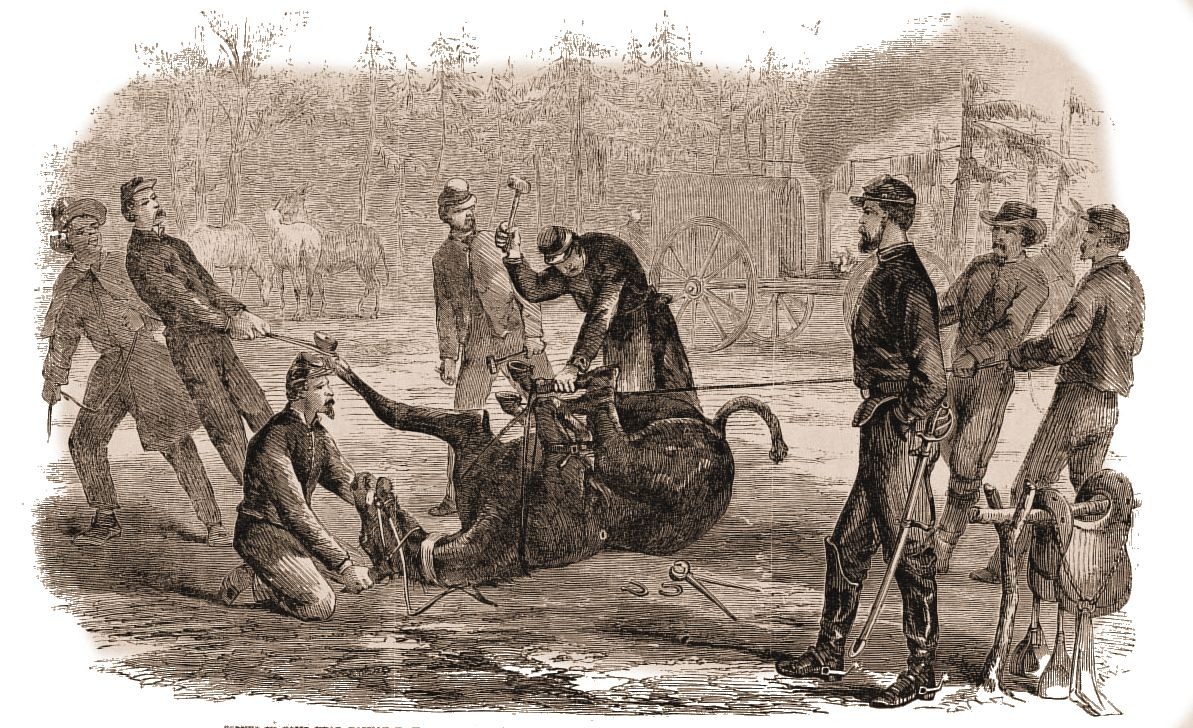
shoing a mule

Mr. Forbes says: “ I was strolling along the camp to-day in search of adventure, when I was attracted by a little knot of soldiers at a short distance, and a horse on the ground as though kicking for its life.  The horse turned out to be a mule undergoing the process of shoeing.  It was a large, strong, raw-boned animal, with a keen, intelligent eye, which would shame many human countenances.  One of his fore legs was fastened up with a strap; he having been thus pushed on his side, a rope is then fastened to the remaining foreleg, which is stretched out and held by a crowd of assistants.  The poor animal, finding itself powerless, keeps up a continual wail or moaning, much like that of a child in pain.  The shoes are fitted and then fastened on, the mule is released and suffered to rise, very much dejected with the rough and ungentlemanly treatment it has received.  Mules are being rapidly adopted as draught animals – they are capable of enduring more fatigue, and altogether are far hardier than the horse.  They are now used as pack-mules for our cavalry.”

Published in the March 14, 1863, issue of Frank Leslie’s Illustrated Newspaper.

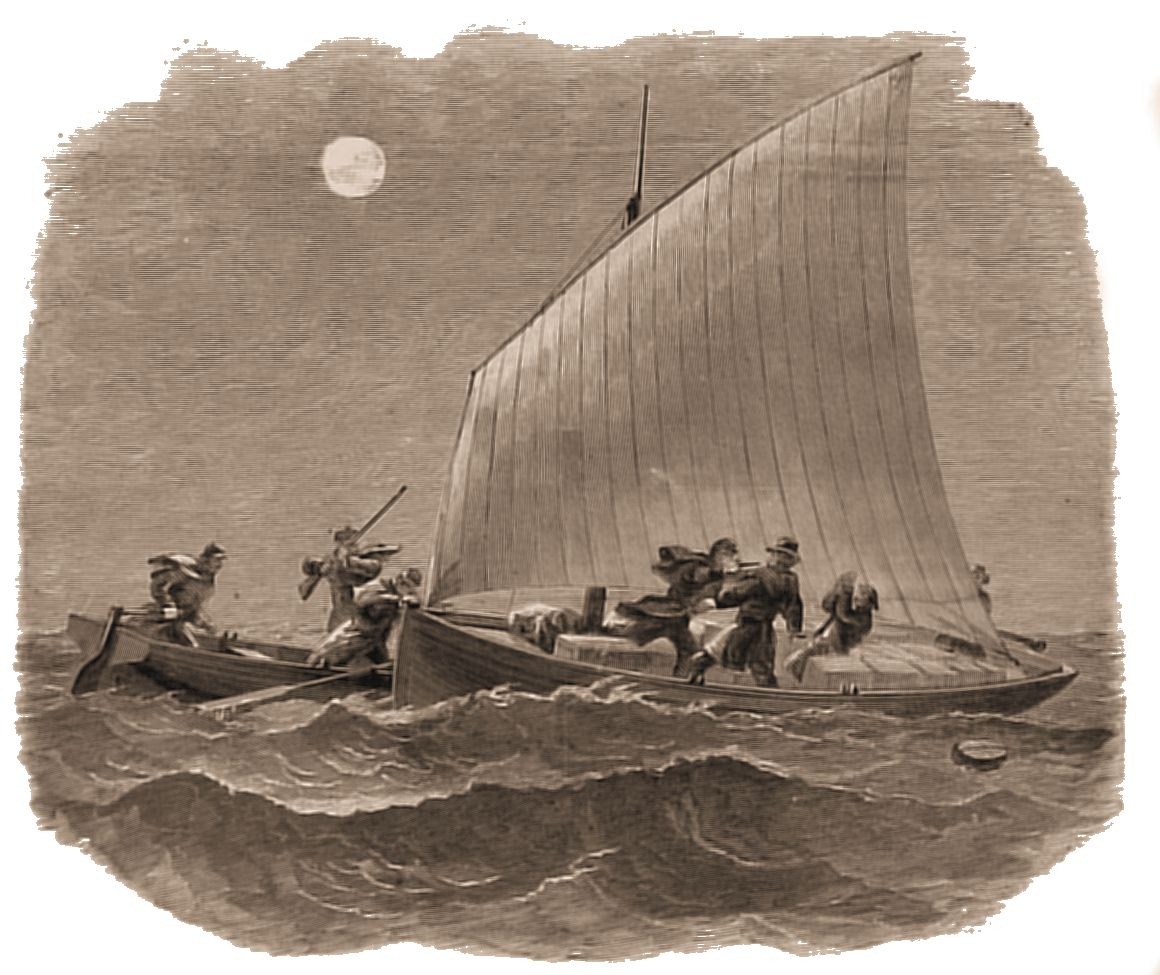
Capture of a  Contrabandist on Lake Pontchartrain

On the night of 3d February as Capt. J. G. Healy, of the 9th Connecticut volunteers, with three private was picketing the lake, he saw by the moonlight a sloop sailing towards Dixie, evidently having come from New Orleans. He immediately put off with his three men and a boat, and soon pulled up to the strange sail, the crew of which fired several shots, some of which came in close proximity to Capt. Healy. Running alongside, Capt. Healy sprang on board the sloop, and presenting his revolver to the head of one of the smugglers, demanded their surrender. They complied with his demand. When the sloop was brought ashore it was found to contain a very valuable cargo of medicines and other useful articles.

When the Union boat was nearing the lugger one of the crew was observed throw a parcel overboard; it was “fished in,” and found to contain a number of letters from many of the prominent citizens of New Orleans to some of the chief rebels. The crew, which consisted of two Jews and a Creole, were immediately committed to jail, and will be held to give evidence against some of those whose letters have been thus captured. The cargo is valued at $50,000.

From the March 14th issue of Frank Leslie’s Illustrated Newspaper.

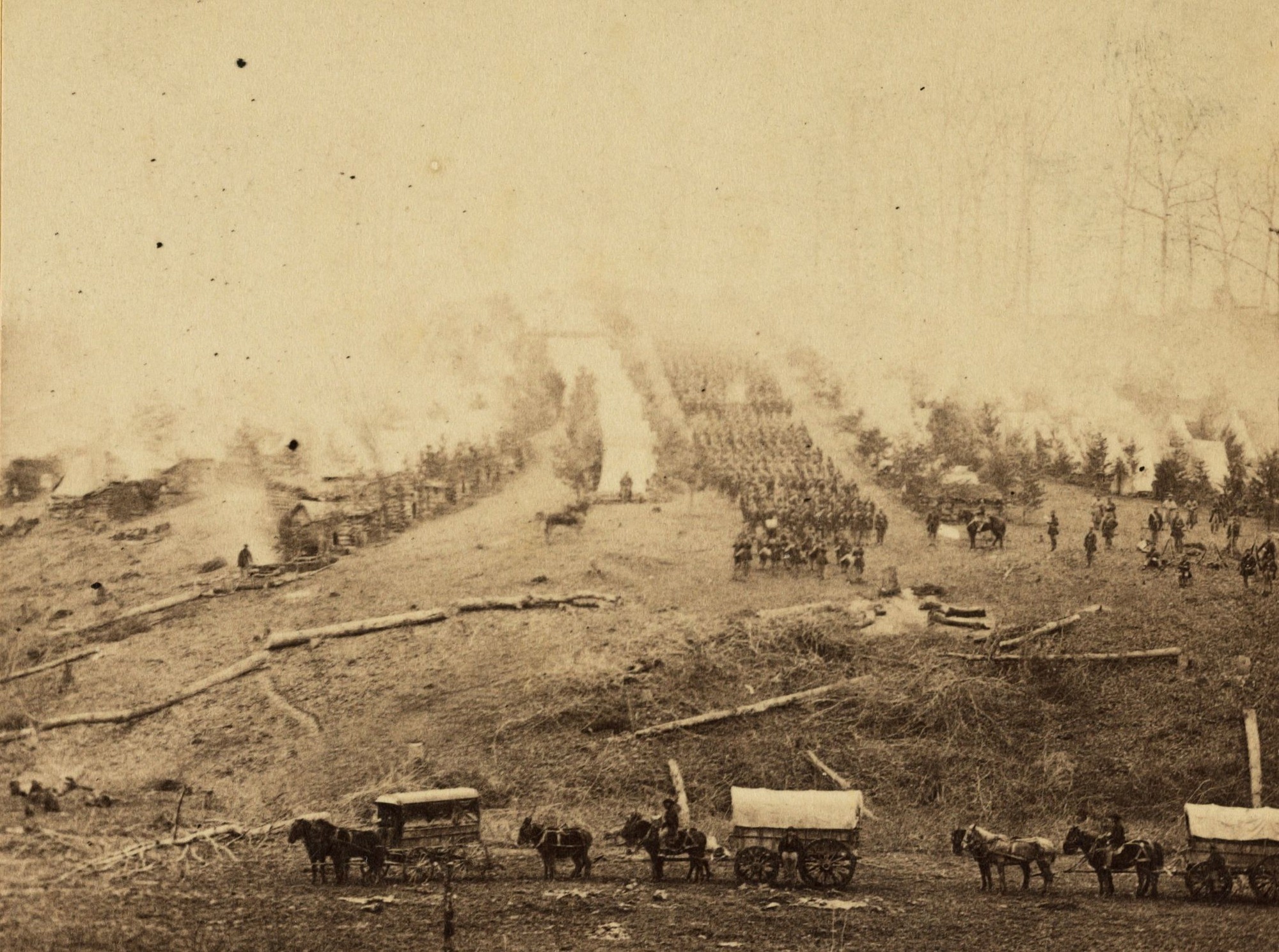
parade through camp 1863

Three horse-drawn covered wagons in the foreground. Soldiers marching in formation between rows of small cabins and tents in the background.

Source: Stereograph from collection of William A. Pinkerton.

Copyright 1863 by Alexander Gardner.

Library of Congress image.

___________________

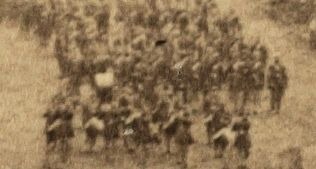
Closer inspection with cropped images show that the formations are facing towards the camera with a band or drum corps at the front.

formation - 1

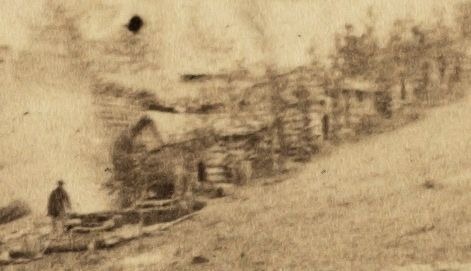
The time of year is winter, as evidenced by the winter quarters shown in the image and the bare trees in the background.


formation - 3

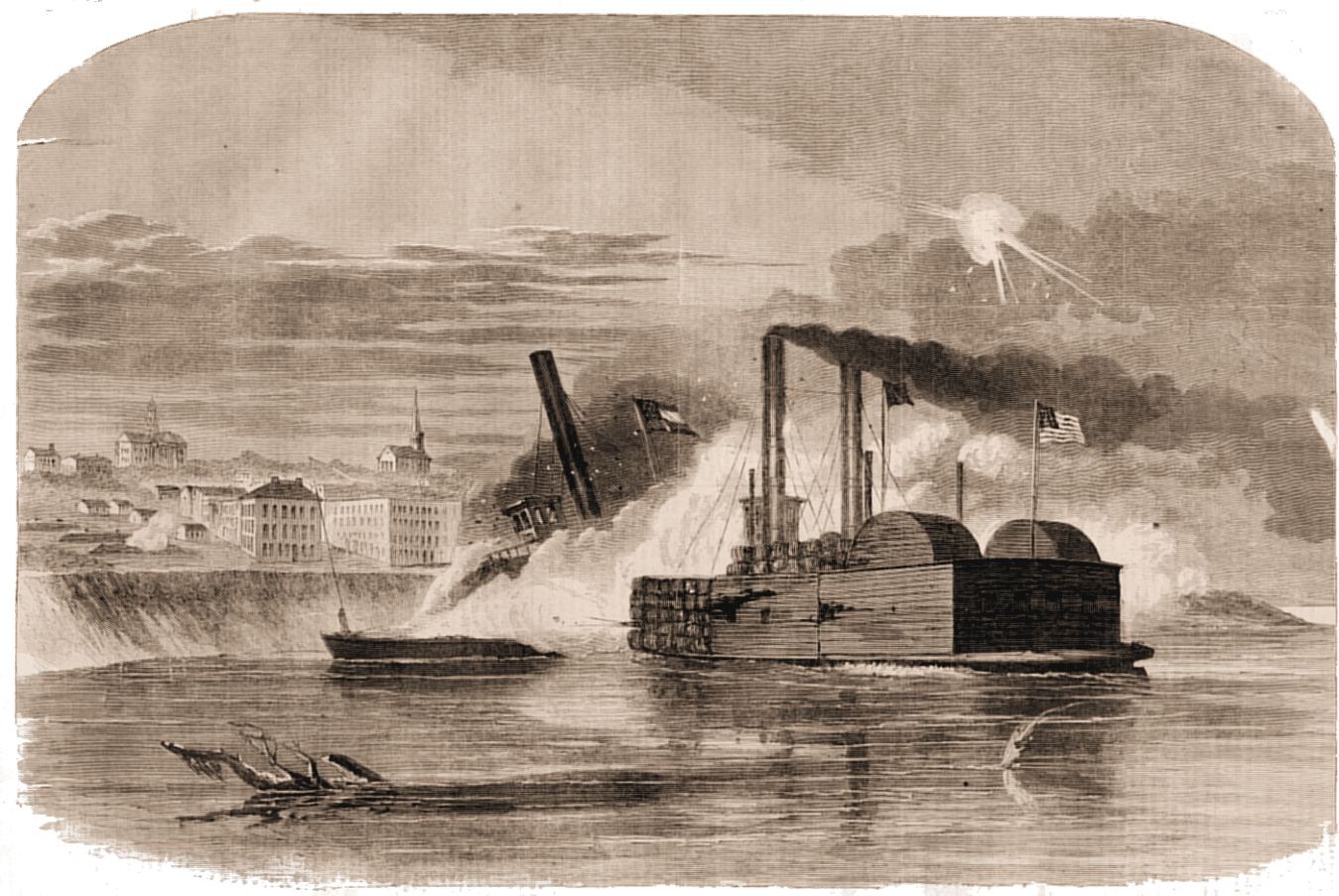
The Federal Ram, Queen of the West, Attacking the Rebel Gun-Boat ,Vicksburg, Off Vicksburg

The Federal Ram “Queen of the West” Attacking the Rebel Gun-Boat “Vicksburg” Off Vicksburg.

Harper’s Weekly, February 28, 1863

_______

THE “QUEEN OF THE WEST.”

WE illustrate on page 132 the attack of the Federal ram Queen of the West upon the rebel ram Vicksburg, off the city of Vicksburg, on February 2. The following letter to the Herald gives a graphic account of the affair:

MISSISSIPPI RIVER, NEAR VICKSBURG, Feb. 2, 1863.

A very exciting scene was witnessed here this morning. The Union ram Queen of the West, Captain E. W. Sutherland, ran the blockade of the rebel batteries at Vicksburg. Colonel Charles P. Ellet, commander of the ram fleet, was on board of her, and directed all her movements. The event has created great excitement in this vicinity. When the rebels saw the ram run into the rebel steamer, near the city, and then pass down the river uninjured, they were not less astonished than chagrined, because it was believed, by them at least, that no Union steamboat could safely pass their formidable batteries.

The following is a partial list of the officers on board the ram: Colonel Charles R. Ellet, in command; E. W. Sutherland, Captain; J. E. Tuthill, First Lieutenant; Sims Edison, Master; J. C. Duncan, Master; Reuben Townsend, Engineer.

The Queen of the West had been previously provided with all the arrangements deemed necessary to insure the complete success of the dangerous undertaking. Three hundred bales of cotton had been procured further up the river and placed on board, particularly about the machinery, in order to save her from any serious injury by shot and shell from the rebel batteries. Rear-Admiral Porter had given orders that she should proceed down to Vicksburg, destroy the rebel steamboat City of Vicksburg, lying opposite the city, and then run past the lower rebel batteries. The Colonel was directed to keep close to the right bank going down, to have all his lights on board extinguished—as it was intended that she should run the gauntlet in the darkness—and, having safely passed the batteries, to anchor below the mouth of the canal and there wait for further orders.

The Colonel started with the ram from above the bend at half past four o’clock this morning. Soon after getting under way he discovered that the change made in the position of the wheel—which was removed from its former position to a narrow place behind the bulwarks—rendered it almost impossible to steer the boat with sufficient accuracy. Consequently an hour was spent in effecting the necessary alterations. It was about six o’clock, just as the sun was rising, when the ram rounded the point of land lying opposite Vicksburg. She had only men enough on board to work her, it having been arranged that the remainder of the crew would cross the point of land and get on board of her below after she had passed the batteries. When rounding the point she was distinctly seen by the rebels. They immediately opened a heavy fire from several of their batteries, which crown the crests of the bluffs about the city. The Queen slowly and steadily proceeded down the river under a heavy fire from those batteries, until she reached a point opposite the spot where the steamboat City of Vicksburg was lying. Colonel Ellet says that steamboat was lying in almost the same position as was the rebel ram Arkansas when he ran into her with that same Queen of the West. If the rebel steamboat should be struck as the ram was running down the river, the prow, instead of penetrating her, would be inclined to glance, and the full force of the blow would thus be lost. Wishing to make the shock as effective as possible, when the ram had reached the proper position the Colonel turned her partly around, so as to face the city, and then made across the river straight for the fated steamboat. The rebels, who had crowded on the banks, scampered off in the most affrighted manner from the shore and sought safety in the city. The ram still went steadily on to the execution of her destructive errand. She struck the rebel steamboat forward of the wheel-house; but at the moment of collision the current caught the stern of the ram and swung her round so rapidly that nearly all the momentum of the blow was lost. To set the rebel steamboat on fire was part of the arrangement. That portion of the programme was intrusted to Sergeant J. H. Campbell. He was directed to fire the forward guns loaded with combustible balls saturated with turpentine. As the ram swung round he was ordered to fire them. Just at that moment a 64-pound shot from one of the rebel batteries came crashing into the barricade of cotton near him; but the brave Sergeant did not hesitate a moment in the execution of the order. The guns were fired, a tremendous blaze was vomited forth from them, and the rebel steam-boat was in flames.

About the same time the ram was found to be on fire. A shell from shore had set her on fire near the starboard wheel, while the discharge of the guns with the combustible balls had fired the cotton on her bow. Both steam-boats were thus ablaze at the same time. The flames spread rapidly on both vessels. The smoke from the front of the ram rushed into her engine-room and threatened to suffocate the engineers. Those on board the rebel steam-boat did all they could do to extinguish the flames on their boat. This they soon accomplished. Colonel Ellet had intended to strike the rebel steamboat in the stern, and thus finish the work of demolition; but the spreading flames on the Queen of the West made it necessary for him to attend to the safety of his own vessel. He therefore ran down stream, and set all hands on board at work extinguishing the flames. Though the cotton had been wet before starting, the fire was extending rapidly, and several burning bales were thrown overboard in order to save the ram. She then anchored below the mouth of the canal, where she awaited further orders.

All this time, both when approaching the city and leaving it, the rebel batteries were blazing away at the Queen of the West with light and heavy guns. Some of our guns on shore replied to them. When the ram was near the Mississippi shore several regiments of rebels opened on her with musketry from rifle-pits on the bank, and, as opportunity offered, the guns planted in the streets of Vicksburg so as to rake the river fired on her also. It was a very exciting scene. About one hundred and twenty shots were fired from the batteries; but the ram was struck only twelve times, and sustained no injury from the musketry. She was struck twice in the bull above the water-line, the cabin was considerably smashed, and one casemated gun was dismounted and destroyed.

Thus the Queen of the West ran the blockade of Vicksburg by daylight, damaged the rebel steamboat opposite the city, and she herself sustained no material injury. Afterward the rebels endeavored to get steam up on board the City of Vicksburg; but, although she was not sunk, appearances indicate that she has been damaged seriously.

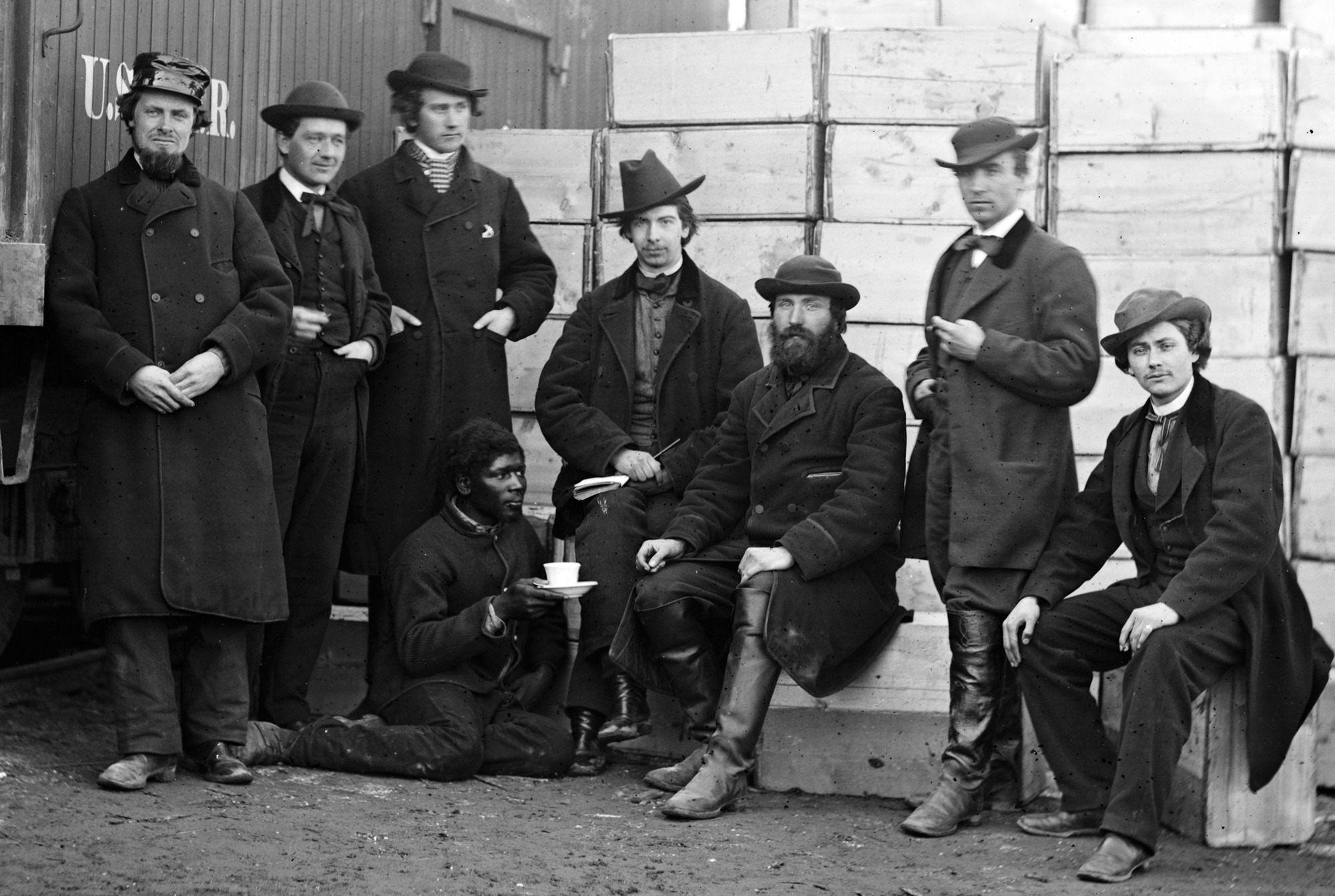
Aquia Creek Landing, Va

Aquia Creek Landing, Va. Clerks of the Commissary Depot by railroad car and packing cases, photographed by Alexander Gardner in February 1863, exact date not provided.

Library of Congress image.

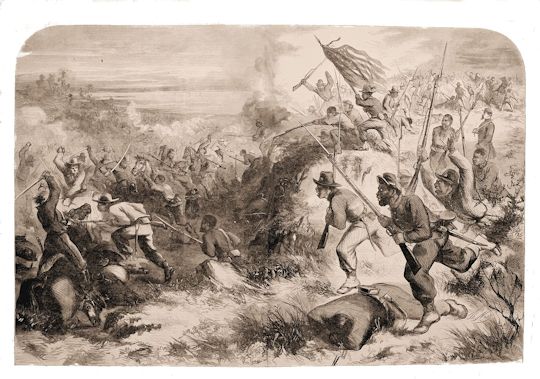
A-Negro-Regiment-in-Action-small

NEGROES AS SOLDIERS.

WE devote pages 161, 168, and 169 to illustrations of the negroes as soldiers. So much ignorant prejudice is still entertained in many parts of the North to the employment of colored troops that it is due to the country that the capacity of the negro to drill and fight can not be too strongly insisted upon.

The picture on page 161 represents the negro learning the use of the Minie rifle. The drill masters in the Department of the South report that the negroes in the South Carolina regiments evince great aptitude at learning the manual of arms. They are more docile than white recruits, and when once they have mastered a movement they retain the knowledge perfectly. Similar testimony is borne by officers in the West. One of them predicts that with proper drill and training the negroes will be the steadiest rank and file in the world.

With regard to their fighting qualities we can not do better than reproduce the following extracts. The first is from a letter to the New York Times, describing the battle, or rather the skirmish of Island Mounds, where a detachment of the First Kansas Colored Volunteers attacked and routed a band of rebels. He says:

The detachment under Gardner was attacked by the foe, who swept down like a whirlwind upon it. One volley was fired in concert, which emptied several saddles, and then this devoted body was separated by the force of that sweeping charge. The fight thus became a hand to hand encounter of one man to six. The rebels were mostly armed with shot-guns, revolvers, and sabres, our men with the Austrian rifle and sabre-bayonet. The latter is a fearful weapon, and did terrible execution in the hands of the muscular blacks. Six-Killer, the leader of the Cherokee negroes, fell with six wounds after shooting two men, bayoneting a third, and laying a fourth hors du combat with the butt of his gun. Another one, badly wounded, Sergeant Ed. Lowrey, was attacked by three men; he had discharged his rifle, and had no time to load again, when they fell upon him with revolver and sabre. He was then badly hurt with a shot-gun wound. One man demanded his surrender, to which the reply was a stunning blow from the butt of the rifle, knocking him off his horse. The negro, when approached, had his sabre-bayonet in hand, about to fix it on his gun. The prostrate man got a crashing blow from it on the skull as he fell, and then, as the other charged, the bayonet was used with effect on the nearest horse, and the butt of the gun on the next man.

Captain Crew, retaining his position at the head of the few men who keep together, retreated with his face to the enemy, firing his revolver as he did so. He fell with a terrible wound in the groin, but again rose and retreated. Surrounded by half a dozen of the foe, he was ordered to surrender. “Never!” he shouted, at the same time calling to the half dozen negroes around him to die rather than give up. He then fell dead with a bullet in his heart. His body was instantly rifled of revolver and watch, though his purse was not found. Five minutes afterward the rebel who took the watch was killed by one of the negroes, who again took the watch from him and brought it into camp.

So ended the battle of Island Mounds, which, though commenced through the rash and impetuous daring of the officers, yet, under most unfavorable circumstances, resulted in a complete victory to the negro regiment.

What I narrate I saw myself, and having witnessed several engagements since this rebellion commenced, I know what fighting amounts to.   H.

__________

The other extract is from the official report of Colonel Higginson of the First South Carolina Volunteers (colored), describing an expedition into the interior undertaken by him:

ON BOARD STEAMER “BEN DEFORD,” Sunday, Feb. 1, 1863. Brigadier-General Saxton, Military Governor, etc.:

GENERAL,—I have the honor to report the safe return of the expedition under my command, consisting of 462 officers and men of the First Regiment of South Carolina Volunteers, who left Beaufort on January 23, on board the steamers John Adams, Planter, and Ben Deford. The expedition has carried the regimental flag and the President’s Proclamation far into the interior of Georgia and Florida. The men have been repeatedly under fire; have had infantry, cavalry, and even artillery arranged against them, and have, in every instance, come off not only with unblemished honor, but with undisputed triumph. At Township, Florida, a detachment of the expedition fought a cavalry company which met us unexpectedly on a midnight march through pine woods, and which completely surrounded us. They were beaten off with a loss on our part of one man killed and seven wounded, while the opposing party admits twelve men killed (including Lieutenant Jones, in command of the company), besides many wounded. So complete was our victory that the enemy scattered, hid in the woods all night, not returning to his camp, which was five miles distant, until noon next day—a fact which was unfortunately unknown until too late to follow up our advantage. Had I listened to the urgent appeals of my men, and pressed the flying enemy, we could have destroyed his camp; but in view of the darkness, his uncertain numbers, and swifter motions, with your injunctions of caution, I judged it better to rest satisfied with the victory already gained.

Nobody knows any thing about these men who has not seen them in battle. I find that I myself knew nothing. There is a fiery energy about them beyond any thing of which I have ever read, unless it be the French Zouaves. It requires the strictest discipline to hold them in hand. During our first attack on the river, before I got them all penned below, they crowded at the open ends of the steamer, loading and firing with inconceivable rapidity, and shouting to each other, “Never give it up!”

__________

Published in March 14, 1863 issue of Harper’s Weekly.
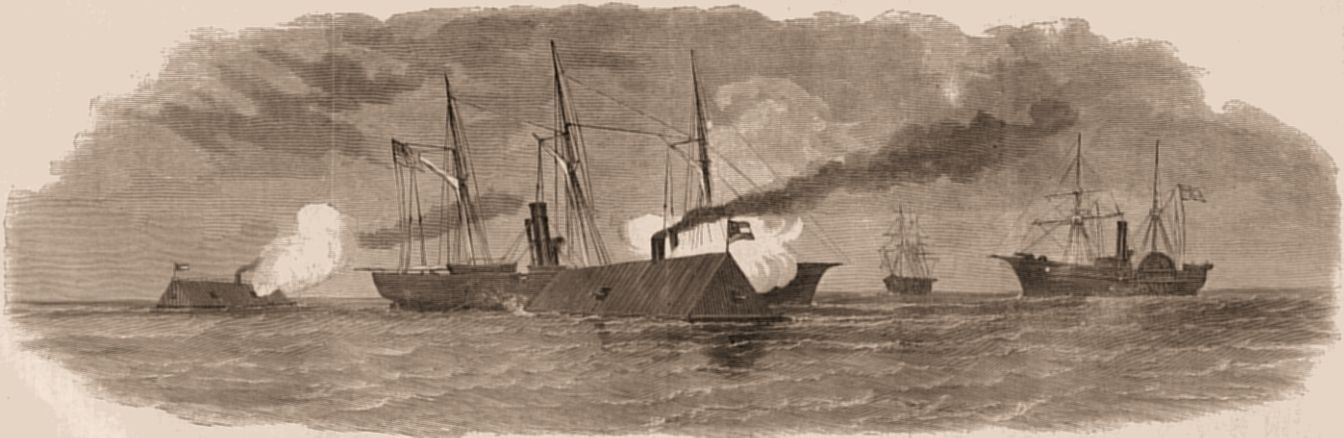
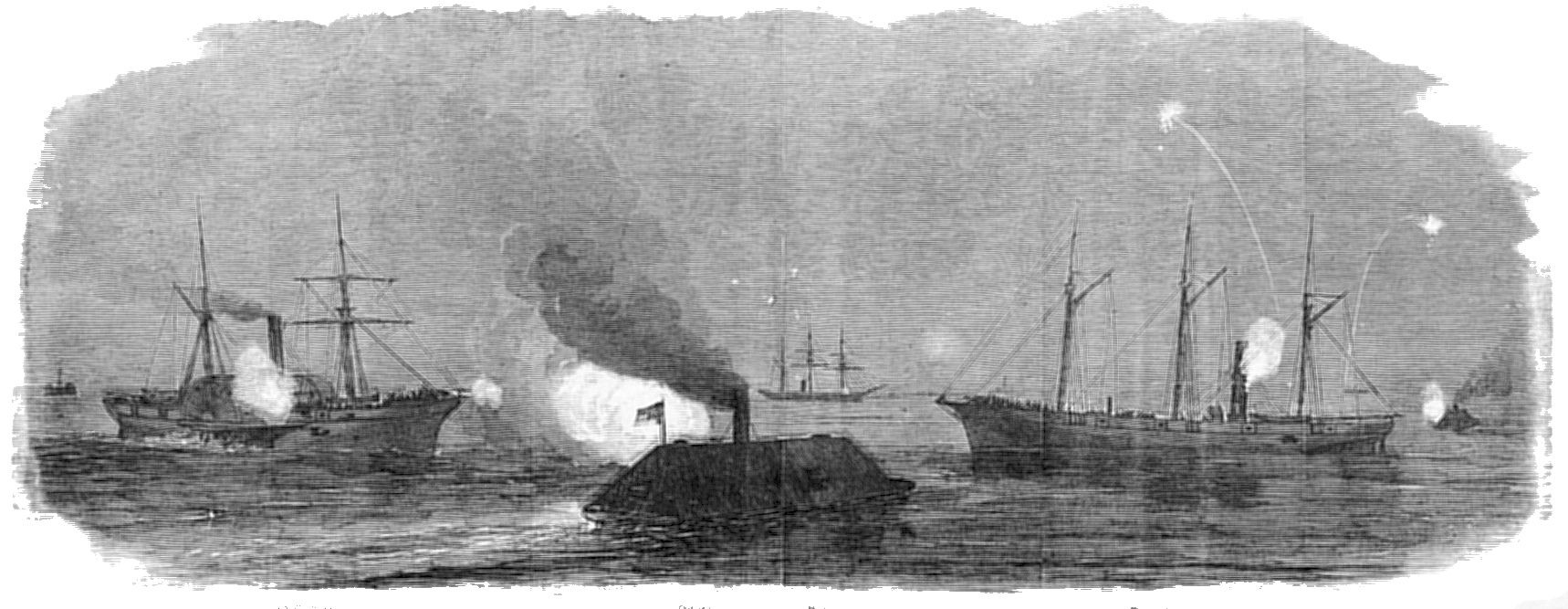
The Rebel Rams Engaging our Blockading Fleet off Charleston, South Carolina, January 31, 1863

The Rebel Rams Engaging our Blockading Fleet off Charleston, South Carolina, January 31, 1863.—Sketched by an Occasional Correspondent.

xxx

IN our last we announced, on the strength of rebel telegrams to Richmond, which had found their way into the New York Herald, that the rebel rams at Charleston had attacked our blockading fleet off Charleston, and destroyed the Mercedita. We have since received a sketch of the affair from an occasional correspondent, which we reproduce on page 117, and subjoin the following reliable account of the transaction:

It appears from the statement of an intelligent eye-witness that the cause of this attack of the rebel rams on our squadron was owing to the capture of the Princess Royal, the captain and pilot of that vessel having escaped ashore during the darkness of the night, and communicated intelligence to the enemy.

The Princess Royal endeavored to run the blockade by way of Beach Inlet on the 29th ult., but was discovered by the pilot-boat Blunt. On signal being given the Unadilla proceeded toward her, and captured the prize without other assistance. It was then discovered that the captain and pilot had succeeded in getting ashore by a small boat, carrying important dispatches to the rebel Government. The Unadilla carried her to the side of the Housatonic, and lay there till daylight, when a thunder of guns was heard, accompanied by sharp flashes of fire. It was supposed that our fleet was engaged in making, or the Alabama or Florida were endeavoring to force, an entrance. At daybreak two rebel iron-clads were seen coming down from the direction of Stone Inlet toward our fleet.

They attacked the Mercedita first. One ram struck her on the water ridge, keeling her over, and at the same time firing a shot, which entered one of her boilers, causing the death of three persons, including a gunner, by a shot and steam. The ram then hailed the Mercedita, and Captain Stellwagen lowered one of his small boats, after leaving one of the plugs out, allowing the water to enter it. The ram answered our hail by replying, “Confederate ram Palmetto State. Do you surrender?” This was repeated three times, Captain Stellwagen replying at each inquiry, “I am in a sinking condition.” The rebels answered, “God damn you to hell, if you don’t surrender we will blow you out of water. Send your boat aboard.”

The boat which Captain Stellwagen lowered then conveyed his lieutenant (executive officer) to the side of the rebel ram, and the officer asked to be admitted on board. This was refused. The lieutenant then repeated Captain Steliwagen’s statement that “we are in a sinking condition.” The rebel officer replied, “You can’t sink lower than the rails; we can not take you aboard.” The officer then gave his parole, as demanded, and returned to his ship. The rebels were thus successfully deceived as to the condition of the Mercedita, thinking she was in a sinking condition. She lay in shoal water, and hence their reply that “she could not sink lower than her rails.”

The ram then steamed toward the Keystone State, and sent a shot through her steam drum, causing the death of twenty-one persons—twelve by the shot and nine by being scalded by steam. Fifteen were wounded, and are lying at Port Royal, some in a precarious condition. In the mean time the United States gun-boat Housatonic engaged the other ram, driving her away. At half past six o’clock in the morning both rams left the scene and proceeded up to Charleston.

During this attack on our fleet, the Princess Royal, which lay near the Housatonic, and was the chief object of contest on both sides, succeeded in getting off, mainly through the energies of Third Assistant Engineer Thurston, who piled into her fires all the inflammable material at hand.

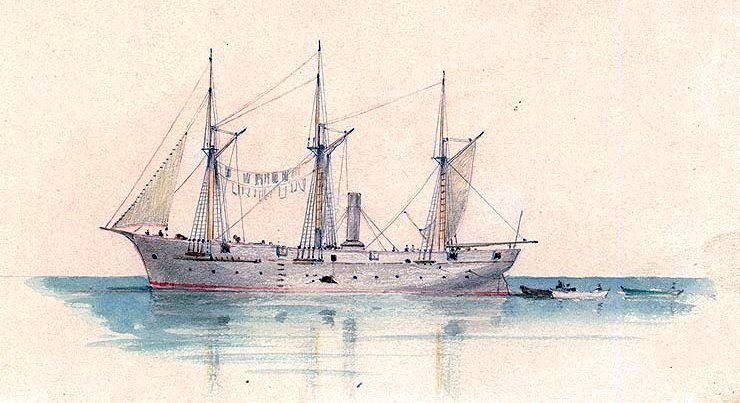
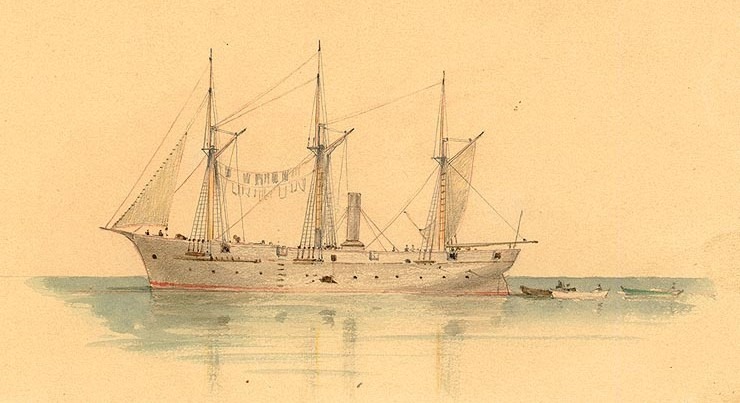
USS Mercedita

The USS Mercedita, involved in The Fight off Charleston.

1x1t

Image digitally adjusted for fade; original image from Naval Historical Center below.

1x1t

USSMercedita

The War in South Carolina. The Rebel Rams from Charleston Harbor Attacking the Federal Squadron, January 31.

The Rebel Rams from Charleston Harbor Attacking the Federal Squadron, January 31. (From a sketch by a naval officer, published February 28, 1863 in Frank Leslie’s Illustrated Newspaper.)

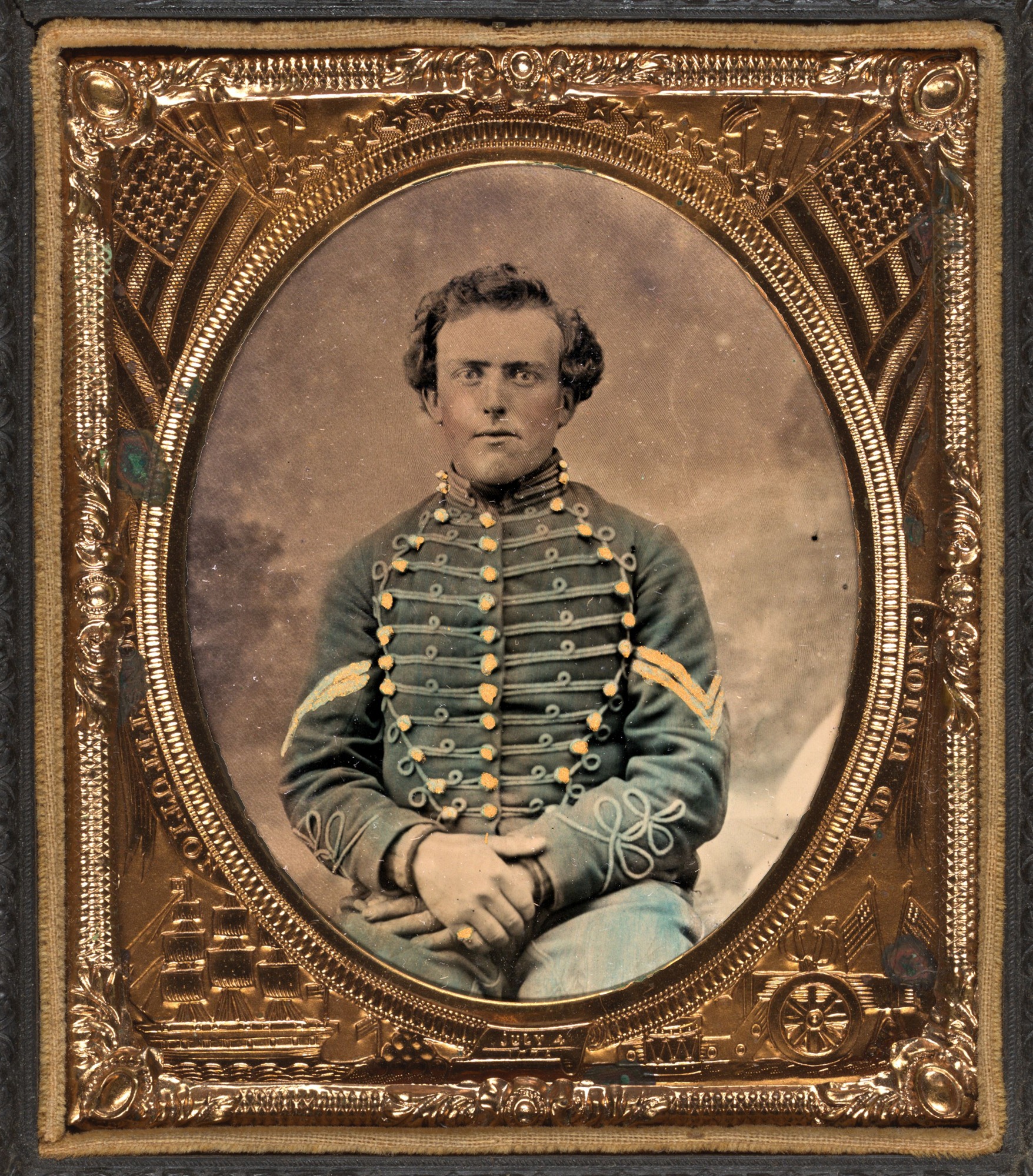
Unidentified soldier in 3rd New Jersey Cavalry Volunteers-2

Unidentified soldier in 3rd New Jersey Cavalry Volunteers (The Butterflies) jacket with corporal’s chevrons (see comments below for identification of this soldier)

Medium: 1 photograph : sixth-plate tintype, hand-colored ; 12.5 x 11.3 cm (frame)

Donated by Tom Liljenquist; 2010

Liljenquist Family Collection of Civil War Photographs; Ambrotype/Tintype photograph filing series; Library of Congress Prints and Photographs Division.

Record page for image is here.

______________

Note:  This image has been digitally enhanced for fade correction, color enhancement and selected spot removal.

Civil War Portrait 023