Following the American Civil War Sesquicentennial with day by day writings of the time, currently 1863.

The American Civil War

July 5th.—As the young gentleman of colour, to whom I had given egregious ransom as well as an advance of wages, did not appear this morning, I was, after an abortive attempt to boil water for coffee and to get a piece of toast, compelled to go in next door, and avail myself of the hospitality of Captain Cecil Johnson, who was installed in the drawing-room of Madame Jost. In the forenoon, Mr. John Bigelow, whose acquaintance I made, much to my gratification in time gone by, on the margin of the Lake of Thun, found me out, and proffered his services; which, as the whileom editor of the Evening Post and as a leading Republican, he was in a position to render valuable and most effective; but he could not make a Bucephalus to order, and I have been running through the stables of Washington in vain, hoping to find something up to my weight—such flankless, screwy, shoulderless, cat-like creatures were never seen—four of them would scarcely furnish ribs and legs enough to carry a man, but the owners thought that each of them was fit for Baron Rothschild; and then there was saddlery and equipments of all sorts to be got, which the influx of officers and the badness and dearness of the material put quite beyond one’s reach. Mr. Bigelow was of opinion that the army would move at once; “but,” said I, “where is the transport— where the cavalry and guns?” Oh,” replied he “I suppose we have got everything that is required. I know nothing of these things, but I am told cavalry are no use in the wooded country towards Richmond.” I have not yet been able to go through the camps, but I doubt very much whether the material or commissariat of the grand army of the North is at all adequate to a campaign.

The presumption and ignorance of the New York journals would be ridiculous were they not so mischievous. They describe “this horde of battalion companies—unofficered, clad in all kinds of different uniform, diversely equipped, perfectly ignorant of the principles of military obedience and concerted action,”—for so I hear it described by United States officers themselves— as being the greatest army the world ever saw; perfect in officers and discipline; unsurpassed in devotion and courage; furnished with every requisite; and destined on its first march to sweep into Richmond, and to obliterate from the Potomac to New Orleans every trace of rebellion.”

The Congress met to-day to hear the President’s Message read. Somehow or other there is not such anxiety and eagerness to hear what Mr. Lincoln has to say as one could expect on such a momentous occasion. It would seem as if the forthcoming appeal to arms had overshadowed every other sentiment in the minds of the people. They are waiting for deeds, and care not for words. The confidence of the New York papers, and of the citizens, soldiers, and public speakers, contrast with the dubious and gloomy views of the military men; but of this Message itself there are some incidents independent of the occasion to render it curious, if not interesting. The President has, it is said, written much of it in his own fashion, which has been revised and altered by his Ministers; but he has written it again and repeated himself, and after many struggles a good deal of pure Lincolnism goes down to Congress.

At a little after half-past eleven I went down to the Capitol. Pennsylvania Avenue was thronged as before, but on approaching Capitol Hill, the crowd rather thinned away, as though they shunned, or had no curiosity to hear, the President’s Message. One would have thought that, where every one who could get in was at liberty to attend the galleries in both Houses, there would have been an immense pressure from the inhabitants and strangers in the city, as well as from the citizen soldiers, of which such multitudes were in the street; but when I looked up from the floor of the Senate, I was astonished to see that the galleries were not more than three parts filled. There is always a ruinous look about an unfinished building when it is occupied and devoted to business. The Capitol is situated on a hill, one face of which is scarped by the road, and has the appearance of being formed of heaps of rubbish. Towards Pennsylvania Avenue the long frontage abuts on a lawn shaded by trees, through which walks and avenues lead to the many entrances under the porticoes and colonnades; the face which corresponds on the other side looks out on heaps of brick and mortar, cut stone, and a waste of marble blocks lying half buried in the earth and cumbering the ground, which, in the magnificent ideas of the founders and planners of the city, was to be occupied by stately streets. The cleverness of certain speculators in land prevented the execution of the original idea, which was to radiate all the main avenues of the city from the Capitol as a centre, the intermediate streets being formed by circles drawn at regularly-increasing intervals from the Capitol, and intersected by the radii. The speculators purchased up the land on the side between the Navy-yard and the site of the Capitol; the result—the land is unoccupied, except by paltry houses, and the capitalists are ruined.

The Capitol would be best described by a series of photographs. Like the Great Republic itself, it is unfinished. It resembles it in another respect: it looks best at a distance; and, again, it is incongruous in its parts. The passages are so dark that artificial light is often required to enable one to find his way. The offices and bureaux of the committees are better than the chambers of the Senate and the House of Representatives. All the encaustics and the white marble and stone staircases suffer from tobacco juice, though there is a liberal display of spittoons at every corner. The official messengers, doorkeepers, and porters wear no distinctive badge or dress. No policemen are on duty, as in our Houses of Parliament; no soldiery, gendarmerie, or sergens-de-ville in the precincts; the crowd wanders about the passages as it pleases, and shows the utmost propriety, never going where it ought not to intrude. There is a special gallery set apart for women; the reporters are commodiously placed in an ample gallery, above the Speaker’s chair; the diplomatic circle have their gallery facing the reporters, and they are placed so low down in the somewhat depressed Chamber, that every word can be heard from speakers in the remotest parts of the house very distinctly.

The seats of the members are disposed in a manner somewhat like those in the French Chambers. Instead of being in parallel rows to the walls, and at right angles to the Chairman’s seat, the separate chairs and desks of the Senators are arranged in semicircular rows. The space between the walls and the outer semicircle is called the floor of the house, and it is a high compliment to a stranger to introduce him within this privileged place. There are leather cushioned seats and lounges put for the accommodation of those who may be introduced by Senators, or to whom, as distinguished members of Congress in former days, the permission is given to take their seats. Senators Sumner and Wilson introduced me to a chair, and made me acquainted with a number of Senators before the business of the day began.

Mr. Sumner, as the Chairman of the Committee on Foreign Relations, is supposed to be viewed with some jealousy by Mr. Seward, on account of the disposition attributed to him to interfere in diplomatic questions; but if he does so, we shall have no reason to complain, as the Senator is most desirous of keeping the peace between the two countries, and of mollifying any little acerbities and irritations which may at present exist between them. Senator Wilson is a man who has risen from what would be considered in any country but a republic the lowest ranks of the people. He apprenticed himself to a poor shoemaker when he was twenty-two years of age, and when he was twenty-four years old he began to go to school, and devoted all his earnings to the improvement of education. He got on by degrees, till he set up as a master shoe maker and manufacturer, became a “major-general” of State militia; finally was made Senator of the United States, and is now “Chairman of the Committee of the Senate on Military Affairs.” He is a bluff man, of about fifty years of age, with a peculiar eye and complexion, and seems honest and vigorous. But is he not going ultra crepidam in such a post? At present he is much perplexed by the drunkenness which prevails among the troops, or rather by the desire of the men for spirits, as he has a New England mania on that point. One of the most remarkable-looking men in the House is Mr. Sumner. Mr. Breckinridge and he would probably be the first persons to excite the curiosity of a stranger, so far as to induce him to ask for their names. Save in height—and both are a good deal over six feet— there is no resemblance between the champion of States Rights and the orator of the Black Republicans. The massive head, the great chin and jaw, and the penetrating eyes of Mr. Breckinridge convey the idea of a man of immense determination, courage, and sagacity. Mr. Sumner’s features are indicative of a philosophical and poetical turn of thought, and one might easily conceive that he would be a great advocate, but an indifferent leader of a party.

It was a hot day; but there was no excuse for the slop coats and light-coloured clothing and felt wide-awakes worn by so many Senators in such a place. They gave the meeting the aspect of a gathering of bakers or millers; nor did the constant use of the spittoons beside their desks, their reading of newspapers and writing letters during the dispatch of business, or the hurrying to and fro of the pages of the House between the seats, do anything but derogate from the dignity of the assemblage, and, according to European notions, violate the respect due to a Senate Chamber. The pages alluded to are smart boys, from twelve to fifteen years of age, who stand below the President’s table, and are employed to go on errands and carry official messages by the members. They wear no particular uniform, and are dressed as the taste or means of their parents dictate.

The House of Representatives exaggerates all the peculiarities I have observed in the Senate, but the debates are not regarded with so much interest as those of the Upper House; indeed, they are of far less importance. Strong-minded statesmen and officers—Presidents or Ministers—do not care much for the House of Representatives, so long as they are sure of the Senate; and, for the matter of that, a President like Jackson does not care much for Senate and House together. There are privileges attached to a seat in either branch of the Legislature, independent of the great fact that they receive mileage and are paid for their services, which may add some incentive to ambition. Thus the members can order whole tons of stationery for their use, not only when they are in session, but during the recess. Their frank covers parcels by mail, and it is said that Senators without a conscience have sent sewing-machines to their wives and pianos to their daughters as little parcels by post. I had almost forgotten that much the same abuses were in vogue in England some century ago.

The galleries were by no means full, and in that reserved for the diplomatic body the most notable person was M. Mercier, the Minister of France, who, fixing his intelligent and eager face between both hands, watched with keen scrutiny the attitude and conduct of the Senate. None of the members of the English Legation were present. After the lapse of an hour, Mr. Hay, the President’s Secretary, made his appearance on the floor, and sent in the Message to the Clerk of the Senate, Mr. Forney, who proceeded to read it to the House. It was listened to in silence, scarcely broken except when some Senator murmured “Good, that is so;” but in fact the general purport of it was already known to the supporters of the Ministry, and not a sound came from the galleries. Soon after Mr. Forney had finished, the galleries were cleared, and I returned up Pennsylvania Avenue, in which the crowds of soldiers around bar-rooms, oyster shops, and restaurants, the groups of men in officers’ uniform, and the clattering of disorderly mounted cavaliers in the dust, increased my apprehension that discipline was very little regarded, and that the army over the Potomac had not a very strong hand to keep it within bounds.

As I was walking over with Captain Johnson to dine with Lord Lyons, I met General Scott leaving his office and walking with great difficulty between two aides-de-camp. He was dressed in a blue frock with gold lace shoulder straps, fastened round the waist by a yellow sash, and with large yellow lapels turned back over the chest in the old style, and moved with great difficulty along the pavement. “You see I am trying to hobble along, but it is hard for me to overcome my many infirmities. I regret I could not have the pleasure of granting you an interview to-day, but I shall cause it to be intimated to you when I may have the pleasure of seeing you; meantime I shall provide you with a pass and the necessary introductions to afford you all facilities with the army.”

After dinner I made a round of visits, and heard the diplomatists speaking of the Message; few, if any of them, in its favour. With the exception perhaps of Baron Gerolt, the Prussian Minister, there is not one member of the Legations who justifies the attempt of the Northern States to assert the supremacy of the Federal Government by the force of arms. Lord Lyons, indeed, in maintaining a judicious reticence whenever he does speak, gives utterance to sentiments becoming the representative of Great Britain at the court of a friendly Power, and the Minister of a people who have been protagonists to slavery for many a long year.


July 5.—Yesterday M. P. and myself spent several hours riding about to visit our friends. The news of the day was, that General Patterson, with a large force, had crossed the river and taken possession of Martinsburg, and that General Johnston had sent Colonel Stuart, with his cavalry, to reconnoitre and cut off his supplies, and to prevent a retreat. All these things make us anxious, particularly as the booming of cannon is not unfrequent; but my faith in the justice of our cause is strong.

Post image for A Diary of American Events – July 5, 1861

—This morning the rebel troops stationed at Fairfax Court-House, Va., were advancing upon the Federal lines, when a regiment of their infantry fired by mistake upon a company of their cavalry, killing seven or eight men. and wounding several others.—N. Y. Evening Post, July 6.

—This morning the Missouri rebel troops, under Gov. Jackson, broke camp near Rupes Point, in Jasper Co., Missouri, and marched south in the direction of Carthage, the County seat of Jasper County. At Brier Forks, seven miles north of Carthage, they were met by Col. Siegel, with 1,500 Union men, who immediately gave them battle.

The State troops were posted on a ridge in a prairie with five pieces of artillery, one twelve pounder in the centre, two six-pounders on the right and left, cavalry on each flank, and infantry in the rear.

The artillery of Colonel Siegel approached within eight hundred yards, with four cannon in the centre, a body of infantry and a six-pounder under Lieutenant-Colonel Hassendare on the left, Colonel Solomon’s command with a six-pounder on the right, and a body of infantry behind the centre artillery.

Colonel Siegel’s left opened fire with shrapnells, and soon the engagement became general. The rebels had no grape, and their artillerists being poor, their balls flew over the heads of the National forces. After two hours’ firing, the enemy’s artillery was entirely silenced, and their ranks broken.

The State troops were now driven back some distance, and the officers ordered a retreat. The centre gave way, but the order not being heard on the flanks, the advancing United States troops were in danger of being surrounded themselves, and fell back. They retreated slowly, keeping up the fight, the artillery making fearful havoc among the enemy’s ranks.

About 1,500 rebel cavalry then attempted to outflank Siegel, and cut off his baggage train, which was three miles back, when a retrograde movement was ordered. The train was reached in good order, surrounded by infantry and artillery, and the retreat of the National troops continued until a point was reached where the road passed through a high bluff on each side, where the enemy’s cavalry were posted in large numbers. By a feint, as if intending to pass around the bluff, Siegel drew the cavalry in a solid body into the road at a distance of 150 yards from his position, when by a rapid movement of his artillery, he poured a heavy crossfire of canister into their ranks; at the same time the infantry charged at a “double quick,” and in ten minutes the State troops scattered in every direction. Eighty-five riderless horses were captured and sixty-five shot-guns, and a number of revolvers and bowie-knives were picked up from the ground.

At the crossing of Dry Fork, the Federal lines were very near being broken, when by the timely arrival of 200 Union men from Shoals Creek, they crossed with but a loss of five killed, and two mortally wounded. The battle continued, the United States troops alternately fighting and retreating until dark, when they reached Carthage, having crossed Buck Branch and Spring River. On the way, the fighting was all done with the artillery, Col. Siegel retreating as soon as they got them in position, and playing on their ranks as they advanced.

The rebel loss was great; a resident of Carthage states that he passed over a part of the battle-field after the conflict, and saw wagons and hacks passing in every direction, gathering up the dead for interment.

The loss on the part of the State troops cannot be less than from 300 to 500. The ground in many places was strewn with dead horses.

The retreat of the National forces was conducted in a style worthy of veteran troops, and with as much coolness as if they were on a parade-ground, instead of the field of battle.— (Doc. 70.)

—About five o’clock this morning twenty-five of Hawkins’ Zouaves encountered a rebel force, supposed to number about one hundred and fifty, including twenty-five cavalry, and one field-piece, seven miles from Newport News, Va.; three of the rebels were shot, and also six of Hawkins’ Zouaves. The latter sent for reinforcements, and five companies were sent to sustain them.—N. Y. Evening Post, July 6.

July 4.—This day General Scott promised himself and his Northern friends to dine in Richmond. Poor old renegade, I trust he has eaten his last dinner in Richmond, the place of his marriage, the birthplace of his children, the home of his early friendships, and so near the place of his nativity and early years.

How can he wish to enter Richmond but as a friend? But it is enough for us to know that he is disappointed in his amiable and patriotic wish to-day. So may it be.

I have seen W. H., who has just returned from Fairfax. Last week he scouted near our house, and gives no very encouraging report for us. Our hills are being fortified, and Alexandria and the neighbourhood have become one vast barracks. The large trees are being felled, and even houses are falling by order of the invader! Our prospect of getting home becomes more and more dim; my heart sinks within me, and hope is almost gone. What shall we do, if the war continues until next winter, without a certain resting-place? Our friends are kind and hospitable, open-hearted and generous to a wonderful degree. In this house we are made to feel not only welcome, but that our society gives them heartfelt pleasure. Other friends, too, are most kind in giving invitations “for the war”—” as long as we find it agreeable to stay,” etc.; but while this is very gratifying and delightful, yet we must get some place, however small and humble, to call home. Our friends here amuse themselves at my fears; but should the war continue, I do not think that they have any guarantee that they will not be surrounded by an unfriendly host. They think that they will not leave their homes under any circumstances; perhaps not, because they are surrounded by so much property that they must protect; but the situation will be very trying. Whenever I express a feeling of despondency, Mr. _____ meets it with the calm reply, that the “Lord will provide,” so that I am really ashamed to give place to fear. The situation of the people of Hampton is far worse than ours—their homes reduced to ashes; their church in ruins! That venerable colonial church, in which for generations they have been baptized, received the Holy Communion, been married, and around which their dead now lie. Their very graves desecrated; their tomb-stones torn down and broken; the slabs, sacred to the memory of their fathers, children, husbands, wives, which have been watched and decorated perhaps for years, now converted into dining-tables for the Yankee soldiery. How can human hearts bear such things and live? We have not yet been subjected to any thing of the kind, and I humbly trust that so dire a calamity may be averted.

July 4th.—Russell abuses us in his letters. People here care a great deal for what Russell says, because he represents the London Times, and the Times reflects the sentiment of the English people. How we do cling to the idea of an alliance with England or France! Without France even Washington could not have done it.

We drove to the camp to see the President present a flag to a Maryland regiment. Having lived on the battlefield (Kirkwood), near Camden,¹ we have an immense respect for the Maryland line. When our militia in that fight ran away, Colonel Howard and the Marylanders held their own against Rawdon, Cornwallis, and the rest, and everywhere around are places named for a doughty captain killed in our defense—Kirkwood, De Kalb, etc. The last, however, was a Prussian count. A letter from my husband, written June 22d, has just reached me. He says:

“We are very strongly posted, entrenched, and have now at our command about 15,000 of the best troops in the world. We have besides, two batteries of artillery, a regiment of cavalry, and daily expect a battalion of flying artillery from Richmond. We have sent forward seven regiments of infantry and rifles toward Alexandria. Our outposts have felt the enemy several times, and in every instance the enemy recoils. General Johnston has had several encounters—the advancing columns of the two armies —and with him, too, the enemy, although always superior in numbers, are invariably driven back.

“There is great deficiency in the matter of ammunition. General Johnston’s command, in the very face of overwhelming numbers, have only thirty rounds each. If they had been well provided in this respect, they could and would have defeated Cadwallader and Paterson with great ease. I find the opinion prevails throughout the army that there is great imbecility and shameful neglect in the War Department.

“Unless the Republicans fall back, we must soon come together on both lines, and have a decided engagement. But the opinion prevails here that Lincoln’s army will not meet us if they can avoid it. They have already fallen back before a slight check from 400 of Johnston’s men. They had 700 and were badly beaten. You have no idea how dirty and irksome the camp life is. You would hardly know your best friend in camp guise.”

Noise of drums, tramp of marching regiments all day long; rattling of artillery wagons, bands of music, friends from every quarter coming in. We ought to be miserable and anxious, and yet these are pleasant days. Perhaps we are unnaturally exhilarated and excited.

Heard some people in the drawing-room say: “Mrs. Davis’s ladies are not young, are not pretty,” and I am one of them. The truthfulness of the remark did not tend to alleviate its bitterness. We must put Maggie Howell and Mary Hammy in the foreground, as youth and beauty are in request. At least they are young things—bright spots in a somber-tinted picture. The President does not forbid our going, but he is very much averse to it. We are consequently frightened by our own audacity, but we are wilful women, and so we go.

______

¹ At Camden in August, 1780, was fought a battle between General Gates and Lord Cornwallis. in which Gates was defeated. In April of the following year near Camden, Lord Rawdon defeated General Greene.

JULY 4TH.—These simple things provoked some remarks from the young gentlemen in the department, and gave rise to predictions that he would soon supplant us all in the affections of the Secretary. And he is nimble of foot too, and enters the Secretary’s room twice to Col. B.’s or Major T.’s once. I go not thither unless sent for; for in a cause like this, personal advancement, when it involves catering to the caprices of functionaries dressed in a little brief authority, should be spurned with contempt. But Col. Bledsoe is shocked, and renews his threats of resignation. Major Tyler is eager to abandon the pen for the sword; but Congress has not acted on his nomination; and the West Pointers, many of them indebted to his father for their present positions, are inimical to his confirmation.

.john beauchamp jones cartoon

.

.(First cartoon in yesterday’s post.)

.

.


John Beauchamp Jones images.

john beauchamp jones cartoon2

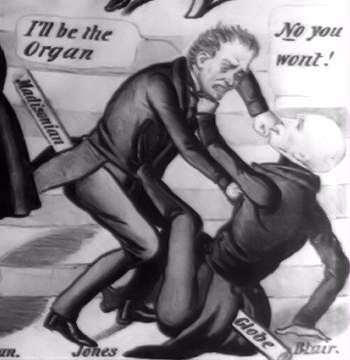
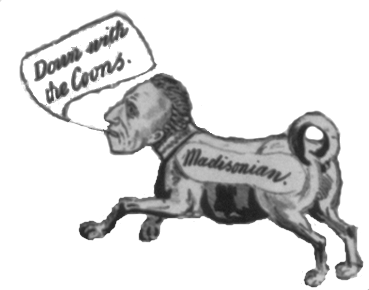
The only actual images of Jones that I have been able to find online are as a minor figure in two political cartoons from before the civil war when he was the editor of a newspaper, the “Madisonian.”
In a second cartoon from 1844, minor characters John Beauchamp Jones and Francis Preston Blair, editors of influential rival newspapers, the “Madisonian” and the “Globe,” fight for the privilege of being the administration organ for the newly elected James K. Polk. (from
original image at Library of Congress)

—Lieutenant-Colonel J. W. Ripley, head of the Ordnance Department, received the brevet of Brigadier-General in the United States Army. A well-merited honor. He is one of the oldest and most valuable officers of the army. He was abroad on leave at the commencement of the rebellion, but hastened home to offer his services. On being asked by a friend if he had returned to engage in the war, he replied: ” Yes, and to give my last drop of blood to defend my Government.” He has disowned his nephew, Major Ripley, who took part in the attack on Fort Sumter.

Captain (now Major) Doubleday of the First Artillery, recently promoted to be a Major in the Seventeenth foot, received his new commission.—Baltimore American, July 5.

—The Mozart Regiment, N. Y. Volunteers, embarked this morning, at Yonkers, and left for Elizabethport, N. J., to take the cars for Washington. The regiment numbered 1,046, and were armed with Enfield muskets. They had two hundred common tents, forty officers’ tents, ten baggage wagons, each drawn by six horses, four hospital ambulances, twenty camp stoves, and two brass 12-pound howitzers.— N. Y. World, July 6.

—A Union meeting was held at the city of Louisiana, Missouri, at which Mr. Charles D. Drake delivered an elaborate speech in defence of the Union and the Constitution.—(Doc. 63.)

—Pursuant to the call of the President of the United States, Congress assembled at Washington this day in special session. Galusha A. Grow, of Penn., was elected speaker of the House, and took the oath of office, which was administered by Mr. Washburne of Illinois. The President’s message was received and read together with reports of the heads of the various departments. The message is brief, and the facts it states are well known; the important points of the document are those which embody the recommendations of the President in relation to the measures to be adopted for the prosecution of the war. Compromise by Congress ho regards as out of the question. The people only can compromise on a question which affects the existence of the nation. He therefore asks that Congress give to the Executive the “legal means to make the contest a short and decisive one, by placing at the control of Government for the work at least four hundred thousand men and four hundred millions of dollars.” That number of men, he says, are ready and willing to take arms for the support of the Government, whilst the amount asked for war purposes is quite within the ability of the country to supply.—(Doc. 65, 66, 67, 68.)

—A Small flag of the Southern Confederacy was raised over a house on an alley in the upper part of the city of Louisville, Ky., to-day. The perpetration of such a deed on such a day is almost sacrilegious. The miserable flag’s time was short. Some patriotic Germans took it down, and bore it away, and burned it. Its ashes are a part of the mud of the streets.— Louisville Journal, July 8.

—The passenger trains on the Louisville and Nashville railroad were seized this morning at Camp Ironsdale, near Mitchellsville, by order of Major-General Anderson, and carried to Nashville, Tenn. The managers had taken all the engines and running stock to Louisville. Ky., against which policy Tennessee had remonstrated, and this seizure was a necessity as a measure of protection. Major-General Anderson informed the agent of the road that no further seizures would be made, and that trains should pass uninterrupted.—Louisville Journal, July 5.

A skirmish took place at Harper’s Ferry, Va., this evening between companies of the New York Ninth Regiment and a detachment of Confederates, who had returned to Harper’s Ferry. A number of men belonging to one of the companies of the New York Ninth crossed over to the Ferry, for the purpose of seeing the work of destruction which had been perpetrated by the rebels, when they were fired upon by a party of men from Bolivar heights. They immediately crossed the river, returned to their encampment, and being reinforced, proceeded at once to the Potomac, opposite Harper’s Ferry, and opened fire upon them. The rebels, concealing themselves in the houses and behind the abutments of the burned bridge, had a decided advantage, and from their position poured a galling fire upon the Federal companies on this side, which were perfectly exposed: yet they stood their ground with almost reckless bravery, until the firing ceased from the opposite side, when they retired with a loss of two killed and three wounded. Several of the rebels were killed, one was killed by a citizen of Harper’s Ferry, who engaged in the fight, he being driven from the place by the rebels.—Baltimore American, July 8.

—The rebels erected a battery, and mounted two rifled cannon at Matthias Point, Va. —N. Y. Times, July C.

—The New Hampshire Legislature adjourned to-day, after a session of thirty days. Resolutions were reported, declaring the war now in progress a war solely for the maintenance of the Government and the suppression of rebellion; declaring against the right of secession; asserting that neither the President nor Congress can constitutionally entertain any proposition which has for its object the dismemberment of the Government or the dissolution of the Union; and finally declaring that the State of New Hampshire pledges her resources for the integrity of the Union, the support of the Constitution, and the enforcement of the laws of the General Government. When these resolutions were put to the vote the members all rose and gave a unanimous aye. Not a member voted in the negative. A militia bill was passed authorizing the Governor to raise three regiments, to each of which he may add a company of artillery, cavalry, and riflemen.—National Intelligencer, July 9.

—The Sixth Regiment of Massachusetts Militia, commanded by Colonel E. F. Jones, were presented with an elegant silk flag, by the loyal citizens of Baltimore, at the Relay House, where had assembled several thousand ladies and gentlemen for the purpose of witnessing the ceremonies. The regiment having been formed in a semicircle, S. J. K. Handy, Esq., advanced, and addressed the command in an eloquent and patriotic strain, presenting the flag in the name of the loyal citizens of Baltimore. Colonel Jones received the flag, and responded briefly to the address. He remarked, among other things, that ladies and gentlemen, representatives of the loyal citizens of Baltimore, had come to place the regiment under an additional obligation, in bestowing such a beautiful flag upon them. An acquaintance which opened in blood had been continued and cultivated with services of great kindness. The command appreciated the many acts which had been bestowed upon their wounded, as well as the kind expressions of the Union-loving citizens of Baltimore. The flag was accepted not only as a token of loyalty, but as an evidence of friendship, which he hoped would continue to grow and strengthen; and when it was unfurled at home, many eyes would be filled with tears in memory of those who had fallen. The presentation laid the old State of Massachusetts under an obligation to the city of Baltimore, and would ever be remembered by her best citizens. In concluding, he assured all present that the object of his regiment was not to oppress, or even to harass the South, but to protect the Capital and preserve the Government. He regretted that his language could but faintly express his feelings, but if his friends could look into his heart they would much better understand him. At the conclusion of his speech three cheers were given for Massachusetts, in response to which nine cheers were given by the regiment for teo loyal citizens of Baltimore. Baltimore American.

—A Correspondent of the Charleston Courier:—”There are some who affect to believe that we shall have a peace before we have a fight. The reaction so long predicted al the North having begun, the circulating petitions of merchants, bankers, clergymen, and other citizens of New York, which are pressing their peaceful influences upon Abraham Lincoln, are also operating here. The question is already being discussed in its various bearings, and the auspicious event has even been assigned a place this side of Christmas.

We have no idea, however, of giving up the contest without, at least, one grand exhibition of the power, the prowess, and the resources of the people who have been stigmatized as “the ruffian rebels of the South.” We went into the war on principle; let us come, out on principle, but not until we have left a mark upon our enemies that shall secure for us for all times to come the respect of the world. The hundred thousand men we have in the field will not be content to lay down their arms in peace, until they have struck a blow that shall quiver through the North; and unless this be done, the millions they have left behind them will have their “welcome home” alloyed by the thought that their husbands, sons, and brothers have returned without teaching that lesson of humiliation to an insolent foe, which, next to the Lord’s Prayer, has been the uppermost desire in every Southern heart.”

Post image for “Camp Woolsey” has a strange sound to us…; Woolsey family letters–Abby Howland Woolsey to Joseph Howland

New York, July 3, 1861.

My dear Joe: It was a satisfaction to us, at least, to receive your telegram of yesterday morning about half-past four in the afternoon. I was sorry that Eliza could not have seen it before she and Georgy left, at 3 p. m. But she was in good spirits, having received your letter with the account of your strange, safe march “through Baltimore,” “that luke-loyal, flagless city,” as somebody from the Garibaldi Guard, writing to the Post, calls it. By the way, I think your camp and the Babel-camp of the Garibaldians must be near each other, from the accounts. I am glad yours is on that high open ground— a hitherto undefended part of Washington, too, I think. “Camp Woolsey,” has a strange sound to us, there never having been any military association with the name in our family. Naval officers you know we have had, and there is a little village of five houses down at Pensacola named after the Commodore “Woolsey.”[1] I send by this mail some maps for Georgy and Eliza. Carry, Jane and I are living very quietly and miss you all sadly. Mother and Hatty intend to spend the Fourth at Astoria.

Every morning I wake up to bright sunshine and familiar sounds and sights, and think for a second that perhaps all this pageant and preparation of war has been a horrid dream! A busy reality to you I dare say, hardly giving you time to read this or even to remember

Yours affectionately,

A. H. W.


[1] Abby forgets the service during the Colonial wars of Colonel Melancthan Taylor Woolsey (brother of our great-grandfather, Benjamin Woolsey), who, according to the inscription on his tombstone, at Dosoris, L. I., “departed this life 28th of September, 1758, in the service of his country against the French in Canada.”


There was also our great ancestor, Captain George Woolsey, our grandfather’s great-grandfather, who was commissioned Captain in the Burgher Guard of New York, in 1696; and a brother of our great-grandmother, Anne Muirson Woolsey, Heathcote Muirson, a revolutionary soldier, was mortally wounded in an attack by the British on Lloyd’s Neck, L. I., July, 1781.

July 3.—A real fight has occurred near Williamsport, but on the Virginia side of the Potomac. General Cadwallader crossed the river with, it is said, 14,000 men, to attack our force of 4,000 stationed there under Colonel Jackson. Colonel J. thought it folly to meet such an army with so small a force, and therefore ordered a retreat; but quite a body of artillery remained to keep the enemy at bay. They retained with them but one gun, a six-pounder. The Rev. Dr. Pendleton, now captain of artillery, commanded this gun, and whenever he ordered its discharge, he was heard to say, reverently, “The Lord have mercy upon their souls—fire!” The result was almost miraculous; but four of our men were missing, two of whom were killed; twenty were wounded, and have been brought to the Winchester hospitals; sixty-five prisoners were taken, and are now in Winchester. Many of their men were seen to fall. Our men, who did this deadly firing, retreated in perfect order. I heard this from one who was on the field at the time. It is said that in Dr. Pendleton the soldier and the chaplain are blended most harmoniously. A gentleman who went to the camp to visit his sons, who belong to the “Rockbridge Battery,” told me that he arose before daylight, and was walking about the encampment, and when near a dense wood his attention was arrested by the voice of prayer; he found it was the sonorous voice of Dr. P., who was surrounded by his company, invoking for them, and for the country, the blessing of Heaven. What a blessing it is for those young men, away from the influences of home, and exposed to the baneful associations of the camp, to have such a guide! It has almost reconciled me to the clergy going upon the field as soldiers. The Bishop of Louisiana has been to Mountain View, to consult Bishop Meade on the subject of his taking the field. I do not know what advice was given. These reverend gentlemen, who were educated at West Point, are perfectly conscientious, and think it their duty to give their military knowledge to their country, and their presence may do much for the spiritual good of the army.

Brave Richard Ashby is dead; how I grieve for his family and for his country, for we cannot afford to lose such men!

John Beauchamp Jones images.

john beauchamp jones cartoon

The only actual images of Jones that I have been able to find online are as a minor figure in two political cartoons from before the civil war when he was the editor of a newspaper, the “Madisonian.” For this image, during the 1844 presidential contest,  Democratic presidential nominee James Polk is portrayed as a buckskinned hunter who has treed “coons” Henry Clay and Theodore Frelinghuysen. (Clay’s nickname “that old coon” had wide currency in the campaign.)

See the full cartoon at the Library of Congress website.


JULY 3D—The Secretary said to me to-day that he desired my young friend, the classical teacher, to assist me in writing letters. I told him I needed assistance, and Mr. Jacques was qualified. Major Tyler’s ill health keeps him absent half the time. There was abundance of work for both of us. Mr. J. is an agreeable companion, and omitted no opportunity to oblige me. But he trenches on the major’s manor, and can write as long letters as any one. I would never write them, unless the subject-matter demanded it; and so, all the answers marked “full” by the Secretary, when the sum and substance is to be merely an affirmative or a negative, will fall to my co laborer’s share.