Following the American Civil War Sesquicentennial with day by day writings of the time, currently 1863.

The American Civil War

To The Hon. W. H. SEWARD,

United States Senate, Washington, D. C.

New York, January 17, 1861

My Dear Sir,—I had intended for the last few days to express to you my sincere admiration of your patriotic and statesmanlike speech in the United States Senate, on Saturday last, but have been prevented by indisposition until to-day.

The graphic and masterly manner with which you depict the blessings of the Union, and the inevitable calamities of its dissolution, will, I trust, open the eyes of the extreme men on both sides to the madness of their course. In paying to your patriotism a willing tribute of the gratitude of a political opponent, for the manly stand which you have taken, may I also be allowed to express the hope that we may look forward to your leading your party further on in the path of moderate and conciliatory measures, which alone can save us from all the horrors of dissolution and civil war.

Without wishing for a moment to defend the revolutionary proceedings of South Carolina, and some of the other cotton States, I may be allowed to express my intimate conviction, based upon information from the most conservative men in the border States, that nothing can prevent Virginia, Tennessee, North Carolina, and Kentucky, from joining the movement of the cotton States, unless compromise measures, based upon the propositions of Senator Crittenden, can be carried bv a sufficient majority through Congress, to insure their embodiment in the Constitution.

I know that many, if not most of the Republican leaders are, until now, opposed to these measures, but do they represent the real feeling of their constituents? I think not; the large masses of our Northern people are, by an overwhelming majority, devotedly attached to the Union. They are ready and anxious to bring every sacrifice for its preservation, and will, to a man, abide by your doctrine: “Republicanism is subordinate to the Union, as every thing else is, and ought to be.”

If we could get at the true sentiment of our people throughout the North, I think we might get over our present difficulties; in fact, I do not see any other means of saving the Union. I therefore approve most cordially of your suggestion for a general convention, and hope only that you could be induced to modify your recommendation, so as to make this appeal now, and not in two or three years.

If, by a tardy action, the tobacco States are allowed to cast their lot with the seceders, and thus form a powerful Southern Confederacy of fifteen States, as they will most assuredly do unless an equitable compromise on the territorial question can be obtained, I .fear that a reconstruction of our confederacy would be utterly hopeless hereafter.

Providence has assigned to you a position of great and fearful responsibility in this crisis. You can preserve this great Union, with all its untold blessings, not only to the millions of freemen who congregate under its protecting wing, but to the oppressed in every portion of the inhabited globe. The downfall of our government would be the death-knell to political and religious liberty in both hemispheres. You have the sympathies of every patriot with you in the course which you have initiated by your great speech. The manifestations, on the part of prominent men of both parties, are most unequivocal in their sincere approbation of the stand which they hope to see you take.

Your efforts will entitle you to the gratitude of the whole American people, and vou will change the proud position of the great leader of a victorious party for the more exalted and honorable one of the benefactor and savior of your country.
—The names of William L. Yancey of Alabama, and James H. Hammond of South Carolina, appear in the Apalachicola Times of this day, as candidates for the presidency and vice-presidency of the Southern Confederacy.

WAR DEPARTMENT, January 16, 1861.

Maj. ROBERT ANDERSON,
First Artillery, Commanding Fort Sumter:

SIR: Your dispatch No. 17, covering your correspondence with the governor of South Carolina, has been received from the hand of Lieutenant Talbot. You rightly designate the firing into the Star of the West as “an act of war,” and one which was actually committed without the slightest provocation. Had their act been perpetrated by a foreign nation, it would have been your imperative duty to have resented it with the whole force of your batteries. As, however, it was the work of the government of South Carolina, which is a member of this confederacy, and was prompted by the passions of a highly-inflamed population of citizens of the United States, your forbearance to return the fire is fully approved by the President. Unfortunately, the Government had not been able to make known to you that the Star of the West had sailed from New York for your relief, and hence, when she made her appearance in the harbor of Charleston, you did not feel the force of the obligation to protect her approach as you would naturally have done had this information reached you.

Your late dispatches, as well as the very intelligent statement of Lieutenant Talbot, have relieved the Government of the apprehensions previously entertained for your safety. In consequence, it is not its purpose at present to re-enforce you. The attempt to do so would, no doubt, be attended by a collision of arms and the effusion of blood–a national calamity which the President is most anxious, if possible, to avoid. You will, therefore, report frequently your condition, and the character and activity of the preparations, if any, which may be being made for an attack upon the fort, or for obstructing the Government in any endeavors it may make to strengthen your command.

Should your dispatches be of a nature too important to be intrusted to the mails, you will convey them by special messengers. Whenever, in your judgment, additional supplies or re-enforcements are necessary for your safety, or for a successful defense of the fort, you will at once communicate the fact to this Department, and a prompt and vigorous effort will be made to forward them.

Very respectfully, your obedient servant,

J. HOLT.

FORT TAYLOR, KEY WEST, FLA.,
January 15, 1861.

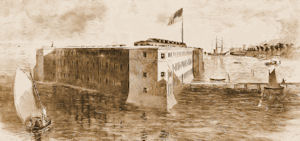
SIR: In consequence of the secession of this State and the seizure of the forts and arsenals in other Southern States. I have moved my command to Fort Taylor, and shall defend it to the last moment against any force attempting to capture it. I have four months’ provisions and 70,000 gallons water, but we cannot stand a siege against any organized army, and therefore should be re-enforced immediately. Two vessels of war should be stationed here to protect the entrance to the harbor and prevent a landing beyond the range of my guns. Mail facilities having ceased through Florida, all orders for this post should be sent via Havana from New York through the American consul.

I am, sir, very respectfully, your obedient servant,

J. M. BRANNAN, ……..
Captain, First Artillery, Commanding.

Maj. GEORGE DEAS,
……….Assistant Adjutant-General, Dept. of the East, Troy, N. Y.

—Judge Smalley delivered a charge to the grand jury of the Federal court in New York, specifying what overt acts constitute treason. (The Evening Post of the 14th of January contains this charge in full.)

MONDAY 14

Something of a snowstorm today. Tonight is more like rain freezing as it falls. The walks are a glade of ice. There appears to be a more hopeful feeling abroad today in reference to the affairs of the country. The Govt is geting into the hands of Union men. The Cabinet is now composed entirely of that class. Genl Dix taking the place of Thomas. His first assistant (Clayton) has also resigned to save himself from being turned out. It is rumored today that all “seceders” are to be turned out if they do not resign their posts in the different Depts. Spent the evening next door, Mr Bartletts, clerk in State Dept.

______

The three diary manuscript volumes, Washington during the Civil War: The Diary of Horatio Nelson Taft, 1861-1865, are available online at The Library of  Congress.

FORT TAYLOR, KEY WEST, FLA.,
January 14, 1861.

SIR: I have the honor to report that in consequence of the recent seizure by unauthorized persons of several forts and arsenals in the Southern States, I have placed my entire command in Fort Taylor for the purpose of protecting it. I shall, until orders from the General Government to the contrary, defend it to the best of my ability with the scanty force (forty-four men) at my disposal. I inclose a copy of a communication I addressed direct to the Adjutant-General on December 11, 1860, to which I have received no reply; also a copy of a letter from Capt. E. B. Hunt, Corps of Engineers, in charge of Fort Taylor. As mail facilities have entirely ceased between Key West and the North, I would suggest that any orders for me be forwarded from New York City, via Havana, to the care of the American consul.

I am, sir, very respectfully, your obedient servant,

J. M. BRANNAN, ……
Captain, First Artillery, Commanding.

Lieut. Col. L. THOMAS,

Asst. Adjt. Gen., Headquarters of the Army, Washington, D.C.

.

[Inclosure No. 1.]

.

KEY WEST BARRACKS, FLA.,……
December 11, 1860.

SIR: The present condition of affairs in this State indicates very clearly that Florida by the act of her people, will secede from the Federal Government. I have reliable information that as soon as the act is committed an attempt will be made to seize upon Fort Taylor. I therefore request instructions what I am to do–endeavor at all hazards  to prevent Fort Taylor being taken or allow the State authorities to have possession without any resistance on the part of my command? These instructions are absolutely necessary now, as it may be too late after the State secedes to receive any, in consequence of communications being cut off from the seat of Government.

I am, sir, very respectfully, your obedient servant,

J. M. BRANNAN,…….
Captain, First Artillery, Commanding.

Col. S. COOPER,
…………..Adjutant-General U. A. Army, Washington City, D. C.

.

[Inclosure No. 2.]
.

FORT TAYLOR, KEY WEST, FLA.,……….
January 12, 1861.

SIR: In consequence of the disordered state of public affairs, of the reported seizure of various neighboring forts and arsenals, of my own lack of means for maintaining a secure guard of this most important fortification, and of the near approach of the discharge of most of my enrolled mechanics and laborers, I deem it my duty to call upon you to make [secure] the military custody of Fort Taylor, and to adopt such measures for its security as you shall deem proper. I shall heartily cooperate in my appropriate capacity as an officer of Engineers, and shall in a few days complete all the defensive preparations now required. I would, therefore, hereby ask you at once to assume the military command of Fort Taylor. I shall by letter of this date ask Captain Craven, of the Mohawk, to consult with you and give his aid for this object.

Very respectfully, yours, &c.,

E. B. HUNT,
Captain, Engineers.

Capt. J. M. BRANNAN,
……….First Artillery, Commanding Key West Barracks.

—Governor Pickens, of South Carolina, sent to Washington for a balance of $3,000 due him as late Minister to Russia. The Department adjusted his accounts by sending him a draft on the Charleston Sub-Treasury, the money in which has been seized by the State.

.
.

FORT COLUMBUS, N. Y. H.,
January 13, 1861.

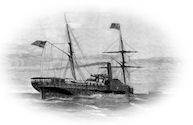
COLONEL: Pursuant to instructions, dated Headquarters of the Army, January 5, 1861, I embarked on the evening of Saturday, 5th instant, from Governor’s Island, at 6 o’clock p.m., on a steam-tug, which transferred us to the steamer Star of the West.

My command consisted of two hundred men, recruits from the depot, fifty of whom were of the permanent party. My officers were First Lieut. W. A. Webb, Fifth Infantry; Second Lieut. C. W. Thomas, First Infantry, and Assist. Surg. P. G. S. Ten Broeck, Medical Department.

On Tuesday afternoon, 8th instant, arms and ammunition were issued to all the men. About midnight same evening we arrived off Charleston Harbor, and remained groping in the dark until nearly day, when we discovered the light on Fort Sumter, which told us where we were. The other coast light marking the approaches to the harbor had been extinguished, and the outer buoy marking the channel across the bar gone.

During the night we saw what we supposed to be the light of a steamer cruising off the harbor, but she did not discover us, as our lights were all out. Just before day we discovered a steamer lying off the main ship channel. As soon as they made us out they burned one blue light and two red lights, and, receiving no response from us, immediately steamed up the channel. As soon as we had light enough we crossed the bar, and steamed up the main ship channel. This was on the first of the ebb tide, the steamer ahead of us firing rockets and burning lights as she went up. We proceeded without interruption until we arrived within one and three-quarter miles of Forts Sumter and Moultrie–they being apparently equidistant–when we were opened on by a masked battery near the north end of Morris Island. This battery was about five-eighths of a mile distant from us, and we were keeping as near into it as we could, to avoid the fire of Fort Moultrie. Before we were fired upon we had discovered a red palmetto flag flying, but could see nothing to indicate that there was a battery there.

We went into the harbor with the American ensign hoisted on the flagstaff, and as soon as the first shot was fired a full-sized garrison flag was displayed at our fore, but the one was no more respected than the other. We kept on, still under the fire of the battery, most of the balls passing over us, one just missing the machinery, another striking but a few feet from the rudder, while a ricochet shot struck us in the fore-chains, about two feet above the water line, and just below where the man was throwing the lead. The American flag was flying at Fort Sumter, but we saw no flag at Fort Moultrie, and there were no guns fired from either of these fortifications.

Finding it impossible to take my command to Fort Sumter, I was obliged most reluctantly to turn about, and try to make my way out of the harbor before my retreat should be cut off by vessels then in sight, supposed to be the cutter Aiken, coming down the channel in tow of a steamer, with the evident purpose of cutting us off. A brisk fire was kept up on us by the battery as long as we remained within range, but, fortunately, without damage to us, and we succeeded in recrossing the bar in safety, the steamer touching two or three times. Our course was now laid for New York Harbor, and we were followed for some hours by a steamer from Charleston for the purpose of watching us.

During the whole trip downward the troops were kept out of sight whenever a vessel came near enough to us to distinguish them, and the morning we entered the harbor of Charleston they were sent down before daylight, and kept there until after we got out of the harbor again. From the preparations that had been made for us I have every reason to believe the Charlestonians were perfectly aware of our coming.

We arrived in New York Harbor on the morning of the 12th instant, and disembarked at 8 o’clock this morning, the 13th, by orders from Headquarters of the Army.

The conduct of the officers and men under my command during the whole trip, and particularly while under fire, was unexceptionable.

Capt. John McGowan, commanding the steamer Star of the West, deserves the highest praise for the energy, perseverance, and ability displayed in trying to carry out his orders to put the troops in Fort Sumter. He was ably assisted by Mr. Walter Brewer, the New York pilot taken from this place.

I am, colonel, very respectfully, your obedient servant,

CHAS. R. WOODS,

First Lieutenant, Ninth Infantry, Commanding.

Col. L. THOMAS,

Assistant Adjutant-General, U.S.A., Washington. D.C.

—The Star of the West arrived at New York, having failed to land her troops at Fort Sumter. The Captain reported that unexpected obstacles in the removal of buoys, lights, and ranges, which, though he arrived in the night, compelled him to wait till daybreak outside the harbor, rendered a successful entrance impossible.—(Doc. 21.)

—Senator Seward, in his place in the Senate, spoke upon the present troubles of the country, and avowed his “adherence to the Union, in its integrity and with all its parts; with his friends, with his party, with his State, or without either, as they may determine; in every event, whether of peace or of war; with every consequence of honor or dishonor, of life or death.” He said that “Union is not less the body than liberty is the soul of the nation.” The speech is denounced by both extremes, and is understood by the Southerners to mean “coercion,” while the political friends of the Senator consider it a relinquishment of his principles.—Times, Jan. 18.

Four Barrancas and the navy yard at Pensacola, were seized. The late commandant of the navy yard, in a dispatch to Government, says:

“Armed bodies of Florida and Alabama troops appeared before the gate of the navy yard, and demanded possession. Having no means of resistance, I surrendered and hauled down my flag. They are now in possession.”

A dispatch to the Florida senators announced the same as follows:

“We repaired down here and captured Fort Barrancas and navy yard, and then paroled the officers, granting them permission to continue to occupy their quarters. We are now in possession. This move was in consequence of the Government garrisoning Fort Pickens, which has before remained unoccupied. You will propose to the Administration, resuming the status quo ante bellum and we will immediately evacuate.”

The Pensacola navy yard contains a hundred and fifty-six thousand dollars’ worth of ordnance stores.—Richmond Enquirer, Jan. 14.

—Artillery were ordered to Vicksburg by the Governor early this morning, to hail and question passing boats on the Mississippi river.

A salute of fifteen guns was fired last night at Jackson, on the reception of the news from Alabama and Florida.—Raleigh Standard, Jan. 14.