Following the American Civil War Sesquicentennial with day by day writings of the time, currently 1863.

The American Civil War

CINCINNATI, January 12, 1861.

DEAR UNCLE:—I will write oftener hereafter. I have some work, the days are short, and the state of the country is a never-ending topic which all you meet must discuss, greatly to the interruption of regular habits. I rather enjoy the excitement, and am fond of speculating about it.

We are in a revolution; the natural ultimate result is to divide us into two nations, one composed of free States, the other of slave States. What we shall pass through before we reach this inevitable result is matter for conjecture. While I am in favor of the Government promptly enforcing the laws for the present, defending the forts and collecting the revenue, I am not in favor of a war policy with a view to the conquest of any of the slave States; except such as are needed to give us a good boundary. If Maryland attempts to go off, suppress her in order to save the Potomac and the District of Columbia. Cut a piece off of western Virginia and keep Missouri and all the Territories.

To do this we shall not need any long or expensive war, if the Government does its duty. A war of conquest we do not want. It would leave us loaded with debt and would certainly fail of its object. The sooner we get into the struggle and out of it the better.

There, you can read that perhaps. If you can’t, you lose nothing. If you can, it is no more worthless than the dispatches from Congress.

Sincerely,

R. B. HAYES.

S. BIRCHARD.

—To-day a party of Louisiana State troops, under command of Captain Bradford, took possession of the United States Marine Hospital, about two miles below New Orleans. The patients in the Hospital, numbering two hundred and sixteen, were ordered to be removed; those who are convalescent, immediately, and those who are confined to their beds, as soon as possible. The reason assigned for this inhuman action is that the authorities want the quarters for their own troops.

—A Union meeting was held at Wilmington, N. C., this evening, which was attended by over one thousand persons.—Evening Post, Jan. 15.

—Florida and Alabama adopted ordinances of secession; Florida passed her ordinance by a vote of 62 to 7, and Alabama by yeas 61, nays 39. The Alabama Convention was far from unanimous; a large part of that State is decidedly opposed to extreme measures.

The Alabama ordinance of secession cells upon the people of all the Southern States to meet in convention at Montgomery, on the 4th of February next, for the purpose of forming a provisional or permanent government. Immediately after the passage of the ordinance, an immense mass meeting was held in front of the capitol; a secession flag, presented by the women of Montgomery, was raised on the State House, cannon were fired, guns fired, etc., and in the evening the whole town was illuminated.—(Doc. 19.)—Evening Post, Jan. 12.

—Judge Jones, of the United States District Court, this afternoon announced from the windows of the court-room in the custom-house building, at Mobile, that the United States Court for the Southern District of Alabama was “adjourned forever.”

Mr. George M. Brewer, of the same place, gave one hundred cords of wood for the use of the garrison at Fort Morgan, and proffered the services of twenty negro men as laborers on the works.—Mobile Advertiser, Jan. 12.

At Richmond, Va., a banquet was given to John B. Floyd, late Secretary of the Navy. That gentleman made a speech, wherein he related a conversation with the President, which he claimed showed a breach of faith on the part of the latter, leading to the former’s resignation. He also counselled resistance to Federal coercion. Speeches were made by Lieutenant-Governor Montague, Attorney-General Tucker, and others. The policy of the Legislature was severely commented upon.

—Abolitionists attempted to hold a meeting at Rochester, N. Y. It was broken up by citizens, and resolutions in favor of the Union were passed, and cheers given for General Scott and Major Anderson. A flag bearing the inscription, “No compromise with slavery,” was not allowed to be suspended across Buffalo street. The authorities prevented a general riot. —N. Y. Herald, Jan. 12.

—Both branches of the New York Legislature adopted strong Union resolutions, tendering the assistance of the State to the President, and ordered them sent to the President, and the Governors of all the States.—(Doc. 20.)

January 11th, 1861. We did not try to be early this morning, as the big event of the day did not take place until one o’clock. Capitol Square was so crowded you could see nothing but heads and the Capitol itself was full of people looking from the windows, which looked out on the east portico. Somehow Father and I had seats on the portico itself, close up to the wall where we were not in the way and yet we could both see and hear.

There was a table already there with a large inkstand and several pens, nothing more. A subdued murmur came from the assembled citizens but there was none of the noise and excitement which had prevailed on other days; all seemed impressed with the solemnity of the occasion for oh, it is solemn! I did not realize how solemn until Mr. Sanderson read the Constitution and I understood just why it was necessary for Florida to secede.

As the old town clock struck one, the Convention, headed by President McGehee, walked out on the portico. In a few moments they were grouped about the table on which some one had spread the parchment on which the Ordinance of Secession was written. It was impossible for me to tell in what order it was signed, the heads were clustered so closely around the table, but presently I heard Col. Ward’s familiar voice. There was a little break in the crowd and I saw him quite plainly. He dipped his pen in the ink and, holding it aloft he said, in the saddest of tones, “When I die I want it inscribed upon my tombstone that I was the last man to give up the ship.” Then he wrote slowly across the sheet before him, “George T. Ward.”

The stillness could almost ‘be felt. One by one they came forward and after a while Col. Owens, a Baptist minister, who is lame, came up to sign and in a loud voice he said: “Unlike my friend, Colonel Ward, I want it inscribed on MY tombstone that I was the FIRST man to quit the rotten old hulk.”A very faint applause greeted this, but it died away before it hardly began. This was no time for jesting; it meant too much.

When at length the names were all affixed, cheer after cheer rent the air; it was deafening. Our world seemed to have gone wild.

General Call is an old man now; and he is a strong Union man. Chancing to look toward him I saw that the tears were streaming down his face. Everybody cannot be suited and we are fairly launched on these new waters; may the voyage be a prosperous one.

Nearly everybody seems to be happy and satisfied. The Supreme Court Judges, into whose hands the document just signed, has been placed, have carried it to Miss Elizabeth Eppes to engross or adorn it with blue ribbon; the judges selected Miss Bettie because she is a granddaughter of Thomas Jefferson. I hope President Jefferson likes our Ordinance—I believe those who are gone know all we are doing here below.

Father says the rest of the proceedings of this convention will be confined to business matters and though he is planning to attend, he will leave me at home and let me go on with my studies. I wonder if I can collect my wits enough to learn my lessons. I will have Saturday to rest up in and Lulu will make us some candy.

—An intense excitement at Charleston on account of a rumor that the sloop-of-war Brooklyn was dispatched for that place. Great preparations are made to receive her. The buoys in the harbor are removed, and threats are made to fire on the ship.

—A steam-tub called the Aid left the wharf to-night for the purpose of reconnoitring. She is mounted with one gun, and is under the commend of Lieut. Hamilton, formerly of the Federal navy.

Fort Moultrie is being rapidly put in order by a large force of workmen. There are over forty South Carolina railroad hands actively and constantly employed under Mr. Bryant. Twenty hearty, strong negroes were sent down by the Rev. Mr. Prentiss and set to work, and did work faithfully all night upon the ramparts.—Charleston Courier, Jan. 11.

FORT PICKENS, FLA., January 10, 1861.

SIR: I have the honor to report that on this date, I removed my command from Barrancas Barracks, Fla., to Fort Pickens, under special instructions received the previous day from the General-in-Chief.

……….I am, sir, very respectfully, your most obedient servant,

A. J. SLEMMER, ……….
First Lieutenant, First Artillery, Commanding Post.

Col. S. COOPER, Adjutant-General U.S. Army.

January 10th, 1861.—It is night and I am very tired but there is much to tell. The Ordinance of Secession was voted on today. Bishop Rutledge made the opening prayer and it was very impressive. He pleaded so earnestly for God’s guidance for these members, in whose hands lay the future of Florida. These men feel their responsibility I am sure, their faces are so serious and yet so alert. Not one word escapes them and when an amendment is needed they are so careful to make it plain to all. I heard something today about a flag which had been presented to Florida but I have not seen it as yet.

After the committees were disposed of the Ordinance of Secession was voted on. The vote was 62 for and 7 against. The ordinance was declared adopted at 22 minutes after 12 o’clock. It was resolved that at one o’clock on the next day, January 11th, the Ordinance of Secession should be signed on the east portico of the Capitol. The convention then adjourned until the afternoon session.

Mississippi seceded last night and it seems we will have plenty of company. The Union men in the hall looked very sad. They have worked hard for their side, but they had only a few followers.

—Mississippi State Convention passed the ordinance of secession. Delegations from South Carolina and Alabama were invited to seats in the Convention. They were greeted with applause. Efforts were made to postpone action, which were voted down. The fifteen delegates who opposed the ordinance will sign it to-morrow, making the vote unanimous.

Fireworks were displayed at the capitol in Jackson this evening. The excitement is intense.—N. O. Picayune, Jan. 10.

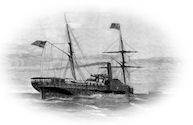
—At half-past 7 A. M. the steamship Star of the West was signaled at the entrance of Charleston harbor. As she made her way toward Fort Sumter, a shot was sent across her bow from a battery on Morris’ Island, when she displayed the United States flag, and was repeatedly fired into from the Morris’ Island battery and from Fort Moultrie. Her course was then altered, and she again put to sea. Guns were ran out at Fort Sumter, but none were fired. At 11 o’clock Major Anderson sent a flag with a communication to Governor Pickens, to inquire if this act had the sanction of the State Government; was informed that it had, and thereupon sent a special messenger to Washington with dispatches.—(Doc. 18.)

January 9th, 1861.—There has been a hot time in the convention today; the nearer they get to a final decision the hotter it gets. Colonel Ward made a most eloquent address to the convention. He told them that he was a Union man but it was in this way: in his opinion the South had done more to establish that Union than any other section; it was a Southern man who wrote the Declaration of Independence, it was a Southern man who led the American army, it was Southern men who framed the Constitution, a Southern man wrote our National Anthem and, in so doing had immortalized the Star-spangled Banner and he proposed to hold on to that which we had done so much to bring about. He was willing to fight, if fight we must, but he wanted to fight in the Union and under that flag which was doubly ours. The heartiest applause greeted him as he sat down. It was plain to see that his audience was tremendously affected but the next speaker tore his fine argument to shreds. So it went on all day, some committee business would interrupt now and then but the most of the time was spent in debate for or against secession.

Our old friend, Mr. Burgess says: “If Mrs. Harriet Beecher Stowe had died before she wrote ‘Uncle Tom’s Cabin,’ this would never have happened.” He says, “she has kindled a fire which all the waters of the earth cannot extinguish.” Isn’t it strange how much harm a pack of lies can do?

FORT SUMTER, S.C., January 9, 1861.
(Received A. G. O., January 12.)

Col. S. COOPER, Adjutant General:

COLONEL: I have the honor to send herewith the correspondence which took place to-day between the governor of South Carolina and myself in relation to the firing by his batteries on a vessel bearing our flag. Lieutenant Talbot, whose health is very much impaired, will be the bearer of these dispatches, and he will be enabled to give you full information in reference to this and to all other matters.

I am, colonel, your obedient servant,

ROBERT ANDERSON,

Major, First Artillery, Commanding.

[Inclosures.]

FORT SUMTER, S.C., January 9, 1861.

To his Excellency the GOVERNOR OF SOUTH CAROLINA:

SIR: Two of your batteries fired this morning upon an unarmed vessel bearing the flag of my Government. As I have not been notified that war has been declared by South Carolina against the Government of the United States, I cannot but think that this hostile act was committed without your sanction or authority. Under that hope, and that alone, did I refrain from opening fire upon your batteries. I have the honor, therefore, respectfully to ask whether the above mentioned act–one, I believe, without a parallel in the history of our country or of any other civilized government–was committed in obedience to your instructions, and to notify you, if it be not disclaimed, that I must regard it as an act of war, and that I shall not, after a reasonable time for the return of my messenger, permit any vessels to pass within range of the guns of my fort. In order to save, as far as in my power, the shedding of blood, I beg that you will have due notification of this my decision given to all concerned. Hoping, however, that your answer may be such as will justify a further continuance of forbearance upon my part,

I have the honor to be, very respectfully, your obedient servant,

ROBERT ANDERSON,

Major, First Artillery, Commanding.

_________

STATE OF SOUTH CAROLINA, EXECUTIVE OFFICE,
Headquarters, Charleston, January 9, 1861.

Maj. ROBERT ANDERSON,

Commanding Fort Sumter :

SIR: Your letter has been received. In it you make certain statements which very plainly show that you have not been fully informed by your Government of the precise relations which now exist between it and the State of South Carolina. Official information has been communicated to the Government of the United States that the political connection heretofore existing between the State of South Carolina and the States which were known as the United States had ceased, and that the State of South Carolina had resumed all the power it had delegated to the United States under the compact known as the Constitution of the United States. The right which the State of South Carolina possessed to change the political relations which it held with other States under the Constitution of the United States has been solemnly asserted by the people of this State in convention, and now does not admit of discussion. In anticipation of the ordinance of secession, of which the President of the United States has received official notification, it was understood by him that sending any re-enforcement of the troops of the United States in the harbor of Charleston would be regarded by the constituted authorities of the State of South Carolina as an act of hostility, and at the same time it was understood by him that any change in the occupation of the forts in the harbor of Charleston would in like manner be regarded as an act of hostility. Either or both of these events, occurring during the period in which the State of South Carolina constituted a part of the United States, was then distinctly notified to the President of the United States as an act or acts of hostility; because either or both would be regarded, and could only be intended, to dispute the right of the State of South Carolina to that political independence which she has always asserted and will always retain. Whatever would have been, during the continuance of this State as a member of the United States, an act of hostility, became much more so when the State of South Carolina had dissolved the connection with the Government of the United States. After the secession of the State of South Carolina, Fort Sumter continued in the possession of the troops of the United States. How that fort is at this time in the possession of the troops of the United States, it is not now necessary to discuss. It will suffice to say that the occupancy of that fort has been regarded by the State of South Carolina as the first act of positive hostility committed by the troops of the United States within the limits of this State, and was in this light regarded as so unequivocal that it occasioned the termination of the negotiations then pending at Washington between the Commissioners of the State of South Carolina and the President of the United States. The attempt to re-enforce the troops now at Fort Sumter, or to retake and resume possession of the forts within the waters of this State, which you abandoned, after spiking the guns placed there, and doing otherwise much damage, cannot be regarded by the authorities of the State as indicative of any other purpose than the coercion of the State by the armed force of the Government. To repel such an attempt is too plainly its duty to allow it to be discussed. But while defending its waters, the authorities of the State have been careful so to conduct the affairs of the State that no act, however necessary for its defense, should lead to an useless waste of life. Special agents, therefore, have been off the bar to warn all approaching vessels, if armed or unarmed, and having troops to re-enforce the forts on board, not to enter the harbor of Charleston, and special orders have been given to the commanders of all forts and batteries not to fire at such vessels until a shot fired across their bows would warn them of the prohibition of the State. Under these circumstances, the Star of the West, it is understood, this morning attempted to enter this harbor, with troops on board, and having been notified that she could not enter, was fired into. The act is perfectly justified by me. In regard to your threat in regard to vessels in the harbor, it is only necessary to say that you must judge of your own responsibilities. Your position in this harbor has been tolerated by the authorities of the State, and while the act of which you complain is in perfect consistency with the rights and duties of the State, it is not perceived how far the conduct which you propose to adopt can find a parallel in the history of any country, or be reconciled with any other purpose of your Government than that of imposing upon this State the condition of a conquered province.

F. W. PICKENS.

_________

FORT SUMTER, S.C., January 9, 1861.

General TOTTEN:

MY DEAR SIR: I have only a moment to write by Lieutenant Meade [?], who comes with dispatches from Major Anderson. I wish to assure you, however, that the officers of your corps are doing everything in their power to make this work impregnable, even with the present small garrison of seventy men. We even mount all the guns, as we can do it much more rapidly than the garrison. We have twenty-nine guns on the first tier and eleven on the barbette tier. Four 8-inch columbiads are ready to mount to-morrow. I shall place the 10-inch on the parade as mortars.

The firing upon the Star of the West this morning by the batteries on Morris Island opened the war, but Major Anderson hopes that the delay of sending to Washington may possibly prevent civil war. The hope, although a small one, may be the thread that prevents the sundering of the Union. We are none the less determined to defend ourselves to the last extremity. I am in want of funds, and would respectfully urge that as soon as possible $15,000 may be placed to my credit in New York. In haste.

Very respectfully,

J. G. FOSTER,

Captain, Engineers.

P. S.–I beg to refer you to Lieutenant Meade [?] for particulars.

J. G. F.
—The Southern Confederacy (published at Atlanta, Ga.), a paper which has been fighting most gallantly for the Union and the laws, says of the late election for members of the Georgia Convention:

“It is a notable fact, that, wherever the ‘Minute Men, as they are called, have had an organization, those counties have voted, by large majorities, for immediate secession. Those that they could not control by persuasion and coaxing, they dragooned and bullied, by threats, jeers, and sneers. By this means thousands of good citizens were induced to vote the immediate secession ticket through timidity. Besides, the towns and cities have been flooded with sensation dispatches and inflammatory rumors, manufactured in Washington city for the especial occasion. To be candid, there never has been as much lying and bullying practised, in the same length of time, since the destruction of Sodom and Gomorrah, as has been in the recent State campaign. The fault has been at Washington city; from that cess-pool have emanated all the abominations that ever cursed a free people.”

—The Baltimore Exchange says “the whole population of Maryland is united in the desire to preserve the Union; yet it may be that the people, by a blind and ill-advised course, may render the State obnoxious in future to the charge of having contributed, by her indecision and weakness, to the overthrow of the republic.”—Evening Post, Jan. 8.

—Governor Hicks, of Maryland, in a letter to J. L. Curry, Commissioner from Alabama, says he regards cooperation between the slave States as an infraction of the Constitution, which he, as Governor of Maryland, swore to support. The people of that State are firm in their friendship for the Union, and will never swerve from it; they have seen, with mortification and regret, the course taken by, South Carolina; for in their opinion it is better to use the Union for the enforcement of their rights than to break it up because of apprehensions that the provisions of the Constitution will be disregarded, and they will cling to it until it shall actually become the instrument of destruction to their rights and peace and safety. Disunion would be ruin to Maryland, and in the proposed Southern Confederacy she sees no refuge from the ills she must suffer in such an event. “Let us,” says Governor Hicks, “have our rights in the Union, and through and by the Constitution.”—Baltimore Sun.

—The N. C. troops, and persons residing in the vicinity of Forts Caswell and Johnson, took possession of those defences this day. (A correspondence on this subject took place immediately between Governor Ellis and Secretary Holt. The forts were surrendered and the State troops removed.—Doc. 17.)

—Secretary Thompson resigned his place in the Cabinet, upon learning that the Star of the West had sailed from New York with troops.

—From Charleston it is announced that the messages to Fort Sumter cannot be delivered, as there is no communication between the fort and the city.

—The Sub-Treasurer of Charleston has communicated to the Government, that the South Carolina authorities will not allow him to pay any more drafts, not even to pay Anderson’s. All the cash in his vaults is to be retained there.

—It is ascertained that all the seceding States lave drawn their quota of arms for 1861 in advance. The order from South Carolina was filled only a few days before the passage of the ordinance of secession.—Commercial, Jan. 8.