Following the American Civil War Sesquicentennial with day by day writings of the time, currently 1863.

The American Civil War

May 5.—Clement C. Vallandigham was arrested at his residence in Dayton, Ohio, this morning, by a detachment of soldiers sent from Cincinnati by order of General Burnside. — The Third New York cavalry, on an expedition to Pettie’s Mills, twenty-seven miles from Newborn, N. C, captured an entire rebel company, together with their camp, horses, and equipments, without loss to the National side.—Fort de Russey, situated on the Red River, about eight miles from its mouth, was occupied by the National forces under the command of Admiral Porter—(Doc. 187.)

—John J. Pettes, rebel Governor of Mississippi, issued a proclamation calling on every man in the State, capable of bearing arms, to take the field, “for united effort in expelling the enemy from the soil of Mississippi.”

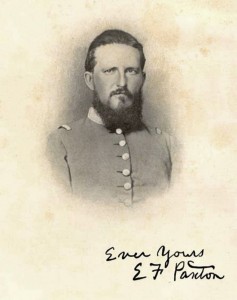
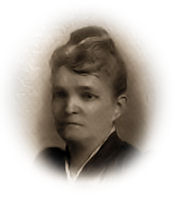
Letter From Henry K. Douglas To Mrs. Paxton

May 4, 1863.

Madam: As the senior officer of Gen’l Paxton’s staff, and a person with whom he was probably more intimate than with any one in the brigade, I deem it my duty, although a painful one, to notify you of the circumstances of his death. He fell yesterday morning while bravely leading his brigade into action, and lived only about an hour after receiving his wound. As soon as he was struck he lifted his hand to his breast-pocket. In that pocket I knew he kept his Bible and the picture of his wife, and his thoughts were at that moment of heaven and his home. Beloved and esteemed by officers and men, his loss is deeply mourned, and the brigade mingle their tears with those of his family relations. I have for some time thought that the General expected the first battle in which he led his brigade would be his last, and I had observed, and am satisfied from various conversations with him, that he was preparing his mind and soul for the occasion. It is a consolation to know that while he nobly did his duty in the field and camp without regard to personal consequences, he had been convinced that there was a home beyond this earth where the good would receive an eternal reward. For that home he had richly prepared himself, and, I confidently hope, is there now. Almost the last time I saw him, and just before the brigade moved forward into the fight, he was sitting behind his line of troops, and, amidst the din of artillery and the noise of shell bursting around him, he was calmly reading his Bible and there preparing himself like a Christian soldier for the contest.

Dr. Cox, A. D. C, has already departed with his body for home.

__________

Letter From Henry K. Douglas To J. G. Paxton

Hagerstown, Md., Feb. 18,1893.

Yours of the 14th is received to-day. I knew your father very well. When he was on the staff of Gen’l Jackson, so was I; and for a time, when he commanded the Stonewall Brigade, I was the A. A. G. and A. I. G. of the brigade, in rank its senior staff officer. My relations with him were very close—indeed, confidential.

I had observed, during the winter of 1862-63, a growing seriousness on his part in every respect. There was nothing morbid about it, but he was much given to religious thought and conversation. He was a very regular reader of the Bible, and, I think, often talked with Gen’l Jackson on the same subject. He was thoroughly impressed with the conviction that he would die early in the opening campaign, and was determined to prepare for that fate.

In my letter to your mother, written the day after his death, I merely alluded to certain conversations which I will now explain more explicitly.

The night of the 2nd, Gen’l Paxton seemed—as we in fact all were—very much depressed at the wounding of Gen’l Jackson. Late that night, in the course of a conversation with me, your father quietly but with evident conviction expressed his belief that he would be killed the next day. He told me where in his office desk certain papers were tied up and labelled in regard to his business, and asked me to write to his wife immediately after his death. I was young and not given to seriousness then; but I was so impressed with his sadness and earnestness, and all the gloom of the surroundings, that I did not leave him until after midnight.

The next morning we were astir very early. I found Gen’l Paxton sitting near a fence, in rear of his line, with his back against a tree, reading the Bible. He received me cheerfully. I had been with him but a few minutes when the order came for his brigade to move. He put the Bible in his breast-pocket, and directing me to take the left of the brigade, he moved off to the right of it. I never saw him again. I find, in looking at my brief diary of that day, that he had been killed for some time before I knew it, and that I was commanding the brigade by issuing orders in his name long after his death. “When I knew of it, I informed Col. Funk, who immediately assumed command. I mentioned in the letter to your mother that he lived an hour after his wounding. Capt. Barton says this is an error, and it is probable he is correct. I was not with Gen’l Paxton when he was shot, and I suppose that what I stated in my letter was obtained from some one else. Capt. Barton was with the General. I find this in my notes: “I missed Gen’l Paxton and the rest of the staff; but as I missed part of the 2nd Regiment, I thought it and the General had become temporarily separated from the rest of the Brigade.” I find in my notes of the 4th: “I wrote a letter to Mrs. Paxton concerning the death of the General.” This is the letter a copy of which you sent me, and I am very glad to get it.

Gen’l Paxton was a unique character. He was a man of intense convictions and the courage of them. Kindhearted, he was often brusque to rudeness. He was conscientious in the discharge of his duties, and painstaking. He was of excellent judgment, slow and sure, and yet fond of dash in others. He was esteemed by the officers, beloved by the men, and respected by all. He was an excellent officer, a faithful, brave and conscientious soldier. He had a keen sense of humor, well restrained, and often laughed at and condoned recklessness of which he did not approve. I think I must have tried him often; but if so, he never let me know it. I had his friendship, and in all his friendships he was staunch and true.

P.S. I find this in the account of my interview with Gen’l Jackson on Sunday evening, the 3rd: “He spoke feelingly of Gen’l Paxton and Capt. Boswell, both dead, and his eyes filled with tears as he mentioned their names. He asked me to tell him all about the movements of the old brigade. When I described to him its evolutions: how Gen’l Paxton was reading his Bible when the order came to advance; how he was shortly afterwards mortally wounded; how Gen’l Stuart led the brigade in person, shouting, “Charge, and remember Jackson!” etc., etc., his eyes lighted up with the fire of battle as he exclaimed, “It was just like them—just like them!”

__________

Letter From Randolph Barton To J. G. Paxton

Baltimore, MA., Sept. 14, 1885.

My recollection is that in the summer or September of 1862, your father, who up to that time had been a member of the staff of Gen’l Jackson (Stonewall), was by that officer appointed to the command of the Stonewall Brigade,—Gen’l Winder, its last commander, having been killed at Cedar Mountain.

I was a brevet second lieutenant in Co. K, 2nd Va. Infantry, Stonewall Brigade, during the winter of 1862-863, and your father was at that time acting Brigadier Gen’l. Early in 1863, upon the recommendation of Mr. Henry K. Douglas, your father detailed me to act as Assistant Adjutant-Gen’1 of the brigade, and about March or April, 1863, I left my company and went to his headquarters. A little later the Confederate Congress confirmed his appointment as Brigadier-General, and thereupon, although he did not positively tell me that he wished me to remain with him permanently, he suggested that I should supply myself with a horse, which I took as a hopeful sign of my promotion.

My impressions are not clear, at this length of time, as to your father’s religious life during the period immediately preceding the opening of the campaign of 1863, but I am sure he daily read his Bible, and on Sunday went to the brigade’s religious services, held in a large, rude log house, in which I remember distinctly to have seen Gen’l Jackson with great regularity.

On the afternoon of May 2, 1863, about three o’clock, Gen’l Jackson’s command completed the flank movement which placed him in Hooker’s rear. Your father’s brigade brought up the rear of the column, and as it emerged from the dense pine forest and blinding dust upon the plank road leading from Orange C. H. to Chancellorsville and Fredericksburg, Gen’l Jackson halted it, allowed the rest of the column to go on, and for some moments, seated on a fallen log back in the woods, engaged your father in earnest conversation.

Gen’l Jackson then rejoined his column, your father formed his brigade across the road, about evenly divided by the road, and with his staff advanced down the road some few hundred yards. After a while firing commenced on the left, and one of us was despatched by your father to bring up the brigade in line of battle, which was done, and by nightfall we had resumed our position at the right of Gen’l Jackson’s line. The enemy had been completely surprised by the advance on our left, had fled in great confusion, and our brigade had been very slightly engaged.

We spent the early hours of that night on the roadside, or in shifting positions. Finally, about one o’clock the next morning, we got into the line of battle not far from the enemy. Our rest was constantly broken by volleys of musketry, and we all knew that daybreak would usher in an awful conflict. I was close to your father all this time, as my duty required, and recall now with vivid distinctness the fact that he was dressed in a handsome gray suit, which had only a day or so before been received from Richmond, having on its collar the insignia of a Brigadier-Gen’l. Perhaps the wreath was not on the collar, only the stars,—one of your father’s characteristics being aversion to display. By the very first dawn of day, when with difficulty print could be read, your father opened a Bible,—a very thick, short volume, probably gilt-edged,—read for some time, and as the sound of approaching conflict increased, carefully replaced it in his left breast-pocket, over his heart. In a few moments a staff officer from Gen’l Stuart, who had succeeded Gen’l Jackson, hurried us to the right of the plank road, and we were immediately engaged in a terrific battle. Our brigade had faced the enemy and were slowly advancing, firing as they advanced. I was within a foot or two of your father, on his left, both of us on foot, and in the line of our men. Suddenly I heard the unmistakable blow of a ball, my first thought being that it had struck a tree near us, but in an instant your father reeled and fell. He at once raised himself, with his arms extended, and as I bent over him to lift him I understood him to say, “Tie up my arm”; and then, as I thought, he died. Some of our men carried him off, and after a while, being severely wounded myself, I went back, passing his body in an ambulance.

__________

The following extracts are taken from the official records of the Union and Confederate Armies, Series I, Vol. XXV,—Chancellorsville:

____

No. 398, P. 1006. Report Op Brig.-gen. E. E. Colston, C. S. Army, Comdg. Trimble’s Division

This was a most critical moment. The troops in the breastworks, belonging mainly (I believe) to General Pender’s and General McGowan’s brigades, were almost without ammunition, and had become mixed with each other and with the fragments of other commands. They were huddled up close to the breastworks, six and eight deep.

In the meantime, the enemy’s line was steadily advancing on our front and right, almost without opposition until I ordered the troops in the breastworks to open fire upon them. At this moment Paxton’s brigade, having moved by the right flank across the road, and then by the left flank in line of battle, advanced toward the breastworks. Before reaching them, the gallant and lamented General Paxton fell. The command devolved upon Colonel (J. H. S.) Funk, Fifth Virginia Regiment. The brigade advanced steadily, and the Second Brigade moved up at the same time. They opened fire upon the enemy and drove them back in confusion. . . .

I cannot, however, close this report without mentioning more particularly, first, the names of some of the most prominent of the gallant dead. Paxton, Garnett and Walker died heroically at the head of their brigades.

_____

No 399, P. 1012. Report Of Col. J. H. S. Funk, 5th Va. Infantry, Comdg. Paxton’s Brigade

I have the honor of submitting the following report of Paxton’s brigade in the late operations around Chancellorsville:

The brigade, under the command of Brig.-Gen. E. Frank Paxton, composed of the Second, Fourth, Fifth, Twenty-seventh and Thirty-third Virginia Infantry Regiments, left Camp Moss Neck on the morning of April 28, marching to Hamilton’s crossing, where we bivouacked. . . .

On the morning of May 3 (Sunday) we were aroused at daylight by the firing of our skirmishers, who had thus early engaged the enemy. At sunrise the engagement had become general, and though not engaged, and occupying the second line, the brigade suffered some loss from the terrific shelling to which it was exposed.

At 7 A.M. we were ordered to move across the plank road by the right flank about three hundred yards, and then by the left flank until we reached a hastily constructed breastwork thrown up by the enemy. At this point we found a large number of men of whom fear had taken the most absolute possession. We endeavored to persuade them to go forward, but all we could say was of but little avail. As soon as the line was formed once more, having been somewhat deranged by the interminable mass of undergrowth in the woods through which we passed, we moved forward. Here General Paxton fell while gallantly leading his troops to victory and glory.

_____

No. 309, P. 1006. Report Of Gen. R. E. Lee, C. S. Army, Comdg. Army Of Northern Virginia. Sept. 21, 1863

Many valuable officers and men were killed or wounded in the faithful discharge of duty. Among the former, Brigadier-General Paxton fell while leading his brigade with conspicuous courage in the assault on the enemy’s works at Chancellorsville. . . .
May 4.—Captain Howard Dwight, of General Andrew’s staff, was killed near Washington, La, after having surrendered to a party of rebel scouts. General Banks at once ordered the arrest of one hundred white men nearest the place of assassination, to be held until further orders.—The sloop Empress, from Nassau, N. P., for Wilmington, N. C, was captured by the United States steamer Chocura.—The schooner Jupiter, bound to Mobile, Ala., was captured by the gunboat Colorado.—The Ninth regiment of New-York volunteers (Hawkins’s Zouaves) returned to New York from the seat of war in Eastern Virginia.— Captain Smith of the Second California volunteers, attacked a party of hostile Indians fifty miles south of Shell Creek, killing five of them and routing the rest.—The battle in the vicinity of Fredericksburgh, Va., was continued this day, the rebels succeeding in recovering nearly all the defences back of the town.—(Doc. 183.)

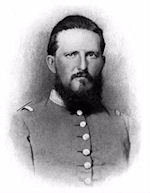
elisha f paxtonTelegram

May 3,1863.

The enemy was dislodged from all his positions around Chancellorsville and driven back towards the Rappahannock, over which he is now retreating. We have to thank Almighty God for a great victory. I regret to state that Gen’l Paxton was killed, Gen’l Jackson severely and Gen’l Heath and D. H. Hill slightly wounded.

(Signed) R. E. Lee,

Gen’l Commdg.

May 3.—A force of Union troops, numbering about one thousand five hundred men, which left Nashville, Tenn., on the eleventh ultimo, under the command of Colonel A. D. Streight, on a raid into Alabama and Georgia, was this day captured in the vicinity of Gadsden, Ala., after successfully resisting the enemy in a series of skirmishes along his march, by a body of rebel troops, under the command of General Forrest— (Doc. 173.)

—The battle of Chancellorsville, Va., was renewed at daylight this morning, and, after severe fighting until noon, the Nationals were obliged to fall back from their position, when hostilities, in a great measure, ceased for the day.—(Doc. 183.)

—The Catholic Bishop of Iowa, in a sermon at Dubuque, pointedly denounced the Knights of the Golden Circle, stating that he would give the members of the church who had joined the organization, two weeks to leave it, and then, if they still continued in it, they might consider themselves excommunicated.—The British schooner Emma Amelia was captured at St. Andrew’s Bay, Fla., by the National bark Roebuck.—Grand Gulf, Miss., was abandoned at daylight this morning, the rebels blowing up the magazines and spiking their guns. Soon after the evacuation the place was entered by the National forces, under Admiral D. D. Porter.— (Doc. 184)

—A short fight occurred near Warrenton Junction, Va., between a party of General Stahel’s cavalry, under Colonel De Forest, and Mosby’s rebel guerrillas, resulting in the rout of the latter with great loss.—(Doc. 185.)

—The ship Sea Lark, in latitude 24° south, longitude 29° west, was captured and burned by the rebel privateer Alabama.

—Colonel Montgomery, in command of a detachment of negro troops, returned to Beaufort, S. C, after a three days’ raid up the Combahee River. During that time he encountered and dispersed several squads of rebel guerrillas, destroyed the town of Asheppo by fire, burned and otherwise destroyed property to the amount of two millions of dollars, belonging to rebel planters along the river, and captured nearly eight hundred slaves, all of whom he carried with him to Beaufort.

May 2.—The battle of Chancellorsville, or the “Wilderness,” Va., between the Union forces, under Major-General Hooker, and the rebels, under Gen. Lee, commenced this day.—(Doc. 183.)

—After repulsing the rebel force under General Marmaduke, at Cape Girardeau, on the twenty-sixth ultimo, General McNeil, with a much inferior force, immediately started in pursuit, and chasing them from point to point, finally came up with them to-day at Chalk Bluff, on the St. Francois, and drove them across the river into Arkansas, thus ending Marmaduke’s rebel raid into Missouri.—(Doc. 177.)

—The Union cavalry force, under Colonel Grierson, arrived at Baton Rouge, La., to-day, after a raid of fifteen days through the State of Mississippi. They had several skirmishes with parties of rebels, defeating them at every encounter; they destroyed bridges, camps, equipages, etc.; swam several rivers, captured a number of prisoners and horses, and obtained a large amount of important information concerning the rebel resources.—(Doc. 170.)

—A reconnoissance in force was this day made to the river Nansemond, Va., by a large body of Union troops, under the command of General Getty, supported by the gunboat Smith Briggs. The rebels were discovered in strong force, and an artillery fight was kept up all day, but without any material results.

Vicksburg, May 1st, 1863.—Ever since we were deprived of our cave, I had been dreading that H. would suggest sending me to the country, where his relatives live. As he could not leave his position and go also without being conscripted, and as I felt certain an army would get between us, it was no part of my plan to be obedient. A shell from one of the practicing mortars brought the point to an issue yesterday and settled it. Sitting at work as usual, listening to the distant sound of bursting shells, apparently aimed at the court-house, there suddenly came a nearer explosion; the house shook, and a tearing sound was followed by terrified screams from the kitchen. I rushed thither, but met in the hall the cook’s little girl America, bleeding from a wound in the forehead, and fairly dancing with fright and pain, while she uttered fearful yells. I stopped to examine the wound, and her mother bounded in, her black face ashy from terror. “Oh! Miss G., my child is killed and the kitchen tore up.” Seeing America was too lively to have been killed, I consoled Martha and hastened to the kitchen. Evidently a shell had exploded just outside, sending three or four pieces through. When order was restored I endeavored to impress on Martha’s mind the uselessness of such excitement. Looking round at the close of the lecture, there stood a group of Confederate soldiers laughing heartily at my sermon and the promising audience I had. They chimed in with a parting chorus:

“Yes, it’s no use hollerin’, old lady.”

“Oh! H.,” I exclaimed, as he entered soon after, “America is wounded.”

“That is no news; she has been wounded by traitors long ago.”

“Oh, this is real, living, little, black America. I am not talking in symbols. Here are the pieces of shell, the first bolt of the coming siege.”

“Now you see,” he replied, “that this house will be but paper to mortar-shells. You must go into the country.”

The argument was long, but when a woman is obstinate and eloquent, she generally conquers. I came off victorious, and we finished preparations for the siege to-day. Hiring a man to assist, we descended to the wine-cellar, where the accumulated bottles told of festive hours long since departed. To empty this cellar was the work of many hours. Then in the safest corner a platform was laid for our bed, and in another portion one arranged for Martha. The dungeon, as I call it, is lighted only by a trap-door, and is very damp. The next question was of supplies. I had nothing left but a sack of rice-flour, and no manner of cooking I had heard or invented contrived to make it eatable. A column of recipes for making delicious preparations of it had been going the rounds of Confederate papers. I tried them all; they resulted only in brick-bats, or sticky paste. H. sallied out on a hunt for provisions, and when he returned the disproportionate quantity of the different articles provoked a smile. There was a hogshead of sugar, a barrel of sirup, ten pounds of bacon and pease, four pounds of wheat-flour, and a small sack of corn-meal, a little vinegar, and actually some spice! The wheat-flour he purchased for ten dollars as a special favor from the sole remaining barrel for sale. We decided that must be kept for sickness. The sack of meal, he said, was a case of corruption, though a special providence to us. There is no more for sale at any price, but, said he, “a soldier who was hauling some of the Government sacks to the hospital offered me this for five dollars, if I could keep a secret. When the meal is exhausted, perhaps we can keep alive on sugar. Here are some wax candles; hoard them like gold.” He handed me a parcel containing about two pounds of candles, and left me to arrange my treasures. It would be hard for me to picture the memories those candles called up. The long years melted away, and I

“Trod again my childhood’s track

And felt its very gladness.”

In those childish days, whenever came dreams of household splendor or festal rooms or gay illuminations, the lights in my vision were always wax candles burning with a soft radiance that enchanted every scene…. And, lo! here on this spring day of ‘63, with war raging through the land, I was in a fine house, and had my wax candles sure enough, but, alas! they were neither cerulean blue nor rose-tinted, but dirty brown; and when I lighted one, it spluttered and wasted like any vulgar, tallow thing, and lighted only a desolate scene in the vast handsome room. They were not so good as the waxen rope we had made in Arkansas. So, with a long sigh for the dreams of youth, I return to the stern present in this besieged town, my only consolation to remember the old axiom, “A city besieged is a city taken,”—so if we live through it we shall be out of the Confederacy. H. is very tired of having to carry a pass around in his pocket and go every now and then to have it renewed. We have been so very free in America, these restrictions are irksome.

______

Note: To protect Mrs. Miller’s job as a teacher in New Orleans, the diary was published anonymously, edited by G. W. Cable, names were changed and initials were often used instead of full names — and even the initials differed from the real person’s initials.

A Soldier’s Story of the Siege of Vicksburg 01

MAY 1ST, 1863.— Logan’s Division, to which we belonged, embarked on transports, that had passed the batteries at Vicksburg and Grand Gulf, last night, about two miles below the latter place, where we had marched down the Louisiana levee to meet the boats. Crossing the Mississippi river, we landed at Bruinsburg, and left that place this forenoon at 10 o’clock, marching twelve A Soldier’s Story of the Siege of Vicksburg 02miles over dusty roads and through a hilly and broken country. Although the boys were tired, their minds were diverted with the scenery of a new State. After crossing the great Mississippi, we bade farewell to Louisiana and its alligators, and are now inhaling the fragrance and delightful odors of Mississippi flowers. Arriving near Port Gibson about dark, found that the advance of McClernand’s corps had defeated the enemy, who had marched out from Vicksburg to check our army. The fight was quite spirited, and the rebels hotly and bravely contested every foot of ground, but they were overpowered, as they will be in every engagement they have with us. Having only two day’ rations in our haversacks, guess we will have to eat rather sparingly of them, for our wagon train is not on the road. Should rations run short, we will have to forage off the country; but even the supplies from that source will not feed Grant’s large army. We were well satisfied, however, that the stars and stripes were victorious, in this battle, without our assistance. We did not smell the battle afar off, but heard cannonading through the day, and fully expected to take a hand in it. When we stopped, as we supposed, for the night, our Colonel drew the regiment into line, and said Gen. McPherson had asked him if his regiment was too wearied to follow the retreating enemy. When the question was put to the men, every one wanted to go, and started on the trail with the swiftness of fresh troops, marching as rapidly as possible until 10 o’clock, then camped in a ravine for the night. During this rapid movement, we did some skirmishing. The Confederate army had retreated, and we made the tail of it fly over the road pretty lively.

“The battle was fought, and the victory won;

Three cheers for the Union! the work was well done.”

A Soldier’s Story of the Siege of Vicksburg 03

Porter’s Gunboats in front of Grand Gulf

May 1.—The battle of Port Gibson, Miss., was fought this day, between the National forces, under Major-General Grant, and the rebels, under General John S. Bowen.—(Doc. 180.)

—A fight took place at Monticello, Ky., between a force of five thousand Nationals, under the command of General Samuel P. Carter, and the rebels, commanded by Colonel Morrison, resulting in the defeat of the latter.—(Doc. 181.)

—The Committee of Thirteen, appointed at the last session of the rebel Congress to “collect and report outrages on persons and property committed by the public enemy in violation of the rules of civilized warfare,” reported in part, and asked leave to continue their labors.—See Supplement.

—The schooner Wanderer, while endeavoring to run the blockade of Wilmington, N. ft, was captured by the National steamer Sacramento.

—A skirmish took place near La Grange, Arkansas, between a detachment of the Third Iowa cavalry, under the command of Captain J. Q. A. De Huff, and a strong force of rebel cavalry, resulting in a retreat of the Unionists, with a loss of forty-one of their number in killed, wounded, and missing.

—A fight took place at the South-Quay bridge, on the river Nansemond, Va., between a detachment of the New-York Ninety-ninth regiment, under the command of Lieut.-Col. Richard Nixon, and a strong force of rebels, terminating, after an obstinate and bloody contest of more than two hours’ duration, in a retreat of the rebels with great loss. The Ninety-ninth had forty-one men killed and wounded.

—Colonel Montgomery, with a detachment of two hundred and fifty negro troops, left Beaufort, S. C, on a reconnoitring expedition up the Combahee River.


April 30.—General Hooker, from his headquarters near Falmouth, Va., issued the following address to his soldiers: “It is with heartfelt satisfaction that the General Commanding announces to the army that the operations of the last three days have determined that our enemy must ingloriously fly, or come out from behind their defences and give us battle on our own pound, where certain destruction awaits him.

“The operations of the Fifth, Eleventh, and Twelfth corps have been a series of splendid successes.”—See Supplement.

—The frequent transmission of false intelligence, and the betrayal of the movements of the army of the Potomac by publication of injudicious correspondence of an anonymous character, made it necessary for General Hooker to issue general orders requiring all newspaper correspondents to publish their communications over their own signatures.—General Orders No. 48.

—A rebel battery on the Nansemond River, Va., was silenced, after a spirited contest, by the guns from the Union battery Morris and the gunboat Commodore Barney.—General Peck’s Order No. 29.

—William F. Corbin and T. G. Graw, found guilty of recruiting for the rebel service, inside the National lines, were this day sentenced to be shot, by a court-martial in session at Cincinnati, Ohio.

—A detachment of the Sixth New-York cavalry, under the command of Lieutenant-Colonel McVicar, while reconnoitring in the vicinity of Spottsylvania Court-House, Va., to-day were surrounded by four regiments of General Fitz-Hugh Lee’s rebel cavalry and fifty-two of their number were killed, wounded, or captured. The balance, numbering fifty-eight, cut their way out. Lieut.-Colonel McVicar was killed at the first rebel onset.