Following the American Civil War Sesquicentennial with day by day writings of the time, currently 1863.

The American Civil War

August 24.—Gen. Butler, believing that a large portion of the colored militia force of the State of Louisiana were willing to take service in the volunteer forces of the United States, issued an order at New-Orleans, directing that the members of the “Native Guards,” and all other free colored citizens recognized by the late Governor and authorities of the State as a portion of the militia of the State, who should enlist in the volunteer service of the United States, should be organized by the appointment of proper officers, and accepted, paid, equipped, armed and rationed as other volunteer troops of the United States, subject to the approval of the President

—The battle between the Union army under General Pope, and that part of the rebel forces under Gen. Lee, which crossed the Rappahannock yesterday, was this morning resumed in the vicinity of Sulphur Springs and Waterloo Bridge. Cannonading was kept up all day, but without doing much damage to either side.—(Doc. 104.)

—Quantrel’s and Hays’s bands of guerrillas, overtook six companies of the Second and three companies of the Sixth Kansas regiments near Lamar, Kansas, when the attack was commenced by the Sixth under the command of Major Campbell and Capt. Grand. The fight continued two hours, during which time the Nationals lost two killed and twenty-one wounded. The Second Kansas regiment took no part in the affair.—The schooner Water-Witch, was captured off Aransas, Texas, by the United States schooner Corypheus. —The Eighteenth regiment of Maine volunteers, commanded by Col. Daniel Chaplin, left their camp near Bangor, for the seat of war.—Charles J. Ingersoll was arrested at Philadelphia, Pa., by Deputy-Marshal Schuyler.

—A skirmish took place near Dallas, Mo., between four companies of the Twelfth cavalry regiment, Missouri State militia, under the command of Major B. F. Lazear, and a numerically superior force of rebel guerrillas, under Col. Jeffries, resulting in a rout of the latter, with some loss.— St. Louis Republican.
August 23.—The United States steam sloop-of-war Adirondack struck on a coral reef near Little Abaco, W. I., and was lost. The crew were saved. —The Eighteenth regiment of Connecticut volunteers, under the command of Col. Wm. S. Ely; the One Hundred and Eleventh regiment, New York State volunteers, Colonel Jesse Segoine, and the Thirty-fifth Massachusetts, commanded by Col. Edward A. Wild, passed through New York City, en route for the scat of war.

—The schooner Louisa, while attempting to run the blockade of Charleston, S. C, was captured by the United States steamer Bienville.—A train of cars on the Memphis and Charleston Railroad, when three miles beyond Courtland, Tenn., was attacked by guerrillas numbering four hundred, who destroyed the train, which was in charge of a detachment of the Forty-second Illinois regiment. Eight rebels were killed. The Federal loss was two wounded and two missing.—This afternoon a mutiny broke out among the soldiers belonging to Spinola’s Empire brigade, at their encampment, East New-York. One man was shot and a number seriously injured. An attack was made upon the Howard House by the mutineers, who subsequently fled to Brooklyn and New York. The police was called out, and succeeded in quelling the riot. A squad of United States marines was put on guard, and order was restored. —A Passenger train on the Winchester (Va.) Railroad, when between that place and Harper’s Ferry, was fired into and stopped by a party of rebel guerrillas. The passengers were released, except four soldiers of the First Michigan, who were made prisoners. The train and its contents were completely destroyed.

—The battle on the Rappahannock between the armies under Gen. Pope and Gen. Lee, was resumed at an early hour this morning by a cannonade all along the opposing lines, which lasted for several hours. In consequence of the swollen state of the Rappahannock, the railroad bridge was in great danger of being carried away, and the advanced column of the Union army was therefore removed from the left to the right bank of the river, and the bridge was destroyed. New positions were taken, from which the old ones could be enfiladed, and on the rebels appearing in strong force for the purpose of occupying the abandoned position, a terrific cannonade was opened upon them, which drove them back into the woods with great loss. In the afternoon a portion of the rebel army succeeded in crossing the Rappahannock River, in the vicinity of Sulphur Springs, and a sharp engagement took place between them and Gen. Milroy’s brigade, the advance of Gen. Sigel’s corps, which resulted in the rebels being driven across Great Run, suffering great loss. In consequence of the success of the rebels in throwing a part of their forces across the Rappahannock, General Pope advanced his whole army from his position in the vicinity of Rappahannock Station to Warrenton and Sulphur Springs.— (Doc. 104.)

—A skirmish occurred near Big Hill, Madison County, Ky., between the Union troops under General Metcalfe and a superior force of rebels, resulting in the retreat of the Nationals to Richmond, Ky.—(Doc. 190.)

August 22.—Rear-Admiral George Campbell Read, Governor of the Naval Asylum at Philadelphia, died in that city this day.—General Michael Corcoran arrived at New-York City, and met with a most enthusiastic reception.

—The Seventeenth regiment of Maine volunteers, commanded by Col. Thomas A. Roberts, passed through New-York City en route for the seat of war.—Two bridges on the Marietta and Cincinnati Railroad, east of Loveland, Ohio, were burned, it was supposed, by rebel sympathizers.

—To-day, and the preceding two days, a series of skirmishes occurred near Crab Orchard, Ky., between the Ninth Pennsylvania cavalry, under the command of Gen. Green Clay Smith, and a rebel cavalry regiment, under Col. Scott, resulting in the defeat and retreat of the latter on each occasion.

—A force of Gen. Stuart’s rebel cavalry made a dash at Catlett’s Station, Va., and destroyed or carried off a great quantity of sutler’s and other stores, sacked the hospital, captured Gen. Pope’s wagons with all his papers, etc., and then proceeded towards Warrenton.—(Doc. 188.)

—President Lincoln, in response to a letter written by Horace Greeley, stated that his paramount object was the restoration of the Union, and not the safety or destruction of slavery. If he could save the Union without freeing the slaves, he would do it; if he could save it by freeing all the slaves, he would do it; and if he could save it by freeing a portion and leaving others alone, he would do that.—See Supplement.

—The One Hundred and Seventeenth regiment, New-York volunteers, Col. W. R. Pease, left Camp Huntington, near Rome, at noon to-day for the seat of war. This was Oneida County’s first regiment under the new call, and her fourth for the war.

—The day before yesterday, and to-day, Fort Ridgely, Minn., was attacked by a large body of Indians, who, on each occasion, were repulsed by the garrison, of whom three were killed and thirteen wounded.—(Doc. 189.)

—This morning, at five o’clock, the rebels opened fire from their batteries along the whole line of the army on the Rappahannock. The Union army on the opposite bank of the river promptly replied, and the cannonade was kept up, with short intermissions, all day. The principal attack was on the Union centre, occupied by General McDowell’s army corps. At about nine A.M., the cannonading having almost ceased, Gen. Sigel ordered Gen. Schurz to ford the river with a brigade of his division, and reconnoitre the enemy’s position on the opposite side. When about a mile from the river, Gen. Schurz discovered the rebels, who, after receiving a volley or two, precipitately retreated, in the hope of drawing the Unionists into an ambush. This failed. General Schurz took up his position, and in turn was attacked by the rebels in force. A fierce battle ensued, which lasted until six P.M., when, the Unionists not being sufficiently strong to hold the advanced position, retired to the north bank of the river, and joined the main body of the army. —(Doc. 104.)

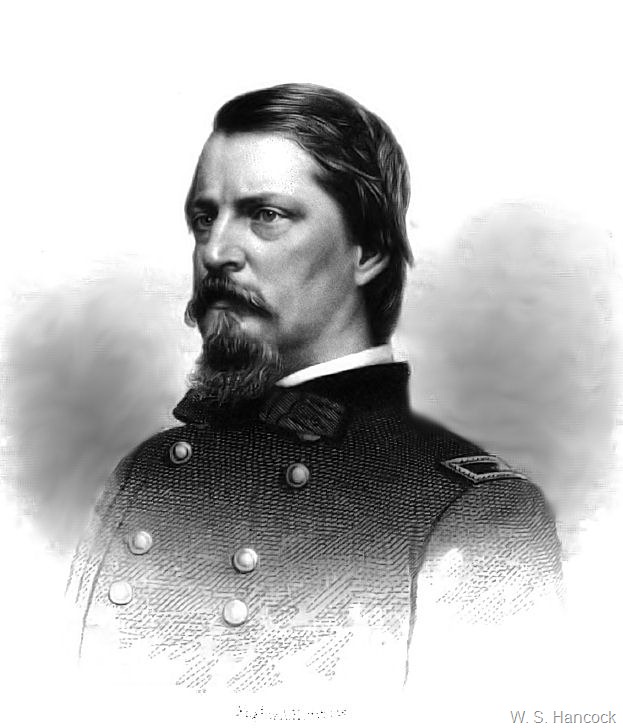
hancock_w_s

August 21.—Jeff Davis issued an order from Richmond, directing that Major-Gen. Hunter and Brig.-Gen. Phelps should no longer be held and treated as public enemies of the rebel States, but as outlaws; and that in the event of the capture of either of them, or that of any other commissioned officer of the United States employed in drilling, organizing, or instructing slaves, with a view to their armed service in the war, he should not be regarded as a prisoner of war, but held in close confinement for execution as a felon, at such time and place as Jeff Davis might order. —To-day the Union army, under Gen. Pope, and the rebel army, under Gen. Lee, faced each other on the Rappahannock, the former on the north and the latter on the left bank of the river. An attempt was made on the part of the rebels to cross the river at Kelly’s Ford, for the purpose of turning the position of the Unionists, but it was foiled by General Reno, who opened fire with his batteries, and then followed it with a cavalry charge, which put them to flight, and determined them to make no more attempts to cross at Kelly’s Ford.—(Doc. 104.)

—A war meeting was held at Southficld, Staten Island, N. Y. —Thomas Shultzer, one of the editors of the Maryland News Sheet, was released from Fort McHenry, on taking an oath not to engage in newspaper business, nor do any thing to aid and abet rebellion during the continuance of the war. Carpenter and Neilson, the responsible editors and publishers of the same paper, refused to take the oath.

—The rebel schooner Eliza, loaded with salt and other contraband goods, was captured off Charleston, S. C, by the United States steamer Bienville.

—The Union pickets on Pinckney Island, near Hilton Head, S. C, were attacked by a superior force of rebel troops, and thirty-two of their number taken prisoners, three killed and three wounded.—A very large and enthusiastic war meeting was held at St. Louis, Mo., in the Mercantile Library Hall, at which Gov. Gamble made the principal speech. He recommended a most vigorous war policy in the State, and deprecated the disposition to find fault with the policy of the Federal Government. He recommended the extermination of the guerrillas in the State, and would make the secessionists pay for the protection they received from the Government. He would drive South all non-combatants who denounced the Government. The military authorities held bonds from the rebels to the amount of over a million of dollars, and he advised all broken bonds to be collected at once. The speech was received with tremendous applause.

—A severe fight took place at Gallatin, Tenn., between a body of Union troops under the command of General R. W. Johnson, and an inferior force of rebel cavalry, under Col. John H. Morgan, resulting in a rout of the Unionists with great loss.—(Doc. 187.)


Winfield Scott Hancock (February 14, 1824 – February 9, 1886) was a career U.S. Army officer and the Democratic nominee for President of the United States in 1880. He served with distinction in the Army for four decades, including service in the Mexican-American War and as a Union general in the American Civil War.

Auguet 20.—British subjects who had declared their intentions to become citizens of the United States, being apprehensive that they might be drafted into the militia, Secretary Seward informed them, through the British Charge d’ Affairs at Washington, that none but citizens were liable to military duty in the United States.— Secretary Seward’s Letter.

—E. Kirby Smith, the rebel General, from his headquarters in East-Tennessee, issued the following address to the citizens of Knox County, and the adjacent counties in Kentucky:

“Finding that you have been deceived by the misrepresentations of our enemies, and have been induced by them not only to leave your homes, but also to resort to the cowardly practice of bushwhacking, I now promise you that, if you return quietly to your homes and lead orderly lives, you will not be disturbed, but will be protected in your rights.

“If, on the contrary, you persist in firing upon my soldiers from the woods, you will be hung when you are caught, and your houses and property will be destroyed.”

—To-day the Union army, under Gen. Pope, reached the Rappahannock River, in its retreat from the Rapidan, closely followed by the rebel army, under Gen. Lee. At Brandy Station the two armies came within sight of each other, and the rear-guard of the Nationals, supposing the advance of the rebels to be a mere skirmishing party, turned for the purpose of driving them back; but on charging upon them, they discovered their error, for after receiving two or three volleys, which thinned their ranks considerably, they retreated to the bridge at the station, closely pursued by the rebels. Here the Unionists were supported by two batteries of artillery, which opened fire on the rebels with great effect, compelling them to fall back undercover of the adjacent woods.— (Doc. 104.)

—A fight took place at Edgefield Junction, Tenn., between a small number of the Fiftieth Indiana volunteers and a superior force of rebel guerrilla cavalry belonging to Col. John H. Morgan’s command, resulting in a retreat of the latter, with a loss of seven men killed and twenty wounded.

—A fight took place near Union Mills, Mo., between a force of National troops, under the command of Major Price, and a party of rebel guerrillas. The Nationals did not discover the rebels until they were fired upon from an ambush; but, notwithstanding this disadvantage, they charged upon them and put them to flight, capturing sixteen horses, a number of guns and swords, and a quantity of lead and powder. Four of the rebels were taken prisoners and one killed. Four of the Union party were killed and three wounded.—St. Louis Democrat, August 23.

August 19.—The steamer Swallow was burned by the rebels, at a point on the Mississippi River, twenty-five miles below Memphis, Tenn.—A skirmish took place near Rienzi, Miss.

— The following order was issued from the War Department at Washington:

The Department of the Ohio, hereby created, will be composed of the States of Ohio, Michigan, Indiana, Illinois, Missouri, and Kentucky, East of the Tennessee River, and including Cumberland Gap, and the troops operating in its vicinity. Major-General H. G. Wright is assigned to the command of the Department of Ohio.

— A large and enthusiastic war meeting was held in Brooklyn, N. Y. A series of patriotic resolutions were adopted, and speeches made by Generals Crooke, Walbridge, Sickles and Spinola, Admiral Paulding, Rev. Dr. Cox, and others.

—A force of Union cavalry from New-Madrid, Mo., under the command of Captain Frank Moore, while on an expedition to Charleston, attacked a rebel camp on White Oak Ridge, near Hickman, killing four and taking nineteen of the rebels prisoners, including three captains. They also captured twenty-seven horses and about one hundred stand of arms. Captain Moore and one private were wounded.

— The Board of Supervisors of Rensselaer County, N. Y., assembled at Troy, appropriated seventy-five thousand dollars as bounty money, to be paid to volunteers enlisting into the army under the call of the President.

— The Sioux Indians destroyed the United States Agencies at Yellow Medicine and Red Wood, and partially destroyed New-Ulm, Minn., killing and brutally mutilating more than a hundred persons, men, women, and children.

August 18.—The following orders were issued from the War Department at Washington: “Hereafter no appointments of Majors-General or Brigadiers-General will be given except to officers of the regular army, for meritorious and distinguished services during the war, or to volunteer officers who, by some successful achievement in the field, shall have displayed the military abilities required for the duties of a general officer.

“No appointment to such grades will be issued by the War Department till an examination is made to ascertain if there are any charges or evidence against the character, conduct or fitness of the appointee, and if there should be any such charges or evidence a special report will be made to the President.”

— The One Hundred and Twenty-fifth and the One Hundred and Twenty-seventh regiments of Pennsylvania arrived at Washington, D. C.

— The National pickets were fired on at Romney Road, Va., and one man mortally wounded. A force sent in pursuit overtook a party of bushwhackers near North River Mills, attacked them, and killed the notorious guerrilla, Bob Edwards. The rest escaped to the mountains. — Colonel Michael Corcoran, of the Sixty-ninth New-York militia, was appointed a Brigadier-General in the volunteer service of the United States.

— The Congress of the rebel States reassembled at Richmond, Va., when Jeff Davis delivered his annual message, addressed “to the Senate and House of Representatives of the confederate States.”—See Supplement.

— The steamers Skylark and Sallie were burned by guerrillas, at the mouth of Duck Creek, fifty miles above Fort Henry, Tenn. The Skylark was heavily laden with government stores. She got aground and an officer unloaded a portion of her stores when he was attacked by thirty rebels. The crew, being unarmed, were compelled to surrender. The guerrillas, after removing the furniture and silver ware, set fire to both the boats. The crews were released on parole.

— The rebel Colonel John H. Morgan, issued a proclamation from Hartsville, Tenn., in which he said that in consequence of the Federal Government causing his friends to pay for property destroyed by him, he would thenceforth put the law of retaliation in full force, and act upon it with vigor. For every dollar exacted from his Southern fellow-citizens, he would have two from men of known Union sentiments, and would make their persons and property responsible for the payment

— Clarksville, Tenn., garrisoned by a small number of Union troops, under command of Col. Mason, was this day surrendered to Col. Woodward and a superior force of rebel guerrilla troops, without firing a shot.—(Doc. 186.)

August 17.—The office of the Constitutional Gazetteer, a newspaper published at Marysville, Kansas, was demolished this morning at an early hour by a party of National soldiers belonging to the company of Captain Bowen.—The One Hundred and Twenty-ninth regiment of Pennsylvania volunteers arrived at Washington, D. C.

— At New-York, Archbishop Hughes delivered a most important and patriotic sermon in St. Patrick’s Cathedral. After reciting his course of action in Europe, he called upon the whole North to come out in its strength, for “volunteering to continue and for a draft to be made.” He said that if three hundred thousand men were not enough, to call out another three hundred thousand. “The people should insist on being drafted, and so bring this unnatural strife to a close” by strength of might alone.

August 16.—An enthusiastic war meeting was this day held at Lake Mahopac, N. Y.—The One Hundred and Twenty-second regiment of Pennsylvania volunteers arrived at Washington, D. C. —Colonels Corcoran and Wilcox, Lieutenant-Col. Brown, and Major Rogers, reached Fortress Monroe, having been exchanged at Richmond, Va. Great joy was manifested at the release of Col. Corcoran and his fellow-soldiers.

—The United States gunboat Pocahontas, one of the blockading squadron off Charleston, proceeded up the Black River, S. C, on a reconnoitring expedition, and in search of a rebel steamer reported to be in the river. When about twenty-five miles up, it was discovered that the rebels had sunk the vessel. In returning, the Pocahontas was fired into by bands of rebel guerrillas all along the banks of the river for a distance of twenty miles, but she sustained no injury, and but one person was wounded.

—Hopkinsville, Ky., was this day captured by a force of rebel guerrilla cavalry, under the command of Colonel A. R. Johnson. A quantity of ammunition and a number of rifles fell into their hands. Colonel Johnson issued a notice to the inhabitants of the town and its vicinity, informing them that he occupied the town and had taken the arms, etc., as a confederate soldier; and that if any Southern man or his property should be molested on account of his visit, he would retaliate on the Union men of the place.

—A company of rebel cavalry dashed across the Rapidan River, Va., near Crooked Run, and captured Lieutenant Black, and five men of the Union army encamped in the vicinity.

—An expedition consisting of the Union gunboats Benton, Mound City and General Bragg, under command of Captain Phelps; the rams Switzerland, Monarch, Lioness and Sampson, under command of Colonel Ellet, and transports Rockctt and McDowell, with the Fifty-seventh Ohio, the Thirty-third Indiana, fifty cavalrymen, and two pieces of artillery on board, under command of Colonel Wood of the Fifty-seventh Ohio, left Helena, Arkansas, this day and proceeded down the Mississippi. On the eighteenth, when near the mouth of the Yazoo River, at Millikins’s Bend, they captured the rebel steamer Fairplay, laden with an entire equipment of arms, accoutrements and ammunition for an army of six thousand men. At Haines’s Bluff they captured four pieces of artillery, and a large quantity of ammunition. At Richmond, La., they destroyed the railway depot, together with its contents, a large quantity of sugar, commissary stores, ammunition, etc., and engaged a force of rebels whom they put to flight. On the twenty-fifth instant the expedition returned to Helena, without losing a man.—(Doc. 183.)

—The Richmond (Va.) Examiner of this date, speaking editorially of the approaching session of the rebel Congress, among other things, said: “It will be for Congress to repair, as it best can, the mischief done the public service by a weak and impracticable executive; to look at the reduction of our forces in the field; the decay of military discipline; the demoralization of our armies, and the jeopardy to which our cause has been put by a long course of trifling conduct, childish pride of opinion, unworthy obstinacy, official obtuseness, conceit, defiance of public opinion, imperiousness and despotic affectation on the part of those intrusted with the execution of the war.”

—The evacuation of Harrison’s Landing, on the James River, Va., by the army of the Potomac, which commenced on the eleventh instant, was this day completed.—(Doc. 184.)

—A fight took place near Lone Jack, Mo., between a force of about eight hundred Missouri State militia, under the command of Major Foster, and a body of rebel guerrillas under Colonel Coffee, numbering between three and four thousand men, resulting, after an engagement of four hours, in the defeat of the Nationals with a loss of sixty men killed and one hundred wounded and missing. The rebel loss was one hundred and ten killed and wounded.—(Doc. 185.)

August 15. — The Thirty-fourth regiment of Massachusetts volunteers, under the command of Colonel George D. Wells, left Worcester for the seat of war.—A squad of cavalry from Washington, D. C, went into St. Mary’s County, Md., and encountered near Leonardstown Capt. William Clark, of the Thirty-seventh Virginia regiment, with a number of recruits, travelling in a wagon on their way to join the rebels. When they were observed the cavalry abandoned the teams and broke for the woods, but the National cavalry pursued them, and several shots were exchanged. Nine of them, including one officer, were taken and carried to the city and sent to the Old Capitol prison.

—A Sharp fight took place at Merriwether’s Ferry, on the Obion River, Tenn., between a body of Union troops under the command of Col. T. W. Harris, and a force of rebel guerrillas, under Captain Binfield, resulting in a rout of the rebels, who lost twenty men killed and nine taken prisoners.—(Doc. 182.)