March 3d.—In the way of petty tyranny, it seems another Richmond has entered the field. Last week I was presented by some of my friends with a very pretty sword, as a testimonial of their respect and affection for me. To-day I am informed by General _____ that this cannot be tolerated. All the persecution which he and his satellites have heaped on me, have not been sufficient to alienate the affections of those for whom and with whom I have labored for the good of the regiment; but all those who have had any part in the presentation of that sword are to be punished, and this, too, at a time when all ranks, from Corporals to Major Generals, are receiving like testimonials! But (?) the head of this Brigade having failed to crush a Surgeon, aspires to a personal quarrel with privates and nurses. Magnanimous General! I have received a positive order, to-day, to ascertain the names of all who had any hand in the presentation of the sword, and to report them to headquarters, and I have just as positively refused to stoop to participate in any such dirty work. I leave all the honor to the Brigadier General, and after he has vented his malice on such of the privates as he can get other tools to hunt out for him, he is at liberty to try his hand on me again for this disobedience of his dirty order. The work is worthy of him, and of the tools he employs.
The American Civil War
March 3.—The rebel Brig.-Gens. Simon Bolivar Buckner and Lloyd Tilghman, arrived at Boston, Mass., and were immediately sent to Fort Warren, in the harbor. It was not generally known that they were to arrive, but there was a crowd present large enough and noisy enough to make it decidedly unpleasant, both to the prisoners and the officers who had them in charge. They occupied a car situated in the middle of the long train. The crowd pressed round this car as soon as the Generals were discovered, and commenced hissing, groaning and howling in a manner calculated to give the occupants an impression not altogether favorable to the citizens of the “Yankee capital.”
United States Marshal Keyes, Deputy-Sheriff Jones, and Capt. McKim, Assistant United States Quartermaster, went into the car attended by a number of policemen. They soon appeared with the two Generals, and conducted them to the front of the depot, followed by the crowd, which was rapidly swelling in numbers. The prisoners jumped into a hack in waiting there, and were followed by Marshal Keyes and Col. Cutts. Sheriff Jones mounted the box with the driver. As they drove off, the crowd amused itself by groaning vehemently for Jeff. Davis. The hack was driven rapidly to Union Wharf, where the prisoners and officers went on board the steamer May Queen, and started soon after for Fort Warren.
The guard of soldiers did not leave the car in which they had arrived at the depot until the prisoners had been driven off in the hack. When they marched out into the street, some persons in the crowd which still lingered about the place were belligerently inclined. One fellow appealed to his comrade to know if they were going to let “rebels” run loose about the streets; to which appeal one of said comrades made bold to reply that they “warn’t goin’ ter du nuthin’ er that sort.” A policeman made proclamation that the soldiers were good Union men and true, and the crowd thereupon set up a mighty cheer, and poured in compliments upon the soldiers. — Boston Courier, March 5.
—The Richmond Examiner of this date has the following: “The Yankees in Richmond, who have been trading and peddling in the necessities of the war, are showing characteristic acuteness in eluding the draft for military service. Their management is to get some contract from the government, no matter how petty, and then plead the exemption of public contractors. Of course these creatures are close calculators, and are quite willing to take petty contracts, even at losing prices, to save thereby the unpleasantness of fighting, or the cost of obtaining a substitute.
“We can count on our fingers a score of instances of this management, by well-known Yankee merchants and tradesmen in Richmond. We hear of a Yankee dealer effecting the exemption of himself and workmen from military service, by some paltry contract for official upholstery; of another, a coachmaker, getting a contract for haversacks, or some other trifle; and of a third ‘son of the Puritans,’ a bonnet-maker, or manmiliner, notoriously unsound on the Southern question, who has screwed himself into the employment of the government as a travelling agent to purchase leather.”
—The Senate of the United States confirmed Gens. McDowell, Buell, Burnside, McClernand, C. F. Smith, Lew. Wallace, and Sigel, as major generals, and the following as brigadiers: Speed of Tennessee, Col. Logan of Illinois, Col. McArthur of Iowa, Col. Lauman of Iowa, Col. Wallace of Indiana, Col. McCook of Ohio, Col. Berry of Maine, and Col. Ferry of Connecticut
Both Houses of Congress passed the bill giving generals in command of divisions, staffs—one assistant adjutant-general, with the rank of major; one inspector-general, with the rank of major; three aids, with the rank of captains, and making the senior officer in command of artillery the commander of all artillery in the division, and giving him a position on the staff of the general.
— At ten o’clock this morning, the Twenty-seventh, Fifty-second, and Fifty-fifth Illinois regiments, hoisted the Stars and Stripes over the fortifications at Columbus, Ky.
The gunboats Cincinnati, (flag-ship,) Louisville, Carondelet, St. Louis, and Lexington, four mortar-boats in tow of the steamer Lake Erie, and the Twenty-seventh Illinois, Col. Buford, Fifty-second Illinois, Col. Roberts, and Fifty-fifth, Major Sanger, Acting – Colonel, upon the transports Aleck Scott, Illinois, Magill, and Ike Hammett, left Cairo this morning at four o’clock, for Columbus. The fleet arrived at Lucas Bend, about two miles above Columbus, at six o’clock, and was drawn up in line-of-battle order. The drums beat to quarters, and the guns were manned, ready for action. Two tugs were sent in advance, reconnoitring, but failed to provoke a shot from the enemy. Everything about the works was quiet The glasses revealed stragglers on the bluffs and water-batteries, and in a few moments a flag was waved, but its character could not be made out
The fleet gradually neared the town, and lay in the stream off the Belmont battle-field; while scouts were sent out upon tugs toward the rebel works. The tugs approached cautiously until within a quarter of a mile of the batteries, and finding the works deserted, both set off at top speed for the honor of landing first.
The scouts rushed on the double quick to the top of the bluff, and unfurled the Stars and Stripes, saluted by the crews of the gunboats as they steamed up to the town. The transports landed their troops, and Columbus was “occupied.” The works were entirely deserted, and the barracks, or rather rough board and log-cabins, were burned.
An immense amount of coal, stores, and ordnance fell into the hands of the National troops. Many of the rebel cannon were thrown into the river, but six thirty-two – pounders, some howitzers, and an almost innumerable quantity of grape, canister, shell, and round-shot, were found in the batteries. The fortifications were very extensive, and the natural position was almost impregnable.
Columbus was completely deserted, every building was thoroughly ransacked and its contents destroyed by the rebels. The rebels commenced leaving on Thursday last, and finished yesterday.—(Doc. 73.)
— Gen. Banks’s forces occupied Martinsburgh, Va., without opposition. Among the many prisoners taken was Rev. T. J. McNeigh, Chaplain of the Second Virginia infantry. He was captured by company K, Michigan cavalry, Capt Mann, near Perryville.
—The steamer Atlantic sailed from New-York for Port Royal, S. C, with a large cargo of army stores, and about sixty persons, who accompany Mr. Edward L. Pierce, the Government agent in charge of the plantations and contrabands at Port Royal. These persons were all recommended by the National Freedman’s Relief Association, and its auxiliary, the Educational Committee, at Boston. Three fourths of the whole number are men who are to be the superintendents of the abandoned estates, and will direct the labors of the negroes, who are to be employed in such agricultural pursuits as cotton-culture and raising vegetables for their own support and for the use of the army at that point.
Twelve or fifteen of the passengers are ladies, who will become teachers of an industrial school, which will be at once established at Port Royal, under the superintendence of Rev. M. French, of New-York. Mrs. Senator Harlan of Iowa, is among the ladies, and will assist in some department of the work. Rev. Dr. Floy, of the Methodist Episcopal Church of New-York, is passenger by the Atlantic. He goes to Port Royal for the purpose of preparing for missionary efforts among the negroes.
A portion of the superintendents and teachers receive compensation from the associations in New-York and Boston; but some are volunteers. Among the number are men of almost all trades, and some professions. There are several physicians and one or two clergymen.
All the superintendents and teachers were requested to take the oath of allegiance to the United States, previous to going on board the steamer. Twenty-seven gentlemen and four ladies from Boston; twenty-one gentlemen and seven ladies from New-York, and Miss Susan Walker, Mrs. Walter R. Johnson, and Miss Mary Donalson, from Washington and Philadelphia, subscribed to the oath. No man who would not, in case of necessity, fight for his country was permitted to go to Port Royal to assist in the management of the contrabands.—(Doc. 74.)
—Four regiments of rebels, with a four-gun battery, attempted to flank Colonel Geary, near Lovettsville, Va., but were driven off without a skirmish.
—An engagement took place between the National forces, under command of Gen. Pope, and the rebels, about two miles north of New-Madrid, Mo. After a fight of between two and three 1hours, the National forces retired a short distance, having met with a slight loss from the fire of the rebel gunboats.—(Doc. 75.)
—An order, dated at St Louis, Mo., was issued to-day by Maj.-Gen. Halleck, U.S.A., establishing regulations “for the conduct of restored intercourse between the loyal section of the Department of Missouri, and the counties on the Tennessee and Cumberland rivers,” in Tennessee. By it, all vessels running in trade on those rivers, to and from St. Louis, are ordered to take out a special license for that purpose, and be subject to the revenue laws of the United States, and to the regulations and instructions of the Treasury Department. Surveyors and other officers of the customs, or, in their absence, the nearest military commander, were directed to see to the proper execution of the order.
—The town of Fernandina, Fla., surrendered to-day to the United States forces under command of Commodore S. F. Du Pont and Brig. Gen. H. G. Wright. The expedition for its reduction sailed from Port Royal, S. C, on the twenty-seventh of February, and after some delays, owing to the difficult and narrow channels, and frequent reconnoissances, the harbor was entered to-day by the United States steamer Ottawa, Lieutenant Commanding Thomas H. Stevens, and the place found deserted, the rebels being in full retreat, and all the fortifications abandoned. — (Doc. 76.)
Sunday March 2nd/62
Pleasant morning but the ground is covered with snow tonight. Snowed very hard the middle of the day. It has thawed all the time. Went to church with family. Chaplin Marks of the Pa. 42nd Regt held forth, quite an interesting man. The military on both sides of the River are under marching orders and all ready to move. Doct Barnes of the 27th came over yesterday & brought his wife. The 27th is all packed up and ready, stirring times looked for now. The Sick in the camps have been placed in Hospitals. Artillery has been moveing for two or three days past. There is an abundance of it on the Potomac. McClellan depends much upon that arm. There is much excitement in the City and much satisfaction expressed now that the immense army here is to move at last. The force must be crushing to “Secesh.” There cannot be less than 250 thousand men on & near the Potomac in the Union Armies under Genl McClellan.
______
The three diary manuscript volumes, Washington during the Civil War: The Diary of Horatio Nelson Taft, 1861-1865, are available online at The Library of Congress.
Headquarters 2d Brigade S. C.
Beaufort, S. C. March 2d, 1862.
My dear Mother:
In the short letter I wrote you last week, I mentioned that I would not encourage your visiting Beaufort, and will now state my reasons more at length. In the first place, we have here some four thousand men on the island, of whom the best are long separated from the refining influence of home, and, in consequence, the two or three ladies who are visiting here are subject to a deal of coarse remark, to which I would not be willing that any woman should be subjected, where it lay in my power to prevent. Again, it would be quite impossible to provide you with such accommodations as would enable you to spend a few days without more suffering than you could well bear. It is all well for Quartermasters, who are not liable to be removed from this Post at a moment’s notice, to provide themselves with bedding and comforts from the North, suitable for lady friends, but this cannot be the case with those of us who are liable to an order to move at any moment, and to whom only a certain number of lbs. of baggage is allowed. We are not, moreover, so absolutely secure from the probability of an attack, that it is with perfect safety a lady may venture here. Should an attack take place, there would be a double duty to perform, the one to place my mother in security, and at the same time to assist in providing for the safety of the Brigade. I fear it would be hard to combine the two. However, I will say this, a hotel is soon to be opened here. If it has the effect to draw many lady visitors to Beaufort, I would not then say nay to your coming, but I imagine it will become more the resort of topers than of fine ladies. Well, dear mother, let us trust that there will soon be some way opened to us by which we may meet happily.
I tell you what I think would be a capital idea though — that is for Hunt or Walter, or both, to make me a flying visit one of these days. I think that would really be capital.
I was round to dine with Alfred Rockwell to-day. He is certainly a real good fellow, and if I have not given him the credit for rapidity of action, he certainly is doing what he attempts exceedingly well. His whole soul is absorbed in his battery, and he makes a better officer every day. I wrote Horace a few days ago, and trust he may receive my letter. We are getting, in indirect ways, glorious news from the North concerning the capture of Fort Donelson, and are now impatiently awaiting the arrival of a steamer with particulars. We can hardly credit a report now current, regarding a convention to be called by the Governor of Tennessee to repeal the Secession Ordinance in that State. Our latest dates are Feb. 16th, and here it is the 2d of March.
There was quite a funny affair happened last night among the pickets. Fresh meat has long been scarce in the Command, and we are forced to await the arrival of a steamer from the North before we can indulge in such a luxury. This morning, among the “Reports” sent in to these Headquarters from the “Advanced Posts,” was one containing the following remarkable account: That about 1 o’clock last night, the pickets guarding a causeway were startled by the steady tramp of advancing footsteps. On looking in the direction whence the sound came, they saw — Oh wonderful! a cow marching steadily toward them, a secessionist grasping her by the tail, and five men following in single file, protected from harm by the flanks of this redoubtable cow. Our pickets, instead of running, fired upon the foe. The cow fell groaning to the earth, and the secessionists fled and were seen no more. I hardly need add, that those pickets had fresh meat for breakfast, and though the laws against killing cattle are very stringent, in such a case nothing could be said. Capt. Elliott has not yet arrived, so I am not yet in receipt of the wine Uncle Phelps has been kind enough to send me. Still I thank him very much for his kind remembrance.
It is getting late, so many kisses, mother, and good night.
I am very affec’y.,
W. T. Lusk
March 2. — An engagement took place this day between the National gunboats Tyler and Lexington and a rebel battery at Pittsburgh, Tennessee, resulting in the defeat and total rout of the rebels, with a loss of five killed and missing and five wounded on the National side. The number of rebels killed was not known.— (Doc. 72.)
—Gen. Frederick W. Lander died in his camp, at Paw Paw, Western Virginia, this afternoon, from congestion of the brain, superinduced by the debilitating effects of the wound he received near Edwards’s Ferry, in his reconnoissance the day after the fall of Col. Baker. The country loses, in the death of Gen. Lander, one of its bravest and most energetic officers, and one who had given the highest promise of valuable service in this its time of greatest need.—N. Y. Tribune, March 3.
—At Perryville, Md., a National color, the gift of Mrs. John D. Jones, of New-York, was presented to the First battalion of the Eleventh regiment of United States infantry.
Saturday March 1st 1862
This has been another fine dry and bright day. The roads are geting quite good. The dust is thick on Pa. Ave today. There has probably been no fighting over the River as yet but the next week is expected to be an important time in the history of the War. McClellan has got a “good ready” and is now about to act. Nothing is now allowed to be published in reference to the troops or the War, consequently the papers are quite uninteresting. I have been in the office today as usual, have been at home all the evening, reading &c.
______
The three diary manuscript volumes, Washington during the Civil War: The Diary of Horatio Nelson Taft, 1861-1865, are available online at The Library of Congress.
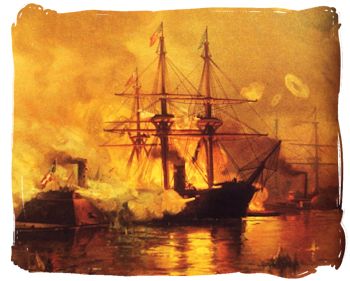
March 1st. The Pensacola arrived from Key Wrest to-day; also a store-ship which brought us two nine-inch guns, increasing our number to twenty-two nine-inch, and two rifled pivots. This morning a boat expedition left the ship in tow of the New London for Biloxi, a small village on the main land, and returned in the evening after capturing a few guns and obtaining much valuable information, and without doing any fighting.
March 1.—Last evening the second battalion of Ohio cavalry arrived at Independence—in the capacity of a patrol guard, and this morning a portion of Col. Parker’s rebel force rode into the town and commenced firing upon the sentries and scouts of the Federals, but almost immediately retreated, followed by the Ohio boys, who kept up a sharp and spirited firing; but owing to the thick fog, it was comparatively ineffective, the rebels scattering to evade pursuit. One of the Federals was killed—private Hickins, of company L. Five rebel prisoners were taken, one of whom stated that Col. Parker was killed in the pursuit.—Louisville Journal, March 4.
—The Mobile Register says: Since the late reverses to our arms, we notice quite a deplorable disposition to growl and grumble against the government of the Confederacy; to charge upon it the responsibility of these disasters, and to complain generally of the administration of affairs. This seems to us all wrong—transparently and absurdly wrong. It evidences no judgment, and is far from speaking well for the possession of those stable qualities of fortitude and patient determination which it is believed the Southern race possesses, and which are essential to our success in this war, and to the maintainance of a sustained career of national greatness in the future. If our confidence in the ability and rectitude of our government is so little that it is to be overthrown by a few insignificant reverses; if our patriotism is of so poor a quality that it may feel disheartened by them, we are not the people to deserve, or to win, or to sustain our independence.
It is as unjust to the government to charge it with the responsibility of losses as it would be to charge with cowardice and inefficiency the brave men who are directly their victims, and experience the misfortunes of war through stress of circumstances and overpowering numbers. We must make up our minds to bear a certain amount of disaster. It is impossible that such a war as this should be a career of uninterrupted successes. We are engaged with an enemy who marshals the most majestic military strength that modern times have witnessed. He assails us along land and coast frontiers of near five thousand miles in extent. Is it possible that our government should have the means or the prescience to make every post impregnable which the foe may choose to select for an assault with overwhelming force f
The enemy is ranging along our lines on coast and frontier, and is prepared at any moment to concentrate an overwhelming force at any weak point he may detect. Our government has neither the men nor munitions, nor the supernatural foresight to enable it to have a powerful force at any position which the enemy may choose to select. With such a foe we must force ourselves to the conclusion — rendered doubly distasteful by our invariable successes in its outset—that the war is a war of “give and take.” We must take the bad with the good, and may conceive ourselves especially fortunate if the latter so far predominates that the war will be shortened as much by the successes of our arms as by the self-exhaustion of the enemy’s efforts.
We should not be disheartened if we hear of a succession of such small successes as have encouraged them, as a consequence of the grand advance and general offensive policy of the enemy. These effect little to directly weaken our vital strength, while they nerve the valor and determination of the nation to its best efforts and sternest resolve. We make them pay dearly for these small successes, and trace in blood every step that they advance upon our soil, and they do not weaken our vital strength, for our grand armies remain intact, and must be overthrown and destroyed ere the cause of the South will look gloomy.
To keep the grand armies of Kentucky and Virginia strong, and to strengthen them, will be the policy of the government, and we may probably soon hear that the forces, which are popularly considered already too small at some points, are being weakened to reenforce the grand armies. It may be that some of these points, where the forces have been so weakened, will be successfully attacked. Grumblers will then have a fine text, of course. But let them not be heeded. The great armies are the true bulwarks of our safety. On them we must rely when the enemy attempt to pour their solid columns of a hundred or a hundred and fifty thousand men into the country. How could such forces be confronted with our troops scattered in squads of five thousand to twenty-five thousand at all the divers points on coast and inland frontier which the people adjacent thereto think should certainly be defended by the best efforts of the government? We must keep our great armies massed in such strength as to be able to give battle to the strongest armies of the enemy.
—John Minor Botts, Valentine Heckler, Franklin Stearns, and others were arrested in Richmond, Va., and committed to prison for “treason” against the Southern Confederacy, having openly avowed their sympathy for the Union, and loudly proclaimed their denunciations of the rebellion. The Richmond Examiner of March third, gives the following minute account of the affair:
“On Saturday night, Capt. Goodwin, by order of the government, proceeded with a party of select men to the farm of John Minor Botts, and took him and all of his papers and private correspondence, in custody. Leaving an officer in charge of the papers and house of Botts, Capt. Goodwin brought him prisoner to this city, and lodged him in McDaniel’s negro-jail, situated in Blankinship’s alley, some fifty yards north of Franklin street.
Capt. Goodwin then went to the farms of Valentine Heckler and Franklin Stearns, and took both of these well-known Union men, and all of their papers and letters, and brought them to this city.
Botts’ and Heckler’s letters and papers have not yet been examined. Stearns’ have undergone only a cursory examination, and so far, nothing of interest has been found among them, except several letters from his friend Botts, begging for money.
We are under the impression that, as yet, the government is in possession of no positive information that would convict Botts of treason. But he is known to be the recognised leader of all the disaffected— all the low Germans of the Red Republican, Carl Schurz school, and of the vile remnant of the Union Party.
Against Stearns’ and Heckler’s loyalty the government has been for a month in the possession of the most conclusive evidence; and it feels confident of its ability to prove that both of these men have been loud in their denunciations of what they have been pleased to term the “Rebellion,” and have, over and again, expressed their willingness to sacrifice their entire property to restore the dominion in the South of the United States Government.
The man Wardwell, another party arrested, has, since the beginning of the war, been known to every citizen as a blatant and defiant Union man.
Miller, who has also been lodged in jail, is the chief or high-priest of the secret Black or Red German Republican Societies of Richmond, some of whose members, it can be proved, have, since the reverse of our army at Fort Donelson, boasted that they had thousands of arms and abundance of ammunition concealed in the city, and that the men were enrolled who would use them on the first approach of the Yankee army.
An Irishman, named John M. Higgins, has also been arrested and put in the same prison. Higgins is a connection of Col. Corcoran, of the Yankee army. Two of Higgins’ aunts married two of Corcoran’s uncles. A letter from Corcoran to Higgins, advising the latter to send his wife and family North, and containing assurances that he (Corcoran) would have them safely conveyed under flag of truce, has recently been intercepted by our government Whether our government has any evidence of Higgins’ intention to follow Corcoran’s counsel has not transpired.
It is said that Stearns, the whisky man, on approaching the prison, surveyed it with a most contemptuous expression, and remarked: “If you are going to imprison all the Union men, you will have to provide a much larger jail than this.” Mr. Stearns will, we think, be not a little mistaken in his calculations. If the government use its power wisely and firmly, this great Union party, on which Stearns, and others like him, have based such great expectations, will, in a day, dwindle into ridiculously small proportions. By neglect, idle, ignorant, and vicious persons have been allowed with impunity to boast their treason in our streets.
The rumor that the above-mentioned parties had been arrested was on every tongue yesterday morning, but no one could, with certainty, say whence the rumor originated, or whether it was authentic And not until a late hour in the evening was it known to be a fact that the parties were confined in McDaniel’s jail Very soon after the information became generally diffused, a crowd collected in the vicinity, and the matter was freely discussed. Not a man was there but expressed himself in unmeasured terms of approbation of the course of the government. The only apprehension that seemed to be felt was, that the government would not be thorough and summary enough in its treatment of traitors. The universal Yankee sympathizers dangling from as many lamp-posts would have a most wholesome and salutary effect.
While standing in the crowd, near the jail, our attention was attracted to a great quantity of burning paper flying out of one of the chimneys. It was immediately suggested that the prisoners, not having been properly searched, were destroying private and perhaps treasonable documents which they had about them.
We have reason to believe that many other arrests will be effected within the next twenty-four hours. We forego to mention names, lest we might throw some impediment in the way of the authorities.
Now that the government appears really in earnest in the suppression of treason, it becomes every citizen who knows a man or set of men inimical to our country and cause to point them out.—Richmond Examiner, March. 3.
—The rebels have established powder-mills in Virginia, South-Carolina, Georgia, and Alabama, and have au abundance of powder, such as it is —a very weak article and deficient in power. As an evidence of this, it may be stated that many of the Federal soldiers wounded at Fort Donelson picked the buckshot out of their merely skin-deep wounds without the assistance of surgeons. —St. Louis Daily News.
—Yesterday Lieut. Orlando Houston, of Capt. Carlin’s Second Ohio battery, while on a foraging expedition ten miles west of Gen. Curtis’s camp in Missouri, was attacked by three companies of Texas Rangers, and himself, eight men, and three horses captured. The balance of the Lieutenant’s men retreated to camp, bringing in their wagons, forage, and a fine stallion which they captured. No lives were lost on the National side.—N. Y. Commercial, March 11.
—The Raleigh (N. C.) State Journal of this date, has the following: “We have no more doubt of the ultimate independence of the South than we have that there is a heaven above us. The simple virtue of patience and endurance on the part of the people of the South will break down the war and the Government of the North, as surely as the war now rages. It is this truth which tends to strengthen the belief of our independence, and the short duration of the war, amongst the statesmen of Europe. Let us, then, continue to show to the world that subjugation is simply impossible, and the war will speedily end without the intervention of Europe. But we predict that our recognition as a government will shortly be announced.”
—Yesterday the National steamer Mount Vernon captured the British schooner British Queen — which was attempting to run the blockade of Wilmington, N. C. She was sent with a prize crew to Philadelphia.
—Gen. Curtis, at Camp Halleck, in Arkansas, in reply to a private communication from a citizen of that State, relative to the subordination of the National troops of his army, issued an address to the people of the South-west, in which he asserts that the legitimate object of war is peace, “that peaceable persons shall be protected,” and advises those in arms against the Government to disband and return to their proper employments, assuring them safety and the fullest protection.—(Doc 71.)
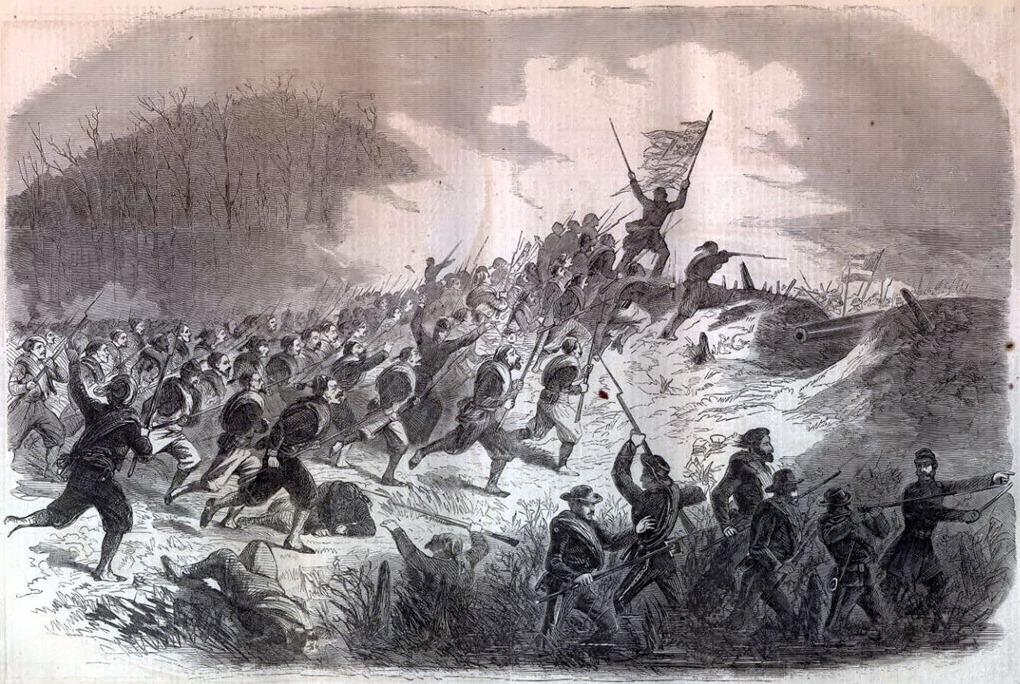
Gallant Charge of Hawkin’s Zouaves upon the Rebel Batteries on Roanoke Island.
March 1, 1862 issue of Harper’s Weekly, page 135:
We devote a large portion of our space this week to illustrations of the Burnside Expedition. On page 136 we give portraits of the commanders GENERAL BURNSIDE and FLAG-OFFICER GOLDSBOROUGH; on the same page a picture of the DESTRUCTION OF THE REBEL NAVY UNDER COMMODORE LYNCH; on page 137 an illustration of the CHARGE OF HAWKINS’S ZOUAVES upon the rebel batteries; on page 140 a portrait of GENERAL FOSTER, who received the surrender of the rebel troops; on page 134 A CHART OF ALBEMARLE SOUND showing the field of operations of the expedition; and on this page a MAP OF ROANOKE ISLAND showing the position of the rebel batteries.
A very neat and comprehensive report of the operations of the combined fleet and army is given in General Burnside’s Report, as follows:
Headquarters, Department of North Carolina,
Roanoke Island, Feb. 10, 1862.
To Major-General George B. McClellan, Commanding United States Army, Washington:
General, – I have the honor to report that a combined attack upon this island was commenced on the morning of the 7th by the naval and military forces of this expedition, which has resulted in the capture of six forts, forty guns, over two thousand prisoners, and upward of three thousand small arms.
Among the prisoners are Colonel Shaw, commander of the island, and O. Jennings Wise, commander of the Wise Legion. The latter was mortally wounded, and has since died.
The whole work was finished on the afternoon of the 8th inst., after a hard day’s fighting, by a brilliant charge in the centre of the island, and a rapid pursuit of the enemy to the north end of the island, resulting in the capture of the prisoners mentioned above.
We have had no time to count them, but the number is estimated at nearly three thousand.
Our men fought bravely, and have endured most manfully the hardships incident to fighting through swamps and dense thickets.
It is impossible to give the details of the engagement, or to mention meritorious officers and men in the short time allowed for writing this report, the naval vessel carrying it starting immediately for Hampton Reads, and the reports of the Brigadier-Generals having not yet been handed in. It is enough to say that the officers and men of both arms of the service have fought gallantly, and the plans agreed upon before leaving Hatteras were carried out.
I will be excused for saying in reference to the action that I owe every thing to Generals Foster, Reno, and Parks, as more full details will show.
I am sorry to report the loss of about thirty-five killed, and about two hundred wounded, ten of these probably mortally. Among the killed are Colonel Russell, of the Tenth Connecticut regiment, and Lieutenant-Colonel Victor de Monteil, of the D’Epineuil Zouaves. Both of them fought most gallantly. I regret exceedingly not being able to send a full report of the killed and wounded, but will send a dispatch in a day or two with full returns.
I beg leave to enclose a copy of a General Order issued by me on the 9th inst.
I am most happy to say that I have just received a message from Commander Goldsborough stating that the expedition of the gun-boats against Elizabeth City and the rebel fleet has been entirely successful. He will, of course, send his returns to his department.
Since then the fleet have occupied Edenton, Hertford, and have made explorations up the Chowan and Roanoke Rivers without meeting any enemy. In all probability the troops have already severed the railway connections at or near Weldon.
Capture of the Forts.
We clip the following account of the Battle at Roanoke Island from the correspondence of the Tribune:
By daybreak on the 8th, General Foster had his brigade in motion to attack the rebels, followed soon after by the brigades of Generals Reno and Parks. The advance was supported by six howitzers, commanded by Midshipmen Porter and Hammond, and manned in part from the fleet. After fording a creek, General Foster’s force came up with the enemy’s pickets, who fired their pieces and ran. Striking the main road, the brigade pushed on, and after marching a mile and a half came in sight of the enemy’s position. To properly understand its great strength, in addition to what skillful engineering had done, the reader will bear in mind that the island, which is low and sandy, is cut up and dotted with marshes and lagoons. On the right and left of the enemy a morass, deemed impassable, stretched out nearly the entire width of the island.
The upper and lower part of the island being connected by the narrow neck on which the battery was situated, and across which lay the road, the battery of three guns had been located so as to rake every inch of the narrow causeway, which, for some distance, was the only approach to the work. General Foster immediately disposed his forces for attack, by placing the 25th Massachusetts, supported by the 23d Massachusetts, in line, and opened with musketry and cannon. The enemy replied hotly with artillery and infantry. While they were thus engaged, the 27th Massachusetts came up, and were ordered by General Foster to the left to the enemy in the woods, where the rebel sharpshooters were stationed. The 10th Connecticut was placed in support of the 25th Massachusetts.
General Reno now came up with his brigade, consisting of the 21st Massachusetts, 51st New York, 51st Pennsylvania, and 9th New Jersey, and pushing through the swamps and tangled undergrowth, took up a position on the right, with the view of turning the enemy. This was done with the greatest alacrity. Meanwhile the contest raged hotly in front, our men behaving gallantly, not wavering for a moment. The Massachusetts men vied with the men of Connecticut; those of New York and New Jersey courageously supporting their brethren of Pennsylvania. Our troops were gradually overcoming the difficulties which impeded their approach, and though fighting at great disadvantage, and suffering severely, were making a steady advance. Regulars were never more steady. General Burnside was near the place of landing, hurrying up the reserves, receiving reports, and, so far as practicable, giving orders.
General Foster was in active command on the ground. His brave and collected manner, the skillfulness with which he, as well as General Reno and General Parks manoeuvred their forces, their example in front of the line, and their conduct in any aspect, inspired the troops to stand where even older soldiers would have wavered. In this they were seconded nobly by officers of every grade. General Parks, who had come up with the 4th Rhode Island, 8th Connecticut, and 9th New York, gave timely and gallant support to the 23d and 27th Massachusetts. The ammunition of our artillery getting short, and our men having suffered severely, a charge was the only method of dislodging the enemy. At this juncture Major Kimball, of Hawkins’s Zouaves (New York 9th) offered to lead the charge, and storm the battery with the bayonet. “You are the man, the 9th the regiment, and this the moment! Zouaves! storm the battery! Forward!” was General Foster’s reply. They started on the run, yelling like devils, cheered by our forces on every side. Colonel Hawkins, who was leading two companies in the flank movement, joined his regiment on the way. On they went, with fixed bayonets, shouting “Zou! Zou! Zou!” into the battery, cheered more loudly than ever. The rebels, taking fright as the Zouaves started, went out when they went in, leaving pretty much every thing behind them, not even stopping to spike their guns, or take away their dead and wounded that had not been removed.
General Foster immediately reformed his brigade, while General Reno, with the 21st Massachusetts and 9th New York, went in pursuit. Following in quick time, General Foster overtook General Reno; who had halted to make a movement to cut off the retreat of a body of rebels, numbering between 800 and 1000 on the left, near Wier’s Point, and not far from the upper battery. Taking a part of his force, General Reno pushed on in that direction. It being understood that there was a two-gun battery near Shellbag Bay, Colonel Hawkins, with his Zouaves, was dispatched in that direction.
General Foster pushed on at a double-quick with the 24th Massachusetts, followed by an adequate force, in the tracks of the rebels, who, panic-stricken, were fleeing at the top of their speed, throwing away as they went guns, equipments, everything, so that the road for miles was strewn with whatever the fugitives could disencumber themselves of. Thus was the pursuit kept up for more than five or six miles, when General Foster, as he was close on the heels of the enemy, was met by a flag of truce borne by Colonel Pool of the 8th North Carolina, with a message from Colonel Shaw of the North Carolina forces, and now senior in command, asking what terms of capitulation would be granted. “No longer than will enable you to report to your senior.” Colonel Pool retired, and, after waiting for what he supposed was a sufficient length of time without a replay, General Foster commenced closing on the enemy, when Major Stevenson of the 24th Massachusetts, who had gone with Colonel Pool to receive Colonel Shaw’s answer, appeared with a message that General Foster’s terms were accepted.
Destruction of the Rebel Fleet
The destruction of the rebel fleet by Commander Rowan is thus described by the same correspondent:
We came in sight of Elizabeth City about eight o’clock, and as we approached we discovered the enemy’s steamers – seven in number – in line of battle, in front of the city, ready to receive us. A fort was also discovered on a point which projected out some considerable distance – one-fourth of a mile, perhaps – in front of the rebel line of steamers; and directly opposite of this fort was a schooner, anchored, on which were two heavy rifle guns, the distance between the fort and this schooner being about half a mile. Four large guns were mounted on the fort, and it was thought by the rebels that no fleet of ours could pass this narrow channel; consequently they considered themselves safe, with the assistance of their navy, drawn up between the city and the fort.
At the sight of the enemy every thing was in readiness for battle. To describe the wild delight of our brave bluejackets when they first discovered the enemy is more than the pen can do.
The charge was short and desperate, and, without any exception, is one of the most brilliant ever made by the American Navy. All eyes were on the Commander, Rowan, to see what the first order would be, as we were rapidly approaching the foe.
In due time he ran up the signal to engage the enemy in close action, hand to hand. We were then about two miles from the enemy. This was a signal for a test of speed as well as a signal for a deadly encounter with a desperate foe, whose all was staked upon this final engagement. For a distance of two miles it was a race between our steamers in their eagerness to outstrip each other, and be the first to meet the enemy of the Republic face to face.
The river began to narrow as we approached the city. The point where the fort was situated necessarily brought our steamers nearer together, making them sure marks for the enemy’s guns; indeed, it would be a miracle if a shot from one of the enemy’s guns did not strike some one of our steamers. Under the circumstances, most any other commander would have thought it advisable to first attack the fort and silence the guns on both sides of that narrow point, and then attack the rebel steamers; but not so with the brave and intrepid Rowan, whose motto is to charge bayonets on the enemy whenever and wherever he may be found. In action the position of the commander’s ship is in the centre of the squadron. The Delaware, Captain Rowan’s flag-ship, was at the head of the advancing column and led the van. No attention was paid to the fort or armed schooner, as they dashed by them through a perfect torrent of shells and grape, boarded the rebel steamers, and engaged them at the point of the bayonet, as the panic-stricken rebels leaped into the water in every direction. Many were killed by the bayonet and revolver in this hand-to-hand fight, and sank below the water. Their real loss will doubtless never be known to us; the slaughter, however, was fearful, and the struggle short and desperate – not more than fifteen minutes in duration.
The fort and armed schooner were deserted quite as soon as were the rebel steamers; for it was made quite as hot work for those behind the guns as it was for their confederates on the gun-boats. Our loss is two killed and about a dozed wounded – all seamen. The death-struggle was brief. In less time than it would take to write a telegraphic dispatch the victory was ours.
The Commodore Perry was in the advance, and made for the rebel steamer Sea-Bird, the flagship of the rebel navy, on which was Commodore Lynch, and run her down, cutting her through. The Ceres ran straight into the rebel steamer Ellis, and run her down in like manner, boarding her at the same time. The Underwriter took the Forrest in the same style; while the Delaware took the Fanny in fine shape, she having received ten shots from our squadron, which made daylight through her in as many places. The Morse, Shawsheen, Lockwood, Hetzell, Valley City, Putnam, Whitehead, Blinker, and Seymour also covered themselves with glory. Every officer and man in our entire squadron behaved like a hero, one as brave as the other, all through this desperate charge. The terrified rebels, as they forsook their gun-boats, fired them, and thus all but the Ellis were burned, including a new one on the stocks. Four were burned, one captured, and two made their escape – the Raleigh and Beaufort. They are in the canal which leads to Norfolk, but are not able to go through, on account of the locks having been destroyed; consequently they will be captured before this reaches you, as they can go only some few miles toward Norfolk.
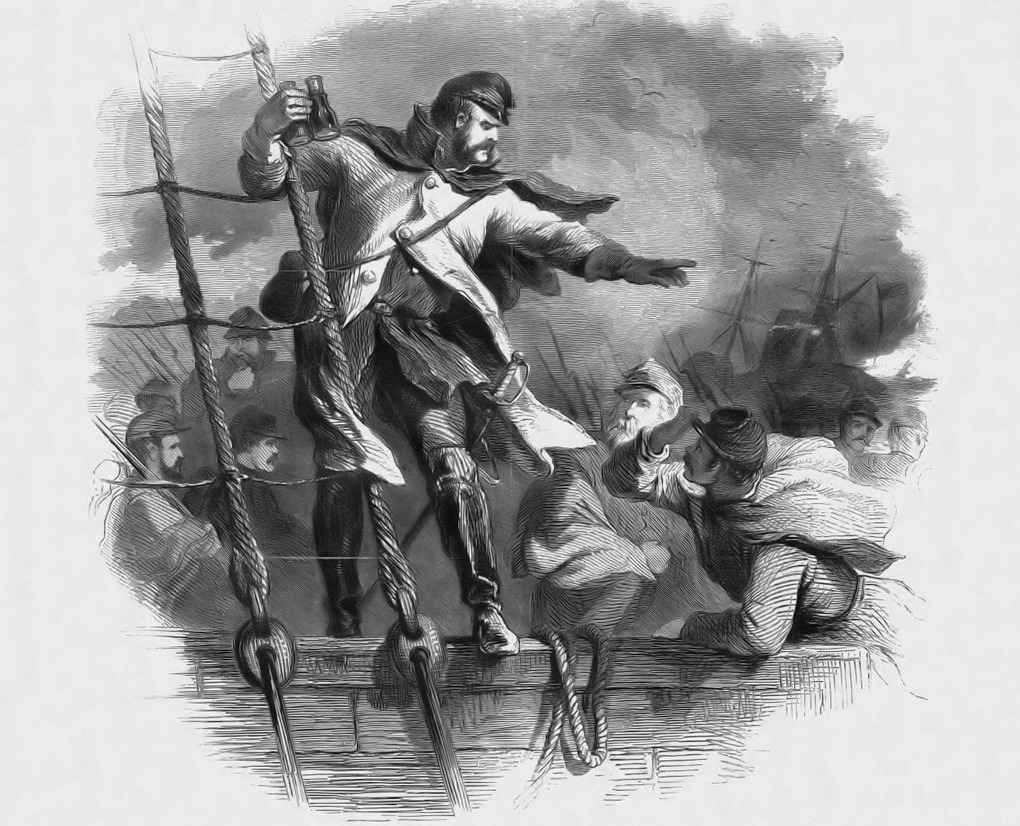
The Burnside Expedition – The Fleet and Transports Off Hatteras During the Storm – The General Giving Orders.
March 1, 1862 – The first blow of the Burnside Expedition has fallen with terrific force on the enemy’s flank. After innumerable delays and disasters, the Expedition succeeded in fairly entering Pamlico Sound on the 4th of February. On the 6th it left Hatteras for Roanoke Island, commanding the passage between Pamlico -and Albemarle Sounds, which had been strongly fortified and garrisoned. It reached its destination on the 7th, and found that the defenses consisted of not less than six forts and batteries, mounting over 40 heavy guns, and garrisoned by between 4,000 and 5,000 men. The passage between the two Sounds was found obstructed by sunken vessels and heavy piles, behind which lay the rebel flotilla of eight vessels, under command of Com. Lynch. The bombardment of the principal fort was at once commenced by the gunboats, under Com. Goldsborough, while Gen. Burnside, under cover of a few vessels, landed his forces on the lower end of Island. This movement was rapidly and successfully effected, in face of the enemy, without loss. These operations consumed the 7th, and it was not until the 8th that the work of reduction commenced in earnest. On that day the barricades in the Sound were forced, the rebel flotilla defeated and dispersed, the forts silenced and captured, and the entire rebel force on the island, with the exception of a few hundreds, who escaped in small boats, taken prisoners.


