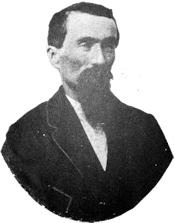
Following the American Civil War Sesquicentennial with day by day writings of the time, currently 1863.

Three Years in the Confederate Horse Artillery — George Michael Neese.

April 17 — This morning, an hour before day, the same old alarm that has waked us so often in the last month was brought into requisition and sounded in our ears again, “Get up! The Yankees are coming. Pack up and get ready to stand to your guns.” This thing of being rear guard of an army and operating on the immediate front of the enemy is a service both active and arduous, full of alarms, hardships, and excitement.

Before daylight we were out on the pike in position, and before sunrise we saw the Yankee skirmish line coming through the fields on our left and their cavalry advancing up the pike at the same time in our immediate front. When the cavalry arrived in the street of Hawkinstown, which was about half a mile from our position, we opened on them with our howitzer, and soon scattered and checked them, but the infantry skirmishers on our left still advanced slowly. We fired on them until they disappeared from sight by filing into a ravine.

The whole Yankee army was advancing, and when they brought their artillery to the front to fire on us, we left and fell back to Rude’s Hill, two miles south of Mount Jackson. At the south end of Mount Jackson where the Valley pike crosses Mill Creek our men burnt the bridge, but its destruction offered very little resistance to the progress of the enemy’s advance, as the creek is small and there is a very good ford just below the bridge. Consequently, we knew that destroying the bridge would present no serious obstacle to the advancing cavalry, but we thought that it would at least for a while check the column of infantry; but it did not in the least, for I saw the leading regiment of the infantry column march down the hill to the ford in quick time and dashed into the creek and through it without the least hesitation or faltering.

They seemed to be familiar with the situation, and acted with a boldness heretofore unshown and wholly unequaled. The creek was no more hindrance to the onward march of their footmen than it would have been to a herd of cattle. We were on a hill about half a mile from the creek when they crossed, and their infantry was close up with the cavalry, and advancing so determinedly and rapidly that meant business all over, that we did not deem it judicious nor very wholesome to go in position just there and then before a column of cavalry and infantry, backed with batteries of Parrott guns. At the southern base of the hill we were on the turnpike crosses the north fork of the Shenandoah. The bridge was already prepared for destruction. The proper quick inflammable material was all in place ready for the igniting match, but the enemy pressed us so vigorously and dashed so boldly over the bridge that they captured the man who set it on fire, and extinguished the kindling flames. When the Yanks rushed impetuously across the bridge like wild men, flushed by the success of its passage, with drawn sabers and firing as they came, our cavalry was rather surprised by the sudden appearance of the enemy in their midst,— as it was a foregone conclusion that the bridge would be destroyed,— consequently our men were incautiously not looking for the unexpected irruption that was so momentously thrust upon them so unceremoniously.

As soon as the front of the column had crossed the bridge the fight commenced in earnest, with saber, pistol, and carbine. Our men stubbornly resisted the advancing foe with saber and pistol, and at one time were mixed up with the Yankee cavalry, fighting hilt to hilt.

One Yankee cavalryman rode boldly toward Colonel Ashby with the deliberation of a desperado, pistol leveled ready to fire; but just as he was in the act of firing Captain Koontz saw him and, surmising his intentions, quickly drew his pistol on him and fired, unhorsing him just in time to save Ashby.

In the meantime the Yankee cavalry were still coming across the bridge, overwhelming our men in number, who at last succumbed and fled from the field. We were in position with our howitzer on the pike nearly half a mile from the bridge, but did not fire, as our men were mixed up with the Yanks.

When our cavalry began to break away we doublequicked for Rude’s Hill, which was a mile away, just about as fast as our horses could travel in an extraordinary emergency. The Yankees were then charging us. When Colonel Ashby galloped past us on his bleeding horse, he called, ” Good-by, boys; they will get you this time.” I think his remarks were partly intended as an effective incentive to make us run faster, which we surely did. I ran one mile just a little faster than I ever hoofed it before. The Yanks gained on me at first, and I could hear their clattering arms close behind me.

But when Ashby passed us and said, “Good-by, boys,” it gave me such an impulse and incitement for running that it really seemed to increase my speed without extra exertion. As we drew near Rude’s Hill, which was to us the goal of freedom, the Yanks gave up the chase and we were safe. The Yankee cavalry then retired to the north side of the river, and nothing in the shape of an enemy remained on our side of the river except a few scattering footmen sharpshooters, with long-range rifles, creeping along the fences in derailed chipmunk style, trying to conquer the Southern Confederacy by shooting now and then at a daring careless Rebel.

Just as we reached Rude’s Hill the Yankees opened a battery of rifled guns on us, which they hurriedly placed in position on the hill a little below the bridge on the north side of the river. When we reached the top of Rude’s Hill we put our Blakely gun in position and fired a few shots at their battery, but the distance was too great for anything except noise and wasting ammunition.

While I was sitting on the ground watching a Yankee battery firing, I heard and saw a shell coming, and from its course and trajectory I knew that it was searching for me, so I moved away as quickly as a man can when a shell is after him. When I got away about eight feet from where I had been sitting a tenpound Parrott shell struck the ground at the very spot that I so hurriedly vacated a moment before, but fortunately the shell did not explode, and laid there still and harmless.

It is wonderful and almost inexplicable how a man can slip between and slide around danger unscathed. If I had not seen that shell coming it would have shattered the clod that anchors me to earth without giving me time to say farewell to the Southern Confederacy.

This afternoon the Yanks put a battery of Parrott guns in position about a mile above the bridge on the highlands that bound the bottoms on the west, and about a mile and a half from our position. When they opened on us with that battery we replied with a few rounds, then left Rude’s Hill and fell back to Sparta, about eleven miles from Rude’s Hill, where we arrived a few hours after nightfall. Weary and nearly exhausted, we laid ourselves away for the night.

The man who so undauntedly approached Colonel Ashby to-day with leveled pistol and was shot by Captain Koontz just in time to save Ashby, bore such a striking resemblance to the Yankee deserter, spy, New Orleans sugar merchant, that it is now admitted and believed that he was the very man that was permitted to ride all through our camps a few days ago without proper surveillance, a dangerous spy, locating camps, bridges, and roads, out-talking and out-lying all creation.

But alas! Mr. Spy, if our deductions are correct your deception and boldness were quickly followed by disastrous consequences, that never fail to settle the spying business, and requires its gathered victims to give an account of their stewardship at the bar of the “Kingdom Coming,” where Rebels cease from troubling and sugar merchants desert and spy no more.

April 12 — Went on picket. After we were at our picket a while, which is on the Valley pike a mile from Edenburg, Colonel Ashby came riding from some of his places of observation up the creek and said to Captain Chew: ” I want you to take a gun up the creek about half a mile,— I will show you where I mean,— and fire five shell in as little time as possible into an infantry camp of the enemy’s. Get your five shell ready, and as quick as you fire them, retire.”

We proceeded to the place indicated by Colonel Ashby. It was an open field from which we plainly saw, half a mile away, a Yankee camp of infantry that was to be stirred up. We did it effectively and in double-quick time. When we went in position there was a band playing in an old barn that stood in the camp. Our first greeting shell cruelly cut the music short off, to be concluded, I suppose, at a healthier and more convenient season. After we fired the five shell and started away a Yankee battery opened fire on us and gave us a few parting shell for spoiling their band music and making their infantry go through with the intricate evolutions of a sure enough war dance.

April 11 — Two guns went on picket. This forenoon an oily-tongued regular talking machine in the shape of a sandy-haired Yankee appeared in our camp, handing himself around in a bold, loquacious, and exhibitory manner as a deserter from the Yankee army. He represents himself to be a sugar merchant from New Orleans, and was in Chicago selling sugar when the war broke out. The reason he gave for joining the Yankee army was that they are very strict in the North about Southern men coming through the lines, and he adopted the method of joining the army and then deserting when the first opportunity presented itself, as the surest way with the least inconvenience and danger to get back to Dixie. He wound up his fluent little speech by saying that he had seen all he wanted to see in the Yankee army, and was tired of war, anyhow, and now he wants to see what the Southern army is made of. A nicely put up little job, Mr. Talking Machine, but a wee bit too thin. He came to our camp riding a splendidly equipped cavalry horse, and while he was talking at greased lightning speed he fortuitously, with regular Yankee shrewdness, called attention to his horse and its equipments of splendid bridle and saddle, and said he knew where there were one hundred Yankee horses similarly equipped that could be captured without much risk or danger, and that if he could get a hundred Rebels to go with him to-night he would pilot them through the lines and insure them a hundred Yankee horses safe in the Rebel lines to-morrow morning.

It seems that he came to our company on a special errand, and after delivering a few nice little speeches, he said, “Is Mose Faris a member of this company?” The question was answered in the affirmative, as Moses Faris is a member of our battery, and was present. Then the talking machine said, “Come here, Mose,” then taking off his hat he turned the lining down and showed Mr. Faris a card, and asked, “Do you know this handwriting?” Mr. Faris recognized the handwriting at once as that of his sister, who lives in Illinois. Then the sugar merchant said, “That is right, Mose,” and took Mr. Faris aside and had a conversation with him, the topic of which will perhaps remain a secret.

This afternoon I saw the deserter riding around through the cavalry camp with Colonel Ashby, and I heard him say that he wanted to see Stonewall Jackson, of whom he has heard so much of late, and wanted to see his army and his headquarters.

I heard Captain Chew say that if he had his way he would not allow the Yankee deserter to ride freely all over our camps and openly acquire all the information that the most zealous spy could desire. Chew believed that he was a spy, for I heard him say so.

April 7 — First detachment went on picket. Fired a few shell into the Yankee encampment to apprise them of the fact that there is life in the old land yet.

April 6 — On picket.

April 5 — On picket. Late this evening we moved camp, and are now quartered in a barn a mile below Mount Jackson. Mount Jackson is a little village on the north side of Mill Creek, seven miles from Edenburg.

April 3 and 4 — On picket. Colonel Ashby rides along his picket line every day. I heard him say today that when the Yankee pickets fire at him, which they sometimes do, he stops and sits on his horse right still, without dodging or moving in the least, and he advised his picket to do likewise. He said that he has observed that if at long range he holds still without evincing any sign of fear or danger by moving or dodging, a sharpshooter or picket will hardly ever fire more than once at him from the same position, as his bold and unconcerned demeanor convinces the Yank at once that the object of his fire is beyond the range and reach of his rifle.

April 2 — This morning we went on picket one mile from the Yankee line, which is established along the north bank of Stony Creek. However, some of their cavalry were on this side of the creek early this morning, but they did not tarry long. We had a lively and interesting little game of shelling with the Yanks this morning. We came back to camp at Red Banks this evening.

April 1 — A few hours after sunrise the report reached camp that the Yanks were again on the advance. We were ordered to pack up double-quick and start our wagons up the Valley. We started down the pike with the battery, but before we got to Woodstock the Yanks had already made their appearance in sight of town. We halted on the hill at the south end of town a few minutes, then fell back to Narrow Passage, three miles south of Woodstock. When we started back a Yankee battery in position on a hill north of town fired some shell at us, but they all fell short.

One gun of Pendleton’s battery was in position at the south end of town and fired at the advancing skirmishers, but the Yanks had a four-gun battery in position on the hill north of town, which opened with all four guns on Pendleton’s piece and it retired under fire.

On the hill south of Narrow Passage we went in position and fired at the advancing enemy as it came in range. Their four-gun battery replied to our fire and we played ball with them a while with two guns to four, then fell back to a hill a little south of Edenburg. Edenburg is a little village on the north side of Stony Creek, five miles from Woodstock.

The Yanks followed our retreat and put their battery in position on the hill at the north end of Edenburg. Their position was higher and consequently commanded the one we occupied. Here we had a repetition of what we have been doing from nearly every hilltop between here and Winchester. We shelled the Yanks and the Yanks shelled us. The firing was rapid for a while, and right across the center of town. Our cavalry burned the railroad and pike bridge at Stony Creek. When that was fully accomplished we retired from our position, as the fire from four guns on a commanding elevation was getting too hottish for two on a lower and exposed altitude.

We fell back to Red Banks, eight miles from Woodstock, on the north fork of the Shenandoah, and camped.

March 29 — Only one gun went on picket to-day. March 30 — This morning we went to Maurertown, which is some three or four miles below Woodstock. From the lower end of the little hamlet we fired three shell into a bushy woods that looked like a good cover for game, as Yankee finders, but our shell failed to stir up anything of the Yankee kind. We came back to camp soon after we fired the three shots.