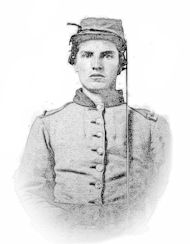
Thursday, 15th.—Cannonading all around the lines. 2 P. M., heavy fighting on the left, which continued until night. Stewart’s Corps flanked and had to fall back, loosing some artillery. Brigade moved to left; being sick, was left in camp with several others. In short time, orders came for sick to move back, as left wing had given way. J. N. Smith, B. F. Wells and myself managed to get back about five miles during the night.

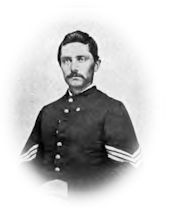
Thursday, 15th—The weather is fine—days warm and pleasant and nights cool. The Thirty-second Illinois arrived in camp at 11 o’clock with sweet potatoes, fresh pork and corn for our brigade. We are still lying in camp without rations. We had company inspection and drill for the recruits. The First Division of the Fifteenth Corps advanced their skirmish line this morning toward the rebels’ post south of Savannah. There was quite an artillery duel and some sharp skirmishing, but our men succeeded in gaining their position.
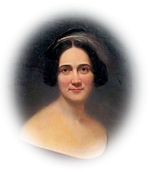
December 14th.—And now the young ones are in bed and I am wide awake. It is an odd thing; in all my life how many persons have I seen in love? Not a half-dozen. And I am a tolerably close observer, a faithful watcher have I been from my youth upward of men and manners. Society has been for me only an enlarged field for character study.
Flirtation is the business of society; that is, playing at love-making. It begins in vanity, it ends in vanity. It is spurred on by idleness and a want of any other excitement. Flattery, battledore and shuttlecock, how in this game flattery is dashed backward and forward. It is so soothing to self-conceit. If it begins and ends in vanity, vexation of spirit supervenes sometimes. They do occasionally burn their fingers awfully, playing with fire, but there are no hearts broken. Each party in a flirtation has secured a sympathetic listener, to whom he or she can talk of himself or herself—somebody who, for the time, admires one exclusively, and, as the French say, excessivement. It is a pleasant, but very foolish game, and so to bed.
Hood and Thomas have had a fearful fight, with carnage and loss of generals excessive in proportion to numbers. That means they were leading and urging their men up to the enemy. I know how Bartow and Barnard Bee were killed bringing up their men. One of Mr. Chesnut’s sins thrown in his teeth by the Legislature of South Carolina was that he procured the promotion of Gist, “State Rights” Gist, by his influence in Richmond. What have these comfortable, stay-at-home patriots to say of General Gist now? “And how could man die better than facing fearful odds,” etc.
So Fort McAlister has fallen! Good-by, Savannah! Our Governor announces himself a follower of Joe Brown, of Georgia. Another famous Joe.

December 14th.—Cloudy, and thawing rapidly. All quiet below.
The bill to employ 40,000 negroes, as recommended by the President, for army purposes, though not avowedly to fight, has passed one House of Congress. So the President is master yet. There ought to be 100,000 now in the field.
An effort will be made by the government to put into the field the able-bodied stuff and other officers on duty in the bureaus here. It will fail, probably, since all efforts have failed to put in their able-bodied clerks. If Bragg were here, and allowed his way, he would move them to the front.
The following dispatch was received from Gen. Bragg to-day:
“Augusta, Ga., Dec. 13th, 1864.—I go to Charleston to-morrow to see Gen. Beauregard, at his request. He has assigned me to duty—B. B.”
I got to-day from Major Cross, A. Q. M. Gen., an order to buy a pair of government shoes (British) for $10. They are most excellent in quality, heavy, with iron heels, etc., and would cost, if made here, $150. This good fortune is worthy of being thankful for.
The military officers in the bureaus, responsive to a resolution of the House of Representatives, are reporting their ages, and most of them admit they are able-bodied and fit for service in the field. They have no fear of being transferred to the front, supposing themselves indispensable as bureau officers.
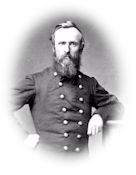
Wednesday, 14. — Snow going off rapidly; sun shining at intervals. In quarters almost all day. News from Sherman favorable. He is near Savannah and can probably avoid a fight and go to the sea if he wishes to do so. Nothing new from Nashville.
Fort Gillem, Wednesday, Dec. 14. Reveille sounded this morning at 4 A. M. and at daylight the whole Company was marched off on detail except guards. I was on post. They went to unload shakes and poles for stable from a barge. They worked hard all day without any dinner. Returned to eat a hearty supper. Weather very foggy and misty all day. The mud is unfathomable and camp is very disagreeable. It was expected that a general engagement would come off to-day, but Thomas is waiting for more favorable weather, it is reported, to move artillery. Considerable firing from forts. Considerable curiosity manifested as to who will be appointed in the vacancy caused by the promotion of the Sweet boys.
14th. Went twice to mustering officer without success. Finished “Dante” and “Dream Life” by Ike Marvel. Beautiful pictures of life, beautiful because so real. Good lessons. Had good visits with Easton and McBride. Clear.
Wednesday, 14th—The capture of Fort McAllister gives us our first communication with the North since the telegraph wires were cut at Marietta, Georgia, on the 12th of November. We have no rations yet, but will have crackers as soon as our men can remove the torpedoes from the Ogeechee river, which is thickly laid with them; then the transports can land provisions. There is great rejoicing in camp, as we have nothing left but unhulled rice. This we hull by placing a handful in our haversacks which we lay on logs and pound with our bayonets. Then we pour the contents from hand to hand, blowing the while to separate the chaff from the grains. All is quiet along the line, except occasional skirmishing. We had regimental inspection this afternoon. The foraging train of the Fifteenth Corps came in this afternoon with some forage. We are now in camp in a large rice plantation about ten miles south of Savannah.
Tuesday, December 13. — Fair day. Passed Hatteras about 4 P.M. Could see the lighthouse. Hardly any one sick.
[For some reason or other I stopped keeping a diary regularly after my release. I suppose that I was so glad to be getting nearer home that I did not care about writing any more. Anyway, we were landed at New York, and I went home. I had got leave of absence from Annapolis, so did not have to stay there. I remember getting off at the station in Jamaica Plain, and my father coming to meet me, expecting to find a skeleton. I suppose I was rather thin, but I was pretty well on the whole.
I add, as a sort of supplement, some notes which I made in the autumn of 1885; also a few letters which I wrote home immediately before and after the close of the war.]
December 13th.—Cloudy and cold, but wind southeast.
The sullen sound of cannon heard this morning as usual down the river. I hear of no active operations there, although the ground is sufficiently frozen to bear horses and artillery.
Rumors of successes on the part of Sherman near Savannah are still in circulation.
The rich men are generally indignant at the President and Gov. Smith for proposing to bring a portion of the negroes into the army. They have not yet awakened to a consciousness that there is danger of losing all, and of their being made to fight against us. They do not even remove them beyond the reach of the enemy, and hundreds are daily lost, but still they slumber on. They abuse the government for its impressments, and yet repose in fancied security, holding the President responsible for the defense of the country, without sufficient men and adequate means.
The following dispatch from Gen. Bragg was received to-day at 10 P.M.:
“Augusta, Dec. 12th.
“The telegraph having been cut, we get nothing from Savannah. A dispatch from Wheeler gives a copy of enemy’s order for the line of investment around Savannah. It is about eight miles from the city, and was to have been reached on the 9th.
“B. Bragg.”
I have at length succeeded in getting a suit of clothes; it was made at the government shop for $50, the trimmings having been found (in the house) by my wife. The suit, if bought of a merchant and made by the city tailors, would cost some $1000. A Yankee prisoner (deserter) made the coat at a low price. The government means to employ them, if they desire it, in this manner. I am very thankful for my good fortune.


