Following the American Civil War Sesquicentennial with day by day writings of the time, currently 1863.

November 2010

(Confidential.)

P. O. Dept., November 25,1860.

My Dear Sir,—I have good reason to believe that the President is beset by secessionists, who are almost exclusively occupying his attention ; and it is important that the true friends of the Union should do all in their power to strengthen his hands. Why will you not either write or come and see him, and get all the strong men of your city to do the same? I cannot call names, but rest assured what I tell you is true. The course of the ‘Constitution’ is infamous, but the President, I presume, has no means of controlling it. Pray let him hear from you all in a most decided manner on this subject. Let him know how much the paper and suspicions of disunion influences near him are injuring him.

Stephens’s speech is admirable; but observe that you do not see it, or anything like it, in the ‘Constitution.’ Get the papers to come out and denounce the ‘Constitution.’ You may rely upon it, all its secession articles are directly against the feelings of the President.

As the existence of the Department depends on the stability of the Union, I shall treat this as ‘on official business.’

Yours truly,

Horatio King.

HON. John A. Dix, New York.

Washington, November 25,1860.

My Dear Sir,—I would call and report to you what I know of the feelings of your friends whom I met recently in a flying visit to my native State, but that I know you are much occupied. May I not, therefore, be allowed to say to you briefly, in writing, that their most anxious desire is that the President will cast the whole weight of his influence against the secession movements at the South and in support of the Union? Among those whom I met was General Dix, who, of course, is greatly concerned with reference to the present excitement. He had written both to Mr. Cobb and Mr. Breckinridge, pressing them to come out boldly against secession. The inclosed note from him may be interesting to you. You need not trouble yourself to return it.

I hope I shall not be deemed obtrusive. My great desire is that the Union may be preserved, and that in your noble efforts to that end you may know that all your true friends will stand by you to the last.

I have the honor to be,

Very sincerely your friend,

Horatio King.

His Excellency, James Buchanan.

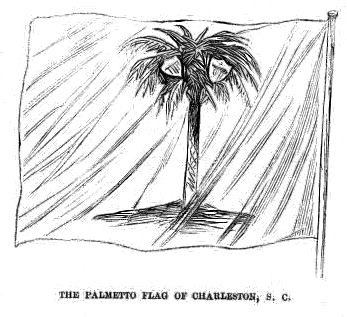
palmetto_flagOn our pages this week, we illustrate passing events of great and stirring interest, both in the South and in the North – the Seceding movements in the South and the Presidential campaign in the North.  We claim to be strictly and entirely neutral in our course of Journalism, chronicleing events as they transpire in every section of the country, without bias, and without feeling; adhering closely to facts, but advocating neither one side nor the other of the disturbing element of partisan politics.

In pursuing this course we do not bate one jot of our independence; we truckle to neither party, nor do we ask favors of any party.  The necessity of our position is, that our circulation must be universal – our expenses are so vast that the patronage of one class, however liberal, would be but a drop in the bucket in the way of enumerating our outlay.

Our aim is to produce a paper which shall be entirely free from objectionable opinions or partizan views of national policy, that it can be circulated in every section of the union and be receive in every family as a truthful exponent of facts as they occur, and a reliable Illustrated History of the time in which we live.

Bearing this aim steadily in view, we do not swerve from our design.  Our Artists and Correspondents furnish us with illustrations and descriptive matter of every event of importance, which we transfer to our pages, and we must not be held responsible if our pages illustrate scenes of which the actors therein are ashamed.  We are Historians, and represent the World as we find it, without fear, favor, or prejudice, confident that, while we persevere in that course, Frank Leslie’s Illustrated Newspaper will be welcomed in every section and in every home in the United States.

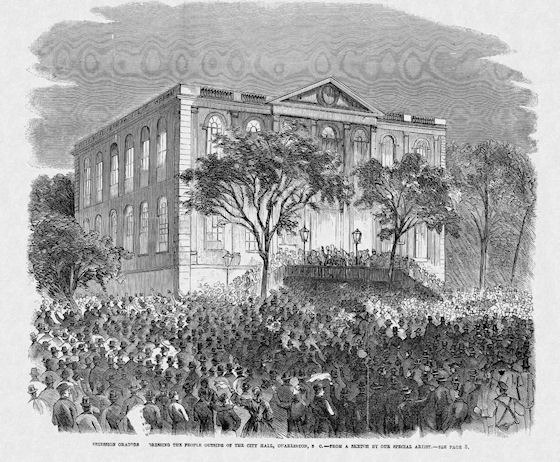
city_hall_charleston

Secession orators addressing the people outside the city hall, Charleston, S.C. – from a sketch by our special artist.

(Confidential.)

P. O. Department, Appt. Office, November 23,1860.

My Dear Sir,—Your private note of yesterday is received. I have shown it to the Postmaster-General. I am told both the President and Mr. Cobb are under a good deal of excitement. I have no doubt the friends of the President are determined to know whether there is secession in the Cabinet, and whether the President is responsible for the infamous course of the Constitution. And all you can do to this end will be a public benefit. . . .

Things are looking a little better in Georgia to-day.

Very respectfully and truly yours,

Horatio King.

Hon. John A. Dix, New York.

.FORT MOULTRIE, S.C., November 23, 1860.

Col. S. COOPER,

Adjutant-General, U. S. Army:

COLONEL: In compliance with verbal instructions from the honorable Secretary of War, I have the honor to report that I have inspected the forts of this harbor. As Major Porter has recently made a report in relation to them, I shall confine my remarks mainly to other matters, of great importance, if the Government intends holding them. At Fort Moultrie the Engineer, Captain Foster, is working very energetically on the outer defenses, which will, should nothing unforseen occur to prevent, be finished and the guns mounted in two weeks. There are several sand hillocks within four hundred yards of our eastern wall, which offer admirable cover to approaching parties, and would be formidable points for sharpshooters. Two of them command our work. These I shall be compelled to level, at least sufficiently to render our position less insecure than it now is. When the outworks are completed, this fort, with its appropriate war garrison, will be capable of making a very handsome defense. It is so small that we shall have little space for storing our provisions, wood, &c. The garrison now in it is so weak as to invite an attack, which is openly and publicly threatened. We are about sixty, and have a line of rampart of 1,500 feet in length to defend. If beleaguered, as every man of the command must be either engaged or held on the alert, they will be exhausted and worn down in a few days and nights of such service as they would then have to undergo.

At Fort Sumter the guns of the lower tier of casemates will be mounted, the Engineer estimates, in about seventeen days. That fort is now ready for the comfortable accommodation of one company, and, indeed, for the temporary reception of its proper garrison.

Captain Foster states that the magazines (4) are done, and in excellent condition; that they now contain 40,000 pounds of cannon powder and a full supply of ammunition for one tier of guns. This work is the key to the entrance of this harbor; its guns command this work, and could soon drive out its occupants. It should be garrisoned at once. Castle Pinckney, a small casemated work, perfectly commanding the city of Charleston, is in excellent condition, with the exception of a few  repairs, which will require the expenditure of about $500. They are–1st, replacing three water Casks and the old banquette on the gorge; 2d, repairing one of the cisterns and the old palisading, which, though much rotten, may at a trifling expense be made to answer for the present; 3d, making six shutters for the embrasures and doing some slight work to the main gates. Two mortars and a few other articles belonging to this work were taken to the United States Arsenal in Charleston some months since for repair. They are still there. I shall ask the officer in charge to return them as soon as he can. The magazine is not a very good one; it contains some rifle and musket powder, said to be good, and also some cannon powder reported damaged. The powder belongs to the arsenal. It is, in my opinion, essentially important that this castle should be immediately occupied by a garrison, say, of two officers and thirty men. The safety of our little garrison would be rendered more certain, and our fort would be more secure from an attack by such a holding of Castle Pinckney than it would be from quadrupling our force. The Charlestonians would not venture to attack this place when they knew that their city was at the mercy of the commander of Castle Pinckney. So important do I consider the holding of Castle Pinckney by the Government that I recommend, if the troops asked for cannot be sent at once, that I be authorized to place an Engineer detachment, consisting, say, of one officer, two masons, two carpenters, and twenty-six laborers, to make the repairs needed there. They might be sent without any opposition or suspicion, and would in a short time be sufficiently instructed in the use of the guns in the castle to enable their commander to hold the castle against any force that could be sent against it. If my force was not so very small I would not hesitate to send a detachment at once to garrison that work. Fort Sumter and Castle Pinckney must be garrisoned immediately if the Government determines to keep command of this harbor.

I need not say how anxious I am–indeed, determined, so far as honor will permit–to avoid collision with the citizens of South Carolina. Nothing, however, will be better calculated to prevent bloodshed than our being found in such an attitude that it would be madness and folly to attack us. There is not so much of feverish excitement as there was last week, but that there is a settled determination to leave the Union, and to obtain possession of this work, is apparent to all. Castle Pinckney, being so near the city, and having no one in it but an ordnance sergeant, they regard as already in their possession. The clouds are threatening, and the storm may break upon us at any moment. I do, then, most earnestly entreat that a re-enforcement be immediately sent to this garrison, and that at least two companies be sent at the same time to Fort Sumter and Castle Pinckney–half a company, under a judicious commander, sufficing, I think, for the latter work. I feel the full responsibility of making the above suggestions, because I firmly believe that as soon as the people of South Carolina learn that I have demanded re-enforcements, and that they have been ordered, they will occupy Castle Pinckney and attack this fort. It is therefore of vital importance that the troops embarked (say in war steamers) shall be designated for other duty. As we have no men who know anything about preparing ammunition, and our officers will be too much occupied to instruct them, I respectfully request that about half a dozen ordnance men, accustomed to the work of preparing fixed ammunition, be sent here, to be distributed at these forts.

Two of my best officers, Captain Seymour and Lieutenant Talbot, are delicate, and will, I fear, not be able to undergo much fatigue.

With these three works garrisoned as requested, and with a supply of ordnance stores, for which I shall send requisitions in a few days, I shall feel that, by the blessing of God, there may be a hope that no blood will be shed, and that South Carolina will not attempt to take these forts by force, but will resort to diplomacy to secure them. If we neglect, however, to strengthen ourselves, she will, unless these works are surrendered on their first demand, most assuredly immediately attack us. I will thank the Department to give me special instructions, as my position here is rather a politico-military than a military one.

I presume, also, that the President ought to take some action in reference to my being a member of the Military Academy Commission, which is to reconvene in the city of Washington in a few days.

Unless otherwise specially directed, I shall make future communications through the ordinary channels.

I am, colonel, very respectfully, your obedient servant,

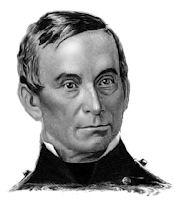
ROBERT ANDERSON,

Major, First Artillery, Commanding.
(Private)

New York, November 22, 1860.

My Dear Sir,— . . . We have divers reports of disagreements in the Cabinet in regard to the disunion movements in the South. I hear nothing from Cobb in reply to my letter.

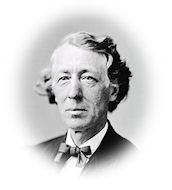
There is a great fallacy at the basis of all the secession movements. It is this, that the violation of a compact by one of the parties releases all, assuming our federal system to be identical with a contract between individuals for certain purposes. It is totally different, and is not subject to the same reasoning and conclusions. The States have organized a central government and ceded to it a part of their sovereignty. The violation of the compact, to warrant a release of the parties, must be on the part of the central government, and not of one of the associates. Mr. Cushing, in his late letter, loses sight of this distinction—a vital one, as I think, in all our reasonings concerning the present disunion movements. In haste, I am,

Truly yours,

John A. Dix.

Hon. Horatio King.

To the Hon. Herschel V. Johnson

Speir’s Turnout, Jefferson City, Ga.

New York, November 22, 1860.

My Dear Sir,—I have seen with great satisfaction that amidst all the turmoil of passionate madness, fed by the incendiary speeches of Yancey and Toombs, your patriotic voice is loud in favor of the Union.

Heaven grant that the wise counsels of such men as you, and the noble Alex. Stephens, may be listened to, and that our Southern brethren may act firmly and manly, but without precipitation. In that case all must in the end come right, and the South will ride triumphantly through the storm.

My only fear is that the secession leaders, reckless of patriotic considerations, and only bent upon the accomplishment of their treasonable ends, may succeed in manufacturing packed conventions in South Carolina, Georgia, and Alabama, for the purpose of precipitating secession without an appeal to the people.

This ought to be prevented at all hazards, and I hope that you, and other patriotic leaders, will rouse the people of your State to a full appreciation of the nefarious game played by their pretended friends. I have expressed my views more at length in a letter, which I addressed to-day to Mr. Forsyth, and of which I beg to hand you a copy.

The South has got the game in her own hands, and it is for her to choose whether to give peace and greatness to our common country, while at the same time securing for herself every Constitutional right, or whether to bury us all in one desolating ruin, which would be to the enemies of human liberty a vindication of the justice of their uncompromising opposition to self-government. The dissolution of the American Union is the death-knell of human liberty.

November 21.—Aunt Ann gave me a sewing bird to screw on to the table to hold my work instead of pinning it to my knee. Grandmother tells us when we sew or read not to get everything around us that we will want for the next two hours because it is not healthy to sit in one position so long. She wants us to get up and “stir around.” Anna does not need this advice as much as I do for she is always on what Miss Achert calls the “qui vive.” I am trying to make a sofa pillow out of little pieces of silk. Aunt Ann taught me how. You have to cut pieces of paper into octagonal shape and cover them with silk and then sew them together, over and over. They are beautiful, with bright colors, when they are done. There was a hop at the hotel last night and some of the girls went and had an elegant time. Mr Hiram Metcalf came here this morning to have Grandmother sign some papers. He always looks very dignified, and Anna and I call him “the deed man.” We tried to hear what he said to Grandmother after she signed her name but we only heard something about “fear or compulsion” and Grandmother said “yes.” It seems very mysterious. Grandfather took us down street to-day to see the new Star Building. It was the Town House and he bought it and got Mr Warren Stoddard of Hopewell to superintend cutting it in two and moving the parts separately to Coach Street. When it was completed the shout went up from the crowd, ” Hurrah for Thomas Beals, the preserver of the old Court House.” No one but Grandfather thought it could be done.

CHARLESTON ARSENAL November 20, 1860.

Col. H. K. CRAIG,

Ordnance. Department:

SIR: In obedience to the instructions of the War Department I came to this place and have assumed command of the arsenal. The excitement concerning this arsenal which existed here a short time since is very much allayed, and this result is in a great measure due to the prudence and discretion of the military storekeeper, Mr. Humphreys, whose conduct on the occasion meets my commendation.

Very respectfully, your obedient servant,

BENJ. HUGER,

Brevet-Colonel, U. S. Army.

[Indorsement.]

ORDNANCE OFFICE, November 24, 1860.

Respectfully submitted to the Secretary of War for his information.

WM. MAYNADIER,

Captain of Ordnance.

New York Tribune, November 19, 1860.—

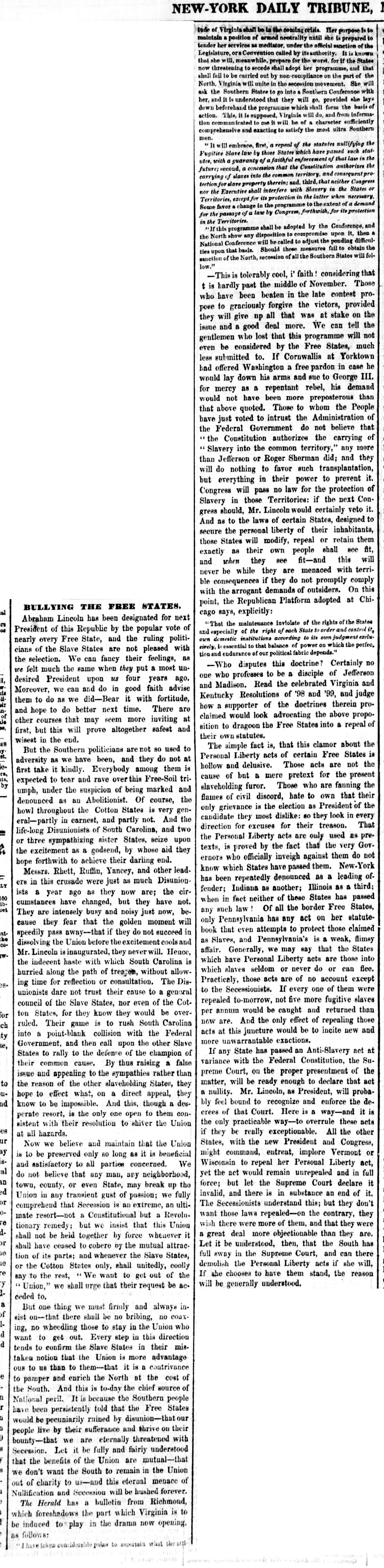
ny_tribune_11-19-1860Now we believe and maintain that the Union is to be preserved only so long as it is beneficial and satisfactory to all parties concerned. We do not believe that any man, any neighborhood, town, county or even State may break up the Union in any transient gust of passion; we fully comprehend that secession is an extreme, an ultimate resort—not a constitutional but a revolutionary remedy. But we insist that this Union shall not be held together by force whenever it shall have ceased to cohere by the mutual attraction of its parts; and whenever the slave States or the cotton States only shall unitedly and coolly say to the rest, ”We want to get out of the Union,” we shall urge that their request be acceded to.

This paragraph, from Horace Greeley’s New York Tribune, is cited in a number of 19th century books on the war.

Of course it was but one part of a longer article, which was titled, “Bullying The Free States.”

Click on the clipping to view the whole article image (1.62 mbytes)