Following the American Civil War Sesquicentennial with day by day writings of the time, currently 1863.

November 2010

From Ulysses Doubleday to John G. Nicolay1

Bank of North America

New York Nov 18. 1860

Dear Sir.

Since I last wrote, enclosing letters from my brother, I have received many others from him, which, coupled with other information in my possession, left no doubt in my mind of the complicity of the President with the designs of the secessionists. I took my proofs, when the election was over, to the editor of the Evening Post, in which a series of articles has been commenced, exposing Mr. Buchanan’s treason, with the hope that the publicity thus given to it, may force him to do at least part of his duty. These articles have been brought to Mr. B’s personal notice, and both he and Secretary Floyd2 have denied their truth. As they are true, this looks as if they were becoming frightened, and the superseding of Col. Gardner,³ an avowed secessionist, by Maj. Anderson4 a loyal Kentuckian, seems still further to confirm this idea. My brother writes that a settled determination to have the forts, as a necessity of their positions, is evinced by the South Carolinians, who begin to ask why the President does not keep his promise to withdraw the troops. I think he is afraid, and, by directing public attention to these disclosures, hope to force him to send more troops. This would greatly simplify Mr Lincoln’s position after the 4th of March. The present aspect of financial affairs here, though gloomy, is not nearly so bad as in 1857. The simple fact that our exports largely exceed our imports is a proof that in a very short time gold must flow this way from Europe in large amounts. I look to a decided and permanent improvement in less than thirty days. I do not expect any answer to this letter.

Respy Yours

U. Doubleday

_____

Note 1 — Ulysses Doubleday was the brother of Abner Doubleday, a captain in the U. S. Army who was stationed at Charleston Harbor. Ulysses Doubleday sent copies of his brother’s letters to Lincoln.

Note 2 — John B. Floyd

Note 3 — Lieutenant Colonel John L. Gardner commanded the U. S. forces at Charleston Harbor until he was replaced by Major Robert Anderson in November 1860.

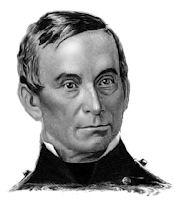
Note 4 —Robert Anderson

Fort Moultrie

November 17, 2010

Harper's Weekly

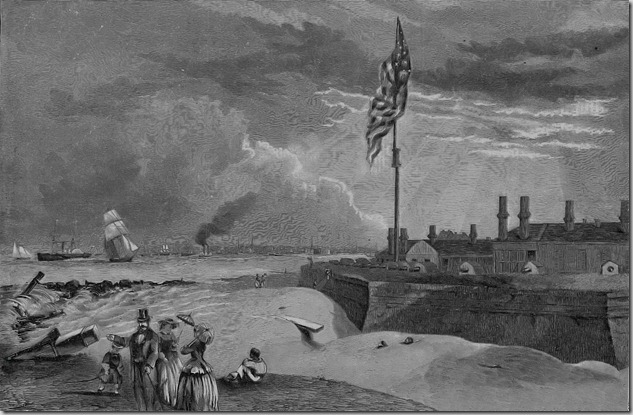
Fort Moultrie (Sullivan’s Island).  Charleston, South Carolina in the Distance – Harper’s Weekly, November 17, 1860

Fort Moultrie (Sullivan’s Island).  Charleston, South Carolina in the Distance – Harper’s Weekly, November 17, 1860

(Private and confidential.)

SPRINGFIELD, ILL., November 16, 1860.

My dear Sir: Mr. Ridgely showed me a letter of yours in which you manifest some anxiety that I should make some public declaration with a view to favorably affect the business of the country. I said to Mr. Ridgely I would write you to-day, which I now do.

I could say nothing which I have not already said, and which is in print, and accessible to the public. Please pardon me for suggesting that if the papers like yours, which heretofore have persistently garbled and misrepresented what I have said, will now fully and fairly place it before their readers, there can be no further misunderstanding. I beg you to believe me sincere when I declare I do not say this in a spirit of complaint or resentment; but that I urge it as the true cure for any real uneasiness in the country that my course may be other than conservative. The Republican newspapers now and for some time past are and have been republishing copious extracts from my many published speeches, which would at once reach the whole public if your class of papers would also publish them.

I am not at liberty to shift my ground—that is out of the question. If I thought a repetition would do any good, I would make it. But in my judgment it would do positive harm. The secessionists per se, believing they had alarmed me, would clamor all the louder.

Yours, etc.,

A. LINCOLN.

.
.

SPECIAL ORDERS,
No. 137.

HEADQUARTERS OF THE ARMY,
New York, November 15, 1860.

Major Robert Anderson, First Artillery, will forthwith proceed to Fort Moultrie, and immediately relieve Bvt. Col. John L. Gardner, lieutenant-colonel of First Artillery, in command thereof; who, on being relieved, will repair without delay to San Antonio, Texas, and report to the commanding officer of the Department of Texas for duty, with that portion of his regiment serving therein.

By command of Lieutenant-General Scott:

L. THOMAS,

Assistant Adjutant, General.


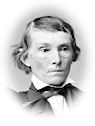
On November 14th, 1860, Alexander H. Stephens, soon to be vice-president of the Confederate States of America, argued against secession in a speech delivered before the Georgia legislature.  In it, he countered most, if not all of the arguments for secession and identified one of the strongest arguments against it:

The greatest curse that can befall a free people, is civil war.

While the exact phrase, “states’ rights,” is not specifically used, the rights of Georgia, “our rights, interest, and honor,” is a central theme to the speech.  Also important to the speech is the question of how successful Georgia would have been and would be in the future without being in the Union.

There are defects in our government, errors in our administration, and short-comings of many kinds, but in spite of these defects and errors, Georgia has grown to be a great State. Let us pause here a moment. In 1850 there was a great crisis, but not so fearful as this, for of all I have ever passed through, this is the most perilous, and requires to be met with the greatest calmness and deliberation.

There were many amongst us in 1850 zealous to go at once out of the Union—to disrupt every tie that binds us together. Now do you believe, had that policy been carried out at that time, we would have been the same great people that we are to-day? It may be that we would, but have you any assurance of that fact? Would we have made the same advancement, improvement, and progress, in all that constitutes material wealth and prosperity that we have?

Read the whole Speech Against Secession by Alexander H. Stephens

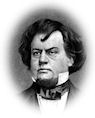
On November 13, 1860, U.S. Senator Robert Toombs gave a speech to the Legislature of Georgia on “the present state of the country and the prospect before us.”

For those interested, the complete speech is available.

Excerpts from the speech related to States’ rights (though that specific phrase was not used):

—–

We have not sought this conflict; we have sought too long to avoid it; our forbearance has been construed into weakness, our magnanimity into fear, until the vindication of our manhood, as well as the defence of our rights, is required at our hands.

—–

Mr. Jefferson acquired Louisiana, extending from the Balize to the British possessions on the north, and from the Mississippi to the Pacific Ocean — a country larger than the whole United States at the time of the acknowledgment of their independence. He guaranteed the protection of the Federal Government by treaty to all the inhabitants of the purchased territory, in their lives, liberties, property and religion — sanctioned by law the right of all the people of the United States to emigrate into the territory with all of their property of every kind, (expressly including slaves,) to build up new States, and to come into the Union with such constitutions as they might choose to make.

—–

With these vast advantages, ordinary and extraordinary, one would have supposed the North would have been content, and would have at least respected the security and tranquility of such obedient and profitable brethren; but such is not human nature. They despised the patient victims of their avarice, and they very soon began a war upon our political rights and social institutions, marked by every act of perfidy and treachery which could add a darker hue to such a warfare.

—–

The South at all times demanded nothing but equality in the common territories, equal enjoyment of them with their property, to that extended to Northern citizens and their property—nothing more. They said, we pay our part in all the blood and treasure expended in their acquisition. Give us equality of enjoyment, equal right to expansion—it is as necessary to our prosperity as yours.

—–

This conflict, at least, is irrepressible—it is easily understood—we demand the equal right with the North to go into the common Territories with all of our property, slaves included, and to be there protected in its peaceable enjoyment by the Federal Government, until such Territories may come into the Union as equal States—then we admit them with or without slavery, as the people themselves may decide for themselves.

—–

In pursuance of this clause of the Constitution, Congress, in 1797, during Washington’s administration, passed a Fugitive Slave law; that act never was faithfully respected all over the North, but it was not obstructed by State legislation until within the last thirty years; but the spirit of hostility to our rights became more active and determined, and in 1850 that act was found totally insufficient to recover and return fugitives from labor; therefore the act of 1850 was passed.

—–

Some of them punish us with penitentiary punishment as felons for even claiming our own slaves within their limits, even by his own consent; others by ingenious contrivances prevent the possibility of your sustaining your rights in their limits, where they seek to compel you to go, and then punish you by fine and infamous punishments for asserting your rights and failing to get them. This is the fidelity of our brethren (!) to their plighted faith—their of repeated oaths! Yet some excellent people among us want some more of such securities for our rights, our peace, and security.

—–

Within a year or two after, a similar case occurred with New-York, while Seward was Governor. He refused, and attempted to cover himself under the idea that there could be no property in slaves. Virginia made the same demand on him, with like results and like submission; and from that day to this that constitutional right has been practically surrendered in the case of negro-stealing.

—–

Gentlemen, I have thus shown you the violations of our constitutional rights by our confederates; I have shown you that they are plain, palpable, deliberate, and dangerous; that they are committed by the executive, legislative, and judicial departments of the State governments of our confederates—that all their wrongs are approved by the people of these States.

—–

I say the election of Lincoln, with all of its surroundings, is sufficient.  What is the significance of his election? It is the indorsement, by the non-slaveholding States, of all those acts of aggression upon our rights by all these States, legislatures, governors, judges, and people. He is elected by the perpetrators of these wrongs with the purpose and intent to aid and support them in wrong-doing.

—–

As for me, I will take any place in the great conflict for rights which you may assign. I will take none in the Federal Government during Mr. Lincoln’s administration.

—–

Make my name infamous forever, if you will, but save Georgia. I have pointed out your wrongs, your danger, your duty. You have claimed nothing but that rights be respected and that justice be done. Emblazon it on your banner— fight for it, win it, or perish in the effort.

ADJUTANT-GENERAL’S OFFICE,
Washington, D. C., November 12, 1860.

Maj. ROBERT ANDERSON,
First Artillery, Care of A. A. G., Hdqrs. Army, New York:

SIR: The Secretary of War desires to see you, and directs that you proceed to this city and report to him without unnecessary delay.

I am, sir, very respectfully, your obedient servant,

S. COOPER,

Adjutant-General.

CHARLESTON ARSENAL, S.C.,
November 12, 1860.

Col. H. K. CRAIG,

Chief of Ordnance, U. S. A., Washington, D.C.:

SIR: In view of the excitement now existing in this city and State, and the possibility of an insurrectionary movement on the part of the servile population, the governor has tendered, through General Schnierle, of South Carolina Militia, a guard, of a detachment of a lieutenant and twenty men for this post, which has been accepted.

Trusting that this course may meet the approval of the Department, I am, sir, very respectfully, your most obedient servant,

F. C. HUMPHREYS,

Military Storekeeper Ordnance, Commanding.

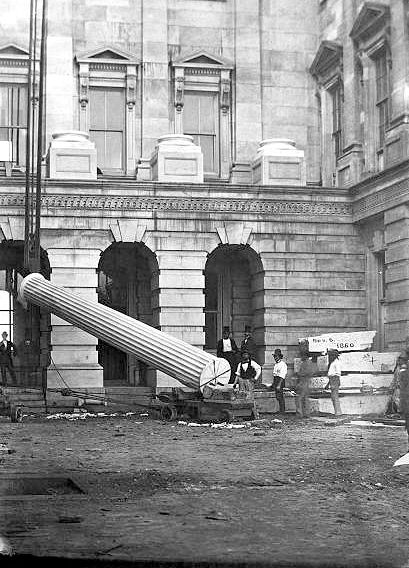
The "Lincoln column," first monolith raised, Nov. 1860, Presidential election, being S. column of connecting corridor

The “Lincoln column,” first monolith raised, Nov. 1860, Presidential election, being S. column of connecting corridor

Date Created/Published: 1860 Nov. 6.

Photo shows construction at U.S. Capitol, including African American workmen with a column named in the photograph to recognize Abraham Lincoln’s election as president on Nov. 6, 1860.

http://hdl.loc.gov/loc.pnp/cph.3b32800

Note:  The Library of Congress web page has the date for the photo as November 6, which was election day.  The results were not known until the next day, so the LOC date in not correct.  Without significant  further research, I think the best that can be said is for the date is some time in November 1860. The title should likely also say that this was the first monolith raised in November.  The construction was quite far along at this point in time, with many other columns in place.

The “Lincoln column,” first monolith raised, Nov. 1860, Presidential election, being S. column of connecting corridorThe “Lincoln column,” first monolith raised, Nov. 1860, Presidential election, being S. column of connecting corridor

To JOHN FORSYTH,

Mobile Ala.

New York, November 11, 1860

My Dear Sir,—I have followed, with the most intense anxiety, the events which the election of Lincoln has called forth at the South. While I fully appreciate the legitimate grievances of your section of the country, I deprecate sincerely the means which a large portion of your citizens seem-determined to adopt for their redress.

Nobody can regret more than I do the election of Lincoln, and I certainly need not tell you how earnestly I strove to prevent that calamity; but now that we are defeated, I think that it behooves every good Democrat, North and South, to reflect calmly upon what course it will be most wise and patriotic to pursue, in order to guard against the evils with which a Republican administration threatens our country. I take it for granted that a large majority of our Southern brethren are in favor of the Union, provided they can have their rights secured under the Constitution, and their property protected against the inroads of Northern Abolitionism. I hope and trust that the disunionists per se stand alone in their conspiracy against the Union, which they have labored to undermine for the last twenty years. Unfortunately, they have been able to bring a large number of the patriotic men of the South to the belief that Lincoln’s election is a convincing proof of an overwhelming anti-slavery feeling at the North; but this is by no means the case, and it is evident that the unfortunate result of the late election was mainly owing to other causes.

The country at large had become disgusted with the misrule of Mr. Buchanan, and the corruption which disgraced his administration. The Democratic party was made answerable for his misdeeds, and a change was ardently desired by thousands of conservative men out of politics. This feeling was particularly strong in the rural districts, and did us infinite harm there.

Had we made an unanimous nomination at Charleston, we should most probably have overcome our opponents; though, for the reason just named, our struggle must have, in any event, been a severe one. But unfortunate dissensions paralyzed our forces at the very outset. When the delegates of the cotton States, under the leadership of Yancey, seceded at Charleston, breaking up the National Convention, they sealed the doom of the Democratic partv, and elected Mr. Lincoln. Will the people of the South now allow these very men to reap the fruits of their reckless course by aiding and sustaining them in their efforts to shatter the magnificent fabric of our Union, which has blessed until now this vast Republic with never-equalled greatness and prosperity? Is Mr. Yancey’s programme to precipitate the South into a revolution, to be carried out by those patriots who, with you, have thus far so nobly fought against him and his nefarious doctrines ? Is it statesmanlike, is it manly, to withdraw from the contest when it becomes most fierce, and when victory (not of an ephemeral power and patronage, but of lasting guaranties and principles) is within our grasp? Is it generous and kind to leave the brave and loyal men of the North, who have stood by you and your rights, and have led a forlorn hope against the most fearful odds—is it right and just, I say, to forsake them in the hour of need, and doom them to a hopeless minority ?

If the Southern character is prominent for any qualities more than others, it is for unflinching courage and noble generosity. These virtues have taught me to cherish and honor the chivalrous South, and I appeal through you to those sentiments, that our Southern friends may pause before leaving the field to their enemies, and abandoning their faithful allies to the mercy of a ruthless victor.

But while I implore them to pause, I am far from wishing them to retrace their steps. A firm, uncompromising, and united position must secure to them their rights and equality under the Constitution. The conservative mind at the North is anxious and ready to co-operate with them, and the reaction which has already taken place among thousands who voted for Lincoln, promises most conclusively a satisfactory solution of our troubles. Only, do not allow the violent men among you to force the Southern people under the whip of packed conventions, into any hasty and inconsiderate steps. No convention should be formed unless by a direct appeal to the people, and in such a convention every slave holding State should be represented. This, I am sure, would, under the recommendation of Congress and local legislatures, soon be followed by a general convention of all the States of the Union.

The faithful enforcement of the fugitive-slave law, and the equal rights of the States in the Territories, must, and will, be guaranteed to the South,—not by any enactments and compromises of Congress, which might at any time be repealed and tampered with, but by amendments to the Constitution of such a nature as to silence forever the just apprehensions of the South.

Upon the leading national men of the South devolves now the sacred duty of stemming the torrent of terrorism, conjured up by rash politicians. The time for a satisfactory settlement of these vital questions has never been more propitious. We have both houses of Congress on our side, and the conservative spirit of the country is appalled at the contemplation of our portentous future.

Already, now, the more moderate organs of the Republican party give strong evidence of this feeling. I hand you inclosed an extract from the New York Times, of yesterday, recommending measures of compromise and justice to the South. The article receives additional importance from the fact that the editor of the Times is one of the leading lights among the Republicans.

Excuse this lengthy epistle ; but the subject is fraught with such deep interest that volumes would not exhaust it. I hope you will find a few moments of leisure to let me hear from you, and I trust that you may, by God’s blessing, be able to give me cheerful tidings.