Following the American Civil War Sesquicentennial with day by day writings of the time, currently 1863.

January 2013

Washington Saturday Jan’y 24th 1863

Mild and pleasant today, not much like winter. We have passed a quiet day, no Stirring news afloat and no startling rumors. Some successes of our Western gun Boats under the gallant Porter on the White River are published. The news boys cry it as “another Union Victory.” Let us take it as such for we need them badly just now. I cannot imagine where we are drifting to as a Nation. An immense Army and (I may almost say) nobody competent to command it. A country with inexhaustable resources and (I may almost say again) nobody competent to direct and apply its energies. In the present fearful crisis, we have realy no Talented Statesman, no public Men (who are up to the “times”) directing the affairs of the Nation, no Military genius to direct our great “Army of the Potomac,” and the army itself is now melting away by resignations of officers, and desertions, at a fearful rate. When drafting in the States has proved a failure, how is it ever to be recruited or preserved from utter ruin unless it soon wins a victory. I have spent the most of this evening with Vanmaster at his office on the Avenue. Bouge came in (quite sober). He is the pink of assurance and self confidence, but poor and needy. Poor Bouge. Twenty years ago he was the (“nice young man” the Ladies Man in Lyons) now geting old, living as it were by chance, the wreck of his former self, the sad effects of “wine & women.” I have not been interupted by any calls today, have worked some & read a good deal.

Saturday, 24th—We had some rain early this morning, followed by a heavy fog which lasted all day. Boats loaded with troops are constantly arriving and landing at different points along the river where the men are going into camp. Some of our boys are quite sick, the result of using the river water on the way down. Accidents are not common here considering the large number of men crowding as they do, but today a private of the First Kansas Infantry fell from the boat and was drowned before help could reach him.

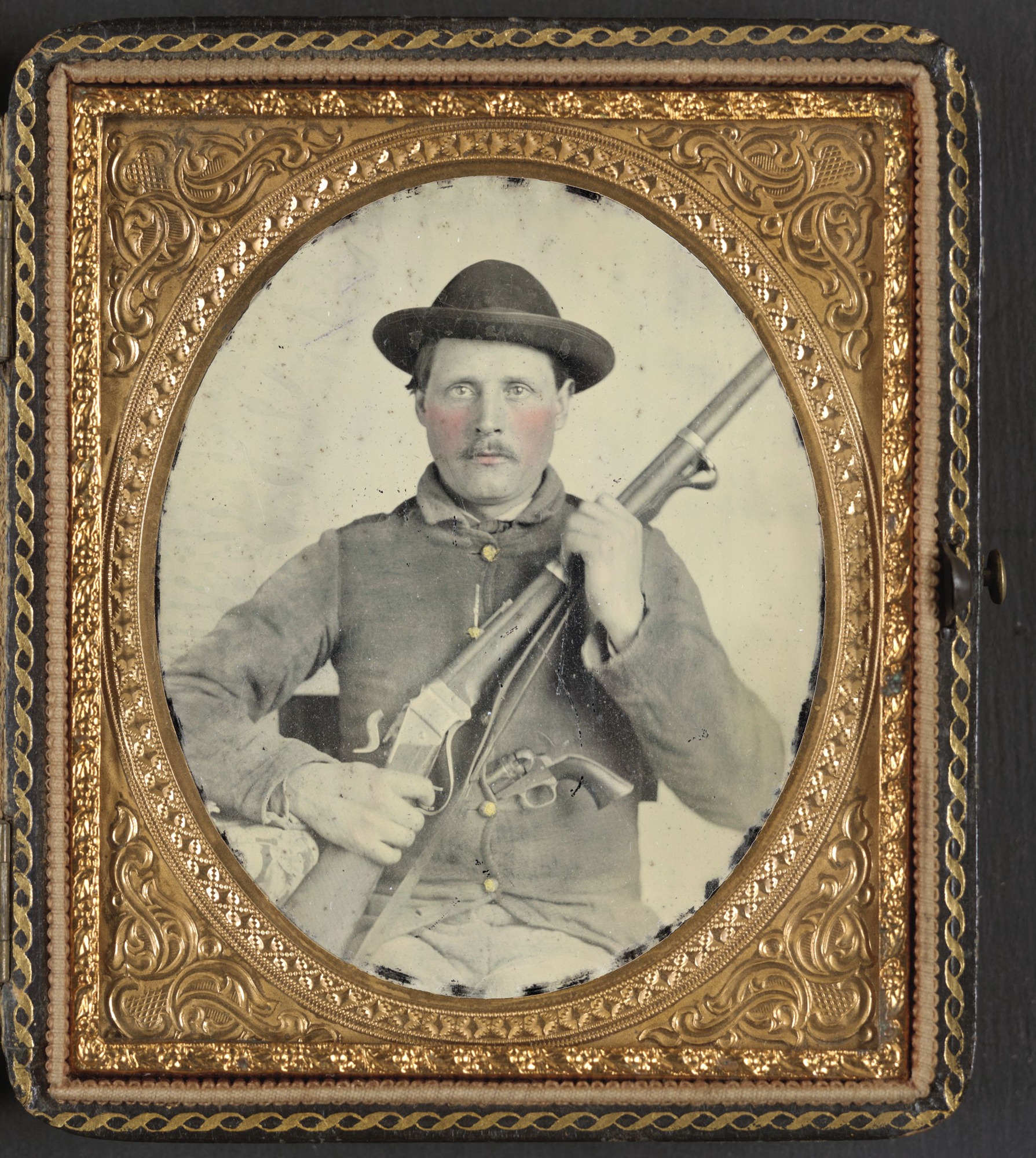
Unidentified soldier in Confederate uniform with Berdan's Sharps rifle and Colt 1862 Police Model pistol

Medium: 1 photograph : sixth-plate ambrotype, hand-colored ; 9.3 x 8.0 cm (case).

Gift; Tom Liljenquist; 2012;

Liljenquist Family Collection of Civil War Photographs; Ambrotype/Tintype photograph filing series; Library of Congress Prints and Photographs Division.

Record page for image is here.

Civil War Portrait 020

January 24.—General Dodge, commanding the military district of Corinth, Miss., reported that the rebels were putting to death many of the inhabitants of his district, for the only reason that they were loyal and Union-loving people. He gave the names of several who were hanged, others who were hunted down by bloodhounds, and of others whose houses were burned over their heads.—(Doc. 111.)

—The steamer Warsaw, while on her way to Memphis, was fired into by a rebel battery of two guns, at Island No. 84, on the Mississippi River.—Brigadier-General Daniel S. Donelson was appointed to the command of the rebel department of East-Tennessee, in the place of General E. Kirby Smith.—Richmond Whig.

by John Beauchamp Jones

JANUARY 24TH.—Gen. Smith writes that he deems Wilmington in a condition to resist any attacks.

The exposition of Mr. Benjamin’s dispatches has created profound mortification in the community.

Another transport has been taken from the enemy in the Cumberland River. No further news from Arkansas.

There is a white flag (small-pox) within seventy yards of our house. But it is probable we must give up the house soon, as the owner is desirous to return to it—being unable to get board in the country.

Gen. Rains, who has been making a certain sort of primer, met with an accident this morning; one of them exploded in his hand, injuring his thumb and finger. He was scarcely able to sign his name to official documents to-day.

Mr. Hunter has brought forward a measure for the funding of Treasury notes, the redundant circulation having contributed to produce the present fabulous prices in the market.

In the New Jersey Legislature petitions are flowing in denunciatory of Lincoln’s Emancipation scheme, which would cast into the free States a large excess of profitless population.

Buntyn Station, Saturday, Jan. 24. Rainy and dark all day. Health good. Battery in general dull from the effects of last night’s carousal.

image


Friday night, January 23d.

I am particularly happy to-day, for we have just heard from Brother for the first time since last July. And he is well, and happy, and wants us to come to him in New Orleans so he can take care of us, and no longer be so anxious for our safety. If we only could! —To be sure the letter is from a gentleman who is just out of the city, who says he writes at Brother’s earnest request; still it is something to hear, even indirectly. One hundred and fifty dollars he encloses with the request that mother will draw for any amount she wishes. Dear Brother, money is the least thing we need; first of all, we are dying for want of a home. If we could only see ours once more!

During this time we have heard incidentally of Brother; of his having taken the oath of allegiance —which I am confident he did not do until Butler’s October decree — of his being a prominent Union man, of his being a candidate for the Federal Congress, and of his withdrawal; and finally of his having gone to New York and Washington, from which places he only returned a few weeks since. That is all we ever heard. A very few people have been insolent enough to say to me, “Your brother is as good a Yankee as any.” My blood boils as I answer, “Let him be President Lincoln if he will, and I would love him the same.” And so I would. Politics cannot come between me and my father’s son. What he thinks right, is right, for him, though not for me. If he is for the Union, it is because he believes it to be in the right, and I honor him for acting from conviction, rather than from dread of public opinion. If he were to take up the sword against us to-morrow, Miriam and I, at least, would say, “If he thinks it his duty, he is right; we will not forget he is our father’s child.” And we will not. From that sad day when the sun was setting for the first time on our father’s grave, when the great, strong man sobbed in agony at the thought of what we had lost, and taking us both on his lap put his arms around us and said, “Dear little sisters, don’t cry; I will be father and brother, too, now,” he has been both. He respects our opinions, we shall respect his. I confess myself a rebel, body and soul. Confess? I glory in it! Am proud of being one; would not forego the title for any other earthly one!

Though none could regret the dismemberment of our old Union more than I did at the time, though I acknowledge that there never was a more unnecessary war than this in the beginning, yet once in earnest, from the secession of Louisiana I date my change of sentiment. I have never since then looked back; forward, forward! is the cry; and as the Federal States sink each day in more appalling folly and disgrace, I grow prouder still of my own country and rejoice that we can no longer be confounded with a nation which shows so little fortitude in calamity, so little magnanimity in its hour of triumph. Yes! I am glad we are two distinct tribes! I am proud of my country; only wish I could fight in the ranks with our brave soldiers, to prove my enthusiasm; would think death, mutilation, glorious in such a cause; cry, “War to all eternity before we submit.” But if I can’t fight, being unfortunately a woman, which I now regret for the first time in my life, at least I can help in other ways. What fingers can do in knitting and sewing for them, I have done with the most intense delight; what words of encouragement and praise could accomplish, I have tried on more than one bold soldier boy, and not altogether in vain; I have lost my home and all its dear contents for our Southern Rights, have stood on its deserted hearthstone and looked at the ruin of all I loved—without a murmur, almost glad of the sacrifice if it would contribute its mite towards the salvation of the Confederacy. And so it did, indirectly; for the battle of Baton Rouge which made the Yankees, drunk with rage, commit outrages in our homes that civilized Indians would blush to perpetrate, forced them to abandon the town as untenable, whereby we were enabled to fortify Port Hudson here, which now defies their strength. True they have reoccupied our town; that Yankees live in our house; but if our generals said burn the whole concern, would I not put the torch to our home readily, though I love its bare skeleton still? Indeed I would, though I know what it is to be without one. Don’t Lilly and mother live in a wretched cabin in vile Clinton while strangers rest under our father’s roof? Yankees, I owe you one for that!

Well! I boast myself Rebel, sing “Dixie,” shout Southern Rights, pray for God’s blessing on our cause, without ceasing, and would not live in this country if by any possible calamity we should be conquered; I am only a woman, and that is the way I feel. Brother may differ. What then? Shall I respect, love him less? No! God bless him! Union or Secession, he is always my dear, dear Brother, and tortures could not make me change my opinion.

London, January 23, 1863

The Emancipation Proclamation has done more for us here than all our former victories and all our diplomacy. It is creating an almost convulsive reaction in our favor all over this country. The London Times furious and scolds like a drunken drab. Certain it is is, however, that public opinion is very deeply stirred here and finds expression in meetings, addresses to President Lincoln, deputations to us, standing committees to agitate the subject and to affect opinion, and all the other symptoms of a great popular movement peculiarly unpleasant to the upper classes here because it rests altogether on the spontaneous action of the laboring classes and has a pestilent squint at sympathy with republicanism. But the Times is on its last legs and has lost its temper. They say it always does lose its temper when it finds such a feeling too strong for it, and its next step will be to come round and try to guide it. We are much encouraged and in high spirits. If only you at home don’t have disasters, we will give such a checkmate to the foreign hopes of the rebels as they never yet have had….

London, January 23, 1863

Our customary midweek intelligence has not arrived, owing I suppose to the violence of the storms delaying the steamers, so that we are now fifteen days back. In the meantime the President’s proclamation is doing much for us on this side. That is put in contrast to the paper of Jefferson Davis, much to the advantage of the former. The middle classes generally see and comprehend the existence of a moral question apart from all political disquisitions. The effect is to bring out an expression in popular meetings which is doing something to neutralise the opposite tendency of the governing people. Mr. Seward has printed so largely from my Despatches of last year, that there is now no misunderstanding here of what I think on this matter. I fear that I have forfeited the favor of my aristocratic friends by performing my duty of disclosing their tendencies, but as I have had not unsimilar experiences heretofore at home, perhaps I take it with less uneasiness. There are always great exceptions to be made. And after all, the position of a foreign minister must necessarily be one to inspire caution in making intimacies. My acquaintance is already quite as extensive as I can keep up with. The profound quiet of the months which intervene during the absence of Parliament is almost at an end. On the 5th of February the respective forces in the political campaign will be marshalled, and the war of ins and outs will begin. Although they are nearly equal in numbers I do not find much expectation of an overthrow of the ministry. Lord Palmerston is very popular, and he means to hold on to power as long as he can. If the opposition throw him in the House, he will only appeal to the people, and the chances are that he may sustain himself. For though the special vacancies have been filled rather favorably to the opposition, it is singular that the successful candidates generally pledge themselves to support Lord Palmerston. Thus is shown the singular spectacle of a leader who mounts two parties at the same time and yet having the entire confidence of neither. Such a state of things will not survive his Lordship. And he is nearly eighty years old! So it is not unreasonable to presume that a change cannot be far distant. The question what might be the effect on American affairs is that which gives us an interest in the result. I trust that before it happens we may be so far on our way to a result at home as to save all risk of trouble….

January 23, Friday. As I anticipated, continued and increasing abuses and much illicit traffic are going on under the army permits issued by General Dix to pass the blockade. It will be difficult to stop the abuse, now that it has commenced.

I have sent to Congress a communication with a view to getting an expression of opinion on the subject of League Island for naval purposes.

By request of Senator Foot of the Naval Committee, prepared a bill in relation to midshipmen and sent it with a letter.