Following the American Civil War Sesquicentennial with day by day writings of the time, currently 1863.

January 2013

Sunday Jan’y 25th 1863

Attended religious Service in the Senate Chamber this morning, heard Mr Conway from Cincinnati. His Sermon was most excellent till he began to treat upon the subject of Slavery. On that he was most ultra. Altho a Virginian he was fairly driven out of Washington a few years ago for preaching Anti Slavery sermons in the Unitarian Church. He makes Slavery his “hobby,” and vies with Wendal Phillips in his extravagant views. We dine at two on Sundays after which I spent a couple of hours in the Ascension Hospital, and then called upon Mr & Mrs Bemis at the “Herndon House” where I spent an hour. Capt Denison and Judge Phelps from Canandagua were there. From there I went down to “Willards” to hear any news which might be stirring. It is reported there tonight that Genl Burnside has resigned the command of the “Army of the Potomac.” If it is true, it is well. I do not think he has confidence enough in himself, and I doubt whether the other officers have enough confidence in him. Who is to follow Joseph Hooker, I think. Conversed awhile with Mr Hatch who has two sons (officers in the Army). He thinks they are the smartest and the bravest in the Army. Saw and talked awhile with Doct Sheldon, of the Medical Directors office. He understands that Doct Taft (Charley) has made out all of Doct Dorrs reports. Dr D is the Surgeon superintending the “Ascension Genl Hospital,” 4 churches formerly, now only two. No War news at all today. We are expecting to hear from our army in N.C. every day now, and also from the south western armies.

Sunday, 25th—We moved up the river today about a mile and disembarked on the Louisiana side, going into camp right on the bank. We are from ten to fifteen feet below the water in the river, while the levee is twenty-five or thirty feet higher than our camp. Company E was to go on picket, but the order was countermanded, and then at dark a detail of one thousand men, I being one, from our division, was chosen to go down the river to work on the canal which is being cut across the point of land opposite Vicksburg. It is a fearful mudhole to work in. A large number of negroes are put on the job. The rebels try to shell the place, but their shells all fall short.

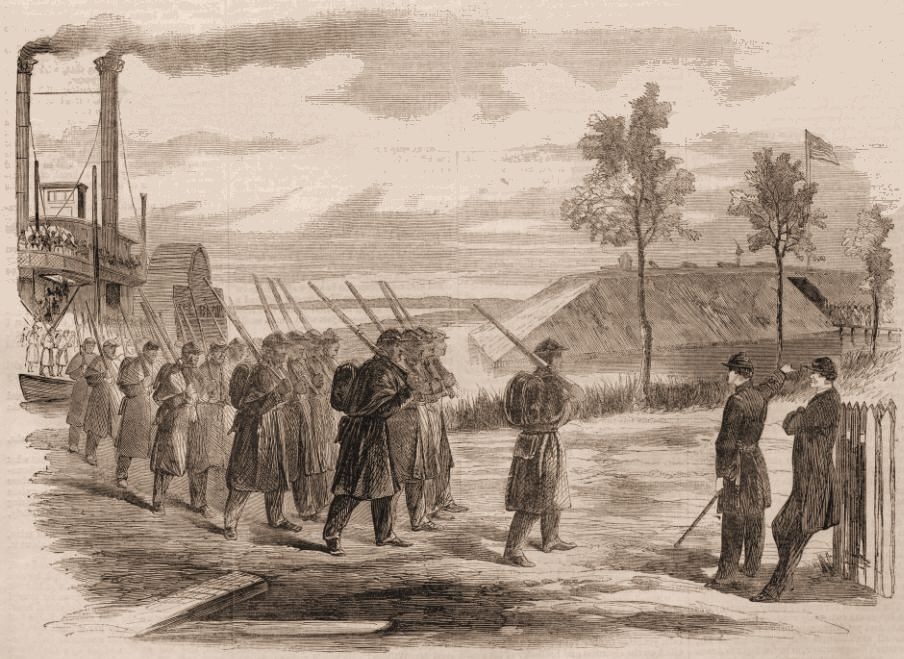
Our Colored Troops at Work—The First Louisiana Native Guards Disembarking at Fort Macombe, Louisiana

WE publish on page 133 two illustrations of THE FIRST LOUISIANA NATIVE GUARDS, from sketches by our special artist, Mr. Hamilton.

It is now some five months since General Butler’s attention was called, by certain free colored men in New Orleans, to the fact that they held commissions from Governor Moore, of Louisiana, as duly enrolled officers of the Confederate army, and requesting to transfer their services to the United States. General Butler, with that keen perception for which he is so remarkable, at once saw the bearings of this important matter, granted the request of his applicants, and issued his order mustering the regiment into our service, under the command of Colonel (then Lieutenant-Colonel) Spencer H. Stafford, one of his aids-de-camp.

Although ready and anxious for a brush with the enemy, that opportunity has not yet been afforded them. They have hitherto been employed down in the Lafourche District, under the command of General Weitzel, guarding the bridges over important bayous, in a circuit of some thirty miles, and forming the base of Weitzel’s late expedition into the Teche District. That affair being over, and the General returned to his encampment at Thibodeaux, the Colonel of the Native Guards reported to the Department Head-quarters for further orders. On the evening of the 21st, pursuant to orders, eight Companies (comprising 800 men), embarked upon the Laurel Hill to join the garrison of Forts Jackson and St. Philip—four Companies to each fort—the remaining two Companies—A and D —being sent to Fort Macombe, on the Chef Menteur Pass, connecting Lakes Borgne and Pontchartrain.

The point selected by our special artist for illustration is the disembarkation from the steamer J. D. Brown, at Fort Macombe. The special New Orleans correspondent of the New York Times tells the following story of these men:

“You see my men can work, Sir, though people say they can’t fight,” said the Colonel, triumphantly. “We don’t trouble our heads much about transportation. Put me down in a forest with those same fellows, and I’ll build you a city; for I have every useful trade represented among them.”

At this moment a Captain came up to the Colonel, saluted him very respectfully, and, after receiving his order, went off.

“I understood you, Colonel,” said I, “that all your line officers were colored men: there goes one, at any rate, who is white.” The Colonel turned to me with a sarcastic smile:

“And do you really think him white? Well you may, Sir; but that man is a ‘negro’—one who carries the so-called curse of African blood in his veins.”

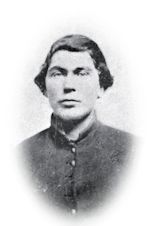
I was literally amazed. Often as my senses had been deceived in this matter, they never had been so completely before. This officer, Captain E. Davis, of Company A [his portrait is given in our group.—Ed.], was a fine-looking young man, not unlike General M’Clellan in mould of features, with light blue eyes, ruddy complexion, soft, silky hair, and a splendid mustache, of a sandy color, nearly approaching red. It would have defied the most consummate expert in Niggerology, by the aid of the moat powerful microscope, to discover the one drop of African blood in that man’s veins. Still there it was upon the record against him.

(Published in Harper’s Weekly, February 28, 1863)

by John Beauchamp Jones

JANUARY 25TH —Gen. Lee mentions, in his recent correspondence, an instance of the barbarity of some of the Yankee soldiers in the Abolition Army of the Potomac. They thrust into the Rappahannock River a poor old negro man, whom they had taken from his master, because he had the smallpox; and he would have been drowned had he not been rescued by our pickets. It is surmised that this dreadful disease prevails to an alarming extent in the Yankee army, and probably embarrasses their operations. Our men have all been vaccinated; and their recklessness of disease and death is perhaps a guarantee of exemption from affliction. Their health, generally, is better than it has ever been before.

The government at Washington has interdicted the usual exchange of newspapers, for the present. This gives rise to conjecture that Lincoln experiences grave difficulties from the adverse sentiment of his people and his armies regarding his Emancipation Proclamation. And it is likely he has met with grave losses at sea, for the invading army in North Carolina has retired back on Newborn. But the season for naval enterprises is not over, and we are prepared to expect some heavy blows before April.

The revelations in the intercepted dispatches captured with Mr. Sanders, whose father is a notorious political adventurer, may be most unfortunate. They not only show that we even were negotiating for six war steamers, but give the names of the firms in Europe that were to furnish them. The project must now be abandoned. And Louis Napoleon will be enraged at the suspicions and imputations of our Secretary of State regarding his occult policy.

Gen. Rains has invented a new primer for shell, which will explode from the slightest [click to continue…]

Buntyn Station, Sunday, Jan. 25. Sunny in the morning, but clouded over by afternoon and rained heavy while out on exercise; got beautifully wet. Received the N. Y. Tribune from John, mailed 18th. Letter from Mary, Jen and James (his first letter). May he be permitted to live a useful and intelligent life to comfort my aged parents. Prospect of their once more finding a home in Dodge Hollow, Iowa County. May they live to see their children once more gathered in the old homestead.

January 25.—The organization of the First regiment of colored South-Carolina loyal volunteers, was this day completed.—General Saxton, in announcing the event to the Secretary of War, said: “The regiment is light infantry, composed of ten companies of about eighty-six men each, armed with muskets and officered by white men. In organization, drill, discipline, and morale, this regiment, for the length of time it has been in service, is not surpassed by any white regiment in this department. Should it ever be its good fortune to get into action, I have no fear but it will win its way to the confidence of those who are willing to recognize courage and manhood, and vindicate the wise policy of the Administration, in putting these men into the field, and giving them a chance to strike a blow for the country and their own liberty. In no regiment have I ever seen duty performed with so much cheerfulness and alacrity; and as sentinels, they are peculiarly vigilant. I have never seen, in any body of men, such enthusiasm, and deep-seated devotion to their officers as exists in this; they will surely go wherever they are led. Every man is a volunteer, and seems fully persuaded of the importance of his service to his race. In the organization of this regiment, I have labored under difficulties which might have discouraged one who had less faith in the wisdom of the measure; but I am glad to report that the experiment is a complete success. My belief is, that when we get a footing on the main land, regiments may be raised, which will do more than any now in service to put an end to this rebellion. I have sent the regiment on an expedition to the coast of Georgia, the result of which I shall report for your information, as soon as it returns.”—General Saxton’s Report.

—A party of rebel cavalry attacked a train on the Nashville and Chattanooga Railroad, at a point nine miles below Nashville, captured and paroled fifty prisoners, and made an attempt to burn the cars, but National reinforcements approaching from different points, they left, after causing a partial destruction of two platform cars.—The obsequies of the rebel Major C. R. Wheat, were celebrated at Richmond, Va. — A battalion of Colonel Mix’s New-York cavalry surprised an important rebel picket station on the road from Newborn to Kinston, S. C, and captured nine rebel soldiers, with their arms and accoutrements.

Saturday, 24th.—Passed through Brandon, once the capital of Mississippi, at 10 A. M.

January 24, Saturday. Had a telegram at midnight from Admiral Porter of captures on White River.

Senator Foot yesterday resigned his seat on the Naval Committee. Some disagreement with Hale, the chairman, who plays the part of a harlequin as well as a demagogue, —is, I am told, a constant marplot and very contentious in the Committee, does nothing to assist but much to embarrass and counteract the Department. Grimes also asked to be excused for the same reason as Foot; does not conceal his dislike and detestation of Hale. The Senate did right in refusing to excuse him.

F. A. Conkling,[1] who, the President says, is “a mighty onhandy man,” called to give me a lecture and instructions relative to the appointment of midshipmen. Said Congress had the right to nominate and it was the duty of the Secretary to appoint. He could not tell me where Congress got that right, or the right to locate them in districts. Was compelled to admit that Congress could not dictate or nominate who should be judges of the Supreme Court, or say from what circuit or State the President should select them, but after a little controversy he acknowledged the cases were analogous. Forgetting his first starting-point, he wanted to know by what authority the Secretary of the Navy appointed midshipmen. I referred him to the Constitution and the laws, which I pointed out. Told him the President by and with the consent and approval of the Senate could make appointments, but Congress could by law confer or vest inferior appointments in the courts of law, heads of Departments, or the President alone; that Congress had, by law, vested the inferior appointment of midshipmen in the Secretary of the Navy, and I had, under that law, made appointments and should continue to do so. After tumbling over the statutes for some time, he found himself unable to controvert my position or to answer me, and left, apparently with a “flea in his ear.” No man ever came upon me more dogmatically, or left more humble.

In answer to Senator Fessenden, who is pushed forward by Preble to urge his restoration, I replied that in my opinion the time had not yet arrived, but, having made known my views, I should leave the subject with the Senate, claiming no infallibility for myself. F. expresses a willingness to take upon himself any responsibility, but did not wish to act in opposition to me, who, he said, had some, but not many, unscrupulous assailants who were anxious to get him in collision with me. He complimented my administration of the Department, which he had honestly sustained because he honestly approved it, and had been annoyed with the mischievous manœuvres of the Chairman of the Naval Committee, which, however, were well understood in the Senate and did me no harm. Preble’s note seeking restoration was surly and crusty. I suggested that on his own account he had better form a different one. Fessenden said he would consult any one I might name. Told him Davis or Smith were pretty good in such matters. F. laughed and said Smith wrote the note.

A California committee was on Tuesday before the Cab­net relative to the gauge of the Pacific Railroad. They gave each their views, — every one, I believe, in favor of the five-feet gauge. When they left, the President proposed a vote without discussion, — not that it should be conclusive but as an expression of the unbiased opinion of each. I was, for the present at least, for four eight and one half, chiefly for the reason that a change could be made from the wide to the narrow at less expense than the reverse; the aggregate cost will be millions less; that usage, custom, practical experience, knowledge proved the superiority of that gauge if they had proved anything, etc., etc. I believe the majority were for that gauge.

The Chronicle contains the argument of Judge-Advocate Holt in Fitz John Porter’s case. It seems to have been made after the finding of the Court instead of before, and is sent out with it as if in defense of the decision. The proceeding is singular and will be likely to cause censure. There is much of partisanship on both sides of Porter’s case. I have abstained from being mixed up in it, and have not had the time, nor am I called upon, to read the voluminous proceedings and comments. If the conviction is correct, the punishment is hardly adequate to, or commensurate with, the offense. I have thought Porter not alone in fault. More than one appeared to me culpable for the disasters of that period.

There is a change of commander of the Army of the Potomac. Burnside relinquishes to Hooker. I hope the change may be beneficial, but have apprehensions. The President asked me about the time of the Second Battle of Bull Run, when Pope was to leave and McClellan was out of favor: “Who can take command of this army? Who is there among all these generals?” The address to me was unexpected, and without much consideration I named Hooker. The President looked approvingly, but said, “I think as much as you or any other man of Hooker, but — I fear he gets excited,” looking around as he spoke. Blair, who was present, said he is too great a friend of John Barleycorn. I have mingled but little in the social or convivial gatherings of the military men, have attended fewer of the parades than any member of the Cabinet, and have known less of their habits. What I had seen and observed of Hooker had impressed me favorably, but our interviews had been chiefly business-wise and in the matter of duty, but there was a promptness, frankness, and intelligence about him that compared favorably with some others. I remarked, “If his habits are bad, if he ever permits himself to get intoxicated, he ought not to be trusted with such a command,” and withdrew my nomination. From what I have since heard, I fear his habits are not such as to commend him, that at least he indulges in the free use of whiskey, gets excited, and is fond of play. This is the result of my inquiries, and, with this reputation, I am surprised at his selection, though, aside from the infirmities alluded to, he doubtless has good points as an officer.

_________________________

[1] A Representative from New York, brother of Rowe Conkling.
Saturday. Went to Sydney Dameron’s little birth-night party; played a little for the young folks to dance. Met Mrs. Richardson, who has founded an asylum for old women, supported by contributions from both friends and enemy. The Federals have seized the city finances, also much private finances, and as they pretend to feed the poor, Mrs. R —— demanded bread of Colonel Deming with a sweet smile and a pretty play of words, “You are said to be the best-bred man in the city, Colonel Deming, and therefore I come to you for bread.” Needless to say she got her bread.

Mrs. Richardson was very anxious that Ginnie or I should write a few complimentary and regretful remarks to be published in the Picayune; subject, “The retirement of Colonel Deming from service.” I have never met the gallant Federal and have heard nothing which could incline me to take such a step, especially as she wished the remarks made in the name of the ladies of New Orleans. Mrs. R —— made him a perfect hero, and to quiet my objections, said she thought that our rulers here who had behaved like gentlemen should be complimented publicly, as a sort of distinction to them, and an acknowledgment on our part that we can appreciate kind treatment. Colonel Deming may be a hero; his resignation, I confess, speaks well for him, if he goes back to become a peace advocate, as Mrs. R —— says, but I thought it better for Mrs. R —— herself to take the responsibility of complimenting him. I told her that personal acquaintance was a great spur and that she could be much more eloquent than I on the subject. Mrs. Norton was anxious that we should accept Mrs. R ——’s proposal, though she hates the Federals, one and all, as bad as we do. She seemed to think it conferred, or would confer, some sort of distinction upon us, and told me I was too squeamish, when I said that I could not accept another’s interpretation of a man; indeed this wise lady seems to have little discrimination. She was eloquent in praise of Governor Shepley but a little while since, and as I have had several interviews with this gentleman, I would prefer to have some one else dissect character for me. The Ogden girls have been in town often, begging us to visit them at Greenville, also Mr. and Mrs. Randolph; so we have decided to go out and spend a week.

24th. Saturday. Spent a portion of the afternoon at Fannie’s. F. Henderson was there and we had a good time. Got home early and read in “Fantine” and visited with Ma. Read some in the February Atlantic.