January 12th. Nothing of importance is occurring now-adays to mark one day from another.
January 12th. Nothing of importance is occurring now-adays to mark one day from another.
January 12, Monday. Accounts from Vicksburg are unfavorable and vague. I fear there has been mismanagement, but we must wait official reports. It is said that Sherman has been superseded by McClernand. I know not how this is. At the commencement of this campaign, as early as last September, it was understood that McClernand was to have command of the army which was to go down the river and cooperate with our naval commander, Porter. The President had confidence in him, and designated the appointment, which was acceptable to Porter, who had a particular dislike of West-Pointers. For this I cared but little, because it was confessedly without knowledge of the officers individually and their merits, a close and a sweeping condemnation of all, — partly, I think, because he did not know them, and feared he should be compelled to play a subordinate part with them, while with a civilian general he would have superiority.
For three months, while Porter has been organising the Squadron, nothing has been heard of McClernand until since the attack on Vicksburg, and now it is merely to tell us he has abandoned the place and withdrawn his forces.
The rumor of the capture of the Harriet Lane with the little garrison at Galveston is confirmed. I am grieved and depressed, not so much for the loss of the Harriet Lane as from a conviction that there has been want of good management. It is about three months since we took Galveston, and yet a garrison of only three hundred men was there when the Rebel army approached the place. Some one is blamable for this neglect.
The court martial on Fitz John Porter closed last Saturday, and the rumor is that he was at once unanimously acquitted. Of the facts I know nothing. I have read none of the evidence. Shall be glad if he is blameless and it shall so appear. My impressions were that while he and some others were not disloyal, as charged, they did not support and sustain the general in command, Pope, in a great crisis as they should have done; that they performed their duty to the letter of the law, perhaps, but not with alacrity and zeal; that while they did not wish the country to suffer a reverse, it would not grieve them if Pope did. In all this I may be doing certain officers injustice. They were, however, the impressions made upon me at the time when disaster was impending and our soldiers were giving their blood and their lives to the country. I am no admirer of Pope, who has the reputation among those who know him of being untruthful and wholly unreliable, a braggart and blusterer. Wrong may be to some extent done him, but there is some cause for what is said of him. He was instrumental in bringing Halleck here, and Halleck gave him the army in return. Both came from the West, and, aided by Stanton and Chase, Pope was placed in command over generals who were his superiors in age, experience, and qualifications. This was as much, to say the least, to humiliate McClellan as to serve the country. Pope preceded Halleck here, but it was the same influence that initiated the two. It is not difficult to see who is the cause of their being here to supplant McClellan, whose tardy inaction here and on the Peninsula disheartened the nation. Fitz John Porter was one of the generals who had great faith in McClellan, who sympathized with him in good and evil fortune, but who was destitute of faith in Pope, as were nearly all his associates, who each, like their commander, felt wronged, almost insulted, by the exaltation of an officer from the Western Department, for whom they had not high regard, placed over them. The change of commanders could not inspire him with confidence and zeal, but if he permitted it to impair his efficiency he is inexcusable.
12th. Monday. Capt. N. called for me. Went into the house and stayed till noon, then went to the depot and met Melissa and S. R. N. Went with them to N.’s Aunt’s. Plain people. Returned to camp and went down with boys to Mr. Rice’s. Melissa there. Very good visit. Miss Cohen there, too. Libbie expects to go home Friday. (S. R. N. was Stiles Nettleton, brother of A. B. N.)
January 12th [1863]. “Picayune extra” is called through the streets to-day and late to-night. Terrible slaughter at the battle of Murfreesboro on both sides; all Rosecranz’s staff killed; Breckenridge’s division on our side defeated; the Federals mowed down by thousands and their slaughter, especially in officers, to use their own words, “heartrending.” The dauntless Confederates, our splendid braves, went down by thousands, leaving many a sweet babe fatherless and many a widow mourning. Ah, when will this deadly, wild war be past? The Monitor is destroyed. Lincoln about to take the field in person, and McClellan restored to command. He is the only Federal general I either fear or respect. Two long trains of artillery passed our door to-day.
One young officer particularly attracted my attention; he looked so truly gallant—some mother ‘s darling, I know. In his young enthusiasm he has come to fight for the Union; he will die for it, probably, without in any way contributing to its restoration. We find a great difference in the appearance of Banks’ troops and those of Butler; the last appeared to be mere scum of the earth, nevertheless I am sorry for them because they suffer. A Federal officer stopped at Mrs. Harrison’s gate a day or two ago, asking a few rosebuds that he might press them to send to his wife; there are no flowers where she is now. This pure remembrance and thought of the soldier touched me. I was touched, too, at the remark of a private passing the gate. “Here I am,” said he, “so many miles from home, and not a soul that cares a damn whether I live or die, or what becomes of me.” Another remarked, when the newsboy cried out “a new order,” “I wish it were an order for peace and one to go home.” Mrs. Norton got quite impatient with Miss Marcella Wilkinson to-day for praising several of the officers who had been kind to her family, and interested themselves in procuring the release of her brother, who had been arrested by Butler. Mrs. N thinks no-one can be a true Southerner and praise a Yankee. She thought it no honor “to be treated decently by one of the wretches; she wished the devils were all killed.” There is a difference even among devils, it seems, as some of Banks’ people do try to be kind to us, while Butler’s were just the reverse. How few people have an enlarged liberality! I wonder if it will ever be possible for a novelist to render to view the faults of his countrymen in this land; the mention of one failing even in private conversation raises a sort of storm, not always polite either. I am thought all sorts of things because I endeavor to do justice to all parties; one day I am an abolitionist, another a Yankee, another too hot a “rebel,” another all English, and sometimes I love my Maryland, and no other State; all the while I love my own land, every inch of it, better than all the world and feel a burning desire ever kindling in my heart that my countrymen should be first in all the world for virtue. They are so kind, so generous, so brave, so gallant to women that I desire for them all the good that belongs to human character, the graces of chivalry as well as its sturdy manhood, and the elegant liberality of philosophy and benevolence.
Went with Mrs. Dameron and Ginnie to look at a house, after the sale of her home; we found one room filled with pretty furniture, which the old man said he could not remove without asking Banks, or Clark, or some of our Yankee rulers, the owners thereof having left town when it was captured and being Confederates, their property having been seized. We found a garden filled with sweet blooming roses and jessamines and violets; also an old picture which interested me,”The Soldier’s Dream,” the foreground representing a man covered with a blanket by a rude camp fire; the background, which is misty and dreamlike, presents a woman and little ones clasping a returned soldier almost at the hamlet door. This picture made me very sad. It suits our present times very well. Will men ever be civilized and let war cease? Did not go out again all day, but saw several visitors in our rooms; I hate the squares and streets .and would be content in a prison to be rid of them.
Georgranna Woolsey to her brother-in-law, Joseph Woolsey.
P. G. HOSPITAL.
Thank you, my Colonel, for the doughnuts and comic papers. They are just what the men prize most, and under every pillow I shall establish a little nest of both! . . . I always accompany a “Life of Headley Vicars” with a piece of chewing tobacco. . . We are going to have a chapel in two weeks. At present it consists of eight holes in the ground and a tolerable fishing pond, but in one fortnight this will be a church and will stand next door to our house, leaving us no excuse for staying at home in the evening. We have embraced the puddles all along as argument against “protracted meetings.” . . . Jane and Sarah and H. Whetten have just been relating their refreshing experiences for the day, in the next room. Miss Wormeley is down stairs getting up her official correspondence with the Surgeon and Q.-M. General. The diet tables are all made out and consolidated for tomorrow, and several reproving notes to ward-masters sent in to meet them at breakfast; and now, nothing comes except the usual burglar and as much sleep as this howling, driving storm will let us have. . . .
Monday, 12th—We struck tent early this morning and at 8 o’clock took up the line of march, the entire Sixth Division being on the road bound for Memphis. Companies E and K are on rear guard. The day being fairly warm and quite pleasant, we covered twenty miles without incident, and bivouacked for the night within nine miles of Memphis.
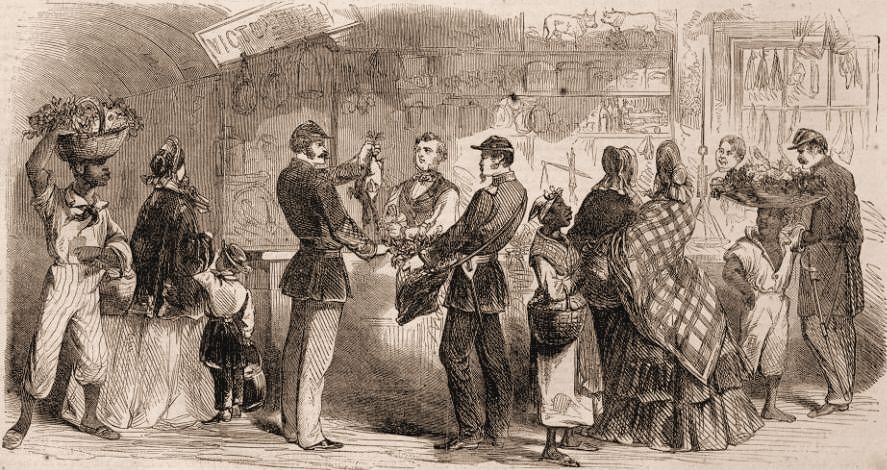
OUR artist, Mr. Davis, some time since sent us a sketch which we reproduce on page 49. It represents our troops in New Orleans “swapping” their rations of flour for tropical fruits and other farm-produce in the markets of New Orleans. Flour has long been extremely scarce at New Orleans; our brave boys, who receive a fair modicum of it daily as part of their ration, manage to dispose of it in market in such a way as, to use their own words, “to live like fighting cocks.” The scene is rather a striking one.
Published January 24, 1863, in Harper’s Weekly
by John Beauchamp Jones
JANUARY 12TH.—The news of the successful defense of Vicksburg is confirmed by an official dispatch, to the effect that the enemy had departed up the Mississippi River. By the late Northern papers, we find they confess to a loss of 4000 men in the several attacks upon the town! Our estimate of their loss did not exceed that many hundred. They lost two generals, Morgan and another. We did not lose a hundred men, according to our accounts. The Herald (N. Y.) calls it “another Fredericksburg affair.”
The estimate of the enemy’s loss, at Murfreesborough, from 12,000 to 20,000, in killed, wounded, and prisoners, and ours at from four to nine thousand. Bragg says he will fight again near the same place, and his men are in high spirits.
Our men fight to kill now, since the emancipation doom has been pronounced. But we have had a hard rain and nightly frosts, which will put an end to campaigning during the remainder of the winter. The fighting will be on the water, or near it.
The legislature is in session, and resolutions inimical to the passport system have already been introduced. But where are State Rights now?
Congress meets to-morrow.
January 12.—Day before yesterday the brigantine J. P. Ellicott, was captured by the rebel privateer Retribution, her officers and crew taken on board the privateer, and a prize crew put in charge of the brigantine. The wife of the mate was left on board the Ellicott, and to-day having succeeded in getting the rebel crew intoxicated, she put them in irons, took possession of the vessel, and piloted it into St. Thomas, where she delivered the rebels and the ship to the United States Consul.—New York Commercial Advertiser.
—Louts Napoleon this day opened the session of the Senate and Corps Législatif of France, with a speech, in which he referred to affairs in America, as follows: “The condition of the Empire would be flourishing if the war in America had not dried up one of the most fruitful sources of our industry. The forced stagnation of labor has caused in many districts an amount of destitution which deserves all our sympathy, and a grant will be asked from you (the legislature) for the support of those who, with resignation, submit to the effects of a misfortune which it is not in our power to stop.
“Nevertheless, I have made the attempt to send beyond the Atlantic advices inspired by a sincere sympathy; but the great maritime Powers not having thought it advisable as yet to act in concert with me. I have been obliged to postpone to a more suitable opportunity the offer of mediation, the object of which was to stop the effusion of blood, and to prevent the exhaustion of a country the future of which cannot be looked upon with indifference.”
—Holly Springs, Miss., was visited by a party of rebel guerrillas, who retired after committing various depredations on the property of the loyalists.—General Banks, at New-Orleans, issued a general order, confirming General Butler’s order of December ninth, 1862, assessing cotton factors and others who had subscribed to the secession fund, for the support of the poor.
Buntyn Station, Monday, Jan. 12. The scouts Sunday were driven back, or rather, hearing the noise of advancing troopers, they withdrew, and this morning, 3:30 A. M. sixteen men, were mounted and sent out under charge of Sergeant Hauxhurst. They scoured the country for nine miles south and returned without seeing any armed person, but reported that they had been seen. They returned at about 11 A. M. Men were detailed to fell trees on the right to protect our flank. Rec’d four papers from home.
 Follow on facebook
 RSS
RSS email
email