
January 13.—P. T. Barnum delivered his lecture on ” The Art of Money Getting” in Bemis Hall this evening for the benefit of the Ladies Aid Society, which is working for the soldiers. We girls went and enjoyed it.
January 2013
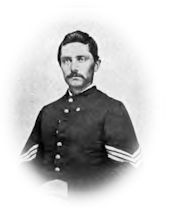
Tuesday, 13th—We left bivouac this morning at 6 o’clock and moved on to within a mile of Memphis, where we went into camp. The day was cloudy, threatening rain, and by evening had turned quite cool, with a high wind blowing. The ground being very rough here, the setting up of our tents was pretty slow work.
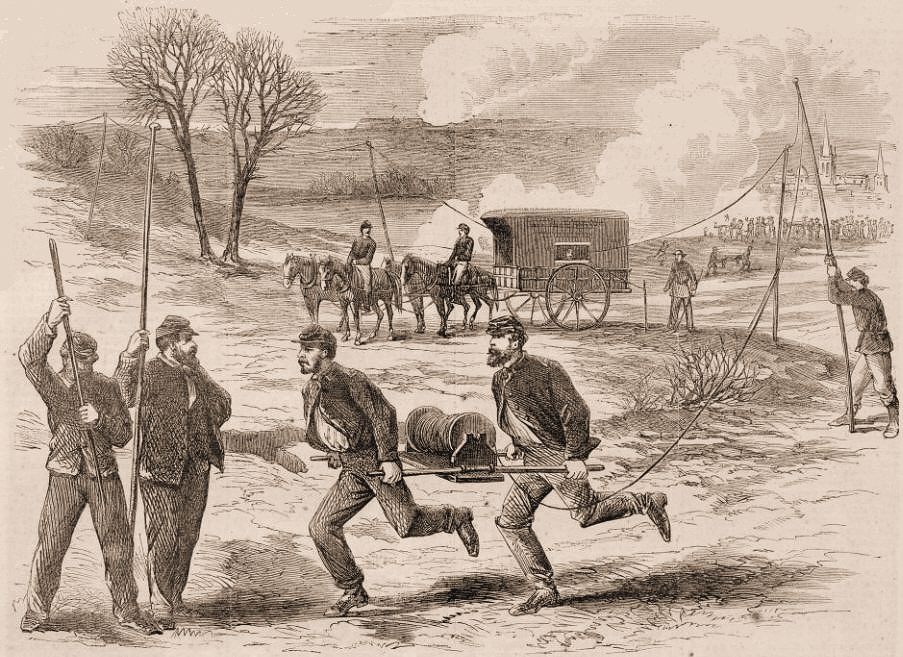
On this page Mr. Waud has illustrated for us the Army Telegraph. Of this important institution he says: “The army signal-telegraph has been so far perfected that in a few hours quite a large force can be in constant connection with head-quarters. This, while a battle is progressing, is a great convenience. The wire used is a copper one insulated, raised on light poles, made expressly for the purpose, on convenient trees, or trailed along fences. The wire and the instrument can be easily carried in a cart, which as it proceeds unwinds the wire, and, when a connection is made, becomes the telegraph-office. Where the cart can not go the men carry the drum of wire by hand. In the picture the cart has come to a halt, and the signal-men are hastening along—some with the drum, while others with crow-bars make the holes for the poles, upon which it is rapidly raised.
“The machine is a simple one, worked by a handle, which is passed around a dial-plate marked with numerals and the alphabet. By stopping at the necessary letters a message is easily spelled out upon the instrument at the other end of the line, which repeats by a pointer every move on the dial-plate. The whole thing is so simple that any man able to read and write can work it with facility.”
Published January 24, 1863, in Harper’s Weekly

by John Beauchamp Jones
JANUARY 13TH.—The generals in North Carolina are importunate for reinforcements. They represent the enemy as in great force, and that Weldon, Goldsborough, Raleigh, and Wilmington are in extreme peril. Lee cannot send any, or, if he does, Richmond will be threatened again, and possibly taken.
How shall we live? Boarding ranges from $60 to $100 per month. Our landlord says he will try to get boarding in the country, and if he succeeds, probably we may keep the house we now occupy, furnished, at a rent of $1200, for a mere robin’s nest of four rooms! But I hope to get the house at the corner of First and Casey, in conjunction with Gem Rains, for $1800. It has a dozen rooms.
January 13.—The United States gunboat Major Slidel, under the command of Lieutenant Van Dorn, surrendered to a party of rebel guerrillas at Harpeth Shoals, on the Cumberland River, Tenn., without firing a shot . The United States transport steamers Hastings, Trio, and Parthenia, with wounded troops, were also captured by the same party of rebels, at the same time and place. After robbing the wounded soldiers of all their money, overcoats, boots, and blankets, they were transferred to the Hastings, which was then permitted to proceed on her voyage. The other vessels, including the Slidel, were burned.—(Doc 104.)
—At New-Orleans, General Banks gave the following notice to the people of that place: “That offensive personal demonstrations, by language or conduct of any character, by persons of any class whatever, with the intention of giving personal offence, or tending to disturb the public peace, are forbidden, and will be punished with relentless severity. Parents will be held responsible for the respectful conduct of their children, and prompt measures will be taken to fasten upon the proper parties any act of this character. All persons who may be witnesses to such conduct are directed, as a measure of public peace, to give information thereof to the Provost-Marshal, or at these headquarters.”—The schooner Hampton was captured in Dividing Creek, Va., by the United States steamer Currituck.— Com. Barwood’s Despatch.
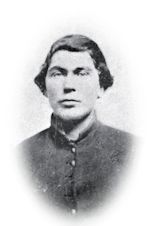
Buntyn Station, Tuesday, Jan. 13. Cloudy and appearance of rain. The health in general is not very well, several troubled with ague, etc., supposed to be owing to the water which is very bad, being taken out of an artificial pond. Stood guard. Rained very heavy in the night.
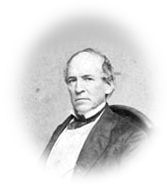
Washington Monday Jan’y 12 1863
The capture of Galvestion & the Steamer “Harriet Lane” by the Rebels has become a fixed fact and is not a “Secesh lie,” and what is full as bad, our forces were badly repulsed at Vicksburgh with much loss to us. Our “Army of the potomac” is still idle on this side of the Rappahannock. Around Washington there are troops enough to fill the City with their officers every day who for the most part much prefer to air their Uniforms on the Avenue to staying with their commands in the Camps. I was placed this morning upon the Examining Board of the Land office, that is, to examine the patent Deeds and records after they are finished by the writers. It is a place of considerable responsibility and importance. I was at Vanmasters Room an hour or two tonight. He seems to be doing an extensive business prosecuting Claims &c. A great crowd at Willards,. “Stars” and eagles and smaller birds very plenty. Met Whiting the distinguished Lawyer of Boston. He is here as the Attorney of the War Department, also saw Col Allen of Boston. Pay Master Austin from Auburn NY has his office & Room below Stairs at my present place of abode. He invited me to call and see him this morning and I must do so. There is plenty of Small pox near the City or rather in the suburbs if not directly in our midst. About 250 cases are reported among the Negroes near the Contraband Depot up 12th Street. There are many cases now all over the City.
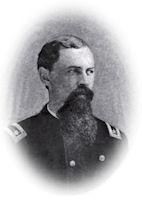
Camp 103d Illinois Infantry, Jackson, Tenn.,
January 12, 1863.
Your letters are beginning to come through with more regularity and on decidedly better time. Have received your date of December 30, although the last was dated November 16th, and was the first you wrote after we left Peoria. You bewailed our being sent south of Cairo, which I think very ungenerous in you. Well, you’ll probably be suited in our present location, which is the only consolation I have in being sent so far rearward. There are some slight hopes though, that we may be sent to Vicksburg, which will ripen into a distant probability (nothing more I’m afraid) if the news of our repulse there be true. We’re encamped in the suburbs of this delightful little town, but so strict are the orders of the general (Sullivan) that, as far as seeing the town or making purchases therein are concerned, we might as well be camped on Pike’s Peak. All right, Mr. Sullivan, have your own way. He is by all odds the most like a soldier of all the garrison commandants I have been under. Will wager that you will never hear of his being surprised. The news from Holly Springs is that the last house in the town was burned night before last. Pretty rough, but I say, amen. Its pretty well understood in this army now that burning Rebel property is not much of a crime. I for one will never engage in it, until orders are issued making it duty, and then I think I can enjoy it as much as any of them. If any part of this army is ever called home to quell those Illinois tories, orders to burn and destroy will not be necessary. Since I have seen the proceedings of that traitorous legislature, I begin to understand why these loyal Tennesseans and Alabamians are so much more bitter against traitors than we are. It would make your blood run cold to hear the men in this army, without regard to party, curse those traitors. There is a gay time in prospect for those chaps. Don’t think I am much out of the way in saying that Merrick, Jem Allen, Dick Richardson, and the editors of the Chicago Times would be hung if caught within the lines of many Illinois regiments in this army. There are many officers who, while they doubt our ability to subjugate (that is the question) the South, would take an active part in ending the man who would propose to give the thing up. I come pretty near belonging to that party, though I think that if we can’t accomplish the whole end desired, we can confine the Rebels to Virginia (Eastern), the Carolinas, Georgia and Florida. Alabama, I believe, we can hold if we get Mississippi. Boats which left Vicksburg on the 6th inst. reported it taken, but it must be a mistake, as it has not been confirmed. I think it was wicked to put that brave old 8th Missouri and 4th Iowa into the front of the battle, after they had suffered so severely at Donaldson, Shiloh, Farmington, etc., but ever since Shiloh it seems that the old soldiers have had the front all the time. ‘Tis reported that when Grant moves again, he will leave all the new regiments as railroad and property guards, and move with the old army. The last night I stayed in Holly Springs, Mrs. Stricklin invited in some young ladies to help entertain the colonel, Lieutenant Nickolet and myself. They beat all the secesh I have seen yet. One of them played all the secesh pieces she knew, and when I asked her to play “John Brown,” she swelled up so with wrath, that I was strongly tempted to propose tying my suspenders around her to save hooks and eyes. One of them asked me if I did not think the Southerners the most polite, refined and agreeable people I had ever met. It took me twenty minutes before I could finish blushing for her lack of modesty, and then I was so dead beat that I could only take up the word refined, and tell her how much I admired their beautiful use of language. I instanced, “what do you’uns all come down here to fight we’uns for,” “I recon we war thar,” which you’ll hear from the best of them. That first quotation as they speak it is the funniest sentence imaginable. I got into a row with every one I talked with, but finally, was fool enough to escort one home. Rumor (almost official) says to-night that we go to Memphis to-morrow, or soon, and thence to Vicksburg. Congratulate us on our good luck. This regiment will never be satisfied without a fight. They run in in our pickets once and awhile here, and I believe two were killed (pickets) yesterday, but guess there is no chance for a fight. The 18th Illinois Infantry is being mounted.

January 12.—There are a large number of prisoners in camp near us. I saw some twenty-five hundred marched through the town. They tell the people that they will soon be here as conquerors.
All seem to have much more confidence in General Bragg than they had, and are much pleased at the prospect of affairs in Tennessee; for many thought it impossible for our small army to keep the enemy even at bay.
Captain Thatcher is now in the hospital. I went to see him. He related his story to me. I feel sorry for him, and sincerely trust that he will get justice. He was a member of the Missouri State Guard, and came out with General Price.
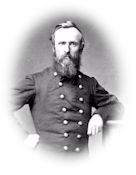
Camp Reynolds, Near Gauley Bridge, January 12, 1863.
Dear Uncle: — Yours of the 6th came duly to hand. The death of Magee is indeed a public calamity. No community has such men to spare. There is, I judge, no doubt of the death of Leander Stem. More of my acquaintances and friends have suffered in that than in any battle of the war except those in which my own regiment took part. It was Rosecrans’ personal qualities that saved the day. He is not superior intellectually or by education to many of our officers, but in headlong daring, energy, and determination, I put him first of all the major-generals. He has many of the Jackson elements in him. Another general, almost any other, would, after McCook’s misfortune, have accepted a repulse and turned all his efforts to getting off safely with his shattered army.
Sherman has been repulsed, it seems. No doubt he will get aid from below and from Grant. If so, he will yet succeed.
I do not expect a great deal from the [Emancipation] Proclamation, but am glad it was issued.
Notice Governor Seymour’s message. It shows what I anticipated when I was with you — that the logic of the situation will make a good enough war party of the Democracy in power. If you want to see eyes opened on the slavery question, let the Democracy have the power in the nation. They would be the bitterest abolitionists in the land in six months. I am perfectly willing to trust them.
I received a letter from Dr. Joe saying he would bring Lucy and Birch and Webb back with him. They will enjoy it, I do not doubt.
I am now in command of [the] First Brigade of [the] Second Kanawha Division. General Ewing has gone South with six regiments from this quarter. This leaves us none too strong, but probably strong enough. I shall probably have command of the extreme outposts. I am not yet in command at Gauley Bridge. I say this because I think it very insufficiently garrisoned, and if not strengthened a surprise would not be remarkable. If I am put in command, as seems likely, I shall see it fixed up very promptly.
Sincerely,
R. B. Hayes.
S. BIRCHARD.


