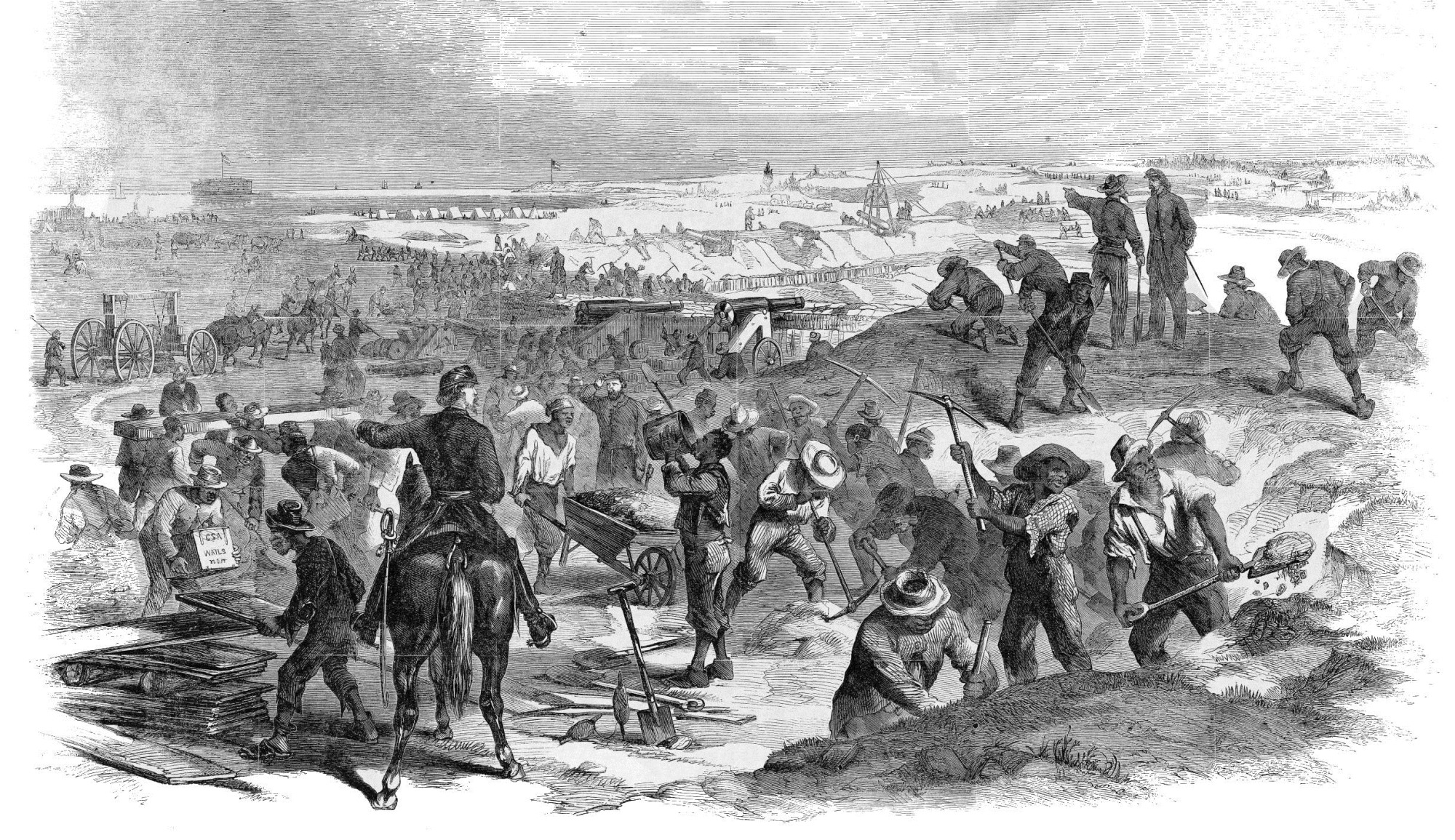
The Rebels Preparing for the Union Attack on Charleston – The Confederates Building Fortifications on James Island, Under the Direction of Gen. Beauregard , to Repel the Land Attacks of the Union Army. (From a sketch by A.P. Palmer, late of the 21st Regt., S. C. Confederate Volunteers, published in the January 31st issue of Frank Leslie’s Illustrated Newspaper)
January 2013
by John Beauchamp Jones
JANUARY 10TH—We have news from the West, which is believed to be reliable, stating that Bragg captured 6000 prisoners altogether in his late battles; took 30 cannon, 800 stand of arms, and destroyed 1500 wagons and many stores. The estimated loss of the enemy in killed and wounded is put down at 12,000. Our loss in killed and wounded not more than half that number.
To-day we have official intelligence confirming the brilliant achievement at Galveston; and it was Magruder’s work. He has men under him fitted for desperate enterprises; and he has always had a penchant for desperate work. So we shall expect to hear of more gallant exploits in that section. He took 600 prisoners.
We have news also from Vicksburg, and the city was not taken; on the contrary, the enemy had sailed away. I trust this is reliable; but the Northern papers persist in saying that Vicksburg has fallen, and that the event took place on the 3d inst.
Six hundred women and children—refugees—arrived at Petersburg yesterday from the North. They permit them to come now, when famine and pestilence are likely to be added to the other horrors of war! We are doomed to suffer this winter!
January 10.—A skirmish took place at Catlett’s Station, Va., between a party of National cavalry, under the command of Colonel Schimmelfennig and Hampton’s rebel cavalry.—Governor Letcher, of Virginia, in response to a requisition of Jefferson Davis, issued a proclamation calling out the militia of the counties bordering on the North-Carolina line, to aid in repelling any attempt at invasion by the National forces.— Orison Glines was riden on a rail at Stoneham, Mass., for having deserted from the National army.
Buntyn Station, Saturday, Jan. 10. Warm and pleasant. Orders to hold ourselves in readiness to march at a moment’s warning. Went out with Evans to forage. Got some sweet potatoes from a citizen. Drew soft bread at the quartermaster’s taken from Memphis. Sad news from Vicksburg. Sherman’s forces withdrawn to Napoleon. Health better. Drilled on the piece.
Friday, 9th.—Marched sixteen miles to-day through piney woods country.
Friday Jan’y 9th 1863
No Startling news today afloat. Old Elisha Whittlesey died yesterday very suddenly aged about eighty years, his funeral took place this afternoon. He had been a long time in public life as Comptroller of the Treasury and he possessed the unbounded confidence of all who knew his character was unimpeachable. Called on Maj Williams this evening, paid him $10 for Lieut Belden. Met Doct Stone there, he is in attendance upon Mrs Williams who is sick. The Maj is as full of talk and sharp stories as ever. It is very amusing to hear his remarks upon men and things in Lyons. But I think he is disposed to speak fairly of all, personal feelings of bitterness and acrimony which used to distinguish him when speaking of those opposed to him in politics or otherwise have become much softened. He has learned much the last few years. Congress does not seem to be doing much. The currency Bill, the financial measure of Mr Chase, I fear will be smothered by outside influence. Members will acknowledge the justness and majesty of such a Bill but I fear will lack the courage to face the displeasure of the Banks and interested parties. Mr Chase (the Sec’y of the Treasury) reccommends that all paper money shall be U.S. Money and that all Banking Institutions shall be based upon U.S. Stocks. That would give us a safe and uniform Currency. There seems to be an increasing desire to see this terrible War ended, Negro or no Negro, Slavery or no Slavery. It does seem preposterous to me that we should be spending Millions, nay hundreds of Millions, and sacrificing scores of thousands of lives to abolish Slavery just now, when we have all we can do to hold our own and hope for success without bringing Slavery into the question.
“At this moment public affairs are becalmed, but Parliament is soon to meet…”–Adams Family Letters, Henry Adams, private secretary of the US Minister to the UK, to his brother, Charles.
London, January 9, 1863
I am deep in international law and political economy, dodging from the one to the other; and as I see nothing of the world and am much happier when I see nothing of it, I have no news to tell you. In point of fact I am better satisfied with my position now than ever before, and think I am of use.
At this moment public affairs are becalmed, but Parliament is soon to meet and then we shall all be put on the gridiron again. Luckily one’s skin gets callous in time. We are pretty strong, however, and very active; that is, our party here is; and I hope we can check any hostile plots on this side. Of course we expect to come in personally for a good share of abuse and social annoyance, but I suppose we can stand that. Some day et haec meminisse juvabit. I’ll make you laugh with our little passages at arms. As a general thing, however, we are simply avoided. By the way, if you can get Fred Seward to send you down the volume of Diplomatic Documents just published, I think it will amuse you. It has made a great sensation here, and our opponents have paraded it about as though it were a collection of choice blasphemy, or a compilation of bawdy stories. You would think that the unpardonable sin was in that volume. Unfortunately it is seriously open to ridicule, but apart from that there is really nothing to cry out at and much to praise and admire. I congratulate you on your Captaincy, if it is a cause of congratulation. You know I look on the service merely as a necessary duty, and my highest ambition would be reached by seeing you honorably and safely out of it. When that event arrives, I will resign you my place and retire to private life….
January 9, Friday. On my way to Cabinet-meeting this A.M. met Covode and Judge Lewis of Pennsylvania. The two had just left the President and presented me with a card from him to the effect that Covode had investigated the case of Chambers, Navy Agent at Philadelphia, and that if I saw no objection he should be removed. Told them I was going to the President and the subject should have attention. When I mentioned the subject, the President wished me to look into the case and see that all was right. He had not, he said, examined it, but passed it over to me, who he knew would.
The final accounts of the result at Murfreesborough are favorable. Rosecrans has done himself honor and the country service. From Vicksburg the intelligence is less satisfactory. There appears to have been good fighting but without results. A desperate stand will be made by the Rebels to hold this place. It is important to them to prevent the free navigation of the Mississippi; it is as important to us that it should be unobstructed. They wish to have communication with Texas; we want to cut it off. Had the army seconded Farragut and the Navy months ago, Vicksburg would have been in our possession. Halleck was good for nothing then, nor is he now.
9th. Friday. Got the rations up from the post Commissary, ready for issue the 10th. Was kept quite busy. Finished “Canoe and Saddle” and read in January Atlantic.
January 9th [1863]. A very sad day to Ginnie and myself. I was careless enough to leave the key in my trunk, for I shall never, never learn to lock up, and my purse with $30 or $40 was taken out. There is a child in the house who stays to wait on us in our rooms, the greatest story-teller in the world; she is accused, and I suppose will be punished. If I had lost it in the street I should not have felt so unhappy about it. Punishment of no matter how great a criminal afflicts me. I have gone into the room in which Mrs. Norton has locked Harriet, to try and move her to tell the truth. She has been singing and amusing herself, while we have been suffering for her. She vows that she never touched the purse, yet no one else was in our room. I feel miserable lest she may be punished wrongfully. She is considered so dreadfully bad that she never gets a kind word from any one. The servants hate her and her old grandmother, who has taught her to lie and steal, almost beats her to death sometimes. Ginnie and I have been very kind to her, and she has waited on us so cheerfully and with so much apparent affection, that I feel an indescribable pang at the idea of having brought her into trouble. She says she would not have stolen from us. Oh, well, we are always in trouble of some sort. I feel so low in health and spirits that I wonder sometimes what more can happen. We have had $303.50 stolen in less than two years. It is our habit to be gentle with dependents, though we are proud and exacting with our equals. I begin to think that this is bad policy. The world will not let us be what we wish; it seems a part of chivalry, to my mind, to be gentle to the lowly and proud to the high. I have always practiced this, both from impulse and principle, but I must admit that I have always suffered for it.
Mrs. Norton called on General Banks to-day. She wished us to go with her, but we were not well enough. The orderly did not present her card, so the gentle-mannered ruler demanded of her quite bluntly who she was. “The mother of Mrs. Harrison,” she returned. “What Mrs. Harrison?” “The mother of the lady whose house you occupy.” He started visibly, but roughly demanded, “What do you want?” She stated her desire to sell her house, but as she had not taken the oath of allegiance to the United States she didn’t know if the sale would be lawful. He had no objection, he said; is that all you want? She then asked him if Mr. Harrison were to return to New Orleans would he be compelled to take the oath. “I know nothing about it,” returned the polite general. “I would be obliged if you would tell me who does know, as I had thought you are the very person to whom I should apply.” The General scarcely waited to hear her remark before turning on his heel to leave her. Other ladies were present with their requests. To each and all he spoke rudely. Having waited in vain for his return to the room, they all left. These people rob us of our houses, make laws forbidding us to sell property, or to leave town, or in fact to do anything without their permission, yet they are angry and rude when one calls on this necessary business. Men have been snatched up without knowing wherefore and kept in forts or in the custom house, and their wives and friends have been treated as impudent intruders for even making inquiry after them. Mr. Wilkinson, grandson of old General Wilkinson of the last war, has just got out of confinement, having been placed in same by Butler on the testimony of a negro woman—offence, keeping arms in his house—with the town filled with homeless, lawless negroes who commit robberies and other offences daily. I never realized until this Yankee rule here how many bad men America had produced. I took a walk with Katie Wilkinson; poor girl, she lost her father in the battle of Manassas, the last Manassas. She was devoted to him and he was fondly attached to his girls.