
Jan. 8th. Thursday. Saw Delos a few minutes. Wrote to Fannie. Read some in “The Canoe and Saddle” by Winthrop. Don’t like this as well as “John Brent.” Commenced getting bread from baker of 2nd O. V. C. (A. B. N. and Melissa Tenney married today.)
January 2013

January 8th [1863]. To-day a great show of artillery; no other parade that I see. This day, sacred to a victory over a foreign foe [battle of New Orleans, 1815], finds us in a sad plight. We Confederates are victorious, but over those who should have been our brothers. Went with Mrs. Dameron to look over her sister’s house (Mrs. Shepherd Brown), which has just been given up by one set of Federals, and another has moved in—General Banks and staff. We missed lace curtains, some parlor ornaments, and the beautiful picture of the Magdalen. We’ were treated politely by servant and orderly; with the latter we had a long talk. He is from Boston, whither he longs to return. I think he would be glad of peace on any terms. I felt not the least bitterness towards the poor fellow, who looks sad enough. We talked our views freely. I told him that my brother had last been seen in a battle of ”Stonewall’s” with this very General Banks. Banks was defeated, but I didn’t remind him of it. We took a glass of Yankee ice water. Mrs. Dameron was kind and gentle, though she had many reasons for anger, seeing these people in her absent sister’s house with the household relics scattered and the carpets worn and faded with Federal footsteps; she was driven out of her other sister’s house earlier in the fall; this last, the finest in town, is occupied by General Shepley, as they call him. Can there be a Governor who has never power to do anything? When I was there to see his lordship with Mrs. Norton, the house and furniture looked so familiar and natural that I sat there speechless at first, speculating on the strange state of things. Once I was near opening Mrs. Brown’s bed-room door. His lordship kept us waiting a long while, and when he came in with his deceitful smile I did hate him, the vulgar-minded official who imagines that place will make him a gentleman. I have heard that he was one at home, but his voice betrays him. I made as biting remarks as the business would admit of. He gave me a side glance of hatred from his leaden eye. Mrs. Norton “gave it to him,” to use her own words, but being the mother of the lady whose house and furniture he had taken possession of, he felt as if he could bear with her I suppose.
Mrs. Norton called at her daughter, Mrs. Harrison’s, house before Butler’s people left it, and asked that the sheep might be put out of the yard, as they were ruining the beautiful shrubbery. The mulatto at the gate gave her much insolence; told her “to go about her own business,” he intended that the sheep should stay there, that the shrubbery should be destroyed, and that if she had a daughter “he intended to come and see her.” My blood ran cold when she told me this, and for the first time I realized our position here among these lawless negroes. Mrs. Norton told General Shepley that she demanded of him as a gentleman and a ruler to have that man punished. She asked him what he would feel if a negro should tell him that he would visit his daughters. “I would knock him down,” replied the stalwart Governor. “Then,” says Mrs. Norton, “I demand that you punish him for me.” The smiling Governor promised to go immediately and have him arrested, but that was the last of it. I wonder how a man contrives to smile so, yet look querulous? I recalled Shakespeare when I met him, “a man may smile and smile, etc.” We had an interview with Colonel French. Mrs. Norton went to get her husband’s old gun (her husband had been dead for many years), which she had given up last summer for fear that the negroes would have her arrested, as many have been for retaining weapons. “French could do nothing; we must go to General Banks’ people.” This gentleman has nestled himself in Judge Packard’s house, a very sweet one. He was polite enough, and our interview was soon over. He looks like a great overgrown schoolboy with a lovely complexion, but there is no play of intelligence either in his face or manner. The Yankee Delta calls him the “gorgeous French.” His dress was gorgeous, being laced with gold or brass in all directions.
Called this evening on Madame Francois; met her daughter, a delicate Creole, married to a real robustious Englishman who has grown rich and important in this country; heard from him that the Federals acknowledge the capitulation of Rosecranz and the 4,000 men; heard also that the bombarding fleet has left Vicksburg to return to Memphis for fear of being cut off. Banks has requested, so report says, that no more news be printed until tomorrow, as the town is in a dreadfully excited state. He need not fear; the excitement of joy rarely injures. A flag of truce has come in—report says that Banks has refused to receive it. This cannot be so as I see prisoners are to be exchanged. It might not have been allowed to enter town for fear of excitement; the heart of the city warms to the Confederate uniform. Last summer when it was a rare sight here, we all went to a friend’s house to see a young Confederate captain who, after being confined in the custom house for some time, was allowed to be out on parole. The Ogden girls were with us. After we arrived we found the young man, a Texan, so exceedingly diffident that we were abashed. He was so alarmed that he was quite alarming. His name was Blount, and a more sincere, ingenuous and stalwart young soldier I could not wish to rely upon in time of need. He has long since been exchanged. I saw in the paper to-day that General Chalmers is wounded. His sister-in-law was here a few days ago, expressing great uneasiness for her husband, who is General Chalmers’ brother, and upon General Chalmer’s staff. She hears nothing from him and cannot get a passport to go out. The registered enemies were on the eve of departure when Banks arrived; General Butler had issued an order that they should leave, bearing with them baggage to the amount of $50 only. Hundreds were disappointed when Banks issued another order, changing the entire programme. Many families had parted with everything, having reserved only enough to bear them out, and now they are suffering. Passports are not sold now as in Butler’s day, and we rarely hear from beyond the lines. I never hear from my dear ones in Texas; the few lines from poor Claude, written with his left hand, being the last I received. He was then on his way from Virginia, having bid good-bye to “lines and tented fields” and left one gallant arm behind him. He stopped with Mrs. Chilton, who lives at Jackson, a day or two; there, I hear, he got a situation in the commissary department in Texas.

The boxes of home supplies now had Portsmouth Grove Hospital as their principal destination. The following is one of the letters in return for supplies:
The games, as well as the slates, which came in the boxes and barrels, are a great delight. I have just been over to see Fitch and set him up at a solitaire board. He was all over smiles, and pegging away with his game in bed.
With another gift of tools, the boys in Ward 2o knocked up a nice little bagatelle board with glass balls and a cambric cover. Ward 6 went over to inspect and imitate. They came back disgusted; “would scorn to play on such a thing; would have a board on which a lady could dance a hornpipe, if she pleased.” Highly improbable that any one would please to do that, but I promised them that if they would make a first-rate board, they should have all that was necessary. So they went to work, and the result was a beauty. The table is seven or eight feet long, covered with scarlet flannel, and with turned balls and walnut cups, and the men of the ward have enjoyed every minute of its existence for the past month. I have never gone in when there hasn’t been a crowd round the table pushing balls or keeping count, and I really think that the health of the ward has improved under the treatment.
Money spent in lemons for bronchitis, oranges for fever patients, mittens and socks for “convalescents” (who have to go on guard in puddles of snow-water) and in games and tools for wretched, bored, half-sick, half-well, wholly demoralized men, may not seem a great investment to the givers; would not seem so to me, if I did not live in a general hospital, and know where Government munificence stops and where private beneficence may to advantage begin.
The meals in our hospital mess-hall are nicely served and well cooked. At the beating of the drum the “convalescents” form in line, and march, by wards, into the long hall, where three lines of tables, each 250 feet long, are set. Last night, when we inspected the supper, there were shining tins up and down the tables with a very large portion of rice and molasses, hot coffee, and plenty of bread for each man, and many little pots of butter and jam came in under the Braves’ arms, out of their home boxes, to help garnish the tea.
This morning I was invited by a soldier to join him in a banquet over a box from home; “and all I want beside,” observed he, “is a little gin.” “It is very lucky for you that there was none,” was my answer, “or the whole box would have been confiscated.” “Confiscated, indeed!” returned the Brave; “I should like to see that thing done. I’m none of your cream and chocolate men. I’d carry the case up to Abraham himself! ”
The other day Miss — was washing a boy’s face very gently. “Oh!” said he, “that reminds me of home—” (Miss — highly gratified); “that’s like my sister; she often did that for me. My eyes! wasn’t she a rough one! She’d take off dirt, and skin too, but she’d get the dirt off.”

Thursday, 8th—Although it is now quite warm, we are still waiting for our knapsacks containing our underwear which were stored at La Grange, but we were again disappointed in not getting them today as expected. Our boys have never been so bent on foraging as they have since going into camp here. Last night a squad of boys from Company K were out looking for whatever they could find, but apparently with little success, until returning to camp they passed by the camp of the Sixteenth Iowa, where they noticed two dressed hogs hanging up to cool during the night. What did they do but deliberately walk up and carry off one of the carcasses to their own camp! They immediately cut up the meat, put it into kettles over fires, cooked it, and divided it among the boys of their company, all before daylight. This morning when a squad of the boys of the Sixteenth Iowa walked along our regimental camp in quest of that missing hog, they did not see even a sign of meat, bone or campfire embers.

January 8th.—On the 16th of December, the day after the last entry in my diary, I went to Richmond, and found B. B. at the house of Mr. P., on Grace Street, surrounded by luxury, and the recipient of unnumbered kindnesses; but so desperately ill! The surgeons had been up all night in the various hospitals, and, as numerous as they were, they were sadly deficient in numbers that night. The benevolent Dr. Bolton had taken his wife and her sister, who had learned the art of binding up wounds, to his hospital, and all night long they had been engaged most efficiently in their labour of love. Other ladies were engaged in offices of mercy. Women who had been brought up surrounded by the delicacies and refinements of the most polished society, and who would have paled at the sight of blood under other circumstances, were bathing the most frightful gashes, while others were placing the bandages. I found B. suffering the most intense agony, and Mrs. P. agitated and anxious. No surgeon could be obtained for private houses. I sent for one, who was not an army surgeon, to come at once. He sent me word that he had been up all night, and had just retired. Again I sent to implore him to come; in five minutes he was there. He told me at once that his situation was critical in the extreme; the Minié ball had not been extracted; he must die, if not soon relieved. He wanted assistance—another surgeon. To send in pursuit of Dr. Gibson for my brother, then stationed at Camp Winder, and to telegraph for his father, occupied but a few moments; but the surgeons could not come. Hour after hour I sat by him. To cut off his bloody clothes, and replace them by fresh ones, and to administer the immense doses of morphine, was all that Mrs. P. and myself could do. At dark, Surgeons G. and B., accompanied by my brother, arrived. They did what they could, but considered the case hopeless. His uncle, General C., arrived, to our great relief. He joined us in nursing him during the night. The cars were constantly coming in. Shouts of victory and wails for the dead were strangely blended. I was glad that I did not hear during that dreadful night that the body of that bright, beautiful boy, that young Christian hero, Randolph Fairfax, had been brought to town. The father, mother, sisters !—can they bear the blighting stroke ? The hope, the pride, almost the idol of the family, thus suddenly cut down! We, too, mourn him dead, as we had loved and admired him living. We had watched his boyhood and youth, the gradual development of that brilliant mind and lofty character. His Christian parents are bowed down, but not crushed; their future on earth is clouded; but by faith they see his abundant entrance into the kingdom of heaven, his glorious future, and are comforted. Another young Christian soldier of the same battery was shot down about the same moment—our young friend David Barton, of Winchester. Three months ago his parents buried their oldest son, who fell nobly defending his native town, and now their second has passed into heaven. The Church mourns him as one who was about to devote his life to her sacred cause, but who felt it his duty to defend her against the hosts who are desecrating her hallowed precincts. How many, oh, how many of the young soldiers of the Cross are obliged to take up carnal weapons, to “save from spoil that sacred place!” Poor fellows! their life’s blood oozes out in a great cause. But our church!

“Will she ever lift her head
From dust, and darkness, and the dead?”
Yes, the time is at hand when she, our Southern Church, shall
“Put all her beauteous garments on,
And let her excellence be known.
Decked in the robes of righteousness,
The world her glory shall confess.
“No more shall foes unclean invade
And fill her hallowed walls with dread;
No more shall hell’s insulting host
Their victory and thy sorrows boast.”
The churches of Fredericksburg suffered dreadfully during the bombardment. Some were torn to pieces. Our dear old St. George’s suffered very little; but a shell burst through her revered walls, and her steeple was broken by a passing shot. She stands a monument of Vandalism, though still a Christian chapel, from which the Gospel will, I trust, be poured forth for many years, when we shall no longer be surrounded by those who cry, “Raze it, raze it, even to the foundations thereof.”
But to return to my patient. After days and nights of watching, I left him improving, and in the hands of his parents. The physicians seem still doubtful of the result, but I am full of hope. The ball, after much difficulty, was extracted, since which time he has gradually improved; but his sufferings have been indescribable, W. B. C. is also slowly convalescing. One night while sitting up with B., together with a surgeon and General C., when we had not been able to raise him up for two days, we were startled by his springing from the bed in agony, and running to the fire; the surgeon (his uncle) gently put his arm around him and laid him on the couch. I hastened to the bed to make it comfortable; but it was so large that I could not raise it up; at last I called out, “General, help me to make up this bed; come quickly!” In an instant the large feather bed was grasped by him with strength and skill, turned over and beaten thoroughly, the mattrass replaced; then to help me to spread the sheets, smooth the pillows, etc., was the work of a moment. The patient was replaced in bed and soothed to sleep. Not till then did I remember that my companion in making the bed was one who but a short time before had led his brigade in the hottest of the fight, and would, perhaps, do it again and again. I complimented him on his versatility of talent, and a pleasant laugh ensued. During the Christmas holidays, while most anxious about our wounded, a letter from Kentucky reached us, announcing the death of my lovely niece, Mrs. K. As soon as her home on the Mississippi became surrounded by the enemy, she was obliged to leave it. She then joined her husband, who is on General Breckinridge’s staff, and stationed near Knoxville. As her health was very delicate, she determined, as soon as General B. was ordered off, to attempt to get to her mother in Kentucky; her husband placed her in the care of an elderly physician and friend, who accompanied her in a carriage across the mountains, as the public conveyances between those hostile regions are, of course, discontinued. Before she had travelled many days she was compelled to stop at a small house on the roadside, and there, with much kindness from the hostess, and from her travelling companion, but none of the comforts to which she had been accustomed, she suffered intensely for many days, and then attempted to go on. She reached Georgetown, Kentucky, which was her summer home; her mother was telegraphed for, and reached, her just three days before she breathed her last. Dear H.! another victim of the war; as much so as was her brother, who received his mortal wound at Dranesville, or her brother-in-law, who was shot through the heart at Pea Ridge. Her poor mother deemed it a blessed privilege to be able to be with her in her dying hour; a comfort which she did not experience after her long trip to see her son. I fear she will sink under accumulated misfortunes; cut off as she is from all that makes life bearable under such circumstances. During the campaign of last summer around Richmond, she describes her feelings as being anxious and nervous beyond expression. She heard nothing but threats against us, and braggadocio, until she believed that we must be crushed; the many Southerners around her could not express their feelings except in subdued whispers. The Cincinnati and Covington papers expressed their confidence of success. Each day she would go to Cincinnati to hear the news, and come back depressed; but on the sixth day after the battles commenced, as she took her usual morning walk, she observed that the crowd around the telegraph office was more quiet than usual. As she approached, “curses, not loud, but deep,” reached her ear. Hope dawned upon her subdued spirit. “Is there any thing the matter?” she asked, meekly, of the first gentlemanly-looking man she saw. “The matter!” he exclaimed. “Oh! madam, we are defeated. McClellan is retreating down the river towards Harrison’s Landing. I don’t know where that is, but we are shamefully beaten.” She did not allow herself to speak, but rapidly wended her way home, her face bathed in tears of thankfulness, and singing the Gloria in Excelsis.
Several days ago General Bragg reported a victory at Murfreesboro’, Tennessee. There was certainly a victory on the first day, as 4,000 prisoners were secured, with thirty-one pieces of cannon, and sent to Chattanooga. On the third day the enemy were reinforced, and our army was obliged to fall back. A friend remarked that the Bragg victories never seem to do us much good. The truth is, the Western Yankees fight much better than the Eastern, and outnumber us fearfully. They claim the victory, but acknowledge the loss of 30,000 men. It must have been a most severe conflict. At Vicksburg they have made another attack, and been repulsed; and yet another misfortune for them was the sinking of their brag gun-boat Monitor. It went down off Cape Hatteras. In Philadelphia the negroes and Abolitionists celebrated the 1st of January with mad demonstrations of delight, as the day on which Lincoln’s proclamation to abolish slavery would take effect. In Norfolk the negroes were deluded by the Abolitionists into great excitement. Speeches were made, encouraging them to take up arms against their masters! Hale has offered a resolution in the Northern Congress to raise two hundred regiments of negroes! The valiant knight, I hope, will be generalissimo of the corps. He is worthy of the position!
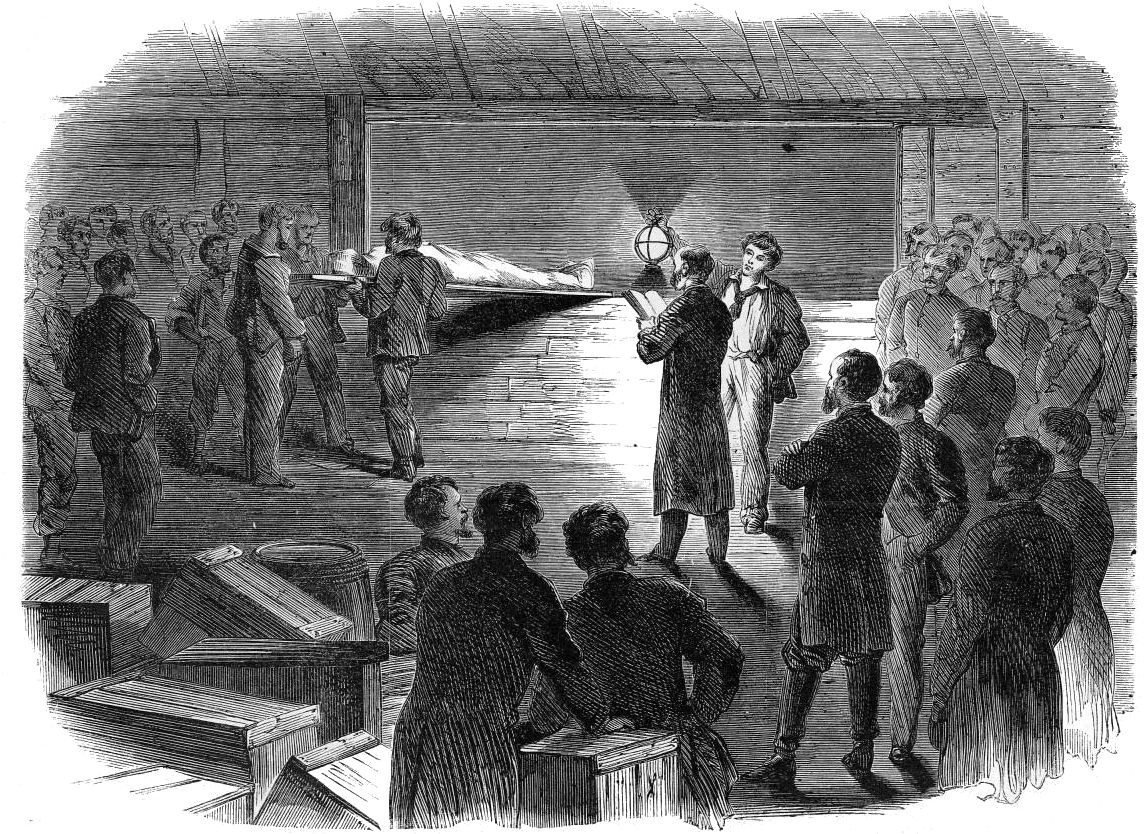
A correspondent thus describes the funeral of a soldier on one of the main regiments at sea:
”Imagine a crowded transport steamer homeward bound from the war, with her human freight of sick and wounded, of officers returning on leave for a brief respite from Southern miasma and camp toil, of poor, enfeebled man dragging themselves home to die.
”The lamps are lit in the long upper saloon. Though the vessel heaves and strains in the wild, angry sea, they shine pleasantly on the little groups which surround the card tables, gather round some veteran storyteller, or chat eagerly as they anticipate, in imagination, their safe arrival and welcome home. All seems bright and cheerful. There is a little stir, a sudden interruption, a poor soldier, himself an invalid, as his sunken cheeks and hollow yet brilliant eyes but too clearly indicate, enters and asks eagerly for physician – his comrade is dying. A little party, of whom the writer is one, detach themselves from the light and noisy gaiety of the comfortable upper cabin and go down into the hold which is been roughly fitted up for human habitation. It reeks with smells; it is dimly lighted by swinging lanterns, which rock to and fro, keeping time, pendulum-like, to the roll of the sea.
”This sounds with salute the ear are in keeping with the same. Here a smothered groan, an impatient murmur, a weary sigh, the heavy monotonous clang of the ever moving machinery, mingle strangely with the dull swash of waves as they glide by, or break angrily beneath our counter, making mournful music. The man lead us on to the darkest, dreariest corner. He passes by a miserable bunk, where, upon a blanket, with his knapsack for a pillow, like something that, in the dim, uncertain light, takes human shape and form.
’Bring a lantern here,’ says the doctor. A light which had hitherto hung against the distant bulkhead, is brought. It reveals a filthy, foul-smelling resting-place, on which lies stretched a young soldier, yet in the agonies of dissolution. The rattle is already in his throat. I take the cold hand in mine, the pulse just flutters – that is all– the extremities are already chill in death. He swallows a little stimulant, but in the lingering disease (chronic diarrhea) has already done it’s wasting work. His comrade leans over and strives to rouse him. He shouts ‘Charlie! Charlie!’ But the words follow upon an ear already deaf to all earthly sounds.
”I think to myself how many times has he heard that name in his far-off New England home, from a mother’s, a sister’s, it may be yet dearer lips. And now the broad chest heaves convulsively, the face is distorted and drawn in its death agony. The eyes are opened and closed again. They will look no more upon the sunlight; they are sealed, to open up on the resurrection. There is a shudder, a contraction and expansion of the lambs, the jaw drops, a ghastly hue overspreads the face – the man is dead; a soul drifts out upon the stormy wind, on its way to God alone knows whither – a unit is removed from the sum of human existence – a Union soldier, who died as patriotically as though he has fallen upon some hard-won field, has gone to his long account.
”And what a death! No one to weep over the clay; the stiffing hand held in a stranger’s grasp; the attenuated corpse rolling to and fro with each motion of the angry waves over which we ride, as it lies waiting for the speedy burial which already hastened corruption renders necessary. The body is borne forward and placed between decks. It is sewn into the camp-worn, travel stained blanket. An hour or two relapses. The chaplain and officers are called. We gather round a strange, mysterious bundle, whose rigid lines and mummy-like shape indicate what is concealed within. Every brow is bared, every utterance hushed, as the corpse, stretched upon a board and covered with the flag he died to serve, is carried to the gangway. Then come the solemn words with which the Episcopal church commits the body to the deep, ‘to be turned into corruption, looking for the general resurrection of the dead and the life of the world to come.’ The lanterns throw their sick sickly gleam upon the funeral rites, upon martial forms, upon the bareheaded semen, waiting to perform the last offices which mortals can render to mortality. The stars shine without, the gloomy sea heaves and tosses, the waves lift up their white fingered hands, as if pleading for their prey. There is a pause, a lifting of the shrouded clay, a dull, heavy splash, and the vessel staggers on and leaves the corpse, to lie weighted down beneath the sea into drift with the tide.
”I turn away, and go sadly back to muse over the strange burial I have witnessed. A hand touches my shoulders, I turn around. The sick soldier who had shouted ‘Charlie!’ in the dead man’s ear hands me the ‘descriptive list,’ which he has taken from the pocket of the deceased. I carry it to the light, and read, ‘Charles Myrick, of Co. A, Capt. Perry, 8th regt. Maine Volunteers, enlisted August 23, 1861, at Lowell, Maine, age 21 years.”
(Published in Frank Leslie’s Illustrated Newspaper, February 7, 1863.)

by John Beauchamp Jones
JANUARY 8TH.—Gen. French writes that the enemy at Suffolk and Newbern amounted to 45,000; and this force now threatens Weldon and Wilmington, and we have not more than 14,000 to oppose them. With generalship that should suffice.
All the Virginia conscripts are ordered to Gen. Wise, under Major-Gen. Elzey. The conscripts from other States are to be taken to Gen. Lee. If the winter should allow a continuance of active operations, and the enemy should continue to press us, we might be driven nearly to the wall. We must help ourselves all we can, and, besides, invoke the aid of Almighty God!
We have nothing fresh from Bragg—nothing from Vicksburg—and that is bad news.
I like Gen. Rains. He comes in and sits with me every day. Col. Lay is the active business man of the bureau. The general is engaged in some experiments to increase the efficiency of small arms.
He is very affable and communicative. He says he never witnessed more sanguinary fighting than at the battle of the Seven Pines, where his brigade retrieved the fortunes of the day; for at one time it was lost. He was also at Yorktown and Williamsburg; and he cannot yet cease condemning the giving up of the Peninsula, Norfolk, etc. Gen. Johnston did that, backed by Randolph and Mallory.
W e have all been mistaken in the number of troops sent to the rescue of North Carolina; but four or five regiments, perhaps 3000 men, have gone thither from Virginia. A letter from Gen. Lee, dated the 5th inst., says he has not half as many men as Burnside, and cannot spare any. He thinks North Carolina, her-self, will be able to expel the Federals, who probably meditate only a marauding expedition. And he supposes Bragg’s splendid victory (what did be suppose the next day?) may arrest the in-roads of the enemy everywhere for a season. At this moment I do not believe we have 200,000 men in the field against 800,000! But what of that, after seeing Lee beat 150,000 with only 20,000 in action! True, it was an ambuscade.
January 8th, 1863.—Cousin Sam Donelson came last night. I have not seen him since the summer of 1859 and I would never have known him. Instead of a slender, pale boy, he is a splendid looking man. He is on Uncle Daniel’s staff, with the rank of Lieutenant.
Aunt Margaret left her home at the beginning of hostilities in the West. She had the farm wagons packed with belongings of the negroes and they walked behind and drove a herd of fine cattle uncle Daniel had raised. Old Aunt Purdy rode one saddle horse and Grace another and so on, until all the numerous riding nags were safely on the road and all the old and feeble negroes had a means of transportation. It is a wonder they got away but she managed to locate them in middle Georgia, where they are still waiting for the war to be over.
Cousin Sam is young and daring, he is having a good time in the main and he doesn’t care how long it lasts. He says Uncle Daniel has grown thin; they are pleased, as, indeed, we all are, at his promotion to be a Major-General. I am sure he deserves it. I love him dearly. He was so good to me when Father was so ill at his home in Tennessee.
January 8.—A fight took place at Springfield, Mo., between the Union forces under Brigadier General Brown, and a numerically superior force of rebels under General Marmaduke, resulting, after a contest of more than ten hours’ duration, in a retreat of the latter. The loss was nearly equal on both sides.—(Doc. 98.)
—Yesterday a large reconnoitring force of Union troops, under the command of Major Wm. P. Hall, embarked at Yorktown, Va., on board the fleet of gunboats and transports, under the command of Captain F. A. Parker, and arrived at West-Point, at the junction of the Pamunkey and Mattapony Rivers, early this morning. Thence they proceeded to Lanesville, where they captured a wagon-train, consisting of contraband goods, en route for Richmond, consisting of gutta-percha, block-tin, paints, medicines, shek-lac, and ordnance stores. Leaving a strong picket-guard at Lanesville, they next proceeded to Indian Town, where they found two wagons loaded with meal, awaiting ferriage to White House, and destined for Richmond. After destroying these, with the telegraph, and seizing the mail, they crossed the Pamunkey to White House, where they destroyed by fire the ferry-boat, two sloops laden with grain, two barges, four pontoon-boats, the steamer Lottie Maynard, a store-house, containing over one thousand bushels of wheat, a large quantity of commissary stores, etc The torch was next applied to the railroad depot, containing a large amount of freight for Richmond, the tank, the rolling stock, signal station, sutlers’ buildings, and stores. The force remained until the demolition was complete, when, the object of the reconnoissance having been accomplished, they returned to Yorktown, having sustained no loss whatever during the expedition.—Official Report.
—Captain Moore, of the Twentieth Illinois cavalry, this morning at sunrise, made a sudden descent upon the camp of Lieutenant-Colonel Dawson’s rebel command, near Ripley, Tenn., and dispersed the occupants, killing eight, wounding twenty, and capturing forty-six prisoners, among whom were one major, two captains, and one lieutenant. He also seized twenty horses, and one wagon-load of arms. Dawson’s party had been engaged for many weeks burning all the cotton that could be found in that part of the country. Captain Moore did not lose a man, and had only three wounded.— Wolverine Citizen.
—The English sloop Julia was captured near Jupiter Inlet, Fla. — General Mansfield Lovell was dismissed from the service of the rebels for incapacity.—The steamer Mussulman was burned by guerrillas at Bradley’s Landing, ten miles above Memphis, Tenn.—General Pemberton, in command of the rebel forces at Vicksburgh, issued an order expressing his high appreciation of their “recent gallant defence” of that position.— The rebel steamer Tropic, formerly the Huntress, of Charleston, S. C, while attempting to run the blockade, was destroyed by fire. Her passengers were saved by the boats of the National gunboat Quaker City.
Buntyn Station, Thursday, Jan. 8. News reached us of a glorious victory at Murfreesboro by General Rosecrans. Rec’d hay for horses. E. Morrill formerly of Sauk City, now of 23rd Wisconsin Regiment stayed with us.


