Following the American Civil War Sesquicentennial with day by day writings of the time, currently 1863.

January 2013

January.—Grandmother went to Aunt Mary Carr’s to tea to-night, very much to our surprise, for she seldom goes anywhere. Anna said she was going to keep house exactly as Grandmother did, so after supper she took a little hot water in a basin on a tray and got the tea-towels and washed the silver and best china but she let the ivory handles on the knives and forks get wet, so I presume they will all turn black. Grandmother never lets her little nice things go out into the kitchen, so probably that is the reason that everything is forty years old and yet as good as new. She let us have the Young Ladies’ Aid Society here to supper because I am President. She came into the parlor and looked at our basket of work, which the older ladies cut out for us to make for the soldiers. She had the supper table set the whole length of the dining room and let us preside at the table. Anna made the girls laugh so, they could hardly eat, although they said everything was splendid. They said they never ate better biscuit, preserves, or fruit cake and the coffee was delicious. After it was over, the “dear little lady” said she hoped we had a good time. After the girls were gone Grandmother wanted to look over the garments and see how much we had accomplished and if we had made them well. Mary Field made a pair of drawers with No. 90 thread. She said she wanted them to look fine and I am sure they did. Most of us wrote notes and put inside the garments for the soldiers in the hospitals.

Sarah Gibson Howell has had an answer to her letter. His name is Foster—a Major. She expects him to come and see her soon.

All the girls wear newspaper bustles to school now and Anna’s rattled to-day and Emma Wheeler heard it and said, “What’s the news, Anna?” They both laughed out loud and found that “the latest news from the front” was that Miss Morse kept them both after school and they had to copy Dictionary for an hour. War prices are terrible. I paid $3.50 to-day for a hoop skirt.

Tuesday, 6th—We received a large mail today, coming through from Memphis, and it is quite jolly in camp. Besides this, our teams returned from Memphis with loads of provisions, and we hope soon to have something more to eat. A report was circulated in camp today that peace had been declared, but no one takes the report very seriously.

289

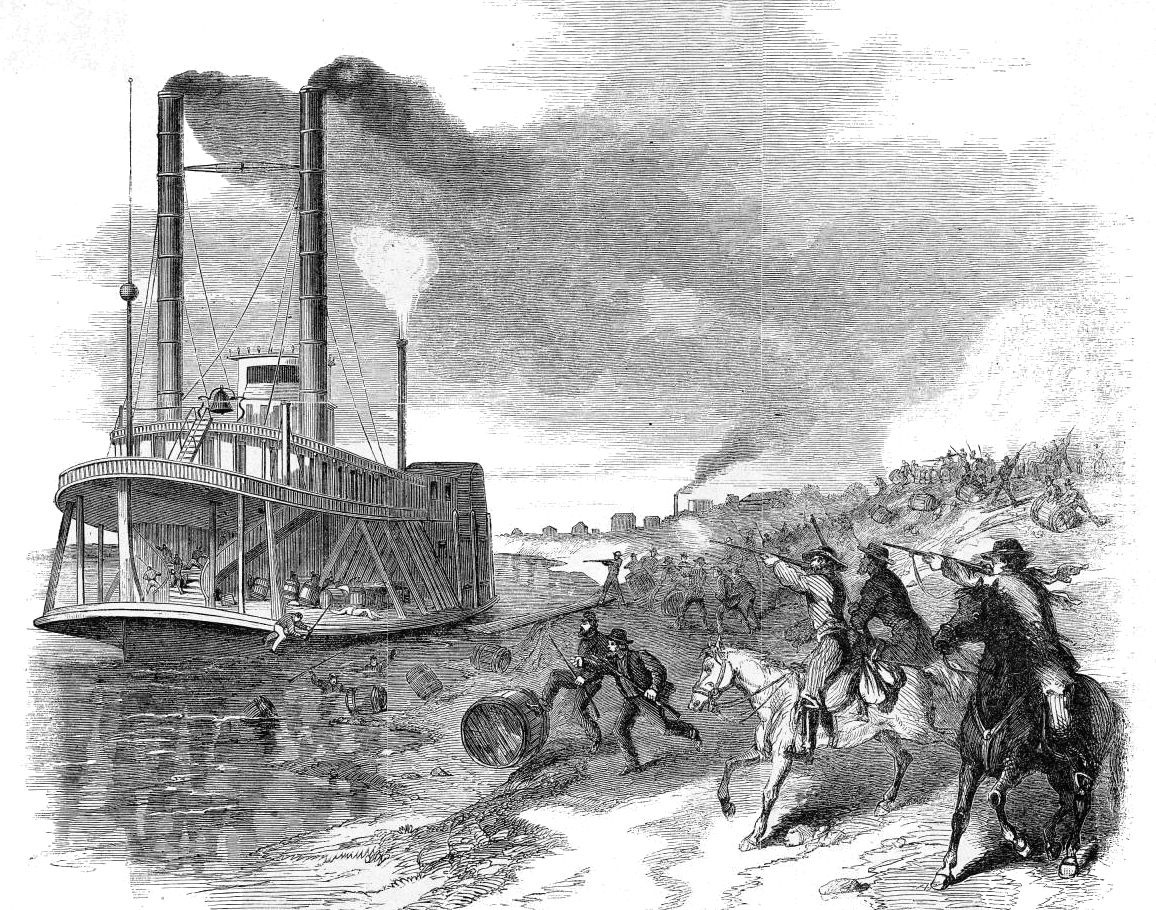
The War on The Mississippi – Sudden and Daring Attack by Rebel Guerillas, Led by Capt. Talbot, on the Sugar Steamer Empire Parish, At the Landing 44 Miles Below Baton Rouge (Published January 31, 1863 in Frank Leslie’s Illustrated Newspaper from a sketch by Mr. F. H. Schell)


From the New York Times of January 3, 1863: “News has just reached us, that while the Empire Parish steamer was loading sugar yesterday (Monday) at noon, at Meringo Plantation, on the right bank of the river, four miles below Baton Rouge, a party of 120 guerrillas, under command of Capt. TALBOT, came down and demanded the surrender of the boat. Capt. BOUCHENAU refused, upon which they commenced firing, killing the Assistant Engineer, C. MCGILL, and wounding four, among others, W.J. REID, of New-Orleans, the agent of the boat. The guerrillas then went down to the plantation of Mr. N. LANDRY and rolled down the bank into the river some 80 hogsheads of sugar. They also captured three negroes, nine mules and three carts, and then departed; the Empire Parish at the same time backing out and saving herself down the river.”

by John Beauchamp Jones

JANUARY 6TH.—To-day we are all down again. Bragg has retreated from Murfreesborough. It is said he saved his prisoners, captured cannon, etc., but it is not said what became of his own wounded. The Northern papers say they captured 500 prisoners in the battle, which they claim as a victory. I do not know how to reconcile Bragg’s first dispatches, and particularly the one saying he had the whole field, and would follow the enemy, with this last one announcing his withdrawal and retirement from the field.

Eight thousand men were taken from Bragg a few days before the battle. It was not done at the suggestion of Gen. Johnston; for I have seen an extract of a letter from Gen. J. to a Senator (Wigfall), deprecating the detachment of troops from Bragg, and expressing grave apprehensions of the probable consequences.

A letter was received from R. R. Collier, Petersburg, to-day, in favor of civil liberty, and against the despotism of martial law.

Senator Clark, of Missouri, informed me to-day that my nephew, R. H. Musser, has been made a colonel (under Hindman or Holmes), and has a fine regiment in the trans-Mississippi Department.

Lewis E. Harvie, president of the railroad, sends a communication to the Secretary (I hope it will reach him) inclosing a request from Gen. Winder to permit liquors to be transported on his road to Clover Hill. Mr. Harvie objects to it, and asks instructions from the Secretary. He says Clover Hill is the point from which the smuggling is done, and that to place it there, is equivalent to bringing it into the city.

January 6.—The British iron steamer Antona, laden with Enfield rifles, a battery of brass fieldpieces, powder, medicines, boots, tea, etc., from Liverpool vid Havana, was captured off Mobile, by the United States steamer Pocahontas, while attempting to run the blockade.—(Doc. 97.)

—General Rosecrans, from his headquarters at Murfreesboro, Tenn., issued a general order, announcing to the commissioned officers of the rebel army, taken prisoners by the forces under his command, “That, owing to the barbarous measures announced by President Davis, in his recent Proclamation, denying parole to our officers, he will be obliged to treat them in like manner.”

—The expedition under the command of General Samuel P. Carter, reached Manchester, Ky., on its return from East-Tennessee.—A meeting was held at Beaufort, N. C, at which resolutions were adopted, denouncing the course of Governor Stanly, in his administration in that State.

Buntyn Station, Tuesday, Jan. 6. Rained in the night. Rec’d some more mail. Horses inspected by Lieutenants Clark, Hood and Simpson. Weather fine. Health not quite as good. Troubled with dumb ague.

Monday 5th.—Crossed Little Warrior 12 M; camped on south side Gurley’s Creek.

Washington Monday Jan’y 5th 1863

Great excitement in the City tonight. We are Victorious at Murfreesboro. A dispatch has been rcd from Rosecrans setting the matter at rest and I breathe easier again. And we also hear that in all probability Vicksburgh is in our possession. All our news from the South West is highly favorable. There is no doubt but the Rebels were largely re-inforced in Tennessee during the five or six days fight from Richmond or rather from the Army before Fredericksburgh. The Rebels make the most of their system of Rail Roads and their facilities for massing troops at any given point has given them a great advantage. Repeatedly have they been able to re-inforce their armies during battle. Especialy were they able to do so at the first battle of “Bull Run” & which won them a Victory and us lasting dishonor. It has been contended that their system of R Roads was designed and the Roads constructed with this very state of things in view years before the Rebellion broke out. But the chief conspirators were silently preparing for it. The worst of it is, they were built (to a great extent) with Northern Capital. At the commencement of the War it is said that the southern States were indebted to the North two hundred millions dollars, much of which was due on Mercantile transactions. We got news today of the loss of the gallant little Monitor off Cape Hatteras. She foundered during a heavy sea and some twenty men went down with her or were lost at the time. The “Rhode Island” had her in tow.

January 5 — Last night we slept on the frozen ground. Service such as we have been doing for the last few days and nights is enough to kill the healthiest Indian in creation, but, strange to say, I have never felt better in my whole life.

This cold, crisp, frosty mountain air is invigorating and makes the blood leap through the veins like young spring floods, carrying health, strength, and vigor to every muscle and fiber in the human machinery and causes the inner man to call loudly for commissary supplies oftener than once in thirty-six hours. Whoop! I feel like going vigorously into action on a twenty pounder chicken pie and put myself on the outside of it, then whip my weight in wild cats.

I think it was the intention to attack the Yankees again this morning at Moorefield, but they were reinforced last night, which precluded all operations in that direction for the present. This morning we struck out for our camp at New Market. We crossed the Shenandoah mountain to-day. To-night we are camped on the headwaters of the North Fork of the Shenandoah in Brock’s Gap Settlement.

January 5, Monday. Commander Bankhead arrived this morning and brings particulars of the loss of the Monitor. Its weakness was in herself, where we had apprehended, and not in an antagonist. This has been in some degree remedied in the new boats we are now constructing.

For months I have been berated and abused because I had not more vessels of the Monitor class under contract. Her success with the Merrimac when she was under the trial as an experiment made men wild, and they censured me for not having built a fleet when she was constructed. Now that she is lost, the same persons will be likely to assail me for expending money on such a craft.

There is a set of factious fools who think it is wise to be censorious, and it is almost as amusing as it is vexatious to hear and read the remarks of these Solomons. One or two of these officious blockheads make themselves conspicuous in the New York Chamber of Commerce, and none more so than Mr. Charles H. Marshall, who attempts to show off his nautical knowledge by constantly attacking and slandering the Secretary of the Navy. Marshall was formerly a shipmaster and it was his often expressed opinion that no man should be Secretary of the Navy who has not had command of, and the sailing of, a ship. Like many others as simple if not as egotistical, he would have the Secretary who administers the department a sailor and for the same reasons he should be an engineer, naval constructor, etc. On every occasion of disaster, no matter from what cause, this man Marshall imputes it to the fact that the Secretary of the Navy has never commanded a ship, and he never admits that any credit is due the Navy Department for intelligent and correct administration, or the Secretary of the Navy for any success of any kind, whether of a squadron or single ship, because he is not and never was a sea-captain. Marshall has had his prejudices sharpened by others and particularly by Moses H. Grinnell, who thinks a shipping merchant would make a good Secretary of the Navy. Both are disappointed men, and each wants to be at the head of the Navy Department.

Thus far the British pirate named Alabama sailing under Rebel colors has escaped capture. As a consequence there are marvelous accounts of her wonderful speed, and equally marvelous ones of the want of speed of our cruisers. Of course there is no controverting these fables; she will be a myth, a “skimmer of the seas,” till taken, and our own vessels, of better speed and power, will be slandered by the Marshalls and Grinnells as destitute of all speed. There are men of better sense in the Chamber of Commerce, but one of these has been an extensive ship-owner, the other a shipmaster; both are good and well-meaning men, have been successful business men, but are egotistical and vainly weak. Neither is competent to administer the Navy Department.

The loss of the Monitor and the report of Admiral Lee and others of the draft of water at the inlet is unfavorable for a naval attack on the battery at Cape Fear, and the army object to move on Wilmington except in conjunction with the Navy. It is best, therefore, to push on to Charleston and strengthen Du Pont. The War Department promised to send forward to South Carolina an additional military force of ten thousand under General Hunter. Halleck is heavy-headed; wants sagacity, readiness, courage, and heart. I am not an admirer of the man. He may have some talent as a writer and critic; in all military matters he seems destitute of resources, skill, or capacity. He is more tardy and irresolute than McClellan and is deficient in the higher qualities which the latter possessed.

We have further cheering news from Tennessee of the success of Rosecrans at Murfreesborough; also hopeful news from Vicksburg. I do not see that the least credit is due to Halleck in either of these cases, unless for not embarrassing the officers in command.

It was arranged and directed by the President that General McClernand should command the forces which were to cooperate with the Navy at the opening of the navigation of the Mississippi and the capture of Vicksburg. But McClernand has scarcely been heard of. He is not of the Regular Army, and is no favorite, I perceive, with Halleck, though the President entertains a good opinion of him. Blair alluded two or three weeks since to the fact that McClernand was crowded aside; said there was a combination to prevent his having that command. The President started from his chair when the remark was made and said it should not be so. Stanton declared it was not so, that he and Halleck had arranged the matter that day. The President looked surprised and said he supposed it had been done long ago.