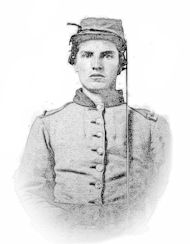
Camp Near Falmouth, Va.
Jan. 5th, 1863.
My dear Mother:
My letters seem very long in reaching you. The one I sent the day before Christmas, containing a little money which I hoped would contribute to the children’s happiness on New Year, had not come to hand on the 31st, yet I had hoped it might precede the rather dolorous document written only the evening before, but which, of course, wouldn’t be overtaken. To tell the truth, I was not a little ashamed at having been so querulous. I do not like the habit of complaining, and do not mean often to indulge in it, but the best of our guardian angels cannot always resist the attacks of those emissaries of Satan — the cooks.
Col. Farnsworth, it is said, will soon rejoin his Regiment. It is still a matter of doubt though, whether his physical health will permit him to remain long. Besides the natural effects of his wound, he is much paralyzed I understand, from severe neuralgia. Be this as it may, I am very sorry for him, and shall welcome him back with pleasure. Farnsworth, McDonald and myself enjoy about an equal degree of popularity in the Regiment. Since writing the last sentence my opinion has been somewhat modified by the arrival of the mail. Farnsworth sends a certificate of disability looking for a further extension of his “leave of absence.” This is indefensible. The law allows disabled officers two months to recover. F. has had four months already, and looks for a further postponement of his return. I have also received your letter bearing date Jan. 2d, and see how much harm I did by indulging in a little fit of spleen. I do not see the slightest hope or prospect of either a short leave of absence, or of promotion, neither of which little matters do I intend shall disturb my equanimity in the slightest degree. To be sure my associations are not always agreeable, but when I entered the service had I any reason to hope they would be? I certainly enjoy more favor than any line officer in the 1st Division. This ought to suffice. Again I am losing years that ought to be spent in fitting me for my profession. Well, what of that? Shall I at this late hour begin to count the cost of doing my duty? No, mother, we both know that this matter must be pushed through to the end. I am not of so much value as to complain of having to bear my part. To hear me talk, one would suppose I was the only one who fancies himself unjustly used. Bah! The army is filled with them. Possibly twenty years hence I shall be grumbling because my professional skill is not properly appreciated. It is hard for disappointed men to believe the fault lies in themselves. Yet such things do happen. I shall be obliged to postpone my Christmas remembrances to you until the paymaster (invisible now for six months) shall visit us.
Very affectionately, Will.
From Mrs. Lyon’s Diary
Fort Henry, Tenn., Jan. 5, 1863.—The last time I wrote, William was off on the second expedition. They returned on Wednesday, dissatisfied at not being allowed to go into Paris. They were ordered to stay eight miles this side, as the rumors were that Forrest had too many men for our forces to fight. Our pickets were driven in, but they captured four horses and arms.
We have just heard the good that the expedition did. The rebels did not know how much force we had, but heard and imagined that there were four times as many as there were. So they turned and went the other way and so came in contact with General Dodge and his army, and had a battle and were badly beaten.
Forrest and Napier had joined forces. Napier was killed and we have taken 900 prisoners, so report says. I expect the Thirteenth will be ordered away from here before long, as General Ransom is determined to have them.
5th. Monday. In the morning George Fairchild called. Pleasant visit. After my work Rob and I rode to the city. Took up my pants for stripes. Got me a vest. Called at Neil House. Phoebe not in. Sorry. Muddy, and I had a servant black my boots! Rode back disconsolate and disappointed.
Monday, 5th—Fell back to Old Fosterville, remained 6th-10th.
Monday, 5th—A report came to camp that the forces under Sherman made an unsuccessful attack upon Vicksburg.1 We are shut out of communications now as well as of provisions; we have had no mail for a month.
1They failed because of the strong fortifications and the fact that Grant failed to make his attack in the rear of Vicksburg at the same time, as planned.—A. G. D.
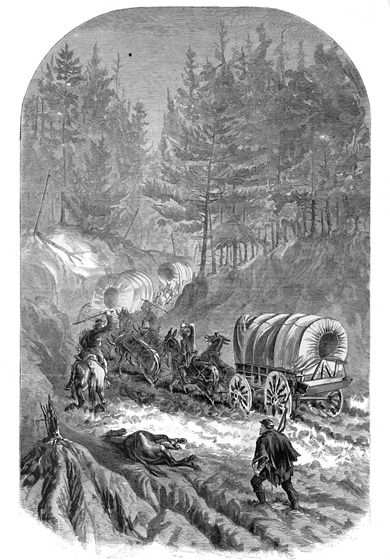
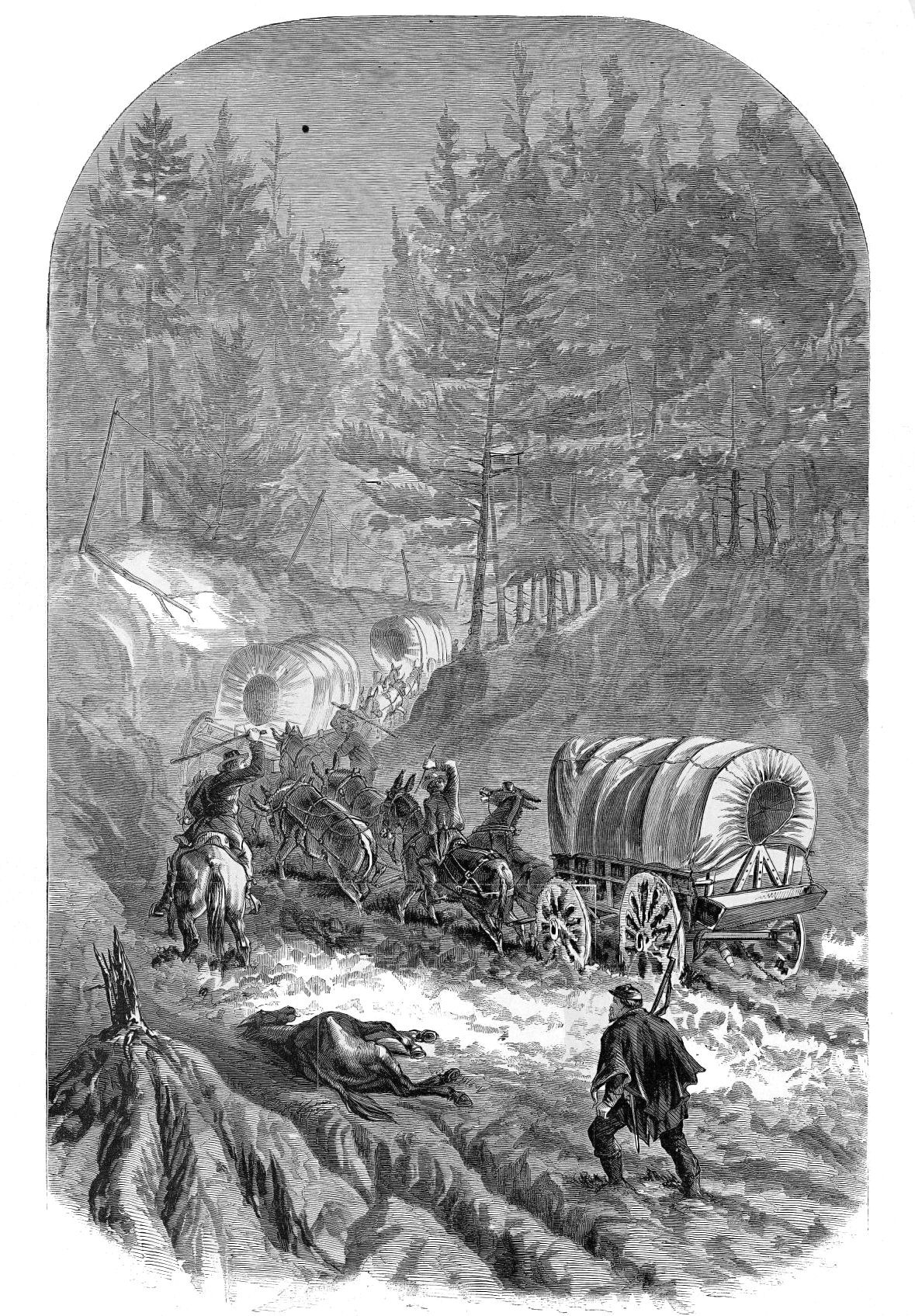
An U.S. Baggage Train on its way to the Army at Falmouth, Va., Published January 3, 1863 in Frank Leslie’s Illustrated Newspaper.
by John Beauchamp Jones
JANUARY 5TH.—We learn from Gen. Bragg that the enemy did not retire far on the 2d inst., but remain still in the vicinity of Murfreesborough. He says, however, that our cavalry are still circling the Yankees, taking prisoners and destroying stores. During the day an absurd rumor was invented, to the effect that Bragg had been beaten. We are anxious to learn the precise particulars of the battle. It is to be feared that too many of Bragg’s men were ordered to reinforce Pemberton. If that blunder should prove disastrous, the authorities here will have a hornet’s nest about their ears. The President arrived yesterday, and his patriotic and cheering speech at Jackson, Miss., appeared in all the papers this morning.
We hear of no fighting at Suffolk. But we have dispatches from North Carolina, stating that a storm assailed the enemy’s fleet off Hatteras, sinking the Monitor with all on board, and so crippling the Galena that her guns were thrown overboard! This is good news—if it be confirmed.
A letter from Major Boyle, in command at Gordonsville, gives information that the smugglers and extortioners are trading tobacco (contraband) with the enemy at Alexandria. He arrested B. Nussbaum, E. Wheeler, and S. Backrack, and sent them with their wagons and goods to Gen. Winder, Richmond. But instead of being dealt with according to law, he learns that Backrack is back again, and on his way to this city with another wagon load of goods from Yankee-land, and will be here to-day or to-morrow. I sent the letter to the Secretary, and hope it will not be intercepted on its way to him from the front office. The Secretary never sees half the letters addressed him, or knows of one-half the attempts of persons to obtain interviews. The Assistant Secretary’s duty is to dispose of the less important communications, but to exhibit his decisions.
January 5.—Captain John H. McNeill of Imboden’s rangers, made a descent upon the National troops in Hardy County, Va., and succeeded in killing one, and in capturing thirty-three men, sixty-one horses, with accoutrements, besides several revolvers and other articles of value. This was accomplished after the rebel forces under General Jones had retired from Moorefield.— Richmond Dispatch.
—By direction of the President of the United States, the troops in the Department of the Gulf were constituted the Nineteenth army corps, to date from December fourteenth, 1862, and Major General N. P. Banks was assigned to the command.—The English sloop Avenger, while trying to run the blockade at Jupiter Inlet, Fla., was captured by the gunboat Sagamore.—Captain W. B. Cushing with the schooner Home, made an expedition up Little River, N. C, surprised and captured a rebel fort, destroyed all its defences and stores, and retired without any casualty.—Official Report.
— Brig.-Gen. R. H. Milrot, commanding the National forces at Winchester, Va., issued a notice to the citizens of that place, of his intention to maintain and enforce the Emancipation Proclamation of President Lincoln.—The rebel pickets, stationed eighteen miles below Kinston, N. C, were driven in by the advance of General Foster’s forces.—An emancipation jubilee was held at Cooper Institute, in New-York City.—Jefferson Davis returned to Richmond from his tour in the South-west.
Buntyn Station, Monday, Jan. 5. Sabres were brightened for inspection at 2 P. M. Order read from General Hamilton stating that Van Dorn was concentrating at Pontotoc for another raid on this railroad, and ordered that stockades be built along the road, and that we be on the alert. No parole to be taken from any cavalry force. The raid to be resisted while there was a musket and cartridge left. 4 P. M. mail came in, a sack full, the first for nearly 20 days. Oh! the welcome it received. Heard from father, brother and four sisters. Welcome! welcome! indeed. 1st piece planted on the track pointing south.
Sunday, 4th.—Marched five miles to Little Warrior River; water bound.