Following the American Civil War Sesquicentennial with day by day writings of the time, currently 1863.

January 2013

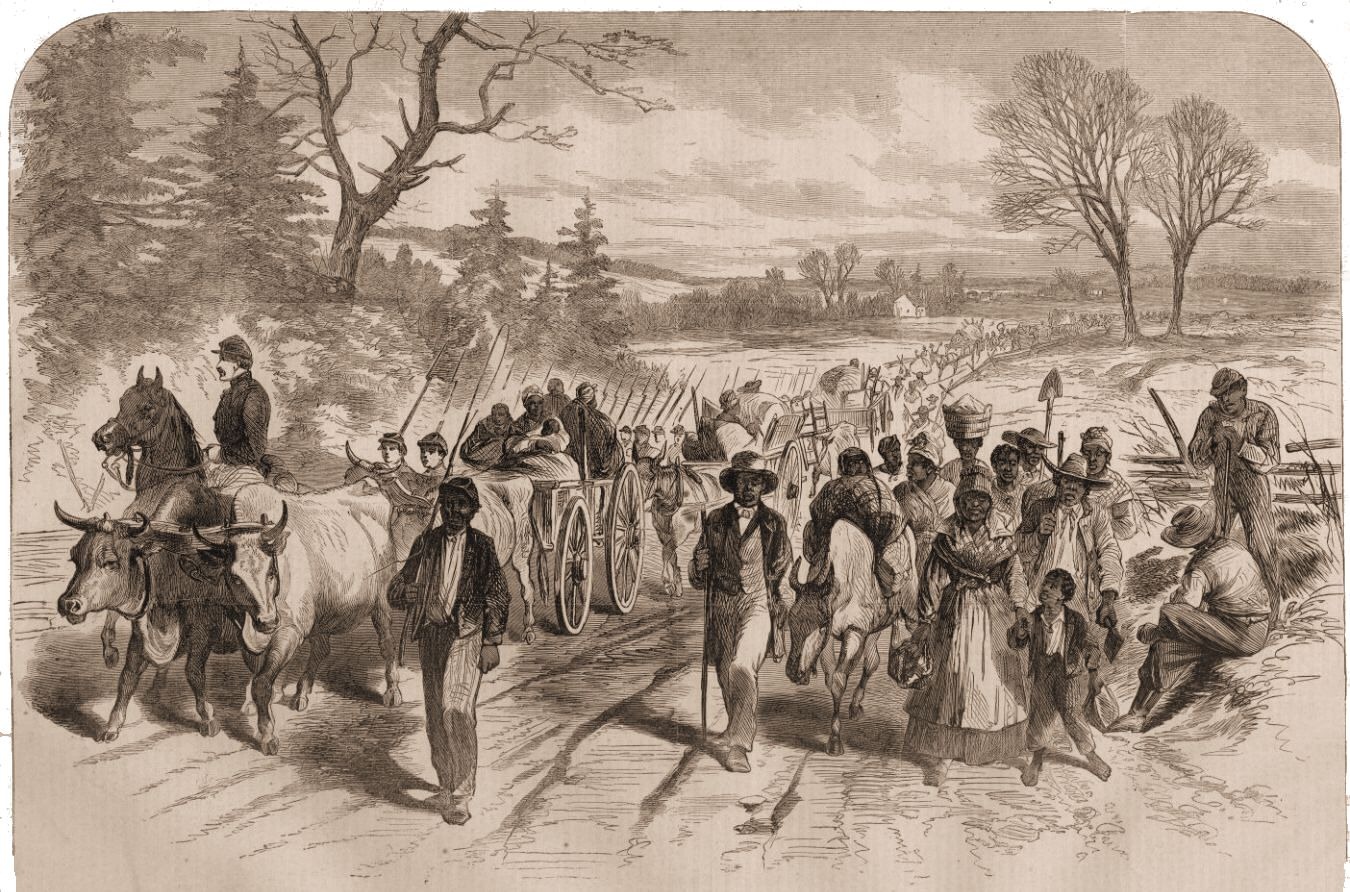
The Effects of the Proclamation -- Freed Negroes coming into Our Lines at Newbern, North Carolina

THOUGH the President’s proclamation of freedom has been so often compared to the Pope’s Bull against the comet, it seems to be producing some substantial fruits. We publish on page 116 an illustration of CONTRABANDS COMING INTO NEWBERN, NORTH CAROLINA, from a sketch sent us by an amateur, who writes as follows:

NEWBERN, NORTH CAROLINA, January 26, 1863.

I inclose a sketch of a very interesting procession which came to Newbern from “up country” a few days ago. It is the first-fruits of the glorious emancipation proclamation in this vicinity, and as such you may deem it worthy of engraving in your illustrated Weekly.

On our late expedition into Greene and Onslow Counties our company (Company C, Fifty-first Massachusetts Regiment) was out on picket duty the night before our return to Newbern, when an old slave came in to us in a drenching rain; and on being informed that he and his friends could come to Newbern with us, he left, and soon the contrabands began to come in, with mule teams, oxen, and in every imaginable style. When morning came we had 120 slaves ready to start with their little all, happy in the thought that their days of bondage were over. They said that it was known far and wide that the President has declared the slaves free.

by John Beauchamp Jones

JANUARY 26TH.—The Northern papers say Hooker’s grand division crossed the Rappahannock, ten miles above Falmouth, several days ago.

Burnside has issued an address to his army, promising them another battle immediately.

Gen. Lee advises the government to buy all the grain in the counties through which the canal runs. He says many farmers are hoarding their provisions, for extortionate prices.

I have no house yet. Dr. Wortham had one; and although I applied first, he let Mr. Reagan, the Postmaster-General, have it. He is a member of President Davis’s cabinet—and receives $6000 salary.

There is much indignation expressed by the street talkers against Mr. Benjamin and Mr. Sanders, in the matter of the intercepted dispatches: against Mr. Benjamin for casting such imputations on Napoleon and his consular agents, and for sending his dispatches by such a messenger, in the absence of the President; against Sanders for not destroying the dispatches. Many think the information was sold to the United States Government.

Col. Wall has made a speech in Philadelphia. He said he should take his seat in the United States Senate as an advocate of peace; and he boldly denounced the Lincoln administration.

Our official report shows that our military authorities, up to this time, have burnt 100,000 bales of cotton in Arkansas. I have not learned the amount destroyed in other States—but it is large. Gen. Lee thinks the object of the expeditions of the enemy on the Southern coast is to procure cotton, etc. The slaves can do them no good, and the torch will disappoint the marauders. [click to continue…]

Buntyn Station, Monday, Jan. 26. Rain, rain, rain. Turned cold towards night. Health not very good on account of the damp. Ague and rheumatism.

January 26.— Major-General Joseph Hooker, having been appointed to succeed Major-General Burnside, assumed the command of the army of the Potomac, and issued general orders to that effect from his headquarters at Falmouth, Va.— Major-Generals W. B. Franklin and E. V. Sumner relinquished their commands in the army of the Potomac—At Vicksburgh, Miss., the gunboat Chillicothe was engaged in shelling the lower rebel batteries, without provoking a return fire.

—Early this morning a party of rebels in ambush, commanded by a lieutenant of the Second South-Carolina infantry, attacked a scouting-party of twenty-one men from Colonel Do Cesnola’s cavalry brigade near Morrisville, Va., killing a scout named Michael A. Fagan, company C, Fourth New-York cavalry, and wounding another scout named Dixon, of the Ninth New-York cavalry.—New-York Times, February 1.

— The bark Golden Rule, Captain Whitebury, belonging to the Panama Railroad Company, was captured by the privateer Alabama, fifty miles south of St. Domingo. The Alabama sent a boat’s crew on board the ship, and the captain was asked if his cargo belonged to neutral owners. He replied that it did, whereupon Semmes demanded the evidence of the fact. This could not be produced, as the captain had not even a bill of lading to show that his cargo was shipped by neutrals. Semmes informed him that if he had even a consular certificate that any portion of his cargo was the property of neutrals, he would let him depart unmolested. In the absence of such evidence the officers and crew were removed to the Alabama, portable articles of value were taken, and the ship set on fire and destroyed. The captain was allowed the liberty of the ship, but the mates and crew were placed in irons. The captain was treated with great kindness, and all hands safely landed at the city of St. Domingo.

—A short skirmish took place at Woodbury, Tenn., between General Palmer’s division of Grant’s army and seven rebel regiments, resulting in the defeat and rout of the latter, with a loss of thirty-five killed, including a rebel colonel, and over one hundred prisoners. General Palmer had two killed and nine wounded.—At Mendota, Illinois, a grand Union meeting was held at which resolutions were adopted and speeches were made indorsing the action of President Lincoln and the Emancipation Proclamation.—Chicago Tribune.

—Inthe rebel Congress in session at Richmond, a desultory debate occurred on a resolution introduced by Mr. Crockett of Kentucky, with reference to the conditions on which peace should be negotiated. Mr. Foote of Tennessee indicated the claims and interest which Maryland would have in such a negotiation, as the faith of Congress had been pledged that peace should not be concluded without securing to her a free election of what her position should be. He expressed continued faith in the loyalty and patriotism of the people of Maryland, and thought that no more prejudice should attach to the position of this State than to that of Kentucky and Missouri. He ridiculed the idea of a Border Confederacy. He was not in favor of any political confederation with the States of the North-West. He had been misrepresented in this respect. He was in favor of a military league, offensive and defensive, with any one of the North-Western States that would lay down her arms, and he would assist and protect such State against the power of the Lincoln Government. He thought that by proper influences and methods the North-West could be disjointed from New-England and the Middle States in this war in less than sixty days.

After touching a number of topics in connection with the probable event of a negotiation for peace, Mr. Foote said he was not prepared to discuss the whole subject within the confines of the present resolution before the House, but that he would at a future time submit some enlarged resolutions on the subject.—Richmond Examiner.

Governor Vance of North-Carolina, issued a proclamation commanding the soldiers of that State who were illegally absent from their regiments in the rebel army, to return to duty on or before the tenth day of February, under pain of being tried, and, upon conviction, executed for desertion.
Sunday, 25th.—Marched short distance; halted for further orders. 11 A. M., marched to railroad; waiting for train to take us to Vicksburg. Camping near Pearl River.

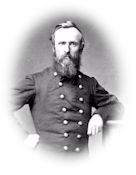
Camp Reynolds, West Virginia, January 25, 1863.

Dear Mother: — Lucy with Birch and Webb arrived here last night safe and sound. We shall enjoy the log-cabin life very much — the boys are especially happy, running about where there is so much new to be seen. … I write merely to relieve anxiety about the new soldiers. — Love to all.

Affectionately,

Rutherford.

Mrs. Sophia Hayes.

Falmouth, Va., Feb. 25, 1863.

Dear Cousin L.:—

Though I receive a good many from here and there, your letters have had a charm for me I found in no others, and I have felt uneasy and restless when the mail has come night after night and no letter from you. I don’t know but I am babyish to think so much of my letters, but it is almost all I have to do now, to read letters and write and think, think. I get tired of this thinking, too, so don’t blame me if I write the second time in return for yours.

I received a letter a few nights ago that interested me very much. When I left home there was a young lady teaching in the village academy. She called the day I left to bid me good-bye and godspeed, and remarked that “she could not shoulder the musket but she was going to the war, not as la fille du regiment, but as nurse.” I am afraid I smiled a little incredulously. I did not think she was really in earnest, but was only saying something to express her sympathy for the soldiers, and every one had plenty of that. Before I left Erie, however, she had gone—tendered her services, been accepted and sent to St. Louis. I heard no more from her till I received that letter, and supposed she had long ago returned to her friends in Indianapolis, but all this time she had been in the army wherever she could soothe the pain or add to the comfort of the sick and wounded soldiers. Six months she was a prisoner among the chivalrous butternuts, much of the time in Corinth. I must confess I admire her spirit, don’t you? She was not bound, as our volunteers are, for any length of time, still she has not deserted yet. “Weary often, but never tired,” she writes.[1]

One of my tent mates left me yesterday morning to report in New York. He goes to receive a commission in one of the black regiments. He has been in the service three months, has never seen a fight except from a distance, and cannot tell to-day whether to hold his gun at shoulder arms with the barrel or rammer to the front. He has been a bugler, an orderly, and the brigade postmaster since he came out, and has never drilled at all. Friends got him the commission. If our negro soldiers are officered by such men, I’m afraid they won’t amount to much.

Whenever you have leisure, remember that I would be very thankful for a letter. Do not think me too much a reprobate. I have made a discovery—there are some in the army who try to live Christians. The other night I stumbled on a little prayer-meeting. The gathering was small, only seven, but it did me more good than many a sermon has.


[1] Note.—Her name was Ada Johnson


Stoneman Station, A. C. & F. R. R., Va.,
Sunday, Jan. 25, 1863.

Dear Sister L.:—

I thought the subject of bugler was exhausted, but I see you want to know more about it. I am chief bugler of the brigade. My duties are, in camp, to sound the calls for roll calls, drills, inspections, guard mounting, etc., at regular hours each day; on the march, to attend on the general in command and sound the calls to march or halt and rest, strike tents and form in line, etc. In short, to act as mouthpiece for the general. So much for duties. As to privileges —one, I’ve nothing to do but bugle; two, my luggage is carried in the headquarters wagons; three, I get better rations than in the regiment, and more of them; four, I get my wood hauled, and in the regiment the men have to carry all they burn a long distance. Well, there are four, perhaps that’s enough, but I might add others. As to the horse, I have one now, and a splendid one, too. He would be worth $175 at home. Colonel Vincent, acting as Brigadier General, went to the brigade quartermaster and told him to furnish me a horse that I could carry the brigade colors on and keep up with him. He is a dashing rider, and no raw head and bloody bones could keep up with him, so he gave me a beautiful black horse, and I am now the brigade color bearer and bugler. My pay should be $21 per month, but I don’t think I shall get now more than $13. They have commenced to-day paying our brigade four months’ pay. Nearly seven months are due.

Well, Burnside has moved again, and got stuck in the mud. That is the short of it. The long of it was the five days it took us to get six miles and back to camp. It beat all the Peninsula mud I ever saw, and demonstrated the falsity of Burnside’s theory that if twelve horses couldn’t draw a cannon twenty-four could. The more horses the worse it was.

We got back to our old camps yesterday, and I apprehend we shall stay a while. The army cannot move in this climate in the winter, and perhaps the people will believe now that “Little Mac” was right in not moving last winter.

Camp Winder, January 25, 1863.

I spent yesterday in bed, and feel to-day like getting back into it. Whilst I have not lost any time from sickness since I last left home, I have been often unwell and compelled to lie in bed for a day or two. A few days’ quiet generally relieves me, but exposure and irregular living generally bring it on again. I never was better than when I came to the army last summer; but about the time of the battle of Cedar Mountain it began, and has continued, making me often hardly fit for duty. It is in some measure owing to a want of vegetables and fruit, and to bad bread. The next opportunity I have, I will send to Richmond and get a stock of crackers, dried peaches, etc.

We have occasionally had an alarm, but generally everything has been quiet. Yesterday morning we had an order to send our extra baggage to the rear, but it arose, I believe, from the accidental bursting of a shell in Fredericksburg, which set the armies on both sides to beating the long roll. My brigade has been rapidly increasing in the last month by the return of sick and absentees. I hope by spring to bring it up to 2200 present, and to have it in a high state of efficiency. Then I expect some good service from it.

You say you have forty-eight barrels of flour at the lumber-house. After saving for your own use what you want, get Wm. White to send off the balance and sell it. Have the balance of the wheat ground, so that you may get the offal, and send off the flour. I wrote you in my last letter a good deal about the farm. Let me hear in your next letter all about them. I have but little time now to think of them, and trust it all to you. If my work here is well done, it will occupy my whole time. I should like to fill my place here, so as to leave it with some credit to myself. To do this will leave me but little time for matters on the farm. So you must be housekeeper, overseer, man of all business, and everything. You may as well learn now, and if you will devote your mind to it you will have no trouble. With such assistance as you can get from Matt and your father, you will be able to get along very well.

When I was lying in bed I half wished that I might get sick, so that I might get home for a little while; but I think my disease is destined to take an unfavorable turn so as to deprive me of that pleasure and keep me in camp.

Give my love to little Matthew and Galla, and tell them I say they must be good boys and do everything you tell them. How I wish that I could be with you again! I hope the day may not be far distant. This hope is the last thing with which I wish to part. Now, darling, good-bye. Write often.

P.S. After closing and sealing up my letter, I break it open to say that I received yours of the 17th inst. It is sad, Love; but still I am glad to know that I am prized at home even by the baby. God bless him, and—a more fervent prayer still—may he teach me my duty! Just here the Chaplain comes to say that the two of my poor soldiers condemned to die desire that their remains may be sent home, and my answer was that all in my power should be done to further their wishes. How I wish that I had some place where less responsibility was thrown upon me! May God give me strength to meet it in the spirit of mercy and justice. How sad it is to think of the distress which this punishment must bring upon others! It makes me shudder to think of such a fate being brought upon the wife and children of my own household. I feel in no humor, Love; I am too sad to write anything which would please you. Again good-bye.

__________

General Paxton’s illness took the “favorable turn” which he hoped for, and his condition became such that a brief leave of absence became necessary, and he spent a few weeks with his family.

Jan. 25th. Sunday. Met M. at Infant Sunday School. Went to Sunday School with the girls, then to church. Pres. Finney preached. Made some hits about the new chapel. Afternoon sat alone and heard good Dr. Morgan. Minnie at our house to tea. After a nap went over to Mrs. Holtslander’s. Apples, pears and cider. Went home with Minnie. Heard John relate about the Chaplain’s sermons.