Following the American Civil War Sesquicentennial with day by day writings of the time, currently 1863.

Thursday, March 14, 2013

March 14th [1863]. For the last few days the Federal soldiers have been arresting all the negroes seen in the streets without passes (given out at the Mayor’s office, Mayor Miller, formerly on General Shepley’s staff, and with whom Mrs. Norton has the written bet about the fall of Port Hudson). General, or Governor, Shepley was standing on his (Mrs. Brown’s) steps as Mrs. Norton passed. She stopped and chatted as usual; asked if Port Hudson “is taken yet.” “I am to drink some of that champagne,” said he. “You must take it at my house,” said she, “for I will win it—you will never win it; you will never take Port Hudson.” The General looked very pale; I expect he thinks so, too. The wife of a Yankee who is lodged in a “captured house” at the corner of our square, had a letter from her husband a few days ago. He is at Baton Rouge, and is to take part in the coming battle. “It will be a terrible fight,” he writes. Two weeks ago she told Mrs. Norton, out of mere bravado and to frighten her, that the Federals had surrounded both Vicksburg and Port Hudson and that both places were in Federal power. She has held levees for the negroes, and has always managed to say something disagreeable about our defeats somewhere or other, or that Butler would soon be back, or something of that sort, whenever we passed her door. But a great anxiety has taken possession of her; she has “no one but her husband,” she says, and indeed we feel sorry for the poor thing. Should Port Hudson fall she will say all sorts of things as we pass, I know, but she is a poor, common creature and is only to be pitied. I hope her husband will be spared her; also that as many of the soldiers as possible will desert to us as have promised to do so. It took three regiments to force off one to go to this Port Hudson affair. We “Rebels” have been making laughing calculations and trying to work out political problems by the rule of three, since this event. Specimens: “If it takes three regiments to move one to the scene of action, how many will it take to move out Banks’ whole army?” “How many will it take to make them fight?” and so forth.

Just called out to see Mrs. Wilkinson—not the paroled one—she tells me that Mrs. Bowen, the wife of a Yankee Colonel, let slip in her converse that three Connecticut regiments mutinied and had to be sent home—officers and men. The rule of three still at work. General Sherman asked Kate Wilkinson why she was so anxious to go over the lines. “Oh, General, I am so tired here, and I do so long for some fresh Confederate air.” The General smiled and said, “Well, stay, and maybe you will have some good Confederate air here soon before long.” We wonder what he meant by that. General Sherman has advised Mrs. Wilkinson not to go yet as there will be danger in the transfer. “Wait,” said he smilingly, “and perhaps we will send you all the way to Vicksburg.” “I have heard something of going that way,” returned Mrs. Wilkinson, “but under our own flag.” The “Rebel” ram Missouri has run the gauntlet out of the Yazoo where she was built, and is safe at Vicksburg. Farragut and Banks are both at Baton Rouge. Word has been received here, it is said, that fighting has commenced at Port Hudson. The few Federals who are left here keep up much journeying to and fro. They are riding furiously up and down the street and the jingling of their swords is sounding in our ears all day long as they pass our door. I can not say that their step is martial, or in the cavalier style. They ride, indeed, infamously in two ways—in the first place they have stolen every horse in town, even ladies’ carriage horses and those from doctors’ buggies; in the next, they sit on them in the most awkward style, bumping up and down, laboring, apparently, more than the horses. They sit back pompously, and no doubt think that we admire them wonderfully. The Indianola, which we captured from the Federals, was reported lost. Indeed, an “extra” informed us that a strange vessel went steaming past the batteries at Vicksburg while our people were raising the Indianola (which had been sunk in the capture), whereupon our Confederate boats took alarm and destroyed the half raised vessel. I thought it queer that two Confederate steamers would run from one Yankee craft, and now we hear that the whole thing was a ruse, and that the Indianola is not only raised, but in good fighting order, having lost in the submerging but two guns.

“We are getting quite a navy—all captured; not one had we with which to begin. When the Queen of the West passed Vicksburg, she ruled, indeed, like a queen over the world of waters, which lie between Port Hudson and Vicksburg, thus locking up our Texas and Red River trade, cutting off our army supplies. The Federals were jubilant over her passing, but she soon fell after a short and inglorious career, and a still more inglorious struggle. She was destroyed by the Red River batteries and deserted by her officers. She floats a new, and I hope to high Heaven, what is to ever be a worthier flag, and her first exploit under it, was to make another Federal bulwark succumb. These iron monsters which were soon to make an end of “the rebellion” are fast falling into our hands, and besides, we have some trusty ones of our own building. We Confederate women are forever counting them in our hearts and on our fingers. They are to open the prison doors of New Orleans. We have three building up the Yazoo; one, the Missouri, has run the gauntlet, and we have seven building at Mobile. In two months we can take this city back. Mrs. Norton is reading out loud—she sees badly—stumbles, I cannot make out what she means, or what I mean myself. I hope my Edith, when she reads this, will take into consideration her auntie’s trials and never feel tempted to scrawl out such a production herself.
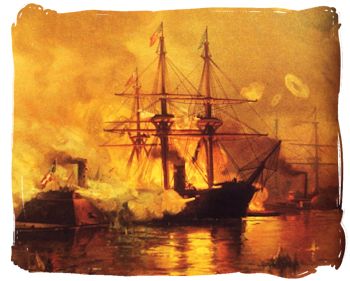

March 14th. This morning at five thirty, called all hands to up anchor, signalized the fleet to get under way, started ahead, ran some distance further up the river, came in sight of the batteries at Port Hudson; at seven thirty A. M., brought ship to anchor; the whole fleet came to anchor at the same time. Here we are able to command a view of the enemy’s batteries; we are lying within four miles of them, just out of range of their guns. The mortar schooners are lying about one mile ahead of our ships, under cover of a point of land; in this position they will bombard the enemy; it is quite probable that an attack will be made to-night. This afternoon an officer came on board with dispatches from Gen. Banks. The mortars have opened fire upon the batteries, simply to get range. Another rebel steamer came down the river this afternoon, making five in all; they lay under cover of the batteries.

It is now decided to make an attack to-night. We took the small gunboat Albatross in tow; she was made fast to our port quarter. The Richmond and Monongahela had, each of them, a gunboat made fast to them also. This was done after dark, so that the enemy could not see our movements; at nine P. M., everything being in readiness, signals were made for the whole fleet to get under way, and follow us up; we beat to quarters, and waited for the fleet to form in line of battle. A very few minutes elapsed before we were all in motion, each vessel taking its respective station; at ten P. M., the tugboat Reliance came up with despatches for the Admiral; spoke, and sent her back to hasten the rear ships; at ten thirty Richmond reported rear ships moving up to station; we moved along very slowly and very cautiously; the night being so very dark, we endeavored to approach the enemy as near as possible without being seen. As soon as we were discovered, the enemy opened their batteries upon us. It was some time before we could get any of our guns to bear; as a matter of course, we were obliged to stand and take it; however, we kept on our course with but one object in view, “conquer or die.” After being under fire of the enemy’s guns for some time, we succeeded in getting our guns to bear, then the firing became general and fearful in the extreme; our ships were all in full blast. In the meantime, the mortar vessels, six in number, let drive their missiles of death. By this time, our ships had got right under the batteries, and in the thickest of the firing. Unfortunately we ran aground; it was not long, however, before we were afloat again, as full steam was applied, and we succeeded in backing off; the enemy, in the meantime, did their utmost to destroy our noble ship.

We were under fire of the enemy’s guns one hour and ten minutes; our ship sustained more damage in this battle than any other we have been in yet. After we had passed by the batteries, our first duty was to ascertain the fate of our fleet; as it was so intensely dark, it was impossible to see the length of the ship from us; not many minutes elapsed before we were informed that the Hartford, and the gunboat which we had in tow, were the only vessels out of the whole fleet that had succeeded in passing by the batteries. We passed on out of range of their guns, and brought ship to anchor. What had become of the balance of our fleet, was now a mystery to us. It was very evident that our ships had met with a serious fate, or else some of them would have passed by. We could see from our anchorage a large fire raging below the batteries, supposed to be the side-wheel steamer Mississippi, from which a frequent number of explosions were heard.

Saturday, 14th—I was on guard at Colonel Crocker’s headquarters in the old Sparrow house and had a fine room to stay in over night. The Sixteenth Iowa got two months’ pay today. Major Wilson of the Thirteenth Iowa left today for his home in Iowa on a thirty-day furlough, and I sent $35.00 home by him. The weather is quite warm.

March 14. — On my side, in a corn-field, about thirteen miles from Baton Rouge, on the Port-Hudson road, with Port Hudson from five to seven miles away. Off for war at last, as sure as we live. It is the noon halt. Grover’s division, far as I can see, lies in lines, one line behind another, in each about one regiment; arms all stacked, with the men behind; some sleeping, some eating, some inspecting feet becoming blistered. Last evening, we left our old camp in good earnest. We marched out half a mile to the camp of the Ninety-first New York, with which we are brigaded; then waited for the army to assemble; from street and path a stream of troops, coming like runnels into a larger stream; until at last Gen. Grover himself, with the red flag and white star of the fourth division, went to the head of the column. A furlong or so in front of us, young Col. van Zandt, our brigadier, took his station with the blue white and blue ensign of the second brigade. We are all in heavy order, each one of us δπλίτης; though, since the review of yesterday, essential things have undergone a wonderful diminution; an effective-looking crowd, though not exactly smooth and neat. We are soon on the point of starting. Our colonel comes riding back from the general, with the resolute, pleasant smile he usually wears, a little more expanded than common. The colonel whispers to Capt. Morton; whereat the captain catches the smile, and he comes back toward his company,— the color-company, you know. “Gen. Grover says the Fifty-second is the best .nine months’ regiment in the service.” A little butter of that sort will help hard fare and tough marching; that the general knows.

Ahead ride the cavalry, yellow trimmings about their collars, yellow welts about the seams of their jackets at the back, and stripes down the pantaloons. Artillery come up. Their trimmings are red; in fine order everybody; horses prancing, cannon polished, muskets in the finest order; an untried army, but of the finest material, and as well equipped, I suppose, as any country through all history has ever equipped her warriors. The march begins, out past the spots where we have stood on picket. I see that the fence-post, against which I leaned all one night, has gone to the coals. We come to two roads branching off from the one on which we are marching: one to Clinton, twenty-five or thirty miles away; the other to Port Hudson. This last road we take. Soon we are beyond the outmost picket-stations, and push forth into unknown regions.

The weather is grand. We are in a heavy magnolia forest: the sun’s rays, now nearly level (for it is late in the afternoon), cannot reach us. We go mile after mile. The road is just what it should be, not muddy, not dry enough to be dusty; but smooth and soft enough for the foot to feel it like a cushion, yet not so soft as to take the foot in too deep. It is just wide enough for the regiment to march comfortably by the flank, in sections four deep. Sometimes we go over a hill: then, far ahead and far behind, I can see the big column of infantry, a huge caterpillar eating its way through the woods, jointed along his back where the sections are separated, spiny as a caterpillar’s back is, with the hundreds of muskets sticking out at various angles. The night settles down, a night of stars; and from the westward, as the glow fades, rockets go darting up, signals from the fleet, out of sight, in the river, ascending like us, loaded with death against the great fortress. Shall we march all night? No one knows, not captain or colonel, only Gen. Grover apparently; but at eight o’clock, or about that, eight miles on our journey, comes the order to bivouac. A pause in the march, then a quarter of an hour of intermittent progress, then horsemen dimly seen in the starlight; the order to “file right,” and I follow the tall color-sergeant over the rails of a destroyed fence into a ridgy corn-field, across which the regiment advances in line, guiding on the centre as well as it can see, then halts; the Ninety-first thirty or forty paces in front, the Twenty-fourth Connecticut about the same distance behind. Stack arms, then camp for the night.

I go back from my place on the left of Co. A to Co. D, and shout through the dark for Bivins. We find a soft place among the furrows: two rubber blankets over a soft ridge make our mattress; then two woollen blankets over; and last the shelter-tents, not pitched, but on top by way of counterpane, to give a finish to the bed. Lie down now, boys, loaded pistol still at the belt, every arm where it can be caught in an instant; for Port Hudson may send out fellows to stir us up during the night. “Corporal Buffum, under the stump there, is your bedroom well aired?” Buffum thinks he shall make out not to suffocate. The night-wind blows over us, the stars shine as only Southern stars do, and in a few minutes fancy runs northward and homeward through a thousand dreams.

The morning comes at last. Is it D or B? The mind gradually gathers itself. Is it the camp by the river, or under the magnolias? Ah! now I have it, — the tall naked trees, the furrows bristling with dry stalks and partially covered with short grass, the army rising like a brimming colony of ants from the ground. Now, as I roll over, my pistol hits me in the ribs, and slap against my legs hits the heavily-weighted cartridge-box. It will make my thigh black and blue, I believe. I have slept as well as I ever did. No one knows exactly when we shall be ordered into line.

At any rate, the canteens must be filled: that is the first thing. Bivins and I draw cuts, and it falls to me: so Cyrus Stowell and I start off, hung round with a maze of white canteen-strings, as if somebody had thrown a net over us. We got back to camp just as the cry “to fall in” is being shouted by the first sergeants. The brigade files out of the corn-field, and is on the road again.

“The thing that hath been, it is that which shall be; and there is no new thing under the sun.” I think of that as two companies from the regiment are detailed as flankers. They go off into the woods, fifteen or twenty rods from the road on each side; and throughout the march we see these two lines guarding the main body against ambuscade, — through stumps and stalks, through old sugar-fields, plantation barn-yards, and wild swamps. I remember to have read, that just so Lord Percy, on the retreat from Concord, threw out flankers to protect his harassed party. Probably the children in the houses we are passing, fifty years from now, will tell how Banks went by to Port Hudson, as the old people along the Lexington road recall their great reminiscence.

When I was studying-up the old Assyrians once, I found out that the soldiers of Sennacherib were prepared against the Jewish horsemen with almost the same tactics which the French were to employ against the Mameluke cavalry, ages after, in the same region. So Lord Clyde, in India, once circumvented an army of mutinous Sepoys with the same strategy, particular for particular, which the old Hebrew leader Joshua used against “the men of Ai,” in the days when the sun and moon stood still. I dare say, in spite of improvements, we look very much like these old soldiers of the past, as the features of our warfare are similar. In clothing and equipments, we are reduced to what is simply convenient and easy. The pattern of our garments and their quantity, the fashion of weapons and trappings, — every thing is fitted for convenient use. What is convenient now, was, no doubt, convenient a thousand years ago. Probably, after all, we do not look much unlike the spearmen of Nineveh, the legionaries of Rome, or the halberdiers of Alva, when they put off holiday things, and undertook the active work of war.

The morning deepens toward noon. Fewer soldiers now leave the line to forage among hen-roosts; and the plunder, collected in the cool of the morning, is thrown away as the sun begins to burn. Only the negroes, a half-dozen or so of whom go with each company, stick to their prizes of chickens and turkeys. The Fifty-second grow red, and sweat; and now, along the roadside, we begin to see — what, I believe, is always seen when an army is on the march — knapsacks, sometimes full and sometimes empty, blankets, shelter-tents, all the articles of a soldier’s kit, thrown away for relief. Occasionally we stop, when the stream of men rushes from the roadway to the grass at the side, and in a moment every man is flat on his back. It is a good way to rest, though a dirty one: the pack behind supports you at a comfortable incline. Sometimes you sit in the dust, sometimes in the dew: one is not over particular when each pore spouts hot perspiration like a perfect geyser. In one of these pauses, we hear cheering far behind us, that comes rolling nearer; when word passes from mouth to mouth, “The general, the general!” In a moment, a clatter of hoofs, and then past us sweeps the “iron leader,” at full gallop and bareheaded, with his staff behind him, on his way to the front of the column.

Men now begin to fall out. They lie panting by the roadside, in fence-corners, under bushes, with heads resting against logs — a sorrowful sight, though not so bad as if we were on a retreat, and a howling enemy were to pick them up instead of friendly baggage-wagons in the rear. Sometimes there is a momentary hitch as the column picks its way around a mud-hole. I find some relief then for my shoulders in stooping over, and hitching the weight of the pack on to my back. It is robbing Peter to pay Paul; but poor Paul has so much the hardest time, that Peter ought to be willing to give him a lift.

Fortunately, the day is very fine; a grand breeze comes blowing up behind us: it is sunny, but cool; and the vines from the roadside wave white roses at us as we go by, as if the hedges were in for the North, however it might be with the people who lived behind them. Thank fortune! so far as my body goes, it is a good one. Heavy, muscular fellows are pitching away their knapsacks, or lying swollen and panting by the roadside: but, in my case, there is no headache yet; heart works smoothly and healthily in the left side, and liver under the diaphragm; legs swing to and fro without a painful chord, and feet are fully up to their responsibilities.

True, it is hard. “Whenever the column halts, I am flat on my back, and in the dirt at once. If there is a pool near, I must dowse my hot head, and re-wet the handkerchief in my cap; but so it is with us all. It is a good thing, when all favors, to be big and imposing, like Corporal Green here, and the rest of our fine, grenadier-looking soldiers; but, for actual work, the little, light-weighted fellows are even with them.

We have come now some six or seven miles. The forenoon draws to its close: true as the needle to the pole, the belly turns dinnerward. The fence is down, here to the left; and the long column, filing into just such an old cornfield as we camped in the night before, rules it across with long, blue lines of soldiery at regular intervals, and proceeds to write it over with such confusion as some thousands of reckless, hungry men would be likely to make. Here it is, that, a dried herring or two and some hard-tack and cheese being promptly put away, the color-corporal, under the lee of the stacked arms of the guard, pitches off his traps, lies down under the folded colors, and writes.


Saturday, March 14th.

5 o’clock, P.M.

They are coming! The Yankees are coming at last! For four or five hours the sound of their cannon has assailed our ears. There! — that one shook my bed! Oh, they are coming! God grant us the victory! They are now within four miles of us, on the big road to Baton Rouge. On the road from town to Clinton, we have been fighting since daylight at Readbridge, and have been repulsed. Fifteen gunboats have passed Vicksburg, they say. It will be an awful fight. No matter! With God’s help we’ll conquer yet! Again! — the report comes nearer. Oh, they are coming! Coming to defeat, I pray God.

Only we seven women remain in the house. The General left this morning, to our unspeakable relief. They would hang him, we fear, if they should find him here. Mass’ Gene has gone to his company; we are left alone here to meet them. If they will burn the house, they will have to burn me in it. For I cannot walk, and I know they shall not carry me. I ‘m resigned. If I should burn, I have friends and brothers enough to avenge me. Create such a consternation! Better than being thrown from a buggy — only I’d not survive to hear of it!

Letter from Lilly to-day has distressed me beyond measure. Starvation which threatened them seems actually at their door. With more money than they could use in ordinary times, they can find nothing to purchase. Not a scrap of meat in the house for a week. No pork, no potatoes, fresh meat obtained once as a favor, and poultry and flour articles unheard of. Besides that, Tiche crippled, and Margret very ill, while Liddy has run off to the Yankees. Heaven only knows what will become of them. The other day we were getting ready to go to them (Thursday) when the General disapproved of my running such a risk, saying he’d call it a d— piece of nonsense, if I asked what he thought; so we remained. They will certainly starve soon enough without our help; and yet — I feel we should all be together still. That last superfluous word is the refrain of Gibbes’s song that is ringing in my ears, and that I am chanting in a kind of ecstasy of excitement : —

“Then let the cannon boom as it will,

We ‘ll be gay and happy still!”

And we will be happy in spite of Yankee guns! Only — my dear This, That, and the Other, at Port Hudson, how I pray for your safety! God spare our brave soldiers, and lead them to victory! I write, touch my guitar, talk, pick lint, and pray so rapidly that it is hard to say which is my occupation. I sent Frank some lint the other day, and a bundle of it for Mr. Halsey is by me. Hope neither will need it! But to my work again!

Half-past One o’clock, A.M.

It has come at last! What an awful sound! I thought I had heard a bombardment before; but Baton Rouge was child’s play compared to this. At half-past eleven came the first gun — at least the first I heard, and I hardly think it could have commenced many moments before. Instantly I had my hand on Miriam, and at my first exclamation, Mrs. Badger and Anna answered. All three sprang to their feet to dress, while all four of us prayed aloud. Such an incessant roar! And at every report the house shaking so, and we thinking of our dear soldiers, the dead and dying, and crying aloud for Sod’s blessing on them, and defeat and overthrow to their enemies. That dreadful roar! I can’t think fast enough. They are too quick to be counted. We have all been in Mrs. Carter’s room, from the last window of which we can see the incessant flash of the guns and the great shooting stars of flame, which must be the hot shot of the enemy. There is a burning house in the distance, the second one we have seen to-night. For Yankees can’t prosper unless they are pillaging honest people. Already they have stripped all on their road of cattle, mules, and negroes.

Gathered in a knot within and without the window, we six women up here watched in the faint starlight the flashes from the guns, and silently wondered which of our friends were lying stiff and dead, and then, shuddering at the thought, betook ourselves to silent prayer. I think we know what it is to “wrestle with God in prayer”; we had but one thought. Yet for women, we took it almost too coolly. No tears, no cries, no fear, though for the first five minutes everybody’s teeth chattered violently. Mrs. Carter had her husband in Fenner’s battery, the hottest place if they are attacked by the land force, and yet to my unspeakable relief she betrayed no more emotion than we who had only friends there. We know absolutely nothing; when does one ever know anything in the country? But we presume that this is an engagement between our batteries and the gunboats attempting to run the blockade.

Firing has slackened considerably. All are to lie down already dressed; but being in my nightgown from necessity, I shall go to sleep, though we may expect at any instant to hear the tramp of Yankee cavalry in the yard.

March 14—This morning, at daybreak, cannonading was heard by us from General Pettigrew’s line, which is on our left flank. We immediately fell into line of battle, our artillery opened fire, then we infantry advanced our line on the Yankees. We halted in an old field and had for a breastwork a rail fence. We fought for four hours—hot at times. We had a number killed and wounded. The enemy fell back on their stronghold—Newbern. This battle is called the Battle of Deep Gully, as it was fought on that stream. We then took up our march again for Kinston. We got eleven miles and halted for the night. Our company was the rear guard of the brigade.

14th. Robinson went home to make a chest for H. quarters. Went over to Capt. N.’s and saw T. E. Davis, Morey, E. W. and Joe Dewey. A letter from Major Purington inquiring about his papers. Got them out and commenced work. Covil said he would do it if I would help him. Evening attended class.

Saturday March 14th 1863

News that Vicksburgh is evacuated by the Rebels comes tonight pretty well authenticated. Nothing further from “Yazoo,” but we are expecting good news from that section all the time. I am rather in hope that Vicksburgh is not evacuated. I think its Capture by Genl Grant a sure thing and I would like to have the Rebel Army captured too. I realy hope they will not be allowed to take away all of the three hundred cannon which they say they have there. The rebels had captured the Gun Boat “Indianola” but blew her up on the approach of a Sham “Iron Clad” which was made out of an old barge and sent floating down the River in the night. They are now mourning over it. I have attended to some business today for Mr Short. Went on to the Av’e after leaving the office and purchased a pocket Dictionary. I am frequently bothered and in doubt about my spelling and have had nothing to refer to. I suppose my folks are much disappointed that I am not at home tonight as I presume they expected me. I must go the forepart of the week. I have been quite busy this evening. Called at Charleys, at Doct Munsons & Mr Reeds, Mr Schrams who was not at home and spent most of the evening at Mr Haws on I Street. They are very pleasant people. Got back to my room about 11 o’clock.

Near Helena, Saturday, March 14. Health not very good. Seven months ago I enlisted in the service of the U. S. Then I hoped that by this time a different phase of the matter could be seen. But alas, it very dark ahead, yet I do not despond, neither have I regretted my enlistment. I can only do the best I can, and be satisfied. A hard tug is before me. May God grant me health and courage to do my duty.

Saturday, 14th—Squadron went on scout. I went to shop and on bread detail.