Following the American Civil War Sesquicentennial with day by day writings of the time, currently 1863.

Thursday, March 21, 2013

March 21. — General Woodbury started for Washington this morning, and General Benham issued General Orders No. 1, announcing his staff. For the present I am acting as adjutant-general. Did not move from headquarters to-day on account of the storm. Saw General Williams[1] about adjutants-general, and found that there were two unassigned, Captain Williams and Captain Wood.


[1] General Seth Williams; he was the bearer of the letters between General Grant and General Lee at Appomattox.

On Staff Duty. [1]

Headquarters Second Vt. Brigade,
Near Wolf Run Shoals, Va.,
March 21, 1863.

Dear Free Press:

I am glad to be able to announce an improvement in the health of the Twelfth regiment since I wrote you last. The existence of some sixty cases of pneumonia and typhoid fever, of which eight proved fatal in quick succession, alarmed us all at one time. But a change has taken place for the better,—due, apparently, to the increased care and precautions taken for the health of the men, for the weather has continued as trying as heretofore. We had snow and sharp cold weather yesterday and last night, and have a drizzling rain to-day. There have been no deaths within a week past; the number on the sick-list has decreased considerably, and the new cases of fever are of a milder type. The suddenness with which death gave the final discharge, in several of the fatal cases, was startling. In one case, the man was taken sick one day, went into hospital the next, and died the next. In another, the poor fellow had just sent a message to his friends saying that he was pretty sick, but hoped he should get along with it, when he fell into a dreamy, wandering state, complained of the weight of his knapsack, and did not see how he could carry it across the river. Suddenly his breath stopped; the soldier was over the river, without his knapsack and never again to be troubled by its weight.

There is now, I believe, but one man in hospital who is considered dangerously ill; and a week of sunshine, such as we must have soon, will bring the regiment back to its usual average of health.

Colonel Blunt, as brigade commander, has been making his presence felt at Fairfax Station in the right way. The Station is a point of supply for all the troops at Centreville, Union Mills, Fairfax Court House, Fairfax Station and Wolf Run Shoals. The quantity of quartermaster and commissary stores here, is of course very large —and the position is to be held at all hazards. It is now, I am happy to say, in a very much better condition for defence than ever before. Rifle pits have been dug and breast-works by the mile , thrown up, by the men of the Fourteenth, Fifteenth and Sixteenth regiments, along the high ground surrounding the Station on every side, from behind which they will be happy to meet any force likely to be sent against them. The picket lines have also been closely looked after; the various departments of supply for the brigade have received attention; and the brigade and regimental hospitals have had the benefit of the colonel’s occasional unannounced presence and quick eye for defects in management. One learns to value energy and attention to his business in a commanding officer, after seeing how the influence of such qualities is felt throughout down to the last private in the brigade.

How long the rebels will leave our infantry regiments unmolested, of course I cannot say; but the way in which our cavalry suffer of late, is a caution to us all. You have heard of the recent capture of Major Wells, a captain, two lieutenants and twenty men of the Vermont cavalry at Herndon Station, Va., some twenty miles north of this place. This was followed up night before last by the gobbling up of a picket reserve of the Pennsylvania cavalry, numbering some twenty men, a short distance to the right of our own picket line on the Occoquan. These surprises of the cavalry, I must say, are getting to be altogether too frequent.

I have, by the way, recently met one or two of the men who were present at the capture of our Vermont cavalry at Aldie, two or three weeks since. Captain Huntoon’s party were thrown off from their guard by a body of the Eighteenth Pennsylvania cavalry which met them on its way in from the outside, and reported no rebels anywhere in the region. The men were hemmed in by the rebels in the yard of a mill, from which they were getting grain to feed their horses. The force under Captain Mosby numbered, according to his own statement, twenty-seven men. Captain Woodward’s horse was killed instantly by a ball in the spine and fell upon Captain Woodward, pinning him to the ground. While lying thus, a rebel ruffian rode up and commenced firing at the prostrate captain, who would probably have been murdered in cold blood had he not managed to draw a small pistol from his breast pocket, with which he was lucky enough to send a ball through his assailant’s body. One man of his company defended himself for some time from two rebels who were trying to seize his horse, which he held by the halter, by striking at them with the bridle and bits. Gurtin, the Rutland boy who was so severely wounded, was seen to stop, with the balls flying around him and after two had gone through him, and deliberately load his revolver, which he had emptied, and discharge it at the rebels, after which he put spurs to his horse and made his escape. He now lies in the hospital at Fairfax Court House in a critical condition, a ball having passed through the bone of the pelvis into the groin, where it cannot be extracted.

Several of the men who were captured with General Stoughton and accompanied him to Richmond, have been paroled and have returned. They say that they were taken to Culpeper that night and the next morning, and remained there over one day, a delay which might have ensured the recapture of the prisoners, had a sufficient cavalry force followed upon their tracks. General Stoughton was well treated at Culpeper by General Fitzhugh Lee, who was a classmate of the general’s at West Point; but after his arrival in Richmond he was taken to the Libby prison, where he now lies in company with 108 officers of our army, who are all confined in one room. A lady acquaintance of the general’s in Richmond had furnished him with some blankets; but he was kept on the same scanty fare as that allowed to the other prisoners—a third of a loaf of bread and a small piece of poor meat per diem. The general and his friends are hoping for his speedy release on parole.[2]

Yours, B.


[1] Shortly before the date of this letter the writer was permanently detailed for duty as aide-de-camp on the staff of the brigade commander.

[2] General Stoughton’s appointment as brigadier general, then pending confirmation by the U. S. Senate, was withdrawn by President Lincoln. This left him without rank in the army. He was paroled, retired to private life, and did not return to the service.

Camp White, March 21, 1863.

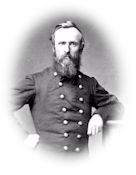
Dearest: — You left this morning. Don’t think I am going daft after you. I am in my tent facing the parade between the captains and companies. McKinley is in his. The doctor, Avery, and [the] major will come over tomorrow. I shall sleep in a tent tonight for the first time since the night before South Mountain — over six months ago. . . .

Did you see us crossing in our boats before your steamer passed? I saw you and swung my hat, but whether you saw me I could not tell.

Our house flag must come out to go on a high pole near headquarters if it is militarily proper, and I think it is. . . . Goodbye, darling.

As ever,

R.

Mrs. Hayes.

Saturday 21. — Lucy and boys on the Allen Collier home.

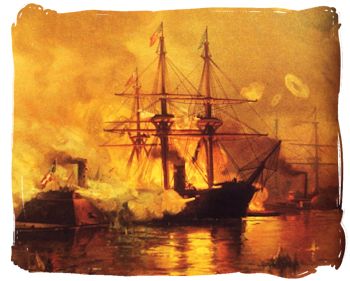
March 21st. At nine A. M., got under way, went to quarters, and steamed up the river a short distance, but owing to the dense fog returned back to our anchorage. To-day we buried one of our men, Robert King, Quartermaster, who had been lying ill for some days. From our anchorage we could see a range of high cliffs, and a small village known as Warrenton. Thinking that there might be batteries erected there, it was decided upon to go up and introduce ourselves by way of informing Mr. Secesh that we are still on the lookout for them. At five P. M., got under way again in company of the Albatross. Steamed up, and when in good range opened fire; continued on up until we had passed by the cliffs, where we expected to find guns mounted, but there were none to be found or at least no response was made to our firing. At six thirty, P. M., came to anchor about three miles above Warrenton. We are now lying about six or seven miles below Vicksburg, and can see the city quite distinctly. This has been quite an adventurous week to us.

Saturday, 21st—The Eleventh Iowa received new guns, the Enfield rifle, and everyone is pleased with the exchange. Receiving orders to move camp, we struck our tents at 3 o’clock p. m. and moved two miles and went into camp in a cotton field close by the levee just above the town of Lake Providence. On account of the flooding waters we had to travel a distance of four miles to reach the point. General Logan’s Division moved up the river about four miles.

March 21. —We staid in the swamp through Monday forenoon. At noon came the order to pack up, which was done with thanksgivings; and we waded and paddled out to the road, just as the sun appeared once more through the clouds. We marched, for the distance of about a mile, through a lane running westward; coming, at last, to an elevated field on the river-bank, at the Montecino Bayou, — a pleasant, well-drained spot, — where we camped at once to dry and rest ourselves; the stacks of guns, as usual, running in a long line, with the shelter-tents behind them; the two flags, in their glazed cases, crossed on the middle stack, indicating the centre of the line. The powerful sun soon dried our outer clothing; and, content with that, at nightfall we lay down to sleep; willing enough to postpone, until another day, the drying of shirts and drawers and the contents of our knapsacks.

We had come to a very pretty spot, and in such contrast to the camp we had just abandoned! I remember, Ruskin says, somewhere, that a picture, and, I believe, a natural landscape, has a shut-up, stifled look, unless there is water in it. I have felt that, I think; and now it seemed as if we were free again, with our fine prospect southward down the broad river. To the east of the camp was a grove of young trees, hung about with tassels of moss, and heavy cordage of strange vines; the trees just leaving forth under the influence of the Southern spring. In the edge of this grove, at the bottom of a ravine, ran a little brook. From the trees we could gather moss and leaves to make our beds more soft, and in the brook we could bathe. Moreover, a few rods southward from the camp was a broad, deep bayou, approached by green, sloping banks, where we could swim as far and deep as we chose. It was luxury itself, Tuesday morning, to strip off our mouldy garments, and, while they lay sunning on the grass, wash the stiff muscles, and blistered, parboiled feet, in the brook, dappled darkly by the shadows of the boughs and leaves.

Our respite, however, was a short one. The night we arrived at this pleasant camp, the colonel passed down through the tents to see what our condition was. He stopped at Capt. Morton’s tent, which was close by ours; and the captain brought out a bottle of currant wine, just from home, calling me up to have a sip also.

The colonel spoke very feelingly of the discomfort to which we had been exposed, and added, “At any rate, now we shall have a rest for a day or two.” Tuesday forenoon, therefore, I paddled about in the brook at my leisure, feeling sure of ample time. At noon, however, the drum sounded once more; and the order came to pack every thing again, and fall in at once. Sudden orders had come, to march. This time, we were to go out to protect a heavy train of wagons, about to proceed out along the Port-Hudson road to gather the cotton stored everywhere in the planters’ barns. Our march was along the same road we had previously traversed, and with similar incidents, though at first with less excitement; for it was no new thing now. The regiment was footsore, jaded, and suffering for the want of sleep. Both my collar-bones turned peace-democrats; and in every cell, with an ache for a tongue, protested against a further prosecution of hostilities. We toiled along, however; at every plantation, as we passed, seeing mule-teams loaded with cotton, and quantities of the snowy product tumbling from the windows and doors of sheds and barns.

We marched out seven or eight miles before we halted. As we advanced, we began to hear reports of the enemy from negroes; and at length reached a plantation from which a rebel force had just retreated. The rebels were hardly out of sight as we came up, and we followed close after them down the road. At length, within about five miles of the batteries, we came to a halt, and encamped in the edge of a grove,—for the night, as we supposed. Many of the men were much fatigued, and sadly footsore. The march had been a hard one for me; for the sun, during the afternoon, was most oppressive: but I made a cup of coffee, and cooked a dish of meat on my plate, and felt better. The men, generally, threw themselves on the ground at once, under the trees. Bivins, however, went to bathe in a brook near; and I took my seat to watch the baggage. It had just grown dark, when word was passed along the line, in a low tone, to be up and off at once.

It was hard enough; but it would have been the height of imprudence — two isolated brigades as we were — to spend the night within so short a distance of a powerful army of the enemy, perfectly aware of our being in the neighborhood. The grove, therefore, gave up its sleepers. In five minutes, the line was moving out of the shadow into the road, and, under the starlight, marching silently and rapidly back.

I like a night-march: the air is more bracing, the roads less dusty, and there is far more scope for romance. In the afternoon, I had had a severe time; but the night-march home was an easy one. I could carry easily all my own baggage, though we were in heavy order; and occasionally spell the sergeant, who almost gave out with lameness, by shouldering the big flag. There was ample room for the play of fancy. The rebel scouts, no doubt, had already crept into the camp we had just abandoned, looking at the embers where we cooked our suppers to judge how long we had been gone; while the cavalry swept forward to occupy the road as we retired. The regiment, in general, however, suffered sadly. Many marched with bare, bleeding feet, and, toward the end of the route, sank to the ground with fainting limbs, to pass the night by the roadside. We reached our camp of the morning at midnight, — the colonel straight on his horse, sitting up in the starlight, at the entrance, to direct the column; his voice, as he gave the last orders, full of sympathy with his way-worn command. We only had strength to spread our rubber-blankets, and fling ourselves upon the ground.

Next morning, the regiment were a poor, languid crowd of hobbling cripples,—putting up shelter-tents with stiffened bones, crawling around fires to cook coffee, and fry, on their tin plates, pillaged meat and potatoes. During the whole forenoon, those who gave out the night before came straggling in. This chronicler was tired and stiff; but he made out to wash his shirt and himself, — two undertakings requiring some degree of resolution. At night, however, I own, I was used up. I felt feverish, and next morning dosed strongly with quinine, which put Niagara Falls into each ear. During that day, I was on the sick-list. The next day, the regiment was ordered back to Baton Rouge. With some mortification, I left the regiment to march; and, with several scores of used-up men, made the passage down on a steamer.

I write now in the old camp, under the magnolias (which has become home to us), ragged, dirty, contented, burnt like an Indian, unkempt, unshaven, but about ready now for another start. During the week, we have marched fifty miles, heavily weighted, through mud, dust, heat, and a deluge of rain. We were on the brink of an engagement, having driven the enemy into the Port-Hudson intrenchments, — following them to within easy rifle-range of the batteries. We find it was not the intention of the general to fight a battle, unless himself attacked. We simply made a demonstration in aid of the fleet, a portion of which succeeded in passing up the river.
March 21 — Remained in camp. Drizzling and rainy all day. Dark and misty clouds are hanging low on the mountains around us. Such gloomy weather as we had to-day is enough to give even the jolliest outing party the blues before breakfast.

March 21.—In a package of letters I have just received from a friend in England, she says they have still great hopes of our success, and that the people sympathize a great deal with us. I wish they would show it differently from what they do. But we are told that the people are very anxious to recognize us, but the government seems determined not to do it. I trust we shall get along without the aid of any foreign power, though I think the colonies would have done very little without it. She also says she envies me the opportunity I have in administering to the wants of the suffering of our army.

21st. John Devlin went down to Oberlin without a pass. Will probably be punished. Took a letter for C. G. and brought another from Fred which C. G. showed to me. Both good. Issued rations for 11 days. After going round with potatoes, felt rather tired. A sore toe, miserable corn.