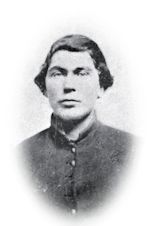
On Moon Lake, Monday, March 23. Reveille at 4 A. M. At dawn we commenced embarking, the left Section under Lieutenant Hood on the “Armada,” center Section under Simpson on the “Jesse K. Bell.” First piece on the “”White Rose.” Second piece on the “Rose Hamilton.” Rained heavy all day. 2 P. M. we swung off, I being on the “Jesse Bell.” Laid off till 4 P. M. when we entered the Pass, the fourth boat of the fleet. At the mouth it was about five rods wide. The water shot through at a wild rate. The wheel was reversed to check the speed of the boat. On we went, through the woods and short turns until we reached Moon Lake, where it widened. The Lake is about three miles long, half a mile wide, where we had smooth sailing until dark, when we tied up near an old negro hut. On the north side a squad of cavalry encamped close by. A member of the 93rd Illinois (which is on board with us) was buried near the shore. Made our bed under the wheels of the pieces, the boat being so crowded; had but poor rest. Slept as close as “three in the bed and two in the middle.”
March 2013
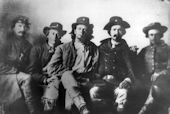
Monday, 23rd—A false alarm to-night, and rain.
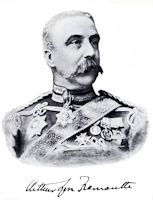
23d March. — Left Havana in H. M. S. Immortality, at 11 A.M. Knocked off steam when outside the harbour.

Monday, 23d [March]. I was very unwell, and it poured down rain all day—a real equinox. Sat pretty much in my room, hearing Mrs. Norton through the open door fretting about not being able to go out and make some visits, and talking about the negroes and the Yankees alternately. I feel all the time as if she feels we ought to be with her and amuse her. I so often nowadays recall scenes and feelings of Frances Burney at Court. Her longing to go—her useless sacrifice of herself and her struggles between a longing for a more congenial society and a fancied gratitude. Read a little and wrote a little and sighed a great deal today. Went to bed, but as it was storming still and Mrs. Norton did not feel sleepy, she talked to us in bed and made every possible noise and inquiry so as to keep us awake. We were both so exhausted by a previous sleeplessness and sickness that I could not show much agreeability in my tone of voice. I am quite ready for any demand upon my friendship and will go to the death for those I love, but I resent being made use of. Mrs. Norton is sensitive to the slightest change in tone from another, and resents it as a wrong done her, though she does not yield her own prerogative in saying whatever she pleases. Indeed, I have a very kind feeling for her, and I pity her age and infirmities. I only feel more fully than ever that people who have nothing in common should never, under any circumstances, live together.
Tuesday broke beautifully clear; soon clouded; poured down again, and even hailed. I had terrible headache and aching of limbs all night— could not get up to breakfast. Ginnie brought me some tea, and seemed so concerned about me, and indeed, looked so very badly herself, that I got up and dressed. I went out on the balcony and helped pick up the unusual hailstones, though stooping was hard work indeed. I had to lie down again and did not go out to see Mr. Randolph, though he sat the morning with Ginnie and Mrs. Norton. He comes often to see if he can aid us in any way— and he would do anything for us—unconditionally, too. Within the last week he has had another child born to him. He regrets that it is not a boy. He was so anxious to call it “Rebel” Randolph. He could call his girl “Rebellion” or “Rebellia,” he says, but cannot bear anything that seems to make a girl or woman conspicuous. I like this sentiment; it accords with his usual ones; he is really brave and manly, and in everything shows tenderness to women and unfortunates. Ginnie’s eyes have been very much inflamed of late, and she has been wearing green glasses. I told an acquaintance that they were as red as blood, meaning the lids, and the report, wonderfully exaggerated, reached our friends at Greenville, and brought them to see us. Mr. Randolph says there was much sympathy and excitement out there as they heard Ginnie’s eyes were running blood, and that she had lost them entirely. So much for report. Thousands of rumors fill the city. The newspapers are a dead waste; they tell nothing. I know from a gentleman who really does know, that Banks, before he left, said, that if any publisher interfered with his actions or proceedings, he would “see to it.” Brashear City has been taken by the Confederates, and Banks, upon his return from Baton Rouge, hurried up to that region, taking the vessels which remained here. They have seized all the cars. There seems to be a great excitement and expectation among our people. We know not what a day may bring forth, and lie down at night not knowing what may happen before morning. Reuben, Mary’s husband, has had a cart here and has removed all Mary’s things and his own. I want to go out and talk to Mary—to beg her not to go away—but Mrs. Norton does not like to have us talk with her servants, and I do not know as I ought to listen to all that she would say about her mistress. I have begged Jane to talk to her, for I know that Mary is acting from the promptings of temper and that she will be sorry for it afterward. I begged Jane to do her duty, and that she would be rewarded for it after this time of desolation is over. That Jane goes out at night without her mistress’ knowledge, I am positive, but I think she is lonely and unhappy here. Farragut reported to be positively a prisoner; the Hartford positively taken, and so is also the Albatross; and Stonewall is positively outside, and the Confederates positively about to attack. I feel a little nervous thrill, but it soon dies out.
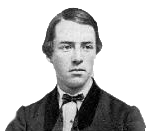
March 23. — General Benham rode off this morning with Captain Bowers, Lieutenant Van Brocklin, and Major Spaulding. He visited the commands of Major Spaulding and Captain Slosson. Major Spaulding and Lieutenant Van Brocklin selected a new encampment for the pontoon train. Captain Lubey went down to Belle Plain to drill in the pontoon-bridge laying. Moved our headquarters over to the Engineer Brigade. Morning pleasant, but towards afternoon it grew cloudy.

by John Beauchamp Jones
MARCH 23D.—The snow has nearly disappeared, and the roads are very bad. No food is brought to the market, and such as may be found in the city is held at famine prices.
I saw a letter to-day from Bishop Lay, in Arkansas. He says affairs in that State wear a dark and gloomy aspect. He thinks the State is lost.
Gen. Beauregard writes the Hon. Mr. Miles that he has not men enough, nor heavy guns enough, for the defense of Charleston. If this were generally known, thousands would despair, being convinced that those charged with the reins of power are incompetent, unequal to the crisis, and destined to conduct them to destruction rather than independence.
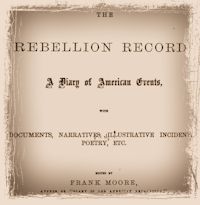
March 23.—The treaty between the United States and Liberia was officially promulgated.— The schooner Charm was captured at the mouth of Indian River Inlet, Fla., by a boat expedition from the National steamer Sagamore.—The expeditionary force of National troops, under the command of Col. John D. Rust, which left Beaufort, S. C, on the nineteenth instant, arrived at Jacksonville, Florida, to-day.—(Doc. 148.)
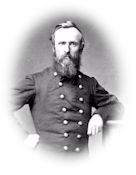
Camp White, Near Charleston, March 22, 1863.
Dear Mother: — One week ago today we started bag and baggage for this place. We are within five or six hours’ travel by steamboat from Ohio (Gallipolis). Steamers pass our camp daily two or three times for home. We are within fifteen hours of Cincinnati and the communication frequent and regular. . . .
We shall remain here probably a good while. The Twenty-third is the only regiment in the vicinity. My command is stretched from Gauley to the Kentucky line. I make my headquarters here but shall go in both directions often. Quite likely, if present arrangements continue, I may run up to Columbus in a month or two. . . . Love to all.
Affectionately, your son,
R. B. Hayes.
Mrs. Sophia Hayes.
Camp White, Near Charleston, Virginia, March 22, 1863.
Dear Uncle: — We came out of the wilderness a week ago today. We are now pleasantly located on the left bank of the Kanawha, just below (opposite) Charleston. We are almost at home, and can expect to see anxious friends soon. You would, I think, enjoy a trip up here in a few weeks. You can get on a steamer at Cincinnati and land at our camp, and be safely and comfortably housed here. Lucy and the boys, after a most happy time, went home yesterday. We shall expect to see them again while we are here.
We seem intended for a permanent garrison here. We shall probably be visited by the Rebels while here. Our force is small but will perhaps do. My command is Twenty-third Ohio, Fifth and Thirteenth Virginia, three companies of cavalry, and a fine battery. I have some of the best, and I suspect some of about the poorest troops in service. They are scattered from Gauley to the mouth of Sandy on the Kentucky line. They are well posted to keep down bushwhacking and the like, but would be of small account against an invading force. We have three weak, but very good regiments, Twenty-third, Twelfth, and Thirty-fourth Ohio, some, a small amount, of good cavalry and good artillery, and about three or four regiments of indifferent infantry. So we shall probably see fun, if the enemy thinks it worth while to come in. Come and see me.
Sincerely,
R. B. Hayes.
S. Birchard.
Camp White, Near Charleston, Virginia, March 22, 1863.
Dear Uncle: — We came out of the wilderness a week ago today. We are now pleasantly located on the left bank of the Kanawha, just below (opposite) Charleston. We are almost at home, and can expect to see anxious friends soon. You would, I think, enjoy a trip up here in a few weeks. You can get on a steamer at Cincinnati and land at our camp, and be safely and comfortably housed here. Lucy and the boys, after a most happy time, went home yesterday. We shall expect to see them again while we are here.
We seem intended for a permanent garrison here. We shall probably be visited by the Rebels while here. Our force is small but will perhaps do. My command is Twenty-third Ohio, Fifth and Thirteenth Virginia, three companies of cavalry, and a fine battery. I have some of the best, and I suspect some of about the poorest troops in service. They are scattered from Gauley to the mouth of Sandy on the Kentucky line. They are well posted to keep down bushwhacking and the like, but would be of small account against an invading force. We have three weak, but very good regiments, Twenty-third, Twelfth, and Thirty-fourth Ohio, some, a small amount, of good cavalry and good artillery, and about three or four regiments of indifferent infantry. So we shall probably see fun, if the enemy thinks it worth while to come in. Come and see me.
Sincerely,
R. B. Hayes.
S. Birchard.


