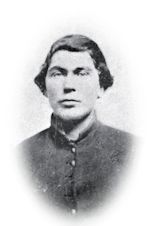
Near Helena, Sunday, March 15. Warm day. Ross’s 8th Division landed a little below from Memphis. 1st Brigade and 2nd Battery left for the Pass yesterday. Received papers of the 13th—Bulletin [Memphis].
March 2013

Mrs. Lyon’s Diary.
March 15, 1863.—We went to church and heard Mr. McKenney, Chaplain of the 71st Ohio, the first preaching I have listened to in three months. After dinner we walked to the burying ground, where the heaviest of the last battle was fought. There were a number of bodies picked up right here. Two battles were fought over this ground. It had once been decorated beautifully. There are a number of slabs that are box-shaped, handsome monuments, nearly all broken by cannon balls and shells. It makes a desolate place of it. After the last battle they dug pits and put from twenty to forty bodies in each grave, without even a box to shelter them. There are a great many interesting places around here, made so by events that will enter history.
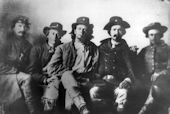
Sunday, 15th—Remain in Camp.

March 15th.—Weather dark and cloudy. We had a good congregation in our little church. Mr. —— read the service. The Bishop preached on ” Repentance.” Richmond was greatly shocked on Friday, by the blowing up of the Laboratory, in which women, girls, and boys were employed making cartridges; ten women and girls were killed on the spot, and many more will probably die from their wounds. May God have mercy upon them! Our dear friend Mrs. S. has just heard of the burning of her house, at beautiful Chantilly. The Yankee officers had occupied it as head-quarters, and on leaving it, set fire to every house on the land, except the overseer’s house and one of the servants’ quarters. Such ruthless Vandalism do they commit wherever they go! I expressed my surprise to Mrs. S. that she was enabled to bear it so well. She calmly replied, “God has spared my sons through so many battles, that I should be ungrateful indeed to complain of any thing else.” This lovely spot has been her home from her marriage, and the native place of her many children, and when I remember it as I saw it two years ago, I feel that it is too hard for her to be thus deprived of it. An officer (Federal) quartered there last winter, describing it in a letter to the New York Herald, says the furniture had been “removed,” except a large old-fashioned sideboard; he had been indulging his curiosity by reading the many private letters which he found scattered about the house; some of which, he says, were written by General Washington, “with whom the family seems to have been connected.” In this last surmise he was right, and he must have read letters from which he derived the idea, or he may have gotten it from the servants, who are always proud of the aristocracy of their owners; but not a letter written by General Washington did he see, for Mrs. S. was always careful of them, and brought them away with her; they are now in this house. The officer took occasion to sneer at the pride and aristocracy of Virginia, and winds up by asserting that “this establishment belongs to the mother of General J. E. B. Stuart,” to whom she is not at all related.
 Camp Winder, March 15,1863.
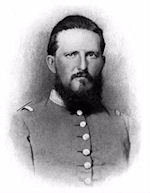
I will devote a part of this quiet Sunday evening to a letter home. Our camp looks to-day like it was Sunday. We stop our usual work when Sunday comes, and, like Christian people, devote it to rest. To-day I attended our church and listened to a very earnest and impressive sermon from one of our chaplains. He is one of the best men and best chaplains I ever knew. He devotes his whole time to his duties, and remains all the time with his regiment, sharing their wants and privations. I am sorry to say we have few such in the army. Many of them are frequently away, whilst others stay at houses in the neighborhood of the camp, coming occasionally to their regiments.
To-day I had a visit from the father and mother of a poor fellow who has been tried by a court martial for cowardice. She was in great distress, and said it would be bad enough to have her boy shot by the enemy, but she did not think she could survive his being shot by our own men. I gave her what comfort I could, telling her his sentence had not been published and there was no means of knowing that he was sentenced to be shot; that if it turned out to be so when the sentence was published, she could petition the President for his pardon; that he was a good man and would pardon her son if it was not an aggravated case. I pitied her, she seemed so much distressed. I heartily wish this sad part of my duties were over. I have about twenty of my men in close confinement, whose sentences have not been published, many of whom are condemned to death. It is for Gen’l Lee to determine what shall be done with them.
Whilst I write the sleet and hail are falling fast, accompanied by frequent claps of thunder, cold and chilly withal. Winter, it seems, will never end. Last week it was all the while a severe wind and freezing cold. I really don’t care much now how long it lasts. I do not wish to move from here until spring is fairly opened. My men are comfortably fixed here, and when we move the huts must be left behind, and, besides this, most of the blankets sent off, as we have no wagons to haul them. My men, I fear, when we move will have to get along with such clothing and blankets as they can carry. Many of our horses have died this winter for want of forage, and those that remain are much reduced in flesh and strength.
I have received your miniature, reminding me of times when you and I were young; of happy hours spent, a long time ago, when I used to frequent your parlor in the hope that you might be what you now are, my darling wife. Then the present was overflowing with happiness, the future bright and beautiful. We have seen much of each other, much of life, its joys and sorrows, since then. By the grave of our first child we have known together the deep sorrow of parting with those we love forever. In this long absence of two years, we have felt the sadness of a separation with such chance of its being forever as we did not dream of when we began life together. May God in his mercy soon bring us together in our dear home, never to separate again, to spend what of life is left to us in peace and happiness. Good-bye.
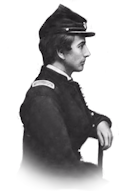
[March 15th] Colonel Zook returned from leave of absence on March 12th, and all were delighted to see him. He is confident of obtaining his promotion, he says, and intends to get transferred to the Western army, if possible, so that he may have an independent command. I am to go wherever he goes, which suits me exactly. The day following his return, brigade drills were resumed and some splendid field days followed. Hancock occasionally drills the division, and on such occasions usually does a lot of swearing. Zook is his particular bete noir and it is amusing to hear them go for each other. As swearing is contrary to the regulations, Zook, who cannot easily be beaten in that line, always gives as good as he gets without fear of consequences, and the officers think it great fun. Hancock is very hot headed; sometimes goes off at half cock, but is a magnificent soldier and a terror to adjutants, having a singular penchant for going over everything himself about two or three times a week. He usually goes into his adjutant’s office about 11 P. M. and asks for the books, papers and correspondence, when an immediate tempest invariably occurs, and the adjutant general is badgered in great style. From whatever brigade a paper may come from that is not to his mind, he immediately sends for its adjutant, who must get out of bed, order his horse, dress himself, and report without the least delay to the irate general. Although I pride myself on the methodical way we do things at our headquarters, I am frequently called out of a snug bed on some of these nocturnal office inspections. The general usually pitches into us right and left, utterly indifferent to choice of language, and will sometimes keep us an hour or more. Whenever he has been extremely brusque, he is sure to calm down in the end and become very gracious. He never forgets a face, and is always more than ready to give everybody credit for what they do, and has complimented me many times on my office, and more than once declared that it was unequaled. He was a quartermaster for many years, and can’t get over his taste for military papers.
Some of the documents passing through headquarters are very interesting, a large number being pathetic appeals made directly to the President for the pardon of some condemned soldier from a mother or sister living, perhaps, in the most remote corner of the country. Every direct appeal to the President is certain of consideration, no matter how obscure the writer, and the letter is at once referred, through the Secretary of War, to the immediate commanding officer for full particulars, with the written opinion of every general officer through whom it passes endorsed upon it, so that by the time it gets back into the President’s hands, he has a complete epitome of the case, and can act understandingly. Whenever there is the slightest excuse for exercising clemency, the culprit is sure to benefit by it, as the President dislikes martial law and is very tender hearted.
Papers of this sort coming down for information have to be registered, indexed, and promptly forwarded to their ultimate destination, and not only this, but kept in mind in case of delay at any headquarters. The regimental commanding officer having referred the paper to the company commander, he, who is the father of his men and knows the history of every one of them, endorses in concise form the particulars of the case with his opinion as to what ought to be done, and then returns it to the regimental commander, who in his turn sends it to brigade, and so through division, corps, and army headquarters to the Secretary of War, and thus back to the President, every headquarters in the meantime, making any remarks on the case they think proper. Sometimes these letters come along with more than a dozen endorsements. Some of them are unique and sometimes amusing.
We have a couple of capital clerks at our headquarters, who besides being beautiful writers, are methodical and very capable. Swartz, in particular, is a most faithful and valuable man. Since General Hooker assumed command, we have frequently seen him, and he appears to be looking after affairs. He is a fine appearing soldier, with smooth shaven face, and, as a division commander, has been very successful. He is a high liver, has a reputation for gallantry, and keeps a good many society people about his headquarters. Anything, of course, is an improvement on Burnside and we all hope Hooker may prove a success.
I saw it stated the other day that the newspapers had killed off McClellan. How curious it is, that people should be so obtuse! McClellan killed himself. The newspapers gave him a reputation gratuitously, before he had ever marched a man out of camp, and when the test came he was found wanting, and although favored beyond all other men, ultimately found his level and has dropped out of sight.

by John Beauchamp Jones
MARCH 15TH.—Another cold, disagreeable day. March so far has been as cold and terrible as a winter month.
March 15. — The schooner Chapman, about leaving San Francisco, Cal., was boarded by officers of the United States government and taken into custody as a privateer. Twenty secessionists, well armed, and six brass Dahlgren guns, with carriages suitable for use on shipboard, were captured. Correspondence found on the persons of the prisoners identified them as in the interest of the rebels.—Eight hundred paroled National prisoners, en route to Chicago, were detained in Richmond, Ind., and while there they completely demolished the office of the Jeffersonnewspaper.
—The British steamer Britannia, from Glasgow, with a valuable cargo, successfully ran the blockade into Wilmington, N. C.
Camp 103d Illinois Infantry, Lagrange, Tenn.,
March 15, 1863.
I have just returned from a walk to and inspection of the cemetery belonging to this nice little town. There, as everywhere, the marks of the “Vandal Yankees” are visible. The fence which formerly enclosed the whole grounds has long since vanished in thin air, after fulfilling its mission, boiling Yankee coffee, and frying Yankee bacon. Many of the enclosures of family grounds have also suffered the same fate, and others are broken down and destroyed. The cemeteries here are full of evergreens, hollies, cedars, and dwarf pines, and rosebushes and flowers of all kinds are arranged in most excellent taste. They pride themselves more on the homes of their dead than on the habitations of the living. I can’t help thinking that their dead are the most deserving of our respect, though our soldiers don’t waste much respect on either the living or dead chivalries. Many of the graves have ocean shells scattered over them, and on a number were vases in which the friends deposit boquets in the flower season. The vases have suffered some at the hands of the Yankees, and the names of Yanks anxious for notoriety are penciled thickly on the backs of marble grave stones. Quite a variety of flowers can now be found here in bloom. I have on my table some peach blossoms and one apple blossom, the first of the latter I have seen. Some of the early rosebushes are leaved out, and the grass is up enough to make the hillsides look quite springlike. For three or four days we have needed no fire, and my coat now hangs on the forked stick which answers for a hatrack in my tent. We left Jackson the morning of the 11th, all pleased beyond expression, to get away. We were from 8 a.m. until 11 o’clock p.m. coming here, only 55 miles. The engine stalled as many as ten times on up grades, and we would either have to run back to get a fresh start, or wait until a train came along whose engine could help us out. We lay loosely around the depot until daylight and then moved out to our present camp, which is one of the best I have ever seen, a nice, high ridge covered with fine old forest trees. This town has been most shamefully abused since we left here with the Grand Army last December. There are only about three houses which have a vestige of a fence left around them. All the once beautiful evergreens look as though three or four tornadoes had visited them and many of the finest houses have been compelled to pay as tribute to the camp fires, piazzas and weatherboarding. Not a chicken is left to crow or cackle, not a pig to squeal, and only such milch cows as were composed entirely of bone and cuticle. The 7th Cavalry is here, and also the 6th Illinois and 2d Iowa. There is only one other regiment of Infantry, the 46th Ohio. It does the picket duty and we are patroling and guarding the government stores. The duty is rather lighter than it was in Jackson, and more pleasant. We have no ground to complain now, and the paymaster is all we want to make us perfectly happy. Two nights before we left Jackson 23 of our regiment deserted, 17 of whom were out of Company A, one of the Lewistown companies. One was from my company, the first deserter I have had. He was detailed from Company A to my company and was besides the most worthless trifling pup in the army. I am accepting the disgrace of having one of my men desert, decidedly glad to be rid of him. Johnny Wyckoff came down a few days ago and after being in camp a few days came to me and said he had his parents’ permission, so I got the colonel to swear him in. We’ll make a drummer of him.
I suppose you will have seen in the Register before this reaches you the answer my company made to that Davidson’s lie in regard to our vote on the resolutions. I did not see the paper until it was ready to send away. I think copperheadism is not worth quite the premium it was a few months since. These notes from the army should have some weight with the gentlemen that run the copper machine. Do you see how the Southern papers cut the scoundrels? That does me much good, though ’tis mortifying to think we have such dirtcatchers in our State.
Well, we are on the right track now, and a few more weeks and we will be steaming down the Mississippi, I think. Our next move will be Memphis, probably, and then, ho! for Vicksburg! That is rare good news from the Yazoo. I hope Ross has done something there. My health is excellent, 155 pounds of ham and crackers, for that is all I’ve eaten in four months. One hundred and sixty secesh soldiers lie as closely as they can be packed in this cemetery. Little boards with initials cut on them are all the marks their graves have. Our boys all cut on a large board with full name of regiment, and residence, at the head of their graves. I send you some blossoms from the graveyard.

March 14th [1863]. For the last few days the Federal soldiers have been arresting all the negroes seen in the streets without passes (given out at the Mayor’s office, Mayor Miller, formerly on General Shepley’s staff, and with whom Mrs. Norton has the written bet about the fall of Port Hudson). General, or Governor, Shepley was standing on his (Mrs. Brown’s) steps as Mrs. Norton passed. She stopped and chatted as usual; asked if Port Hudson “is taken yet.” “I am to drink some of that champagne,” said he. “You must take it at my house,” said she, “for I will win it—you will never win it; you will never take Port Hudson.” The General looked very pale; I expect he thinks so, too. The wife of a Yankee who is lodged in a “captured house” at the corner of our square, had a letter from her husband a few days ago. He is at Baton Rouge, and is to take part in the coming battle. “It will be a terrible fight,” he writes. Two weeks ago she told Mrs. Norton, out of mere bravado and to frighten her, that the Federals had surrounded both Vicksburg and Port Hudson and that both places were in Federal power. She has held levees for the negroes, and has always managed to say something disagreeable about our defeats somewhere or other, or that Butler would soon be back, or something of that sort, whenever we passed her door. But a great anxiety has taken possession of her; she has “no one but her husband,” she says, and indeed we feel sorry for the poor thing. Should Port Hudson fall she will say all sorts of things as we pass, I know, but she is a poor, common creature and is only to be pitied. I hope her husband will be spared her; also that as many of the soldiers as possible will desert to us as have promised to do so. It took three regiments to force off one to go to this Port Hudson affair. We “Rebels” have been making laughing calculations and trying to work out political problems by the rule of three, since this event. Specimens: “If it takes three regiments to move one to the scene of action, how many will it take to move out Banks’ whole army?” “How many will it take to make them fight?” and so forth.
Just called out to see Mrs. Wilkinson—not the paroled one—she tells me that Mrs. Bowen, the wife of a Yankee Colonel, let slip in her converse that three Connecticut regiments mutinied and had to be sent home—officers and men. The rule of three still at work. General Sherman asked Kate Wilkinson why she was so anxious to go over the lines. “Oh, General, I am so tired here, and I do so long for some fresh Confederate air.” The General smiled and said, “Well, stay, and maybe you will have some good Confederate air here soon before long.” We wonder what he meant by that. General Sherman has advised Mrs. Wilkinson not to go yet as there will be danger in the transfer. “Wait,” said he smilingly, “and perhaps we will send you all the way to Vicksburg.” “I have heard something of going that way,” returned Mrs. Wilkinson, “but under our own flag.” The “Rebel” ram Missouri has run the gauntlet out of the Yazoo where she was built, and is safe at Vicksburg. Farragut and Banks are both at Baton Rouge. Word has been received here, it is said, that fighting has commenced at Port Hudson. The few Federals who are left here keep up much journeying to and fro. They are riding furiously up and down the street and the jingling of their swords is sounding in our ears all day long as they pass our door. I can not say that their step is martial, or in the cavalier style. They ride, indeed, infamously in two ways—in the first place they have stolen every horse in town, even ladies’ carriage horses and those from doctors’ buggies; in the next, they sit on them in the most awkward style, bumping up and down, laboring, apparently, more than the horses. They sit back pompously, and no doubt think that we admire them wonderfully. The Indianola, which we captured from the Federals, was reported lost. Indeed, an “extra” informed us that a strange vessel went steaming past the batteries at Vicksburg while our people were raising the Indianola (which had been sunk in the capture), whereupon our Confederate boats took alarm and destroyed the half raised vessel. I thought it queer that two Confederate steamers would run from one Yankee craft, and now we hear that the whole thing was a ruse, and that the Indianola is not only raised, but in good fighting order, having lost in the submerging but two guns.
“We are getting quite a navy—all captured; not one had we with which to begin. When the Queen of the West passed Vicksburg, she ruled, indeed, like a queen over the world of waters, which lie between Port Hudson and Vicksburg, thus locking up our Texas and Red River trade, cutting off our army supplies. The Federals were jubilant over her passing, but she soon fell after a short and inglorious career, and a still more inglorious struggle. She was destroyed by the Red River batteries and deserted by her officers. She floats a new, and I hope to high Heaven, what is to ever be a worthier flag, and her first exploit under it, was to make another Federal bulwark succumb. These iron monsters which were soon to make an end of “the rebellion” are fast falling into our hands, and besides, we have some trusty ones of our own building. We Confederate women are forever counting them in our hearts and on our fingers. They are to open the prison doors of New Orleans. We have three building up the Yazoo; one, the Missouri, has run the gauntlet, and we have seven building at Mobile. In two months we can take this city back. Mrs. Norton is reading out loud—she sees badly—stumbles, I cannot make out what she means, or what I mean myself. I hope my Edith, when she reads this, will take into consideration her auntie’s trials and never feel tempted to scrawl out such a production herself.


