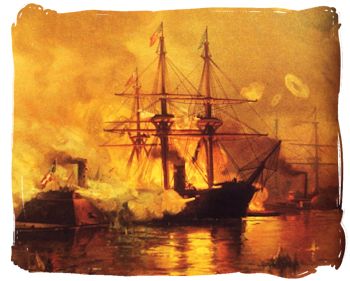
July 8th. At eight o’clock in the morning an orderly from General Banks’s headquarters came on board, bringing despatches for the Commodore. Very soon after he had left the ship we started fires and got up steam, as did also all the gunboats and army transports around us. Between the hours of four and six P. M., heavy squalls of wind and rain came up from the northward and westward, accompanied with thunder and lightning. At six thirty, received the news of General Gardner, C. S. A. at Port Hudson, having surrendered to Major-General Banks, U. S. A., “in rear of same.” The event occurred at two o’clock of this day, and was received with great joy. From six to eight o’clock, the army forces at Port Hudson signalized to us, we answering their signals.
July 2013
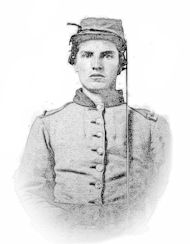
Wednesday, 8th.—Marched into town and got our paroles to-day.
____
Copy Of My Parole.
Vicksburg, Miss., July 8th A. D., 1863.
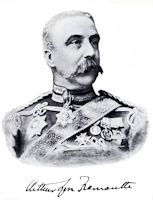
To All Whom It May Concern, know ye that; I, R. M. Magill, a private of Company F, of 39th Georgia, Volunteers, C. S. A., being a prisoner of war in the hands of the United States forces, virtue of the capitulation of the City of Vicksburg, and its garrison by Lieutenant-General John C. Pemberton, C. S. A., commanding, on the 4th day of July, 1863, do in pursuance of the terms of said capitulation, give this, my solemn parole, under oath; That I will not take arms again against the United States, nor serve in any military, police or constabulary force in any fort, garrison or field work, held by the Confederate States of America against the United States of America, nor as guard of prisoners, depots or stores, nor discharge any duties usually performed by officers or soldiers against the United States of America until duly exchanged by the proper authorities.
R. M. Magill,
Private, Company F, 39th Regiment, Georgia Volunteers. Sworn to and subscribed before me at Vicksburg, Miss., this 8th day of July, 1863.
J. O. Pollen, Captain and Par oiling Officer,
20th Regiment, Illinois Volunteers.

8th.—Accounts from Gettysburg very confused. Nothing seems to be known certainly; but Vicksburg has fallen! So says rumour, and we are afraid not to believe. It is a terrible loss to us; but God has been so good to us heretofore that we can only say, “It is the Lord.” A victory is announced to the War Department gained by General Loring in the West; and another gained by General Richard Taylor over Banks. For these successes I thank God from my heart. Many troops have passed here to-day, for what point we know not. Our anxiety is very great. Our home is blessed with health and comfort.
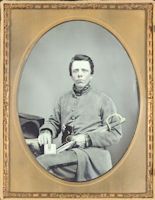
July 8 — Wm. Casey was seriously burnt this evening by foolishly setting powder on fire. We have not as yet received our paroles but expect to get them in the morning. W. R. Clack
by John Beauchamp Jones
JULY 8TH.—I am glad to copy the following order of Gen. Lee :
“HEADQUARTERS ARMY NORTHERN VIRGINIA,
“CHAMBERSBURG, PA., June 27th, 1863.
“GENERAL ORDERS No. 73.
“The commanding general has observed with marked satisfaction the conduct of the troops on the march, and confidently anticipates results commensurate with the high spirit they have manifested. No troops could have displayed greater fortitude, or better performed the arduous marches of the past ten days. Their conduct in other respects has, with few exceptions, been in keeping with their character as soldiers, and entitles them to approbation and praise.
“There have, however, been instances of forgetfulness on the part of some, that they have in keeping the yet unsullied reputation of the army, and that the duties exacted of us by civilization and Christianity are not less obligatory in the country of the enemy than in our own.
“The commanding general considers that no greater disgrace could befall the army, and through it, our whole people, than the perpetration of the barbarous outrages upon the innocent and defenseless, and the wanton destruction of private property, that have marked the course of the enemy in our own country. Such proceedings not only disgrace the perpetrators and all connected with them, but are subversive of the discipline and efficiency of the army and destructive of the ends of our present movements. It must be remembered that we make war only upon armed men, and that we cannot take vengeance for the wrongs our people have suffered without lowering ourselves in the eyes of all whose abhorrence has been excited by the atrocities of our enemy, and offending against Him to whom vengeance belongeth, without whose favor and support our efforts must all prove in vain.
“The commanding general, therefore, earnestly exhorts the troops to abstain with most scrupulous care from unnecessary or wanton injury to private property; and he enjoins upon all officers to arrest and bring to summary punishment all who shall in any way offend against the orders on this subject.
” R. E. LEE, General.”
We have no additional news from the battle-field, except the following dispatch from Winchester:
“Our loss is estimated at 10,000. Between 3000 and 4000 of our wounded are arriving here to-night. Every preparation is being made to receive them. [click to continue…]
July 8.—The drama of Port Hudson I imagine to be pretty much played out. Yesterday our company had come out from the advance to rest. Suddenly an orderly passed through a group of us sitting near the colonel’s quarters, hurrying with despatches to the different commanders of the brigade. McGill rushed out, and read the despatch as he carried it in his hand. It was, “Vicksburg surrendered on the Fourth! ” Every pale, haggard face lit up with a wonderfully jolly light. Presently the brigadier hurried into the trenches; and a soldier, on duty at the mine, by his command, threw the news over among the rebels. At noon, we had a great firing of salutes. This morning, before light, we heard that a conference of the generals was to be held to agree upon the terms of surrender, and that a truce was to begin at once. The major went off through the dark to order the sharpshooters to stop firing; while we rubbed our eyes, wondering if the day had really come, — if our cause had really gained this great success, and we could go home with credit.
7th July (Tuesday).—Lawley, the Austrian, and I drove into Hagerstown this morning, and General Longstreet moved into a new position on the Williamsport road, which he was to occupy for the present. We got an excellent room in the Washington Hotel on producing greenbacks. Public opinion in Hagerstown seems to be pretty evenly divided between North and South, and probably accommodates itself to circumstances. For instance, yesterday the women waved their handkerchiefs when the Yankee cavalry were driven through the town, and to-day they went through the same compliment in honour of 3500 Yankee (Gettysburg) prisoners whom I saw marched through en, route for Richmond. I overheard the conversation of some Confederate soldiers about these prisoners. One remarked, with respect to the Zouaves, of whom there were a few—”Those red-breeched fellows look as if they could fight, but they don’t, though; no, not so well as the blue-bellies.”
Lawley introduced me to General Stuart in the streets of Hagerstown to-day. He is commonly called Jeb Stuart, on account of his initials; he is a good-looking, jovial character, exactly like his photographs. He has certainly accomplished wonders, and done excellent service in his peculiar style of warfare. He is a good and gallant soldier, though he sometimes incurs ridicule by his harmless affectation and peculiarities. The other day he rode through a Virginian town, his horse covered with garlands of roses. He also departs considerably from the severe simplicity of dress adopted by other Confederate generals; but no one can deny that he is the right man in the right place. On a campaign, he seems to roam over the country according to his own discretion, and always gives a good account of himself, turning up at the right moment; and hitherto he has never got himself into any serious trouble.
I rode to General Longstreet’s camp, which is about two miles in the direction of Williamsport, and consulted him about my difficulties with regard to my leave. He was most good-natured about it, and advised me under the circumstances to drive in the direction of Hancock; and, in the event of being ill-treated on my way, to insist upon being taken before the nearest U.S. officer of the highest rank, who would probably protect me. I determined to take his advice at once; so I took leave of him and of his officers. Longstreet is generally a very taciturn and undemonstrative man, but he was quite affectionate in his farewell. His last words were a hearty hope for the speedy termination of the war. All his officers were equally kind in their expressions on my taking leave, though the last sentence uttered by Latrobe was not entirely reassuring—viz., “You may take your oath he’ll be caught for a spy.”
I then rode to General Lee’s camp, and asked him for a pass to get through his lines. We had a long talk together, and he told me of the raid made by the enemy, for the express purpose of arresting his badly wounded son (a Confederate Brigadier-General), who was lying in the house of a relation in Virginia. They insisted upon carrying him off in a litter, though he had never been out of bed, and had quite recently been shot through the thigh. This seizure was evidently made for purposes of retaliation. His life has since been threatened, in the event of the South retaliating for Burnside’s alleged military murders in Kentucky. But few officers, however, speak of the Northerners with so much moderation as General Lee; his extreme amiability seems to prevent his speaking strongly against any one. I really felt quite sorry when I said good-bye to so many gentlemen from whom I had received so much disinterested kindness.
I am now about to leave the Southern States, after travelling quite alone throughout their entire length and breadth, including Texas and the trans-Mississippi country, for nearly three months and a half, during which time I have been thrown amongst all classes of the population—the highest, the lowest, and the most lawless. Although many were very sore about the conduct of England, I never received an uncivil word from anybody, but, on the contrary, I have been treated by all with more than kindness.[1] I have never met a man who was not anxious for a termination of the war; and I have never met a man, woman, or child who contemplated its termination as possible without an entire separation from the now detested Yankee. I have never been asked for alms or a gratuity by any man or woman, black or white. Every one knew who I was, and all spoke to me with the greatest confidence. I have rarely heard any person complain of the almost total ruin which has befallen so many. All are prepared to undergo still greater sacrifices,—they contemplate and prepare to receive great reverses which it is impossible to avert. They look to a successful termination of the war as certain, although few are sanguine enough to fix a speedy date for it, and nearly all bargain for its lasting at least all Lincoln’s presidency. Although I have always been with the Confederates in the time of their misfortunes, yet I never heard any person use a desponding word as to the result of the struggle. When I was in Texas and Louisiana, Banks seemed to be carrying everything before him, Grant was doing the same in Mississippi, and I certainly did not bring luck to my friends at Gettysburg. I have lived in bivouacs with all the Southern armies, which are as distinct from one another as the British is from the Austrian, and I have never once seen an instance of insubordination.
When I got back to Hagerstown, I endeavoured to make arrangements for a horse and buggy to drive through the lines. With immense difficulty I secured the services of a Mr ——, to take me to Hancock, and as much farther as I chose to go, for a dollar a mile (greenbacks). I engaged also to pay him the value of his horse and buggy, in case they should be confiscated by either side. He was evidently extremely alarmed, and I was obliged to keep him up to the mark by assurances that his horse would inevitably be seized by the Confederates, unless protected by General Lee’s pass in my possession.
[1] The only occasion on which I was roughly handled was when I had the misfortune to enter the city of Jackson, Mississippi, just as the Federals evacuated it. I do not complain of that affair, which, under the circumstances, was not to be wondered at.
Tuesday, 7th—A high wind today ended in rain tonight. Colonel Chambers of the Sixteenth Iowa, who has been commanding our brigade, left for Vicksburg this morning to obtain release from this command in order to return to the regular army. The boys of the brigade are glad to see him leave. Colonel Hall takes charge again of our brigade. I went on brigade guard tonight. Our countersign is “Vicksburg.”
July 7. P. M. — Heard the news of Vicksburg captured. Fired one hundred guns and had a good time.
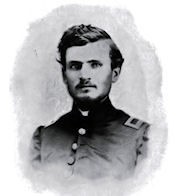
7th. Morgan still 20 hours ahead of us. Out at 2 A. M. Passed through Fredericksburg. Forded Rolling Fork and through Bardstown. Got breakfast 2 miles farther on. Rested an hour. Reached Bardstown Junction (Kentucky) near dark. Got supper and fed. Train came in from Louisville, 36 miles with rations, bacon and bread. Issued them before midnight. Slept till morning, a very hot day.


