November 21.—Abbie Clark and her cousin Cora came to call and invited me and her soldier cousin to come to dinner to-night, at Mrs Thompson’s. He will be here this afternoon and I will give him the invitation. James is asked for the evening.
November 2013

November 21.—I have received a letter from Dr. Hopping. He has now charge of the Kingston Hospital, and is anxious to have Mrs. W. and myself there again. His wife is with him, and is one of the matrons. I should like very much to go, so as to be near the army; and had fully made up my mind to go either there or to Ringgold, but Dr. Hughes and Dr. Gamble are both unwilling to have Mrs. W. and myself leave, and I think it best to wait until the next battle. Our army may be defeated, and in that case the hospitals brought further in the rear.
Some few days ago I received a letter from my brother. He says his battery is stationed on the top of Lookout Mountain, and that he never saw such accurate firing as that of the enemy from below. He says their balls come right to where they are. The enemy have taken our cavalry by surprise, and by it we have lost a very important place, called Raccoon Mountain. The enemy now have sole possession of the Nashville Railroad, and are being heavily reinforced.
I am losing all confidence in General Bragg. He seems to make no use of his victories. I have been told by many of Longstreet’s men that after the battle of Chickamauga, there were thousands of troops who had come from Virginia, who had never fired a gun in the battle, and with them he might have gone and taken Chattanooga.
I have observed that Wellington and Napoloon, especially the latter, gained nearly all of their great victories by the celerity of their movements. Indeed, it has been the case with the most of great generals. But we must not judge, as we can not tell with what General Bragg has to contend. We have so few men, compared with the enemy, that were it not for the feeling which animates ours we would never gain.
To-day, Miss W. and myself took a walk, and visited some of the patients, who are in tents, about two squares distant. They are some of the gangrene cases, all of which are either in tents or rooms by themselves. They are doing pretty well. Many of them are great sufferers from this terrible disease. It has to be burned out with nitric acid, which is a very painful operation. I sometimes look at the wounds while being dressed, and they are dreadful. My wonder is how they can ever be healed.
After visiting them, we went to Mrs. Hill’s to see Captain Insey, one of the men who was sick at Judge Thornton’s, in Okolona, Miss. He is now very ill. He is a member of the Ninth Alabama Battalion. I have a friend in it, James Kay, of whose welfare I was glad to hear, as his mother had written to me concerning him. Mr. Kay is one of our Mobile boys, and I was much gratified when Captain I. informed me that he is a brave and good soldier.
Captain Thompson is very low, and there is no hope of his recovery. He is perfectly resigned to his fate, and talks as calmly on the subject as if he was going to pay a visit to his family.
November 21. Saturday. — Went to Gallipolis to meet the family, — Lucy, Webb, and Rud with Grandma Webb.
by John Beauchamp Jones
NOVEMBER 21ST. —We have further reports from the West, confirming the success of Longstreet. It is said he has taken 2200 prisoners, and is probably at Knoxville.
The President left the city this morning for Orange Court House, on a visit to Gen. Lee and the Army of Northern Virginia.
We are a shabby-looking people now—gaunt, and many in rags. But there is food enough, and cloth enough, if we had a Roman Dictator to order an equitable distribution.
The Secretary of War is destined to have an uncomfortable time. After assuring the Legislature and the people that provisions in transitu would not be impressed, it is ascertained that the agents of the Commissary-General are impressing such supplies, and the Secretary is reluctant to interfere, the Commissary-General being understood to have the support of the President.
A committee of the Grand Jury yesterday submitted a paper to the President, on the subject of provisions—indicating the proximity of famine, and deprecating impressments. The President sent it to the Secretary, saying Mr. Seddon would no doubt take measures to keep the people of Richmond from starving; and directing the Secretary to “confer” with him. But to-day he is off to the army, and perhaps some may starve before any relief can be afforded.
A genteel suit of clothes cannot be had now for less than $700. A pair of boots, $200—if good. I saw to-day, suspended from a window, an opossum dressed for cooking, with a card in its mouth, marked “price, $10.” It weighed about four pounds. I luxuriated on parsnips to-day, from my own little garden.
A dollar in gold sold for $18 Confederate money, to-day. Our paper is constantly depreciating ; and I think it is past redemption, unless we adopt Mr. Moseley’s plan, and cause some six or eight hundred millions to be canceled, and fix a maximum price for all commodities necessary for the support of life. Congress will never agree upon any measure of relief. But if the paper money be repudiated, nevertheless we shall have our independence, unless the Southern people should become mad, divided among themselves. Subjugation of a united people, such as ours, occupying such a vast extent of territory, is impossible. The tenure of its occupation by an invading army would always be uncertain, and a million would be required to hold it.
A hard rain commenced falling this evening, and continued in the night. This, I suppose, will put an end to operations in Virginia, and we shall have another respite, and hold Richmond at least another winter. But such weather must cause severe suffering among the prisoners on Belle Isle, where there are not tents enough for so large a body of men. Their government may, however, now consent to an exchange. Day before yesterday some 40,000 rations were sent them by the United States flag-boat—which will suffice for three days, by which time I hope many will be taken away. Our Commissary-General Northrop has but little meat and bread for them, or for our own soldiers in the field. It must be confessed they have but small fare, and, indeed, all of us who have not been “picking and stealing,” fare badly. Yet we have quite as good health, and much better appetites than when we had sumptuous living.
November 21.—The steamer Welcome was attacked this morning at Waterproof, La., by guerrillas, with cannon planted on the levee, and twelve balls and shells fired through and into the cabin and other parts of the boat, besides nearly three hundred Minié balls from the sharpshooters along the banks of the river.—Acting Master J. F. D. Robinson, commander of the Satellite, and Acting Ensign Henry Walters, who was in command of the Reliance, were dismissed from the Navy of the United States, for gross dereliction in the case of the capture of their vessels on the twenty-third of August, 1863. The Department of the Navy regretted “the necessity of this action in the case of Acting Ensign Walters, inasmuch as the Court report that ‘during the attack he acted with bravery and to the best of his ability, and which, in some measure, relieves his want of precaution against surprise from its otherwise inexcusable character, and shows that his failure to take them proceeded more from inexperience than negligence.'”—General Orders No. 24.
—At Little Rock, Ark., a large Union meeting was held, at which the “restoration of State rights under the old Government” was advocated, and a great number of persons took the oath of allegiance and enrolled themselves for home defence.—English Rebel blockade-runner steamer Banshee, was captured by the United States steamers Delaware and Fulton, off Wilmington, North-Carolina.
—The steamer Black Hawk, when about half a mile below Red River Landing, on the Mississippi River, was fired into from the east bank of the river by a battery of ten or twelve guns, and about fifteen round shot and shell struck the boat. One shell exploded in the Texas, setting fire to and burning that part of the boat and pilot-house. As soon as the captain and officers found the boat on fire, they ran her on a sandbar on the west side of the river, and immediately put all the passengers on shore, after which the fire was extinguished. While the boat lay aground on the sand-bar, the sharp-shooters were pouring in their murderous Minié balls, of which some three hundred struck the boat in different parts of her cabin and hull. It was the guerrillas’ intention to follow the boat, but the gunboat stationed at the mouth of Red River followed them so close, pouring in shell among them, that she drove them back, after which the gunboat took the Black Hawk in tow, and carried her back to Red River, where she repaired sufficiently to proceed on her way. The casualties on board the boat were very severe. Mr. Samuel Fulton, a brother of the captain, was shot in the leg by a cannon-ball. His leg was afterward amputated below the knee. A colored man, by the name of Alfred Thomas, had his head blown off while lying flat down on the cable-deck. James Keller, of Louisville, belonging to the Twenty-second Kentucky volunteers, received a wound in the arm from a fragment of a shell. His arm was afterward amputated, and he soon after died A passenger was slightly wounded in the arm.
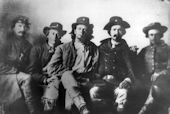
Friday, 20th—Came on through Athens, Sweetwater and Philadelphia; came out one and one-half miles and took supper at a very nice place—Virginians. Met McMahon of Company H. I and Jim came on to Camp near London.
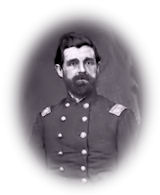
Colonel Lyons.
Edgefield, Tenn., Fri., Nov. 20, 1863.—We had a review yesterday of seven regiments of infantry, one of cavalry and a battery of artillery. We made quite a show. General Granger was the reviewing officer.
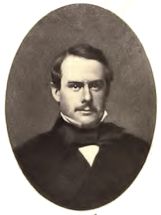
Henry Adams to Charles Francis Adams, Jr.
London, November 20, 1863
Of all things here abroad nothing has caused us more gentle slumbers since the seizure of the iron-clads than the delicious state of tangle Europe has now arrived at. Nothing but panic in every direction and the strongest combination of cross-purposes you can conceive. The King of Denmark has just died with a clearly perverse purpose of increasing the confusion, and any day may see a Danish war. Russia expects war and France acts ,as though it were unavoidable. Meanwhile England hulks about and makes faces at all the other nations. Our affairs are quite in the back-ground, thank the Lord.
Camp in the pocket opposite Chattanooga, Friday, Nov. 20. Scarcely had we closed our eyes to rest, before we were aroused again. Many of the boys had not laid down. It was half past one o’clock in the morning. We were ordered to hitch up in great haste. The rebs were crossing the Tennessee River at some point, and we were to intercept them. Nothing but a prospect of fight would have aroused the sleepy and tired soldiers as quick, and 2 A. M. we moved out, all wagons, battery wagon and forge left behind. It was clear and cold and I was chilled through by my sudden rising from a warm bed. We gradually disappeared from Point Lookout where the rebs’ signal lights were dimly burning. The road was mostly corduroyed and very good, but some places not finished very badly cut. 1st caisson got stuck and it took nearly half an hour to extricate. The cannoneers in mud and slush above their knees. While they were getting out, the other boys took hold and completed the bridge.
As it drew near morning it became darker. Crossed the river on pontoon two miles from where we started. It started right under the rock and it was quite difficult to make the landing with six horses. 3rd Brigade’s camp was on the bank. They had just started. Head of column took the road towards Chattanooga and obliged to come back as we left it to the right. 2nd caisson lost the road in the dark, ran against a stump and capsized. It took some time to extricate the horses and right it. It was loaded with percussion shells, but luckily none exploded. Infantry got the start of us and we drove very fast. Daylight found us travelling east through a very pretty valley formerly used as a camp. No infantry in sight. As smoke was seen in a pocket to the right, Lieutenant Clark halted, and sent to see if it was not our Brigade, which we found to be the case. We entered it, found the 3rd Brigade closely quartered. Went into park and ordered to remain quiet and orderly. Cooked an early breakfast, although we had travelled eight miles beside the other exploits. Wagons came up at 9 A. M. and we fed the last of our forage, four quarts of oats to a team.
The boys were soon scattered around making up for lost sleep, but I thought I would see our position, so I climbed the bluff to the right of us. Chattanooga could be seen very plain right opposite, near the other side of the river. To the right of it was Lookout, towering high above all others, with the puffs of powder smoke vomited occasionally from their Parrott. To the left I could see smoky Mission Ridge crossed with reb encampments. Those with glasses could discern long wagon trains and pack mules climbing up Lookout. I returned well-paid for my labor, although I afterwards understood it was forbidden. We are effectually hidden. Guards are placed over all houses to prevent anyone leaving. A pontoon train is passing. Heavy rain in afternoon. Put up tents and went to bed early.
Friday, 20th—It is rainy and blustery today, but otherwise all is quiet. We received two months’ pay, being paid in crisp new greenbacks. The paymaster always has a guard with him to guard the strong iron box containing the bills.


