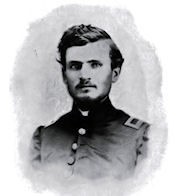
20th. Troops still passing. Various rumors as to the position of Burnside in Knoxville. Got breakfast. 2nd O. V. C. came along. Nearly 20 ate with us. Moved on at 9. Got over the mountain nicely. Two wagons broken. Long hill and rather steep but smooth road. Went down into the valley and fed. Made me sad to see 6 mountain stragglers passing, all half famished and worn out—poor fellows, no rations and no prospect for any. Left flour for Command and 6 beeves. Moved on to Tazewell in rain. Went to Mr. Epp’s, Union man, and heard some music. After supper remembered hearing Maj. Nettleton speak of him. Good time. Camped at T. Rained steadily all night. Many poor, hungry and footsore soldiers and citizens today and tonight.
November 2013
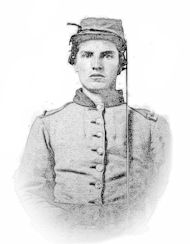
Thursday, 20th.—On detail digging ditches; reported Federals on mountain, ten miles below; regiment gone down that way; five miles out last account; making us work very hard; worked two sections.
by John Beauchamp Jones
NOVEMBER 20TH.—We have reports of some successes to-day. Gen. Hampton, it appears, surprised and captured several companies of the enemy’s cavalry, a day or two since, near Culpepper Court House. And Gen. Wheeler has captured several hundred of the enemy in East Tennessee, driving the rest into the fortifications of Knoxville. Gen. Longstreet, at last accounts, was near Knoxville with the infantry. We shall not be long kept in suspense —as Longstreet will not delay his action; and Burnside may find himself in a “predicament.”
A private soldier writes the Secretary to-day that his mother is in danger of starving—as she failed to get flour in Richmond, at $100 per barrel. He says if the government has no remedy for this, he and his comrades will throw down ,their arms and fly to some other country with their families, where a subsistence may be obtained.
Every night robberies of poultry, salt meats, and even of cows and hogs are occurring. Many are desperate.
November 20.—The Solicitor of the War Department, Mr. William Whiting, in a letter to a gentleman in Boston, wrote as follows:
“There are several serious difficulties in the way of continuing an exchange of prisoners. One is the bad faith of the enemy in putting into active service many thousands of paroled prisoners, captured at Vicksburgh and elsewhere, without releasing any of our soldiers held by them. But another difficulty of still graver importance is the peremptory refusal by the enemy to exchange colored soldiers and their white officers upon any terms whatever. It is well known that they have threatened to sell colored captured soldiers into slavery, and to hang their white officers.
“The Government demands that all officers and soldiers should be fairly exchanged, otherwise no more prisoners of war will be given up. The faith of the Government is pledged to these officers and troops that they shall be protected, and it cannot and will not abandon to the savage cruelty of slave-masters a single officer or soldier who has been called on to defend the flag of his country, and thus exposed to the hazards of war.
“It has been suggested that exchanges might go on until all except the colored troops and their white officers have been given up. But if this were allowed, the rebels would not only be relieved of the burden of maintaining our troops, but they would get back their own men, retaining their power over the very persons whom we are solemnly bound to rescue, and upon whom they could then, without fear of retaliation, carry into execution the inhuman cruelties they have so basely threatened.
“The President has ordered that the stern law of retaliation shall, without hesitation, be enforced, to avenge the death of the first Union soldier, of whatever color, whom the enemy shall in cold blood destroy or sell into slavery. All other questions between us may be postponed for future settlement, but the fair exchange of colored soldiers and of their white officers will be insisted on by the Government before another rebel soldier or officer will be exchanged.”
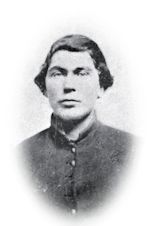
Lookout Mountain, Tenn., Thursday, Nov. 19. Reveille woke us at 4 A. M. Slept cold. A heavy frost covers the ground this morning. Marched before the cooks got breakfast ready, so we had to take dry grub. Took the Chattanooga road and marched leisurely down, coming to the end of the valley; the mountains and the river coming together. Our road lay along the bank, and the R. R. several hundred feet above us, sometimes running over a precipice and then over stilty-like bridges. An engine ran by us here. We next left the river and soon entered the hills, winding through the valleys and crossing stony points, which was very slow and laborious as our horses were jaded out and hard to keep up. A few inhabitants were seen but they could not find much to live on. 4th Corps stationed through the valley as guards, each squad already located in neat “shebangs”. Passed Sand Mountain at noon, a force being stationed upon it, the very high bridge having been destroyed near by and not yet commenced to be built. The R. R. is in bad condition and will require a good deal of labor before it will be rebuilt. A large part of it is laid with wooden rails, an iron plate fastened on top. Coal abounds in the hills. We passed a large bed of nitre, out of which saltpetre was manufactured for Confederate States’ use.
Came in sight of Lookout Ridge about 4 P. M., and at sundown we were directly under the enemy’s line, their picket fires burning brightly not more than half a mile off. Did they but have the artillery they could soon shell us out. The roads are very bad, filled with slough holes some of which were bridged. 8 P. M. halted nearly an hour to allow the pioneer corps to repair the roads. Most of the boys made coffee. Hard-tack very scarce. I had none since dinner. After the roads were fixed we moved out and marched about four miles right under the point of the guns which could not be brought to bear on us. We passed by Joe Hooker’s headquarters. It was a very beautiful evening, bright moonlight, and pleasant marching. Came into camp at 11:30 P. M., our horses having nearly given out. When the wagons came up we fed horses and drew crackers, but I was not as hungry as sleepy, so I laid down in the open air with Point Lookout frowning in full view, on which is a battery of heavy guns that at any moment could hurl terror to our Corps.
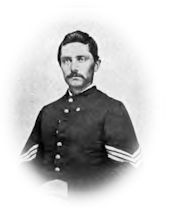
Thursday, 19th—All is quiet and there is nothing of importance. The report in camp is that the Sixth Division will remain at Vicksburg all winter; we are thankful if that is the case, as we are comfortably fixed for winter.
19th. About two stopped at a house and warmed. Got into a bed for two hours. Pitied some poor people. Gave a woman $22 scrip. Wolf and I went to a Mr. Tate’s (rebel off the road) for breakfast. One very affected rebel girl with curls, perfectly disgusting. Train corralled near. One and one-half miles from Bean Station. Lay down and took a nap. Mack lost his horse last night, left him standing while he went to warm, walked 8 miles. Found him today. Pearson and men messing with us. Went with Mr. Berley to Div. Com. to sell him some beef and hogs. Boys came up before night. Sent Lewis back to see about flour and beef for Brigade. Moved about 8 P. M.—just settled for night’s rest—to the foot of Clinch Mountain. Trains and troops crossing all night. Slept well in open air. Hired George
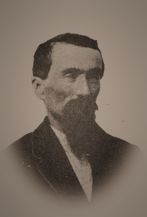
November 19 — Renewed our backward march this morning and arrived at our camp near Orange Court House, where we started from on the evening of the seventeenth. We crossed the Rapidan at Liberty Mills, about six miles west of Orange Court House.
Wednesday, 19th.—Building shanty to-day.
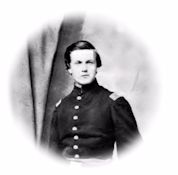
National Hotel, Washington,
Nov. 19, 1863.
Dear Sister L.:—
Perhaps you think my long silence bodes no good. If you do, dispossess yourself of that idea immediately.
I am half “luny” with delight. Do not think that because I would not allow myself to think or speak of coming home, or listen to you, that I cared nothing for my home or my friends. No, indeed! But now times are altered and I shall be with you next week, God willing. “How? Why?” Because I am “First Lieutenant, Eighth Regiment, United States Colored Troops, Philadelphia. Pennsylvania.” and have leave of absence for fifteen days, signed by the Secretary of War, in my pocket.
I shall go to New York to-night to buy some clothes and see my friends. I shall stay till Monday night. Then I come to you. I will stop on my way to Michigan to call for E. and take him home with me.
This is good news to you, I know. It is to me. I hardly expected to get home, but last night I went down to see Major Foster, stated my case and asked ten days. “Why, you can’t go to Michigan in ten days; it will take you all the time to go and come.” I thought, you see, that if I asked too much, I wouldn’t get anything. “Make your application in writing and I will see what I can do for you.” I made the application this morning for fifteen days and got my papers through the whole red tape in an hour.
E. made the most sensible remark I have read since the talk of my promotion. Said he, “I shall think no more of you than I did when you carried a musket, but the world will.” Straps are honored, and already I see the advantage of wearing them, though I have not got them on.


