Following the American Civil War Sesquicentennial with day by day writings of the time, currently 1863.

November 2013

November 19.—With the exception of a few, the wounded are doing pretty well.

We have one man, Captain Thompson, who lost a leg at Chickamauga, and while in the field hospital took gangrene and pneumonia besides. No words can ever express the suffering which this man has endured, and I have never seen him without a smile on his countenance, nor heard a murmur from his lips. One of his men is nursing him, and is very devoted to him.

Mr. Green, our chaplain, has gone on a visit somewhere; so I got one of the ladies of the place to send for Mr. Smith, the Methodist presiding elder, who came and prayed with the captain and many of the others. Captain T.’s cousin, Miss W., a very nice young lady, has come to see him. She is with me, assisting.

November 19.—We wish we were at Gettysburg to-day to hear President Lincoln’s and Edward Everett’s addresses at the dedication of the National Cemetery. We will read them in to-morrow’s papers, but it will not be like hearing them.

Authors Note, 1911. — Forty – eight years have elapsed since Lincoln’s speech was delivered at the dedication of the Soldier’s Cemetery at Gettysburg. So eloquent and remarkable was his utterance that I believe I am correct in stating that every word spoken has now been translated into all known languages and is regarded as one of the World Classics. The same may be said of Lincoln’s letter to the mother of five sons lost in battle. I make no apology for inserting in this place both the speech and the letter. Mr Whitelaw Reid, the American Ambassador to Great Britain, in an address on Lincoln delivered at the University of Birmingham in December, 1910, remarked in reference to this letter, “What classic author in our common English tongue has surpassed that?” and next may I ask, What English or American orator has on a similar occasion surpassed this address on the battlefield of Gettysburg?”

“Four score and seven years ago, our fathers brought forth on this continent a new nation conceived in liberty and dedicated to the proposition that all men are created equal. Now we are engaged in a great civil war, testing whether that nation, or any nation so conceived and so dedicated, can long endure. We are met on a great battlefield of that war. We have come to dedicate a portion of that field as a final resting place for those who gave their lives that that nation might live. It is altogether fitting and proper that we should do this. But in a larger sense we cannot dedicate — we cannot consecrate — we cannot hallow this ground. The brave men, living and dead, who struggled here have consecrated it far above our poor power to add or detract. The world will little note, nor long remember, what we say here—but it can never forget what they did here. It is for us, the living, rather, to be dedicated here to the unfinished work which they who fought here have thus far so nobly advanced. It is rather for us to be here dedicated to the great task remaining before us — that from these honoured dead we take increased devotion to that cause for which they gave the last full measure of devotion — that we here highly resolve, that these dead shall not have died in vain—that this nation under God shall have a new birth of freedom—and that government of the people, by the people and for the people, shall not perish from the earth.”

It was during the dark days of the war that he wrote this simple letter of sympathy to a bereaved mother:—

“I have been shown, in the files of the War Department, a statement that you are the mother of five sons who have died gloriously on the field of battle. I feel how weak and fruitless must be any words of mine which should attempt to beguile you from your grief for a loss so overwhelming, but I cannot refrain from tendering to you the consolation which may be found in the thanks of the Republic they died to save. I pray that our Heavenly Father may assuage the anguish of your bereavement, and leave you only the cherished memory of the loved and lost, and the solemn pride that must be yours, to have laid so costly a sacrifice upon the altar of Freedom.”

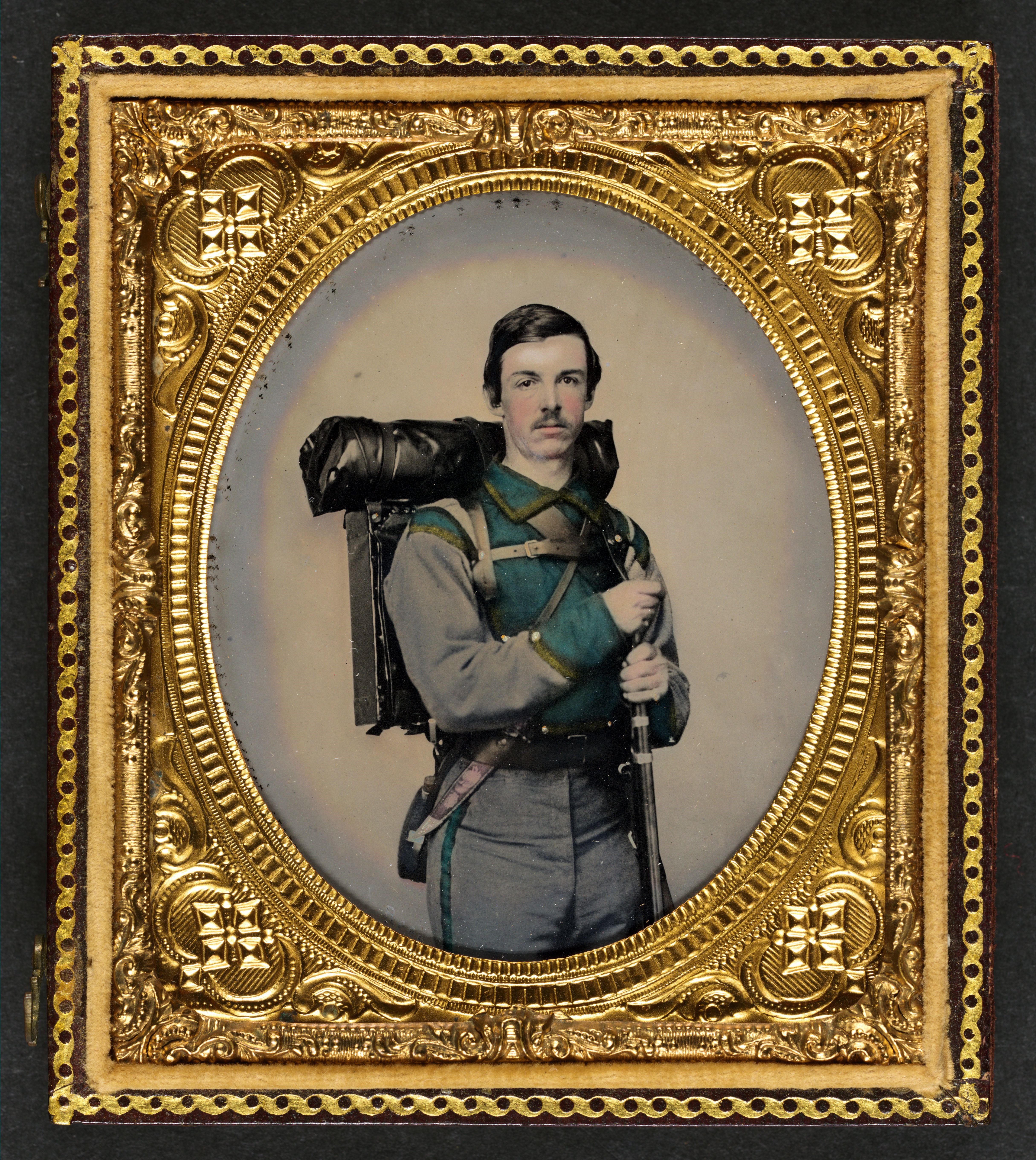
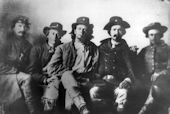
Unidentified soldier in Confederate uniform of Company E, Lynchburg Rifles -- in frame

Unidentified soldier in Confederate uniform of Company E, “Lynchburg Rifles,” 11th Virginia Infantry Volunteers holding 1841 “Mississippi” rifle, Sheffield-type Bowie knife, canteen, box knapsack, blanket roll, and cartridge box

__________

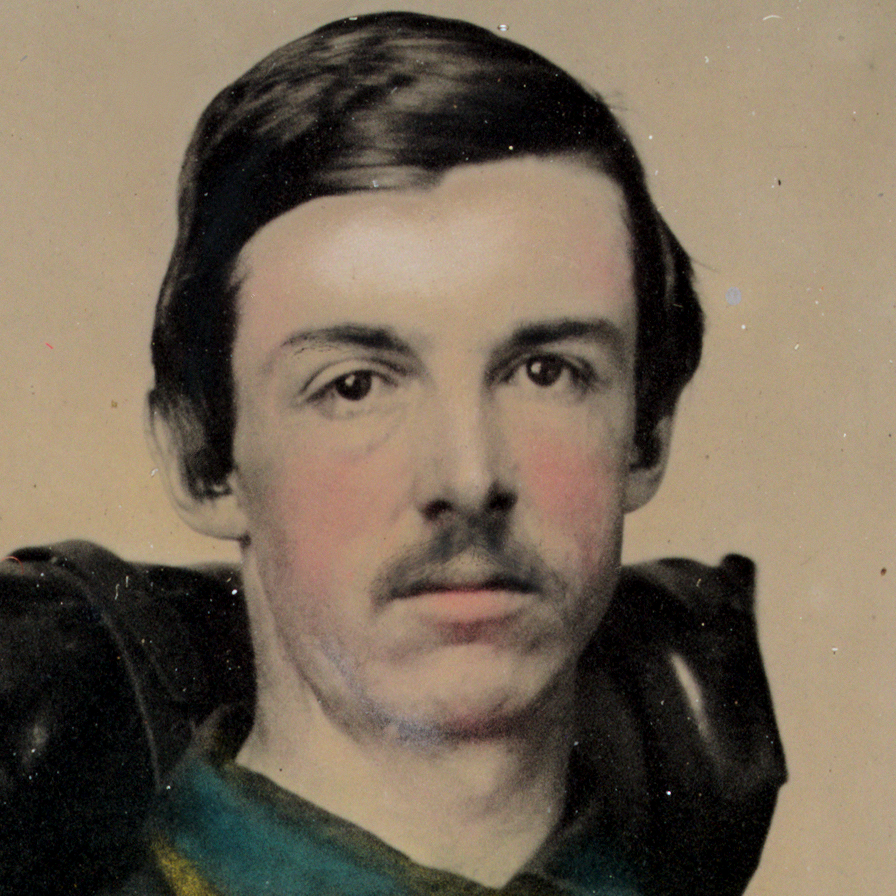
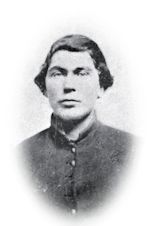
Close-up crop:

closeup -- Unidentified soldier in Confederate uniform of Company E, Lynchburg Rifles

__________

Sixth-plate ambrotype, hand-colored ; 9.4 x 8.1 cm (case)

Photographer: Charles R. Rees; created 1861

Liljenquist Family Collection of Civil War Photographs; Ambrotype/Tintype photograph filing series; Library of Congress Prints and Photographs Division.

Record page for image is here.

__________

digital file from original item, tonality adjustedNote – This image has been digitally adjusted for one or more of the following:

  • fade correction,
  • color, contrast, and/or saturation enhancement
  • selected spot and/or scratch removal
  • cropped for composition and/or to accentuate subject matter
  • straighten image

Civil War Portrait 098

by John Beauchamp Jones

NOVEMBER 19TH. —Miss Harriet H. Fort, of Baltimore, has arrived via Accomac and NorthamptonCounties, with a complete drawing of all the defenses of Baltimore.

The Medical Purveyor’s Guards have petitioned the Secretary for higher pay. They get now $1500 per annum, and say the city watchmen get $2300.

Gens. Banks and Taylor in the West are corresponding and wrangling about the exchange of prisoners—and the cartel is to be abrogated, probably.

The Governor of Mississippi (Clark) telegraphs the President that the Legislature (in session) is indignant at the military authorities for impressing slaves. The President telegraphs back that the order was to prevent them falling into the lines of the enemy, and none others were to be disturbed.

November 19.—General Hampton and General Thomas L. Rosser returned to Fredericksburgh, Va., from a most successful expedition into Culpeper County. On Tuesday night last they crossed the Rapidan with detachments from Rosser’s, Gordon’s, and Young’s brigades, all under the immediate command of General Rosser, for the purpose of ascertaining the position of the enemy on the other side. After marching all night over a desperate road, they succeeded, about daylight on Wednesday morning, in locating the pickets of the enemy. That being accomplished, General Rosser immediately ordered a charge, which was executed by his brigade in the most gallant style, driving the advance back upon the main body, which was encamped a short distance in the rear. Here the enemy had formed a line of defence; but, in defiance of a heavy fire poured into his command, General Rosser pressed forward, and soon drove the entire force (the Eighteenth Pennsylvania cavalry) through their encampment, and pursued them some miles beyond, in the direction of Stevensburgh.

The result of this gallant exploit was the capture of sixty prisoners, among them an adjutant and one lieutenant, two flags, one hundred horses and mules, a number of tents, all the wagons, baggage, etc., of the encampment. The enemy fled through the woods in every direction, many of them without having completed their toilet for the day. Having located the enemy, (the original object of the expedition,) and obtained other valuable information, the command was withdrawn, by the way of Germanna Ford, to the other side of the river, where the prisoners and other captures had been previously forwarded.— Richmond Enquirer.

—A detachment, composed of companies G, H, T, and K, of the Fifty-eighth regiment of Illinois infantry, with a portion of the Second Illinois cavalry, under the command of Captain Franklin B. Moore, pursued Faulkner’s rebel partisans to a point on Obion River, four miles from Union City, Tennessee, where, in attempting to cross the river, the rebels were fired on, and eleven of their number killed. The Nationals captured fifty-three prisoners, a wagon-load of small-arms, thirty-three horses, and four mules. Their casualties were one man wounded and five horses shot.—Large and spirited meetings were held in all the wards in Boston, Mass., last night, to encourage volunteering. Committees were appointed, and the work was pursued with energy. A similar movement was made in cities and towns throughout the State.—At Gettysburgh, Pa., the national cemetery, for the burial of the Union soldiers who fell in the battles fought at that place in July, 1863, was consecrated.

—A combined expedition, consisting of the gunboat Morse, commanded by Captain Charles A. Babcock, and four hundred and fifty men from the One Hundred and Forty-eighth regiment of New-York volunteers, under the command of Lieutenant-Colonel George M. Guion, left Yorktown, Va., on Monday, November sixteenth, in search of a party of the rebel “Marine Brigade,” reported to be on their way from Richmond to Mob Jack Bay, to commit depredations on the Northern commerce.

The Morse landed the regiment the same evening at the head-waters of East River, which at once marched across the county to Matthews Court-House, where information was obtained that the “Marines” had left the place but a few hours previously. Passing the night there, early the next morning the march was continued northward as far as Shuffletown, on the Piankatank River. No traces of the rebels being discovered, the regiment turned about and scoured the country down to the mouth of the Piankatank, encamping that night at Cricket Hill.

The next morning, the eighteenth, crossing in small boats to Gwynne’s Island, the men were deployed across it, and the cover beaten as they advanced. About noon, near the lower end of the island, their labor was rewarded by the discovery of the entire party for which they were in search, consisting of an acting master in the rebel navy, named Webb, and fifteen men. The marines were hidden in the reeds and bushes of swamp, and offered little resistance. Each man was armed with a carbine, cutlass, and pistol of English manufacture. They had with them a twelve pounder breech-loading brass howitzer, which, however, they had previously concealed in the woods. A sloop, with which they intended to commit depredations on passing vessels, was discovered up a creek, and burned.

They were expecting to capture a large vessel, and eventually to attack one of the mail-boats plying between Fortress Monroe and Baltimore, from which city Webb and nearly all of his gang of pirates hailed. In the possession of Webb was found his commission as master in the rebel navy, together with a letter of instructions from Secretary Mallory, ordering him to proceed to the rivers and creeks of Eastern Virginia, organize his party, and annoy commerce as extensively as possible.

The One Hundred and Forty-eighth returned to Yorktown to-day with their prisoners, who were sent to Fort Norfolk.
Knoxville, November 18th, 1863.

It was now about 4 a. m., and daylight would soon appear. The whole corps was waiting for the artillery and wagon train to get a reasonable start. Much rain had fallen and the roads were heavy; horses and mules were poor. About one hundred wagons, heavily loaded with army supplies, were abandoned because we had not time to burn them. A large amount of bread, bacon, sugar and clothing were thus turned over to Longstreet’s Quartermaster. Just as daylight appeared we filed into the road en route for Knoxville. The Third Brigade was in the rear, and our regiment was detailed as rear guard, the post of honor and danger. One company of cavalry, all we had, was left to finish the work of destruction and to act as scouts. We were hardly out of sight before the Rebel cavalry made a dash, capturing several and scattering the rest. Their infantry was not far behind. They pursued and closed in on us with relentless fury. When too hard pressed, our little band would turn and charge with fixed bayonets, thus holding them in check while the others made a little headway. Mile after mile was fought over in this way, every inch contested, but all would not do. They pressed our flank and rear until Burnside was compelled to turn and fight them. The Knoxville road, in the vicinity of Campbell Station, leads through a ravine from one to two miles wide hemmed in by mountains or high hills, which render a flank movement well-nigh impossible. At the head of this ravine Burnside massed his artillery—120 pieces—formed his infantry in their rear for support, and awaited the assault. From our position we had an almost unobstructed view of what was taking place in front. No artillery could be seen; nothing but infantry. We could see them file out from a piece of timber and form in line, from hill to hill and rank on rank. At the word they moved forward, colors flying, shoulder to shoulder, a compact mass, seemingly irresistible. At a given signal from the head of the valley a sheet of flame bursts forth with a crash that shakes the earth—a blast of iron hail sweeps those serried ranks, opening wide gaps. They close and stubbornly move on. Again that withering flame; again that blast of death, and they recoil. Three times they make the attempt, and three times failed—then darkness closed the scene. By this time our wagon train was far on its way toward Knoxville, leaving the road unobstructed. One by one our cannon disentangled itself and straightened out on the line of retreat. The infantry closed in on its rear, making the best time we knew, hoping to reach Knoxville before daylight. We arrived at 3 a. m.

At sunrise the Rebels were within five miles of us. Our position is naturally strong, and our men were at once set to work to make it stronger. By 3 p. m. rifle pits encircled the city from river to river. When they were completed our brigade bands formed on the top of the hill and played “The Red, White and Blue.” “When This Cruel War Is Over,” “Rally ‘Round the Flag, Boys,” and finished up with “Yankee Doodle,” to which the boys responded with a yell of defiance as we stepped down into our ditches. We were ready for them, and every man of us understood we must whip them here or be taken prisoners.

Longstreet advanced leisurely, knowing we could go no further, and confident in his strength, for he outnumbered us three to one. But he evidently did not know our weakness. When stretched around the city we formed a very thin line; indeed, the men in trenches standing fully six feet apart. He might have carried our hastily-constructed works by assault, but it seems he chose to adopt the more humane method, and starve us out. The delay proved our salvation. In our retreat from Lenoir the Seventeenth lost 114 killed, wounded and missing.

Longstreet himself is on the ground, directing the placing of his men. I have seen him in many previous campaigns, and know him by his form and the way he sits his snow-white horse.

Thursday, 18th—Came on to-day to Charlestown and six miles above to Mr. Calloway’s and staid all night.

Wednesday, 18th—The weather is still warm. Our fatigue duty is not so laborious now, but the picket duty is becoming more strenuous if anything on account of the activity of the rebels’ cavalry. The Eleventh Iowa signed the payrolls today.

Sequatchie Valley, Ala., Wednesday, Nov. 18. Reveille sounded before dawn and we were ordered to prepare to march, but they knew not at what hour. All baggage that could be spared was ordered to be left with camp guard. The knapsacks were to be left, but as the cannoneers did not feel disposed to lose all of them as at Vicksburg, they all strapped them on their backs to “tote ’em”. Failed to draw but one load of forage, so a vacant wagon was left and the knapsacks packed in much to the satisfaction of all. Hitched up at 6 A. M. Marched on to the hill where the infantry were encamped. The 2nd and 3rd Brigades had started, leaving tents standing. We were in the rear and compelled to lie in the road until 2 P. M. In the meantime a large mail was distributed. I received four letters, all from home, which of course were very acceptable. Moved down to the river where our Division had been crossing all day on the pontoon. No more than four wagons allowed on at a time, hence a tedious job. 4 P. M. we moved on to it. It consists of a firm scow boat anchored every sixteen feet and stringers laid across, over which were laid twelve-foot plank. It was narrow and shaky, but a tight rein and careful driving brought us over all safe. Had to cross two of them, an island occupied by Hooker’s men in the middle of the river. Men busy at work on R. R. bridge, but not near finished. Came to a halt two miles from the river and lay there over an hour to wait for the train to cross. Large fires were built and the infantry cooked their coffee in their little cans. It was quite dark before the bugle sounded and we marched on at a brisk rate till 9 P. M. Our road lay through the Sequatchie Valley, which was pretty well under cultivation, watered by a large stream coming out of the solid rock a few yards above us, one spring furnishing water enough to run a flouring mill. A large cave was close by, which is reported to be a curiosity, thirteen miles long, out of which saltpetre is dug, but I could not visit it. Unhitched our weary and hungry horses having had nothing but two quarts of corn all day, and but a scant feed last night. Made our bed in the open air and piled in supperless.

18th. Aroused early and notified that a general evacuation is to take place. Saddled, and so till noon. Train ordered to Rice’s Lower Ford. Rode over hastily to St. Clair and notified Pearson when to cross. Got two teams to go to Kirkpatrick’s mill. Some fast and hard riding. 2nd O. V. C. train ferried but the rest crossed at Cobb’s Ford and trudged on towards Bean Station. Some mud. Good joke on 11th Mich. Batt. Sergt.