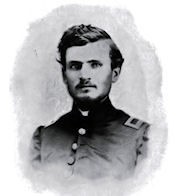
10th. Had little or nothing to do. Went up to see Commissary on business. Absent. Went out to Mr. Lynch’s to see a horse. Learned he had sold it and returned to camp. Left detail for Thede, June, Lewis Emmons and Dan Coats. Night before received letter from Lucy Randall—married.
November 2013
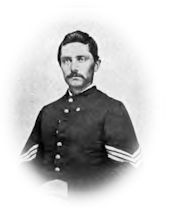
Tuesday, 10th—I was on a detail of two hundred men with one hundred teams to haul the commissary supplies and ammunition from the transports to the storehouses and magazines constructed near the new forts. It is heavy work, and as to handling the ammunition, quite dangerous. General Grant has given orders that Vicksburg must be well fortified and supplied with munitions and provisions, and that it must be held against all possible attack, for it cost too much to obtain it, besides its being a point of the greatest strategic importance.
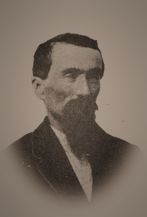
November 10 — This morning we forded the Rapidan at Rapidan Station, then moved in an easterly direction all day toward Fredericksburg. We marched on the old Fredericksburg pike, now a very rough road; at dusk this evening we struck the Orange plank road, about eighteen miles east of Orange Court House, and camped. The weather is very cold.
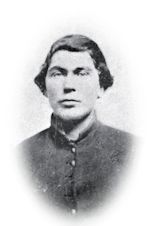
Camp in Oak Barrens, Tenn., Tuesday, Nov. 10. Prepared for an early march. Moved at 9 A. M. as we had to wait for the 2nd Brigade to move ahead. Passed through town, which is an old fashioned place of quite a size. Looks as though it was the same twenty years ago. Of course it was perfectly dead, no sign of trade or purchase of any kind. Crossed Elk River two miles from the town on the best bridge I ever saw. It is built of solid stone all hewed, five arches, with a foot path on top of each side wall. It is but a single track erected in 1861. Poor country! After we left the river valley, nearly deserted fields lie idle. About noon we entered the Oak Barrens, so called from its sterility. It is a perfectly flat tract of land with a yellow clay soil. Oak openings, no underbrush, the oak not very large. It lies lower than the surrounding country and covered with pond holes which we rendered bottomless with a little travel, the wheels cut down so. No houses or fields to be seen. Went into camp in the first field we saw for five miles, and that was deserted. 4th Platoon wheel horse fell dead tonight before it came to camp. He was the biggest and best horse of the Battery, supposed to be overdone. Train of cars passed out on the Fayetteville branch loaded with crackers for our camp. It was escorted by two regiments of Slocum’s Corps, the New York and Pennsylvania regiments. Mail received. I got letter from home of the 25th ult, so we are once more approaching the Union lines. No news or paper seen save wild camp rumors which are conflicting. No corn to feed our horses to-night. I am on guard.
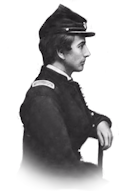
November 10th. A slight fall of snow during the night, the first of the season, which suggests a cessation of campaigning; at 3 P. M. the first division was ordered to encamp on the south side of Mountain Run and put up winter quarters. The order was received with unbounded satisfaction, as the season is late, the weather cold and the troops pretty well tired out. Division headquarters in the Hamilton house.
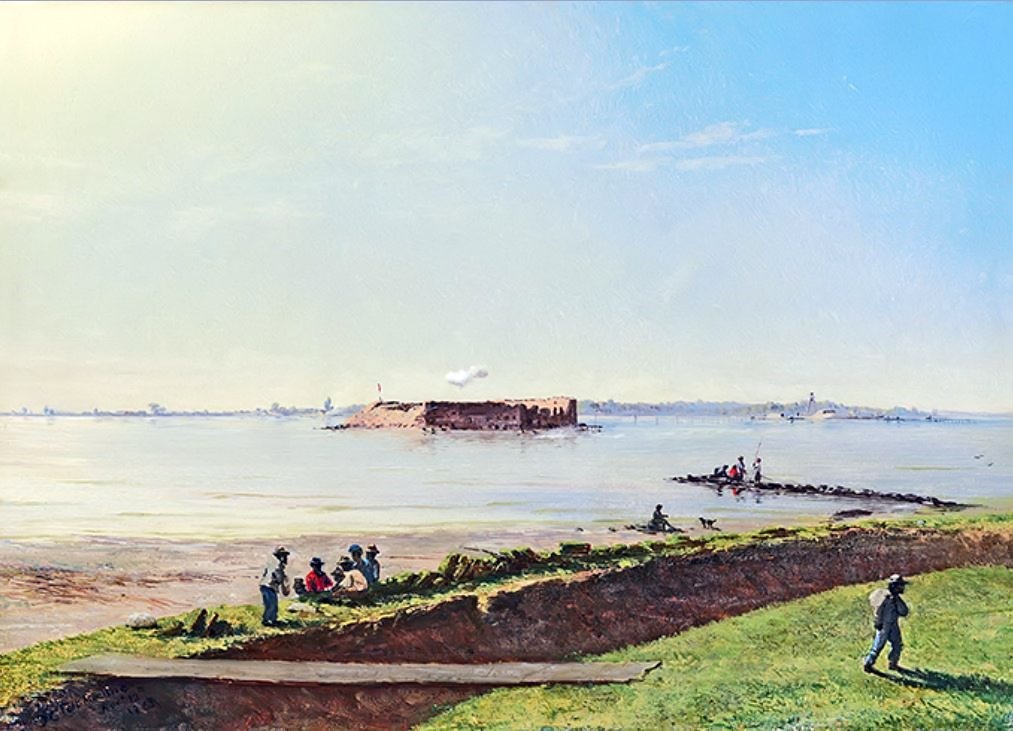
Painting by Conrad Wise Chapman.
“This is a view of Fort Sumter from Fort Moultrie; shows also battery on James Island. A shell is bursting over Fort Sumter. The artist stated he never looked in the direction of Fort Sumter that he did not see a shell bursting over it.” – Conrad Wise Chapman, 1898
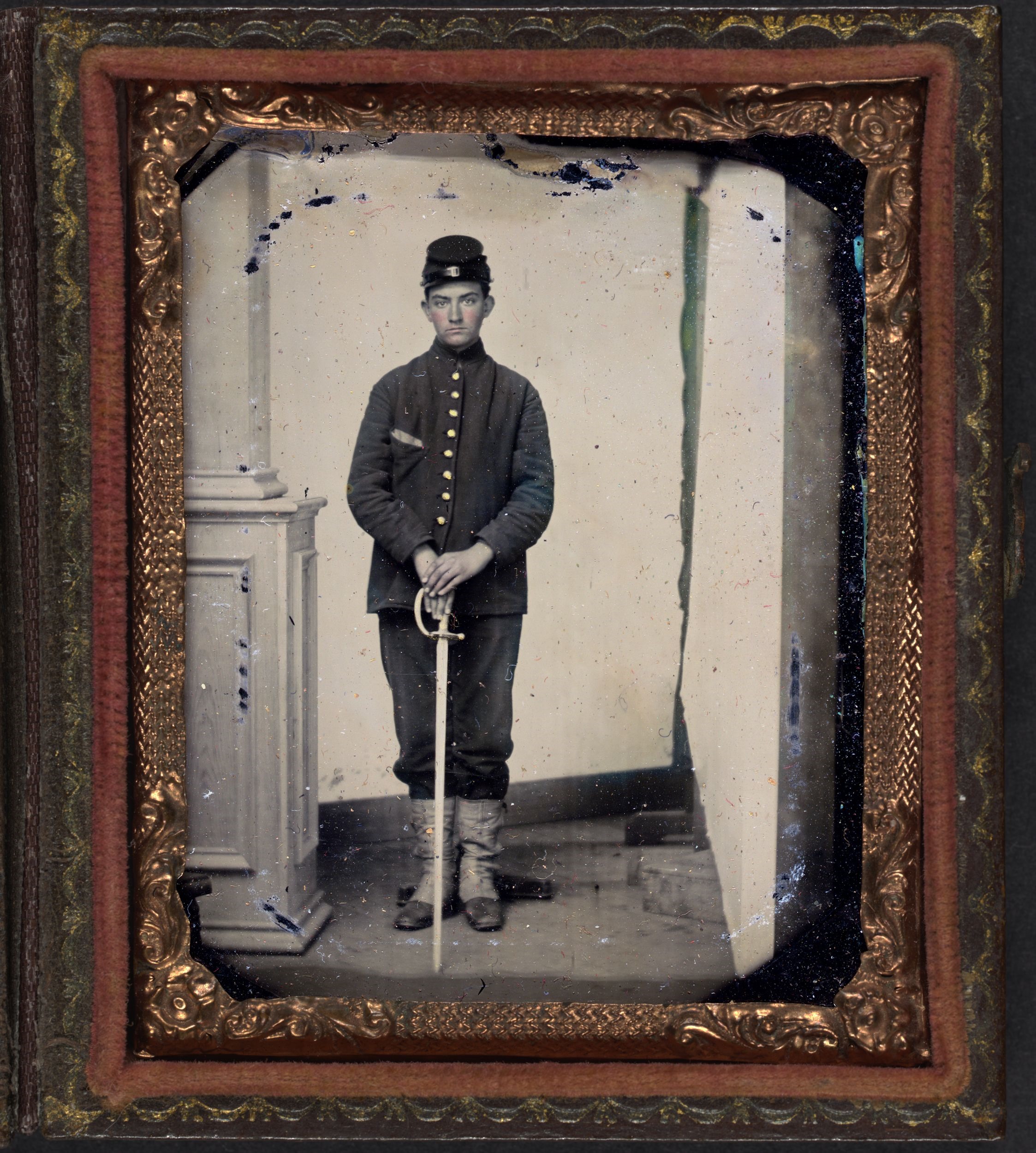
Unidentified young soldier in Union sack coat, forage cap, and white gaiters with sword.
__________
Ninth-plate ambrotype, hand-colored ; 7.2 x 6.2 cm (case)
Liljenquist Family Collection of Civil War Photographs; Ambrotype/Tintype photograph filing series; Library of Congress Prints and Photographs Division.
Record page for image is here.
__________
 Note – This image has been digitally adjusted for one or more of the following:
- fade correction,
- color, contrast, and/or saturation enhancement
- selected spot and/or scratch removal
- cropped for composition and/or to accentuate subject matter
- straighten image
Civil War Portrait 089
by John Beauchamp Jones
NOVEMBER 10TH.—It is supposed our loss in the surprise on Saturday did not exceed 1500, killed, wounded, and taken. It is thought that a battle will occur immediately, if it be not already in progress.
There is no news of moment from any quarter, except the loss of our steamer Cornubia, taken by the blockaders at Wilmington. She was laden with government stores. For months nearly all ships with arms or ammunition have been taken, while those having merchandise on board get in safely. These bribe their way through!
Col. Gorgas gave notice to-day that our supply of saltpeter will be exhausted in January, unless we can import a large quantity.
Another blue day!
November 10.—A successful advance was made by General Kilpatrick, of the army of the Potomac. He passed through Culpeper without seeing any rebels, and continued his march through Stevensburgh, followed by the rebel army.—The rebel steamer Ella, while attempting to run the blockade of Wilmington, North-Carolina, was captured by the National gunboat Howqua.
—Colonel Upton, who commanded the brigade which last Saturday successfully charged and captured the rebels’ works at Rappahannock Station, accompanied by deputations from each of the regiments participating in the assault, presented General Meade with the eight battle-flags taken at that time. Colonel Upton presented the flags in behalf of his command, naming the regiments—the Fifth and Sixth Maine, the Fifth Wisconsin, and the One Hundred and Twenty-first New-York—the latter, Colonel Upton’s own. General Meade responded as follows:
“Colonel Upton, officers and men of the Sixth corps: I receive with great satisfaction the battle-flags, evidences of the good conduct and gallantry you displayed on the seventh instant. The assault of the enemy’s position at Rappahannock Station, intrenched by redoubts and rifle-pits, defended by artillery and infantry, carried as it was at the point of the bayonet, was work which could only be executed by the best of soldiers, and in the result you may be justly proud. It gives me great confidence that in future operations I can implicitly rely on the men under my command doing, when called on, all that men can do; and, although it is my desire to place you in such positions as to avoid, if possible, recurring to such severe tests, yet there are occasions, such as the recent one, when it is the only and best course to pursue; and to feel as I do now, that I command men able and willing to meet and overcome such obstacles is a source of great satisfaction.
“I shall transmit these flags to the War Department I have already reported your good conduct, and received and transmitted to your commanders the approval of the President.
“I shall prepare, as soon as I receive the requisite information, a general order, in which it is my desire to do justice to all the troops who have distinguished themselves; and it is my purpose, by every means in my power, to have those soldiers rewarded who have merited such distinction.
“Soldiers: In the name of the army and of the country, I thank you for the services you have rendered, particularly for the example you have set, which, I doubt not, on future occasions will be followed and emulated.”
Monday, 9th—Came in to Cedar Town this morning. Stay all night at the Hotel, ten dollars apiece. Sold some tobacco to him.


