Following the American Civil War Sesquicentennial with day by day writings of the time, currently 1863.

November 2013

11th.—Just received a visit from my nephew, W. N., who is on his way to Fauquier to be married. I had not seen him since he lost his leg. He is still on crutches, and it made my heart bleed to see him walk with such difficulty. I believe that neither war, pestilence, nor famine could put an end to the marrying and giving in marriage which is constantly going on. Strange that these sons of Mars can so assiduously devote themselves to Cupid and Hymen; but every respite, every furlough, must be thus employed. I am glad they can accomplish it; and if the “brave deserve the fair,” I am sure that the deeds of daring of our Southern soldiers should have their reward. My niece, L. B., of Lexington, would have been married to-morrow night, but her betrothed, Captain S., has been ordered off to meet the enemy. The marriage is, of course, postponed. Poor fellow! I trust that he may come safely home.

I have just written to Colonel Northrup, Commissary-General, to ask an appointment as clerk in his department. So many of the young men have been ordered to the field, that this office has been open to ladies. My cousin, Colonel F. G. Ruffin, of the same office, has interested himself for me. They require us to say that we are really in want of the office—rather a work of supererogation, I should say, as no lady would bind herself to keep accounts for six hours per day without a dire necessity.

November 11—We renewed our march this morning and moved down the plank road about four miles, then turned off to the left and moved in a northerly course through an almost barren section of country. About middle of the day we struck the Culpeper and Fredericksburg plank road at Wilderness Run, five miles west of Chancellorsville. We halted here and camped for the remainder of the day and to-night. We are now near the old field hospital in which General Stonewall Jackson’s arm was amputated after the battle of Chancellorsville last May. The house stands on Wilderness Run, in a lonely place about half a mile south of the Culpeper plank road; it is a good-sized farmhouse, built of wood, square, with two porticos and painted a dove color. From the apex of the roof a hospital flag still flutters in the cold November wind.

Headquarters Third Brigade,
Kelly’s Ford, Nov. 11, 1863.

Dear Sister L.:—

I have another name to put on my battle pin (when I get it), that of “Rappahannock Station, November 8th.” Soldiers have a fashion of counting up their battles, with an honest pride when they reach a certain number, and I will count up mine and then tell you a little about the last. Hanover Court House, a battle then, a skirmish now, Mechanicsville, Gaines’ Mill, which no one calls less than a battle even now, Savage Station, White Oak Swamp, Glendale, Malvern Hill, then the greatest battle of America, Second Bull Run, Antietam, Shepherdstown Ford, Fredericksburg, the slaughter pen, skirmish at Richards’ Ford, Chancellorsville, Loudon Valley, Gettysburg, Jones’ Cross Roads, and Rappahannock Station.

Quite a little list, and as I have always been there when the Third Brigade has, I do not feel ashamed of my record.

About four o’clock last Saturday morning the reveille sounded and in half an hour the camps of our division were all astir, brilliant with fires, bristling with preparation for the march at daylight. Daylight came and we began the march toward the river. The day was cold and windy and very dusty, but we marched rapidly and by noon we reached the rebel pickets, or our advance discovered them a mile from the river. We halted for an hour or two, while the generals made their dispositions, and then formed in line. Our division came next to the railroad, on the south of it. On the other side was the Sixth Corps, Second Division of the Fifth Corps on our left and Third Division in reserve.

At 2:30 p. m. the line advanced. The skirmishers soon ran on to a cavalry picket and fired, and the way the rebs did “git” over the little hill was a warning to slow horses. We advanced steadily and soon came to a line of rebel skirmishers thrown out to meet us. They fired and fell back and soon the artillery opened on our line, but oh, such firing! Shells burst all around and over us, but hardly one in the right place. On our side of the river just above the railroad was a fort mounting six or seven guns and the opposite bank of the river was bristling with field batteries.

Griffin’s battery (our favorite) got into position to send a message to the nearest fort and our skirmishers advanced. The rebs opened on them and the aforesaid pet opened on the rebs, and over the rampart went our boys and out went the rebs. Some of them jumped into the river up to their necks, but they had to come back. The result was sixty-five men and five officers prisoners, and seven guns (all in the fort).

The paper states that the Sixth Corps took the fort. It may be so, but men who were the first in say that only one sergeant and one officer from the Sixth were there, and I know that the Eighty-third and Forty-fourth took the prisoners, because I saw and counted them myself and heard Colonel Connor’s report when he brought them to Colonel Chamberlain.

Well, that was about all of it. It was after sundown when the fort was taken and we could not cross the river till morning. Our casualties were very small, twenty killed and wounded in the brigade, three wounded and none killed in the Eighty-third.

We went back into the woods to bivouac. No fires were allowed, but a good many were made, nevertheless, and I made out to get a cup of coffee. I tied my horse to a fallen tree and lay down close by him, and the rascal kept me awake half the night. He pulled my haversack out from under my head, pulled my blankets off, and once I woke and found him with my bugle in his mouth chewing the tassel.

By daylight we were on the move down the river to Kelly’s Ford, crossed on pontoons and back into the country three miles and bivouacked. Monday we lay all day in bivouac and at sundown got up and came back this side the river. Our First Division did. The rest of the corps remained.

We had big times that night for fires. We had no wood, camped on a plain where there had been an old camp, and not a stake for our horses or stick to burn could we find. The wind blew furiously and it began to snow.

The mounted orderlies and I after unsaddling put out and finally found a pole thirty feet long half a mile away. We took that, carried it up and laid it on the ground to tie to. The other boys had got some brush afire and we got coffee and lay down. That night it snowed an inch deep on our blankets. Next morning we moved back into the woods, where we are now and expect to stay a few days to watch guerrillas.

I have heard nothing from the War Department yet. Begin to think I am rejected. Write again soon.
Winchester, Tenn., Wednesday, Nov. 11. Called up at 4 A. M. Harnessed before daylight. The horses covered with frost. Cold work for bare hands. Started as soon as daylight; about seven miles more of barrens without a house or trace of civilization. Slough holes very often, the pioneer corps bridging many of them while we waded through the others. Four or five horses gave out before we got through. Three left behind. Came out of there by noon on higher ground, well settled, but not very productive. Citizens look decidedly Secesh. Passed Salem at 2 P. M., two overshot waterwheels and a tower. Came into camp within two miles of Winchester at sundown. We are within our own lines. The Army of the Cumberland has a force stationed here, among which is the 1st Wisconsin Cavalry. Drew one day’s rations of crackers.

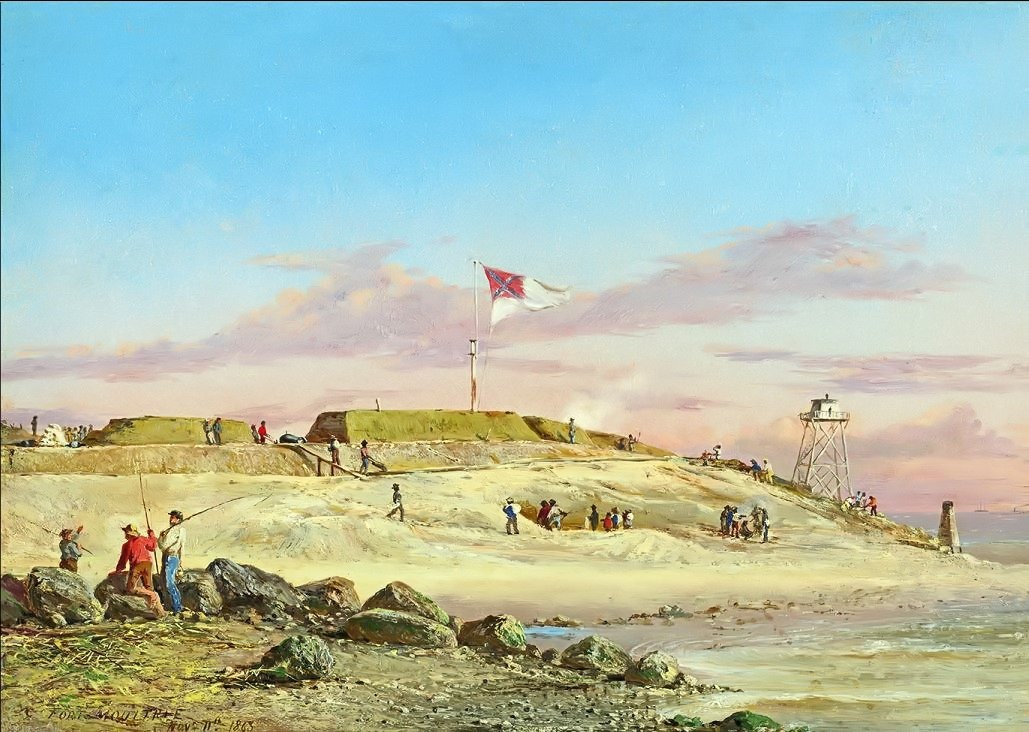
Fort Moultrie, November 11, 1863 - by Conrad Wise Chapman

Painting by Conrad Wise Chapman.

“External view of Fort Moultrie, negroes at work, getting sand to repair fortifications.  Shows some soldiers who have probably been out fishing; and in the distance can be seen blockading fleet.” – Conrad Wise Chapman, 1898

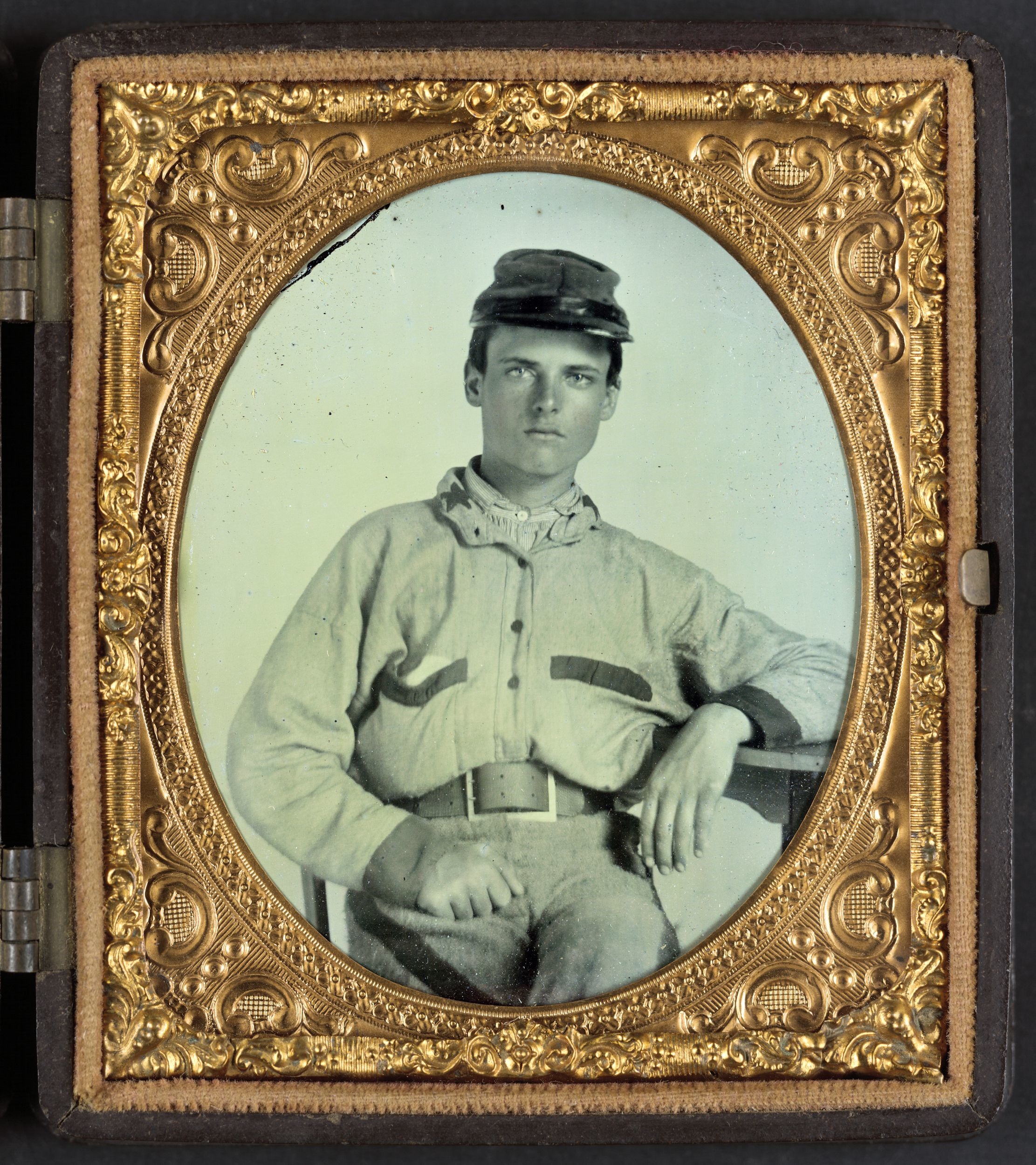
Unidentified soldier in Confederate battleshirt, kepi, and wishbone belt buckle -- in frame


Unidentified soldier in Confederate battleshirt, kepi, and wishbone belt buckle.

__________

Sixth-plate ambrotype ; 9.5 x 8.5 cm (case)

Liljenquist Family Collection of Civil War Photographs; Ambrotype/Tintype photograph filing series; Library of Congress Prints and Photographs Division.

Record page for image is here.

__________

digital file from original itemNote – This image has been digitally adjusted for one or more of the following:

    • fade correction,
    • color, contrast, and/or saturation enhancement
    • selected spot and/or scratch removal
    • cropped for composition and/or to accentuate subject matter
    • straighten image

Civil War Portrait 090

by John Beauchamp Jones

NOVEMBER 11TH.—NO news. I saw, to-day, Gen. Lee’s letter of the 7th instant, simply announcing the capture of Hoke’s and Haye’s brigades. They were on the north side of the river, guarding the pont de tete. There is no excuse, no palliation. He said it was likely Meade’s entire army would cross. This had been sent by the Secretary to the President, who indorsed upon it as follows: “If it be possible to reinforce, it should be done promptly. Can any militia or local defense men be made available?—J. D.”

Gen. Whiting writes that he has refused to permit Mr. Crenshaw’s correspondence with Collie & Co. to pass uninspected, from a knowledge of the nature of previous correspondence seen by him.

The Northern papers state that Mr. Seward has authorized them to publish the fact that the French Government has seized the Confederate rams building in the ports of France.

I have written Custis Lee, the President’s aid, that but one alternative now remains: for the President, or some one else, to assume all power, temporarily, and crush the speculators. This I think is the only chance of independence. I may be mistaken—but we shall see.

Capt. Warner, who feeds the 13,000 prisoners here, when he has the means of doing so, says Col. Northrop, the Commissary, does not respond to his requisitions for meat. He fears the prisoners will take or destroy the city, and talks of sending his family out of it.

I condemned the reign of martial law in this city, in 1862, as it was not then necessary, and because its execution was intrusted to improper and obnoxious men. But now I am inclined to think it necessary not only here, but everywhere in the Confederacy. Many farmers refuse to get out their grain, or to sell their meat, because they say they have enough Confederate money! money for the redemption of which their last negro and last acre are responsible. So, if they be permitted to maintain this position, neither the army nor the non-producing class of the population can be subsisted; and, of course, all classes must be involved in a common ruin. A Dictator might prevent the people from destroying themselves, and it seems that nothing short of extreme measures can prevent it. But, again, suppose the Federal Government were to propose a sweeping amnesty, and exemption from confiscation to all who should subscribe to a reconstruction of the Union—and this, too, at a time of suffering and despondency—and so large a body were to embrace the terms as to render a prolongation of the war impracticable? What would the money the farmers now possess be worth? And what would become of the slaves, especially in Virginia, Tennessee, Kentucky, and Missouri?

November 11.— Major-General Foster having been relieved from the command of the Department of Virginia and North-Carolina, issued an order bidding farewell to the officers and men serving in the department.

—Secretary Stanton sent the following despatch to the Mayor of Buffalo, N. Y., this night:

“The British Minister, Lord Lyons, has tonight officially notified the Government that, from telegraphic information received from the Governor-General of Canada, there is reason to believe there is a plot on foot by persons who have found asylum in Canada to invade the United States and destroy the city of Buffalo; that they propose to take possession of some steamboats on Lake Erie, to surprise Johnson’s Island, free the prisoners of war confined there, and proceed with them to Buffalo. This Government will employ all means in its power to suppress any hostile attack from Canada; but as other towns and cities on the shores of the lakes are exposed to the same danger, it is deemed proper to communicate this information to you, in order that any precautions which the circumstances of the case will permit may be taken. The Governor-General suggests that steamboats or other vessels, giving cause for suspicion by the number or character of persons on board, shall be arrested.

“You will please acknowledge the receipt of this despatch, and communicate to this Department any information you may now or hereafter have on this subject.”

—Major-General Butler assumed command of the departments of Eastern Virginia and North-Carolina. His order contained the following:

“Representations having been made to the Commanding General that certain disloyally disposed persons within this department do occasionally, by force, interfere with, and by opprobrious and threatening language insult and annoy loyal persons employed in the quiet discharge of their lawful occupations, it is hereby announced that all such conduct and language is hereafter strictly forbidden, and will be punished with military severity. All officers of this department are directed to order the arrest, and to bring such persons as are found offending against this order before the tribunal established for the purpose of punishing offences within this department.”

Tuesday; 10th—Came out with Clan Blakemore and Fuget to Mr. Thomas. I spent the night at John Hatchers. Miss Jane Simpson was there to-night. James Pickel was not with me; the other boys went back to town.

Lenoir, November 10th, 1863.

No sooner was the order to build winter quarters given than the men scattered in all directions in search of material. There are many forsaken buildings in this vicinity. These were visited, the siding ripped off, floors torn up, chimneys, if brick, pulled down, and the material appropriated. Hundreds of men worked all night, and by morning had lumber enough to build bunks, floors and gable ends to their buildings. The reason of this all-night work was to get the start of the officers. They knew, by past experience, all building material would soon be put under guard for the use of officers. A large brick storehouse at the depot had been burned. This was seized by headquarters. Not a brick could be obtained, only as it was stolen in the night. Just the same, the boys all had brick chimneys.

Not being disposed to work nights or Sundays, my tent mates and myself did not begin to build until Monday morning. In the forenoon we cut our logs and carried them about half a mile on our backs. In the afternoon two of us laid the foundations, while the other two went with the Sutler’s team for a load of stone for our chimney. They also picked up a few boards. Tuesday we began to build in earnest—two at the house and two at the chimney—carrying them both up together. At night it was ready for the roof. Wednesday we “chunked and daubed” it, and put on the roof, built our bunks, and, toward night, moved in. Thursday we finished the chimney, put up shelves, etc. We have a warm, comfortable house, seven logs high, roofed with two thicknesses of tent cloth, which makes a very good roof. Our bunk is in one end, and occupies four feet across it, leaving a room six feet by eight. We have a splendid fireplace —back and jambs of stone, the top of sticks. In one corner are shelves for our dishes. On one side of the room is a drop table, which we button to the wall when not in use. Our bunk is not made of poles, rough and crooked, like those of last winter, but of pine boards, soft and luxurious.

On Thursday we had regimental inspection of arms. I told the boys I heard “music in the air,” but they could not believe it. It was there, however. About 10 o’clock in the evening Captain Tyler came to our tent and called for me. He told me to wake the boys and tell them to pack their things and be ready to take cars in half an hour for Knoxville. Here was a fix—to leave our soft beds and warm houses, our winter quarters, and go out into the cold— it was bitter cold—to ride on the top of cars twenty, perhaps seventy-five miles, and sleep—if sleep we might—on the cold, damp ground, and march twenty or thirty miles a day on half rations. But away we went, the Third Brigade only, to the station. It was 2 o’clock in the morning before the cars were ready, and we reached Knoxville a little after sunrise. Here we learned the cause of the movement. The Rebels had made a dash on Wilcox, near Greenville, capturing a section of the Second Ohio Battery and part of the Second Tennessee Mounted Infantry. Not knowing their strength, we were ordered to be within supporting distance while a force of cavalry was sent out to reconnoitre. We drew full rations of soft bread and beef, and lay on the cars, the engine keeping up steam until about 4 p. m. We then encamped for the night . Next morning we again drew rations, packed our things and awaited orders with impatience. But no orders came, and there we lay and waited all that livelong day.