Following the American Civil War Sesquicentennial with day by day writings of the time, currently 1863.

November 2013

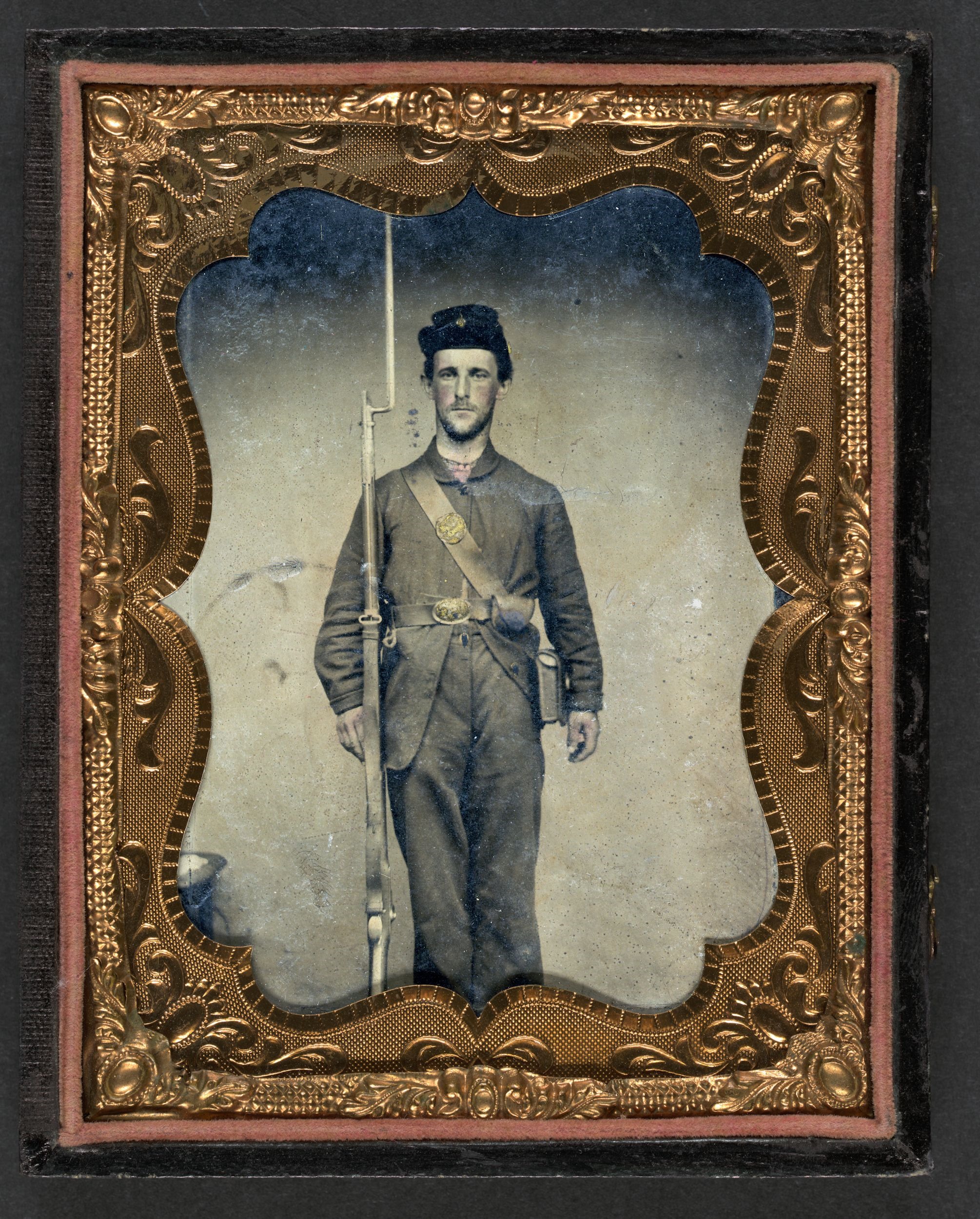
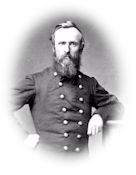
Unidentified soldier in Union frock coat and forage cap with cartridge pouch, ammunition pack, and bayoneted musket in frame


Unidentified soldier in Union frock coat and forage cap with cartridge pouch, ammunition pack, and bayoneted musket.

__________

Quarter-plate tintype, hand-colored ; 11.7 x 9.4 cm (case)

Liljenquist Family Collection of Civil War Photographs; Ambrotype/Tintype photograph filing series; Library of Congress Prints and Photographs Division.

Record page for image is here.

__________

digital file from original itemNote – This image has been digitally adjusted for one or more of the following:
    • fade correction,
    • color, contrast, and/or saturation enhancement
    • selected spot and/or scratch removal
    • cropped for composition and/or to accentuate subject matter
    • straighten image

Civil War Portrait 088

by John Beauchamp Jones

            NOVEMBER 9TH.—The President returned Saturday evening, looking pretty well. Yesterday, Sunday, he was under the necestity of reading a dispatch from Gen. Lee, announcing the surprise and capture of two brigades on the Rappahannock!

            This is a dark and gloomy day, spitting snow; while not a few are despondent from the recent disasters to our arms. It is supposed that we lost 3000 or 4000 men on Saturday. A day or two before, Gen. Echols had his brigade cut up at Lewisburg! Per contra, Brig.-Gen. W. E. Jones captured, on Saturday, at Rogerville, 850 prisoners, 4 pieces of artillery, 2 stands of colors, 60 wagons, and 1000 animals. Our loss, 2 killed and 8 wounded. So reads a dispatch from “R. Ransom, Major-Gen.”

            There is some excitement in the city now, perhaps more than at any former period. The disaster to the “Old Guard” has put in the mouths of the croakers the famous words of Napoleon at Waterloo: “Sauce qui peat.” We have out our last reserves, and the enemy still advances. They are advancing on North Carolina, and there was some danger of the President being intercepted at Weldon. Thousands believe that Gen. Bragg is about to retire from before Grant’s army at Chattanooga. And to-day bread is selling at 50 cents per loaf—small loaf!

            And now the Assistant Secretary of War, Judge Campbell, is “allowing” men to pass to Maryland, through our lines. First, is a Rev. Mr. A. S. Sloat, a chaplain in the army. He was degraded for some offense by his own church, and his wife and children having preceded him (all being Northern born), as stated in his letter on file, he is allowed a passport to follow them. Recommended by Mr. S. R. Tucker. Second, Mr. J. L. White and Mr. Forrester are “allowed” passports to go to Maryland for ordnance stores. Recommended by Col. Gorgas. Third and lastly, “Tom Wash. Smith” is “allowed,” by the Assistant Secretary, to take fifteen boxes of tobacco to Maryland, and promises to bring back “medical stores.” Recommended by B. G. Williams, one of Gen. Winder’s detectives, and by Capt. Winder, one of the general’s sons. They bring in stores, when they return, in saddle-bags, while whole cargoes are landed at Wilmington!

November 9.—A snow-storm prevailed in Virginia this day.—A fight between a party of guerrillas and National cavalry occurred on the Little River, in which the rebels were repulsed with a loss of fifty killed and forty captured.

—The rebel steamer Ella and Anna, while attempting to run the blockade into Wilmington, North-Carolina, was captured by the National gunboat Niphon.—Robert Toombs delivered a speech in the Hall of the House of Representatives of Georgia, in which he denounced the officials of the rebel government, though he adhered firmly to the cause of the South. He especially deprecated the depreciation of the rebel government’s currency system and impressment policy, the latter of which he affirmed “had sown the seeds of discontent broadcast over the land, and was generating hostility to the government itself.”

November 8.—The blockade-running steamers Cornubia and Robert E. Lee, with very valuable cargoes, were captured off the New Inlet, North-Carolina. Major-General Meade, from his headquarters near Rappahannock Station, Virginia, made the following report to the General-in-Chief:

“This morning, on advancing from Kelly’s Ford, it was found that the enemy had retired during the night. The morning was so smoky that it was impossible to ascertain at Rappahannock Station the position of the enemy, and it was not till the arrival of the column from Kelly’s Ford that it was definitely known the position at Rappahannock Station was evacuated. The army was put in motion, and the pursuit continued by the infantry to Brandy Station, and by the cavalry beyond. Major-General Sedgwick reports officially the capture of six guns, eight battle-flags, and over one thousand five hundred prisoners.

“Major-General French took over four hundred prisoners. General Sedgwick’s loss was about three hundred killed and wounded. French’s about seventy. The conduct of both officers and men in each affair was most admirable.”— (Doc. 10.)

—A cavalry fight took place at a point two miles south of Hazel River, on the road leading from Culpeper to Jefferson, Virginia, between the Nationals under the command of General Buford, and Wilson’s division of Hill’s rebel corps.—(Doc. 10.)

—A reconnoissance of the Chowan River, North-Carolina, to the vicinity of the mouth of the Blackwater, under the direction of Major-General Peck, was finished.

Sunday, 8th—Came or went to Mr. Carmichael’s and back to Van Wert before we found him. Jim left his leather with him and we came on to Capt. Wimberly’s and staid all night.

8th. Before noon detailed for picket with the company and part of Co. E. Went on Rogersville road, relieving Co. “B.” Got forage and some provisions. Posted pickets. About 7 P. M. Lieut. Newton came out and relieved me. Found at H. Quarters an order to report to Col. Garrard for duty.

Sunday, 8th—No work today, only picket duty, and all is very quiet here. General Tuttle’s division left Vicksburg this morning for Memphis.

November 8 — Last night at twelve o’clock we received orders to march at daylight this morning to Culpeper Court House. The Yankees have crossed the Rappahannock and our army is falling back toward the Rapidan. At daydawn this morning we started for Culpeper Court House; we had rough road part of the way, as we came through a hilly country. As we neared Culpeper Court House we heard artillery firing in the direction of the Rappahannock. We halted at Culpeper Court House for further orders and remained there until nearly sunset; then we were ordered to Stevensburg, a little village about three miles south of Brandy Station and about six miles from the Rappahannock River.

We started for Stevensburg immediately after we received the order, but before we got to the little village we learned that the Yankees had already taken possession and were holding it, consequently we took a circuitous route and moved back toward the Court House; when we arrived within a mile of the town we were ordered to Brandy Station. It was then night and very dark, but we moved a mile in the direction of Brandy, and our horses being tired and fagged we came back to the Wallet house and bivouacked for the night. The Wallet house is near Culpeper Court House, and on the direct road to Brandy Station.

It was about eight o’clock when we arrived here and camp-fires were blazing and gleaming in every direction by the hundreds, yes, thousands, kindled by General Lee’s infantry. Here at the Wallet house all the negro quarters and outhouses are on fire and burning rapidly, which throws a dancing golden-reddish glare on the black curtain of night.

I heard cannonading on our left this evening at dusk. This evening as we were going toward Stevensburg I saw some of our infantry throwing up breastworks about a mile southeast of Culpeper Court House. From infallible indications and general appearance of all the surroundings and movements to-night I think that our army is preparing to move behind the Rapidan. Cold and windy to-night.

Camp White, November 8, 1863.

Dear Uncle: — I received your letter of the 4th last night. Very glad to hear Birch is still contented. The tool-chest would just hit his fancy. He ought to learn the use of tools, but I don’t imagine he has any mechanical turn. The only decent thing I could ever make was a bow, and that was rather from a knowledge of the best material than from any skill in whittling. . . .

Stormy weather here. A large part of our forces is out after a fight with a considerable Rebel force in the mountains. We are anxiously waiting the result. Only two companies of my immediate command is [are] out. This probably the last of our campaigning in this quarter for a season.

Sincerely,

R. B. Hayes.

S. BIRCHARD.

Sunday, November 8.—I am kept quite busy; I do not have time to talk or read to the men. Mrs. W.’s health being bad, she was advised a change of air, and has gone to Mobile.

Captain Smith, one of my Corinth patients, called to see me. He has never wholly recovered from his wound. He was appointed major of his regiment, and had to resign on account of his health, lie is now chaplain of the regiment. He is hopeful about our cause, as indeed all our soldiers are.

I have received a letter from a Kentucky friend, and with it a trophy found on the late battle-field. It is a kind of book, called “The Holy Comforter,” in which are appropriate selections from Scripture. It is for the use of a sick-room.

My friend says he can not see what such people as the enemy have to do with any thing of that kind, and wishes they would only profit by such teachings. He forgot that wicked people would not put on a cloak of any thing that is wicked wherewith to cover evil, as then it would be no mask.

When we look at the history of the world, and the persecutions, called religious ones, how little the calm and holy spirit of religion has had to do with it all!

Christianity breathes nothing but peace and good-will toward men; but if men, in their blindness and evil hearts, pervert it, it loses none of its sanctity or truthfulness, but only adds tenfold to the condemnation of those who abuse it. The devil quoted Scripture, why may not his followers?

I am not one of those who say there are no Christians in the North, because of the terrible blasphemy which is now raging there. If we are to believe their own papers, the birthday of Tom Paine is kept as a grand festival; and men wearing the garb of the sanctuary cry, Down with the Holy Bible because it upholds slavery. To use the language of a southern poet, where


“A preacher to the pulpit comes,

And calls upon the crowd,

For southern creeds and southern hopes,

To weave a bloody shroud.


Beside the prayer-book on his desk,

The bullet-mold is seen,

And near the Bible’s golden clasp

The dagger’s stately sheen.


The blessed cross of Calvary

Becomes a sign of bale,

Like that which blazed when chieftains raised

The clansmen of the Gael!”


I think, even with the true picture which the above represents, that there are many good and true Christians in the North—men who have not let the wicked one take possession of them altogether. And it is with the hope that we have many such that I look forward to that happy day when they will rise in their might, and with one voice demand that the demagogues and fanatics who are now having full sway desist from this unholy strife, and treat us as they should. They seem to have forgotten that we are God’s creatures as well as they, with at least as much power of reasoning.

My Kentucky friend says he has just heard from his home, and that his wife is dying, and he is not permitted to go and see her. It is not much wonder that he is so bitter.