Fayetteville, Sunday, Nov. 8. A chilly cold night. Froze half an inch of ice on water, but we slept warm. Moved out early. Had a very long and steep hill to climb. Several of the teams failed, but ours came out all right. My off horse was put on the wheel in place of the one there, whose shoulder had been worn raw. Marched weary and slow through a hilly country. Most of the valleys were all under cultivation and very full of excellent corn, but a small proportion of it husked. I think the corn crop here will far exceed the best of Wisconsin’s in number and quality. It is perfectly sound and untouched by frost. The road was very winding but not as rough as before. Came into camp two miles from Fayetteville before sundown, with materials for a good supper and plenty of corn for horses. 2nd Brigade camped here, and the 3rd Brigade came up late.
November 2013
November 8th. At 7 A. M. the Second corps crossed the Rappahannock following the Third corps, which partially crossed yesterday and carried the heights, in spite of a good deal of opposition. The Sixth corps, General Sedgwick, crossed at Rappahannock Station, completely surprising the enemy, capturing a battery and eleven hundred prisoners. The Second corps formed line of battle and advanced to Berry Hill; met with no resistance. Berry Hill is three miles southeast of Brandy Station. The men put up their tents, as the weather appeared very threatening.

by John Beauchamp Jones
NOVEMBER 8TH.—At this late day the Secretary of War is informed by Col. Gorgas that, in consequence of the enemy’s possessing the coal mines in Tennessee, he shall not be able to supply orders for heavy shot, etc., for the defense of Charleston harbor, if the fleet of monitors were to pass the forts. Why, this has been daily looked for any time during the last three months! And information from the Western army indicates that only about one shell in twenty, furnished by Col. Gorgas, will explode. This reminds me of the doubts expressed by Gen. Cobb of the fitness of Col. G. for his position.
This is a bleak November day, after some days of pleasant autumnal sunshine. I still gather a few tomatoes from the little garden; a bushel of green ones on the vines will never mature. The young turnips look well, and I hope there may be abundance of salad in the spring.
Yesterday two tons of Northern anthracite coal in this city sold for $500 per ton, to a church! We hope for relief when Congress meets, a month hence; but what can Congress do? The money is hopelessly depreciated. Even victories and peace could not restore it to par.
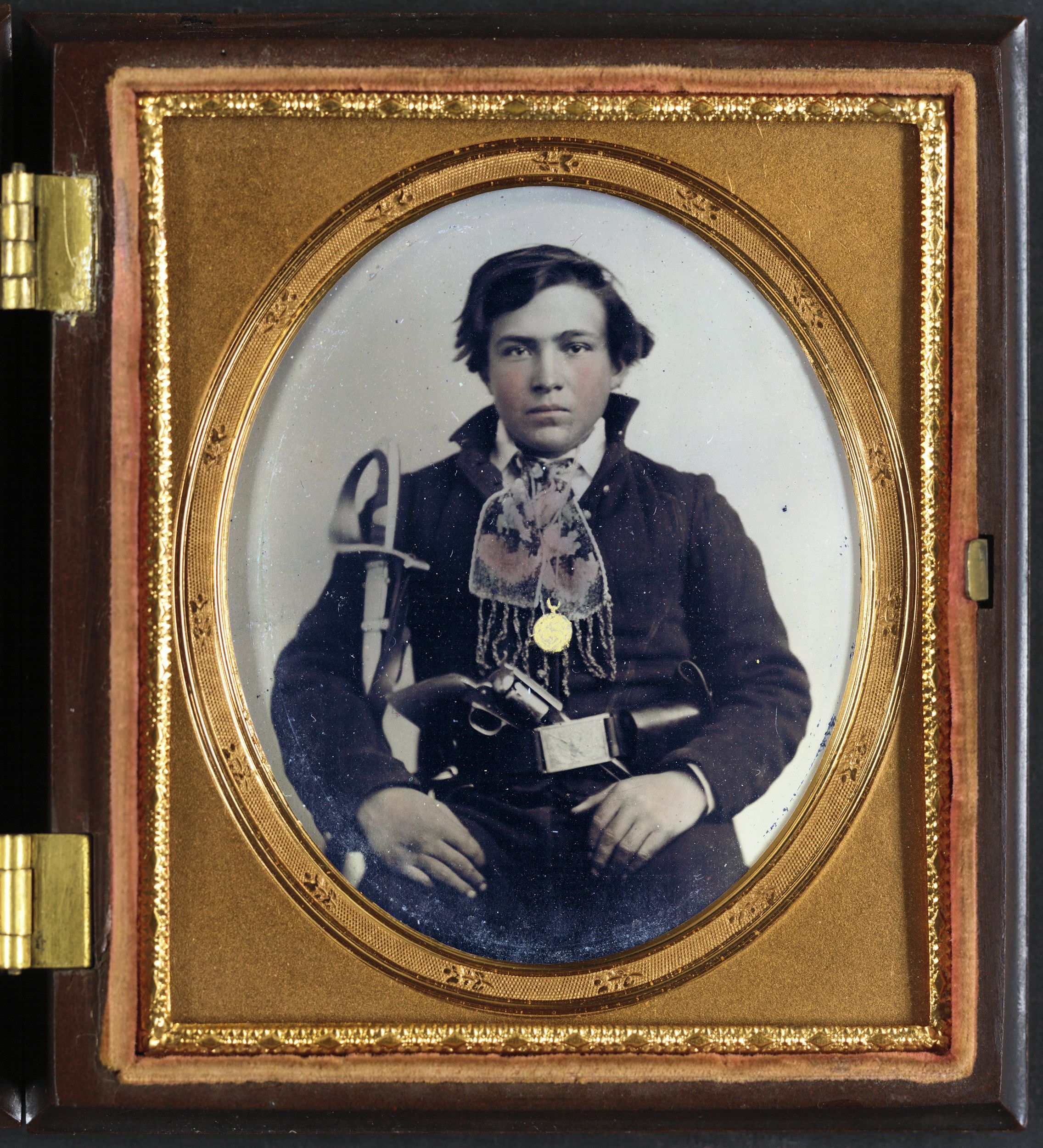
Unidentified soldier in Confederate uniform with cavalry sword and revolver.
__________
Sixth-plate ambrotype, hand-colored ; 9.3 x 8.8 cm (case)
Liljenquist Family Collection of Civil War Photographs; Ambrotype/Tintype photograph filing series; Library of Congress Prints and Photographs Division.
Record page for image is here.
__________
 Note – This image has been digitally adjusted for one or more of the following:
- fade correction,
- color, contrast, and/or saturation enhancement
- selected spot and/or scratch removal
- cropped for composition and/or to accentuate subject matter
- straighten image
Civil War Portrait 087
Near Fayetteville, Tenn., Saturday, Nov. 7. 2nd Brigade started at 6 A. M. We followed at 8 A. M. struck a macadamized road a mile from camp which we followed five miles. The road runs from ——, a beautiful road high and dry. Extensive fields of corn on all sides. Most wealthy country we have seen. Elegant houses of frame and brick. Left the road a quarter of a mile from Elkton and struck north along hilly ridges, very stony and rough. Came into camp at 5 P. M. on a high point, five miles from Fayetteville in Lincoln County. Drew fresh meat from commissary, but we had no salt to cook, no salt in the Division. The timber to-day was mostly beach, grew very tall and large, beautiful timber loaded with nuts, and we ate many. Sugar, cane of sorghum kind raised on a small scale by nearly all, I suppose to supply the deficiency occasioned by the Confederacy. Small wooden mills. Vertical rollers used to press it. Slept in the open air, not thinking it worth while to put up tent.
Saturday, 7th—I met Mr. Gore there, promised to write to Cousin Serena. Came on to Mr. Somer’s and then to Van Wert; staid with Col. Jones to-night; met Mr. Jones and Lady, Mrs. Cullin and Miss Lou, daughter of the Colonel. Had a candy pulling.

7th. Halted near the gap till daylight. Moved on to Russelville where we got forage and halted for dinner. Unsaddled and remained over night. Great reports about the Rogersville affair. 7th Ohio passed by, rather thin. Several 2nd Tenn. prisoners came in, having escaped from the rebels.

Saturday, 7th—I was on fatigue duty again today. Two brigades of General Logan’s Division went out to the Black river post to relieve General Tuttle’s Division, which came in and is to take boat for points up the Mississippi river.
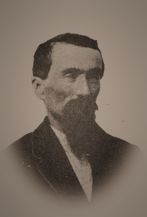
November 7 — Remained in camp. This is a lovely and delightful place to camp, situated among the piledup and rolling foothills of the Blue Ridge, where the roaming mountain wind that sweeps over the wooded slopes of the Blue Ridge dips down and breathes its pure, balmy, pine-laden breath around the grassy hillsides and through the winding dells.
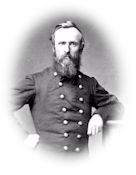
November 7, [1863]. — I am asked if I would not be gratified if my friends would procure me promotion to a brigadier-generalship. My feeling is that I would rather be one of the good colonels than one of the poor generals. The colonel of a regiment has one of the most agreeable positions in the service, and one of the most useful. “A good colonel makes a good regiment,” is an axiom.
Two things make me sometimes think it desirable to have the promotion, viz., the risk of having a stupid brigadier put over me, and the difficulty and uncertainty of keeping up my regiment — that is the risk of losing my colonelcy.


