Following the American Civil War Sesquicentennial with day by day writings of the time, currently 1863.

November 2013

Washington, D. C.

Paris, November 29, 1863.

My Dear Sir,—My departure for Europe was so sudden, and my contemplated stay here so short, that I hardly thought it worth while to apprise you of my voyage to London and Paris, and to offer you my services in both places.

During the four days that I remained in London I have, however, had opportunities to meet and converse with several members of the ministry and leading men in Parliament. The general tone of all these gentlemen was much more friendly to the cause and position of our government than I had anticipated. From all I could gather, there is certainly no danger that England will join France in any movement toward recognition of the South.

The ministers seem fully aware of the mistake they committed in allowing the Alabama to proceed to sea, and they are determined, at all hazards, to stop the sailing of the iron-clads. Laird has put in a plea, first, that they were destined for a French house, and then that they were for the Pasha of Egypt—the government has proofs in hand that both these statements are false.

Lord Russell will probably ask for more ample powers from Parliament immediately after its meeting, to enable him to stop these vessels and enforce a strict observance of neutrality by British subjects. Both he and Mr. Villiers, brother of Lord Clarendon, and one of Her Majesty’s Privy Council, have expressed themselves in very flattering terms with regard to Mr. Evarts, whose mission, they said, was very beneficial and useful, as he gave them very valuable information about many points bearing upon our neutrality laws. Your friend and agent has evidently left a very good impression in the government circles.

I am informed by people who are apt to know, that, with the exception of Gladstone and Palmerston, the members of the cabinet are all in favor of the North. Still, we must not shut our eyes to the fact that the taking of Vicksburg, and our successes last summer, have a good deal to do with this attitude of the British cabinet, and that any serious reverses of our armies in Virginia or Tennessee would be followed by a strong pressure on the ministry for recognition, not only by the opposition at home, but also by France.

There is one point in connection with this which I wish to recommend to your earnest consideration. The sensitiveness on the part of Englishmen of all ranks, with reference to every thing which is said, done, and written in America, is most extraordinary, and the attacks in our papers against the British government have not only the effect to estrange the good-will of our friends, but also to strengthen the hands of the opposition. Even the small matter of the discussion in regard to our inviting the French and English officers to the banquet lately given in New York to the Russians, had ruffled the temper of every Englishman I came in contact with.

To give you an instance of the interest with which every information from America is received, I will only mention to you that upon the arrival of Sir Henry Holland, about ten days ago, Lord Palmerston immediately sent him a telegraphic dispatch inviting him to Broadlands, and within an hour afterward he received a similar invitation to Pembroke Lodge, from Earl Russell. I am told that Sir Henry speaks in the kindest terms of the reception he received, and that he is very much pleased with his interview with you and the President. My object in mentioning to you these details is to suggest to you how far it might appear practicable and advisable to you to exert the influence of the government with our leading papers to adopt a more conciliatory tone toward England—this I should think you could easily accomplish with such papers as the New York Times and other organs of the Republican party.

The London Times continues its bitter vituperations against us, but it does not represent its government and its party, and the best way to neutralize its pernicious influence is not to notice its attacks.

I have not been in Paris long enough to form a correct opinion of what is going on here, still, thus far all confirms me in the impression which I had formed during my last residence here, viz., that the French Emperor is the principal person from whom danger to us is to be apprehended. Luckily, it seems as if he was to have his hands full in Europe. The Polish question has assumed a very threatening aspect, and I don’t see how it can be solved without a war. Thus far the British government seems determined not to join France in a war, but the English people are all very strongly in favor of Poland, and public opinion may force the Palmerston ministry as it did, seven years ago, that of Lord Aberdeen. Apart from the Polish cloud, the Emperor finds his policy in Mexico to become daily less popular with the French people, and I have no doubt but what he has already, ere this, very much modified his brilliant aspirations of French trans-atlantic power. Added to this is the deficit in the budget, which will make a resort to a new loan more than probable, a measure not at all desirable in the present state of the money market and the low prices of the “Rentes.” Nearly all the governments on the Continent are likely to want money very soon, and so a general uneasiness pervades financial circles. With such a state of things there is not much danger that Napoleon will think of interfering with us. The government has stopped the further construction of the four war vessels which were being built in French ports for the Confederates.

Notwithstanding all this the Secessionists here, and their number is legion, are very confident of an early recognition and assistance on the part of France. It is said that their Vice-President, Stephens, is expected here, when he will make the most liberal offers for recognition and alliance. He will even, it is expected, go so far as to agree to a gradual emancipation of slavery, on the part of the Richmond authorities. It is impossible to trace these rumors to any trustworthy source, but it is certain that the rebel agents here are as active as they are numerous and unscrupulous.

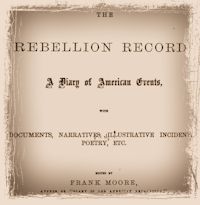
by John Beauchamp Jones

            NOVEMBER 29TH.—The clerks were marched out into the muddy street this morning in a cold rain, and stood there for hours, while the officers were making up their minds when to start for the boat to convey them to Drewry’s Bluff, whence they are to march to Chaffin’s Farm, provided the officers don’t change their minds.

            There are reports of a repulse of the enemy by Lee yesterday, and also of a victory by Bragg, but they are not traceable to authentic sources.

            At 3 o’clock P.M. it is cold, but has ceased to rain.

            The want of men is our greatest want, and I think it probable Congress will repeal the Substitute Law, and perhaps the Exemption Act. Something must be done to put more men in the ranks, or all will be lost. The rich have contrived to get out, or to keep out, and there are not poor men enough to win our independence. All, with very few exceptions, between the ages of 18 and 45, must fight for freedom, else we may not win it.

November 29.—Fort Sanders, near Knoxville, Tenn., was assaulted by the rebel forces under General Longstreet, who was repulsed with a loss of over eight hundred in killed, wounded, and missing. A few hours previous to the assault, the rebel General issued the following instructions to the commanders of the brigades who were to attempt it:

“Headquarters, November 29,1963.

“General: Please impress your officers and men with the importance of making a rush when they once start to take such a position as that occupied by the enemy yesterday. If the troops, once started, rush forward till the point is carried, the loss will be trifling; whereas, if they hesitate, the enemy gets courage, or, being behind a comparatively sheltered position, will fight the harder.

“Beside, if the assaulting party once loses courage and falters, he will not find courage, probably, to make a renewed effort. The men should be cautioned before they start at such work, and told what they are to do, and the importance and great safety of doing it with a rush.

“Very respectfully,

J. Longstreet,

Lieutenant-General.

“Major-General McLaws.”

—The schooner Winona was captured by the gunboat Kanawha, off Mobile Bay, Ala.

November 29—Ours again to-day, but not as hard as before, but heavy enough. The cannonading is getting heavier.

Saturday, 28th—Started this morning on a scout through Blunt—Charley Mason, John Kelison, Jessy Kirkland. Met up with Charley Pelham and Sam Piper.

Kirkendol of Company G was with us. Found Steve Gallagher and Jim with Mr. Upton. Jim was wounded; Steve came on with us. We crossed the River at Niles Ferry and staid all night at Mr. Norwood’s.

Near Chattanooga, Saturday, Nov. 28. Reveille aroused the dreaming camp at 3 A. M. It had been raining nearly all night, but we slept dry and well. Feed call. One of my horses missing. Walked up and down the hills and hollows for over an hour in the search. At last found him. I found breakfast ready, consisting of coffee, corn cake and fresh mutton, which I devoured with a keen appetite. 5 A. M. we started. We were to go back, and faced in that direction. We were glad of it, as both we and the horses were too much worn out to follow, and the roads were getting very bad with the rain and lateness of the season. The excitement was much less. We marched with more labor than if following the enemy, but we knew that plenty of others were on their track, and Bragg’s forces scattered, he taking three different roads, showing that he did not intend to risk a general engagement with Grant very soon. Raining heavy all day. The roads very bad and we had much trouble to get along with artillery. All of the batteries of the 15th Corps not in marching condition. Returned with the 3rd Division in charge of Captain Dillon, which were five besides our own. Stopped at Chickamauga Station at noon to feed, gathering corn along the railroad where hundreds of bushels had been scattered by the rebs.

Reached the pontoon bridge over Chickamauga half an hour of sundown. After a long delay it was clear and we crossed. Met General Sheridan and his Division followed by two others, going to relieve Burnside. Came to our old camp before the battle, after night. The rain had ceased and it turned very cold, and the wind whistled as of old Wisconsin. Unhitched, unharnessed, cleaned off my muddy team, and then with a great deal of chattering and shivering, etc. pitched tents, made our bed on the muddy wet ground. Felt very much like eating a good home supper as prepared by Mary, but after waiting a long time it was substituted by a dish of mush and a cup of coffee and thankful for that. Many of the infantry had nothing but parched corn and no tents, no rails to make a fire; rather tough but I suppose it is honest.

Richmond, Va., November 28, 1863.—Our pleasant home sojourn was soon broken up. Johnny had to go back to Company A, and my husband was ordered by the President to make a second visit to Bragg’s Army.[1]

So we came on here where the Prestons had taken apartments for me. Molly was with me. Adam Team, the overseer, with Isaac McLaughlin’s help, came with us to take charge of the eight huge boxes of provisions I brought from home. Isaac, Molly’s husband, is a servant of ours, the only one my husband ever bought in his life. Isaac’s wife belonged to Rev. Thomas Davis, and Isaac to somebody else. The owner of Isaac was about to go West, and Isaac was distracted. They asked one thousand dollars for him. He is a huge creature, really a magnificent specimen of a colored gentleman. His occupation had been that of a stage-driver. Now, he is a carpenter, or will be some day. He is awfully grateful to us for buying him; is really devoted to his wife and children, though he has a strange way of showing it, for he has a mistress, en titre, as the French say, which fact Molly never failed to grumble about as soon as his back was turned. “Great big good-for-nothing thing come a-whimpering to marster to buy him for his wife’s sake, and all the time he an—” “Oh, Molly, stop that!” said I.

Mr. Davis visited Charleston and had an enthusiastic reception. He described it all to General Preston. Governor Aiken’s perfect old Carolina style of living delighted him. Those old gray-haired darkies and their noiseless, automatic service, the result of finished training—one does miss that sort of thing when away from home, where your own servants think for you; they know your ways and your wants; they save you all responsibility even in matters of your own ease and well doing. The butler at Mulberry would be miserable and feel himself a ridiculous failure were I ever forced to ask him for anything.


[1] Braxton Bragg was a native of North Carolina and had won distinction in the war with Mexico.

Saturday, 28th—A detail of forty men from our regiment was sent into town on provost guard. Our orders were to arrest all citizens and soldiers found upon the streets without passes from the commander of the post here or from the provost marshal, and take them before the latter for investigation and punishment.

28th. Have an old store for the Commissary, storehouse below and office above. Cleaned up and put up a stove. Looked about to get mills. Hear no word from B.—borrowed meal. Aggravating. Lewis not successful. Dan fixed up a very good desk from an old P. O. box. Read some in Burns. Settled some accounts.

November 28 — We were ordered to be ready to march this morning at three o’clock; at two o’clock the confounded old bugle’s shrilly sound screamed through the cold darkness with a chilling thrill, and the orderly sergeant was running through the bivouac with his everlasting “Get out and get ready to march.”

About an hour before daylight an order came for us to report to General Fitzhugh Lee near Moton’s Ford, which is about two miles above Raccoon Ford and on the left of our line. We moved immediately after we received the order, and reported to Fitz Lee early in the day near the Moton house, and about four miles southwest of Moton’s Ford. A little while after we reported to Fitzhugh Lee the Yankees made a demonstration as though they intended to make an attack without delay. We went in position right at Moton’s house and kept our guns in battery all day, but the enemy made no advance on our part of the line, yet the country is blue with Yanks between us and the Rapidan. This evening at dark one of our guns advanced and shelled a piece of woods in which the Yanks had kindled their camp-fires and fixed to spend the night, but when our shells exploded among the tall trees and gently scattered a few whispering fragments of Dixie casting impartially around the camp-fires the enemy hastily bade us good night and disappeared toward the river.

Some little artillery firing along the lines to-day on the right and some sharpshooting near Raccoon Ford. Rained all day. Bivouacked with our guns in battery ready for action, near Moton’s house.