Following the American Civil War Sesquicentennial with day by day writings of the time, currently 1863.

November 2013

Camp White, (Sunday), November 1, 1863.

Dear Mother: — It is a lovely morning. I have just got into new quarters, two tents together on a stockade, making two good little rooms with a coal stove. As cozy as need be. . . .

We had preaching in our camp last Sunday by the chaplain of the Thirty-fourth, Mr. Collier, a rather entertaining speaker, and have been promised meetings every other Sunday hereafter. It is so unusual a thing that the novelty makes it attractive, if there were nothing else to recommend it. . . .

Affectionately, your son,

Rutherford.

Mrs. Sophia Hayes.

November 1.—A mild beautiful day. Mrs. Dr. Reesse called with her carriage, and took me down to visit our patients at the Springs. They are all doing well. Mrs. H. seems perfectly happy in her new vocation.

After leaving there we visited Major Brewster’s, where our old patient, Lieutenant Paine, is lying very sick. We left him in Atlanta, and from there he went to Dr. Collier’s, near Atlanta, followed us here, and since then has been growing worse, He is now in good hands, and is receiving every attention.

On the 29th ult., Mr. G. Cross died. He was wounded at the battle of Chickamauga. When he was first brought here, we did not think he could live but a few days. He was a member of the Twenty-seventh Tennessee Regiment . He has a sister in Atlanta, to whom I have written. We have an addition of two surgeons, Dr. Wellford from Virginia and Dr. Glenn from New Orleans. Dr. G. came out of New Orleans a registered enemy to the United States. Dr. W. is from that heroic but unfortunate city, Fredericksburg, where the enemy robbed him, and destroyed every thing he possessed.

In letters received from home I see that the president has visited Mobile. All are perfectly delighted with him. He made a speech which my father thinks a very fine one. He reviewed the troops, and the folks say he has a fine commanding military appearance.

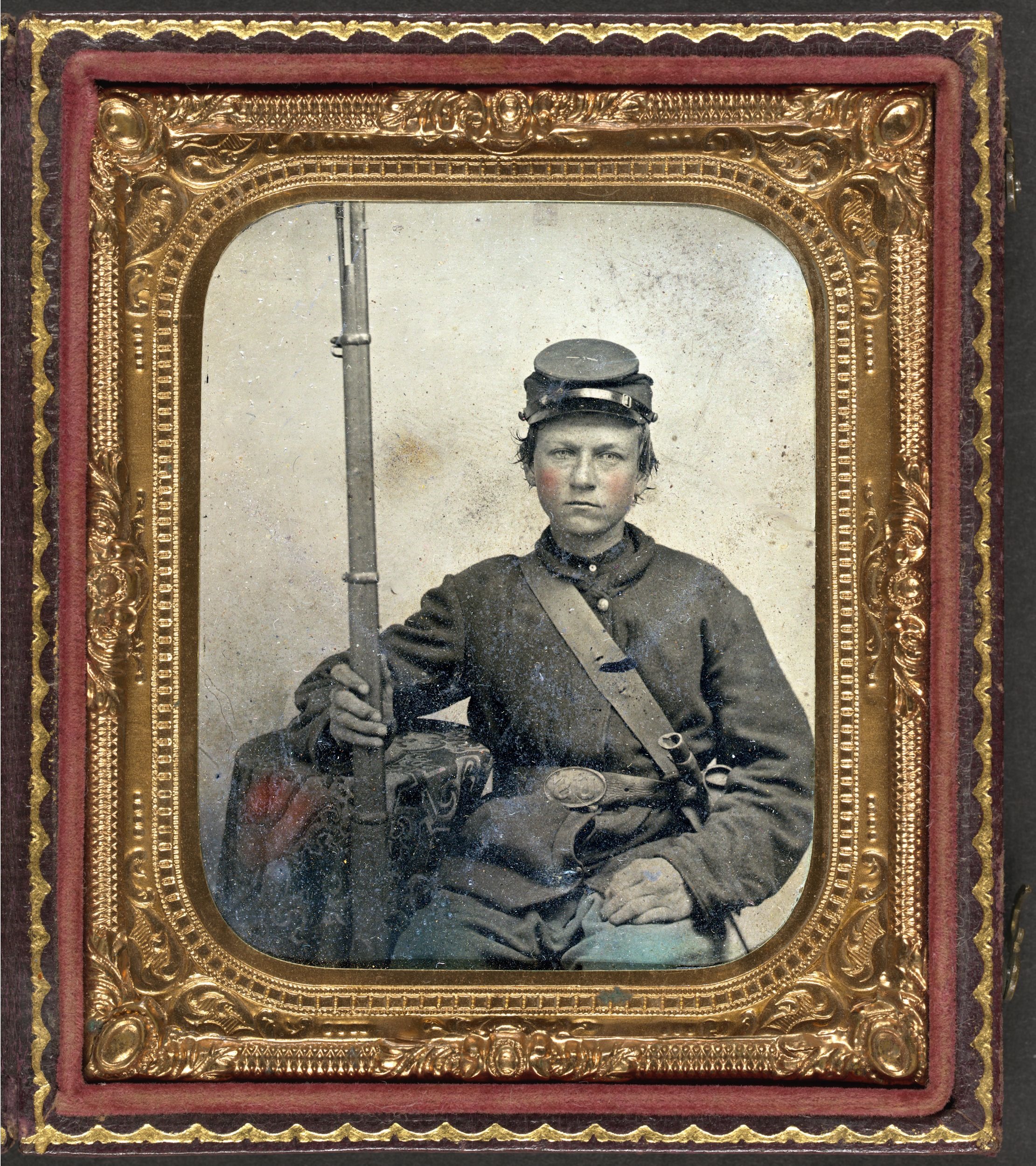
Unidentified young soldier in Union uniform with musket and bayonet in scabbard in case


Unidentified young soldier in Union uniform with musket and bayonet in scabbard

__________

Sixth-plate tintype, hand-colored ; 9.5 x 8.1 cm (case)

Liljenquist Family Collection of Civil War Photographs; Ambrotype/Tintype photograph filing series; Library of Congress Prints and Photographs Division.

Record page for image is here.

__________

digital file from original, tonality adjustedNote – This image has been digitally adjusted for one or more of the following:

    • fade correction,
    • color, contrast, and/or saturation enhancement
    • selected spot and/or scratch removal
    • cropped for composition and/or to accentuate subject matter
    • straighten image

Civil War Portrait 080

by John Beauchamp Jones

NOVEMBER 1ST.—No news from any of the armies this morning. But Gen. Whiting writes that he is deficient in ordnance to protect our steamers and to defend the port. If Wilmington should fall by the neglect of the government, it will be another stunning blow.

However, our armies are augmenting, from conscription, and if we had honest officers to conduct this important business, some four or five hundred thousand men could be kept in the field, and subjugation would be an impossibility. But exemptions and details afford a tempting opportunity to make money, as substitutes are selling for $6000 each; and the rage for speculation is universal.

The President is looked for to-morrow, and it is to be hoped that he has learned something of importance during his tour. He will at once set about his message, which will no doubt be an interesting one this year.

How we sigh for peace, on this beautiful Sabbath day! But the suffering we have endured for nearly three years is no more than was experienced by our forefathers of the Revolution. We must bear it to the end, for it is the price of liberty. Yet we sigh for peace—God knows I do—while at the same time we will endure the ordeal for years to come, rather than succumb to the rule of an oppressor. We must be free, be the cost what it may. Oh, if the spirit of fanaticism had been kept down by the good sense of the people of the United States, the Union would have been preserved, and we should have taken the highest position among the great powers of the earth. It is too late now. Neither government may, for a long series of years, aspire to lead the civilized nations of the earth. Ambition, hatred, caprice and folly have combined to snap the silken cord, and break the golden bowl. These are the consequences of a persistency in sectional strife and domination, foreseen and foretold by me in the “Southern Monitor,” published in Philadelphia; no one regarded the warning. Now hundreds of thousands are weeping in sackcloth and ashes over the untimely end of hundreds of thousands slain in battle! And thousands yet must fall, before the strife be ended.

November 1—Moved into our shanties to-day. There are five of us in mine. They are ten feet square.

November 1, 1863.

A plot to liberate the rebel prisoners in Ohio was discovered, and several parties to it were arrested. It was concerted that on a given night, which had not been definitely fixed, a sufficient number of the conspirators were to assemble in the vicinity of Camp Chase, and at a known signal were to overpower the guard, (which was far from being a strong one,) and at the same time the prisoners, who were to be apprised of what was going on, and who numbered about four thousand, were to make a rush from the inside, and thus secure their freedom. Having armed themselves with the weapons of the guard, they were then to march on Columbus, and seize the arsenal, arming themselves completely with the United States arms stored there. From thence, their next attack was to be on the Penitentiary for the release of John Morgan and his men, by whom the rebel army in Ohio was to be officered. Then the rebel campaign in Ohio was to be commenced, and the first proceeding on the part of the traitors was to be the cutting of the telegraph wires and the burning of the railroad-bridges, in order to prevent the arrival of National troops.

The parties involved in the matter were very numerous, and were to be found in almost every part of the State, some of them occupying positions under the United States and State government, which rendered it a somewhat easier task for the detectives to gain access to the nest of traitors. The leading man in the conspiracy was Charles W. H. Cathcart

A party of guerrillas, under Campbell, entered Charleston, Missouri, night before last, and after robbing the stores and private houses, retreated, carrying away with them Colonel Deal.—Charles R. Ellet, commanding the Mississippi Marine Brigade, died, at Bunker Hill, Illinois, on Thursday last, October twenty-nine. —Jay Cooke, the subscription agent of the United States Government, reported the sales of over thirty-six millions of five-twenty bonds during the previous week.

—The following official communication from Provost-Marshal General James B. Fry, to Colonel Robert Nugent, Assistant Provost-Marshal of New-York, was made public:

“The representations made by Dean Richmond and Peter Cagger, in a printed circular, dated October twenty-seventh, 1863, in respect to the action of the Provost-Marshal General, are untrue.

“It is not true that the State of New-York is charged as with a deficiency for every citizen who has paid the three hundred dollars commutation money, receiving no credit therefor. On the contrary, the State receives the same credit for a man who has paid commutation as if the drafted citizen had gone in person or furnished a substitute; and in like manner towns which had raised the money to pay their quotas receive the same credit as if actual substitutes had been furnished.

“And the President has ordered, that every citizen who has paid the three hundred dollars commutation shall receive the same credit therefor, as if he had furnished a substitute, and is exonerated from military service for the time for which he was drafted, to wit, for three years.

“As the misrepresentations of Dean Richmond and Peter Cagger have been published and circulated for electioneering purposes, it is proper that you give them immediate correction.”

—The bombardment of Fort Sumter continued without cessation. Yesterday morning, a portion of the wall fell in, burying beneath the ruins some men of the Twelfth Georgia and Twenty-fifth South-Carolina. Thirteen were buried by the falling in of the barracks on the sea-face of the Fort. Over one thousand two hundred shots were fired in twenty-four hours — the shots averaged four per minute. The firing was from two monitors—two heavy and two light rifled guns at Fort Gregg, four ten inch mortars at the middle battery, and four rifled guns at Fort Wagner.