Following the American Civil War Sesquicentennial with day by day writings of the time, currently 1863.

November 2013

Chapin’s Farm, Va.,
Sunday Eve., Nov. 27, 1864.

My Dear Sister L.:—

I have been pretty busy the past week in getting my new house done in addition to my other duties, and to-day I have just moved in. I could not get my “details” to-day, being Sunday, so I had to turn to myself and put the floor in this morning. Perhaps you think it bending the Sabbath to build while I should be at church, but I cannot see it in just that light. The colonel burned up his tent the other day and to-morrow we have a new major coming and I have to give up my tent to him, so I made the excuse of necessity, rolled up my sleeves and finished my house so that I could occupy it, and moved in, and I am so comfortable to-night! I have a little the most gorgeous residence I have had since I came to the army. It is about the size of your parlor, perhaps a little larger, with a canvas roof which also serves for window, and then the beauty of it is the fireplace, a regular old-fashioned kitchen fireplace that I can have a group sitting around and enjoying themselves.

To-night while I am writing Lieutenant Colonel Cooper, One hundred and seventh Ohio (Captain Cooper of the Eighth), is with me making out his returns preparatory to leaving for his new command, which, by the way, is down in Jacksonville, where we left them. They are supposed to be having a soft thing down there.

I was just sitting down to dinner when a gentleman of color approached bearing in his arms a box which he desired me to accept and give him a “ceipt” for it, which I proceeded to do, and opening it I found the sheets and the fruits and the pickles, etc., in the tip-toppest order. You sent just what I wanted, and you may congratulate yourself on having accomplished a feat that very few who send boxes to the army do. Almost every one sends something that will mold or sour and spoil the rest. I had not the least idea when I asked you to send me sheets that it was going to cause you much inconvenience. Shows how much I know of such things. You must thank Mrs. Ploss for me and remember that I did not think of sending to her for sheets.

Did I write you that Williston Tyler was dead? He died in Louisville, Ky., where he had gone to work for the Government. Denny took the body home. I received a letter from him yesterday containing his photo. He looks just as he used to. Frank says she has heard from you after a long silence.

I suppose you have heard about the Thanksgiving dinner sent to the army. Our part of the army did not get theirs till Friday, but it was good when it came—most of it. The “Field and Staff” of the Eighth got two turkeys, one of which came into my mess, and a cake with a pretty name and Jersey City address and ‘”Tell me how you like my cake” on the bottom of it. I shall proceed to praise the cake (and it would bear praising) after finishing this.

I have got your picture framed and hung up in my new house, and Ed’s and Etta’s and several others.

Friday, 27th—A detail of men, two of them from Company E, was sent as a guard to go up North with some deserters from our army. Upon being caught, the deserters were brought back, court martialed, and will now be confined in one of the United States military prisons.

27th. Lt. Byard started for home. People sick. Sent two letters, one home. Did some writing, business. Near night moved to Bay Springs. Foster’s Brigade passed today on K. road. Crossed Clinch River. Sent Lu Emmons to the Gap to see if he could not get rations. Cattle came up. Gave hogs to the regiments.

November 27 — The Yankee army crossed to the south side of the Rapidan yesterday, and late last night we were ordered to the front. All our baggage and wagons were ordered rearward to Gordonsville, which is a strong indication that there will soon be a large fine battle on hand somewhere not far away, and from the way our infantry is moving there is fight in the air. At nine o’clock last night we left camp and marched down the plank road; little before daylight this morning we arrived at Verdiersville, twelve miles east of Orange Court House.

At sunrise we left Verdiersville and moved in the direction of Germana Ford on the lower Rapidan. We marched on an old road that leads from the plank road to the old Fredericksburg pike; we struck the Fredericksburg pike at Mine Run, and halted for further orders.

This morning we passed General Early’s division of infantry going to the front. A great many of our infantry passed us to-day moving toward Mine Run and falling in line of battle as they arrived at the front. Our line of battle extends along Mine Run, and General R. E. Lee is ready and fixed to give the Yankees a warm reception if they dare to advance on his line.

We remained all afternoon just in rear of General Lee’s line of battle, awaiting and ready for orders. There was some cannonading and sharpshooting in our immediate front during the afternoon, and some heavy cannonading and musketry fire about a mile to our right.

We are bivouacked to-night on Mine Run.

Mine Run is a small streamlet, as crooked as a snake track, traversing the northern part of Orange County, and empties into the Rapidan about five miles below Raccoon Ford. Weather very cold.

Friday, 27th.—Heavy fighting back about Ringgold; this was Pat Cleaborn’s Division, mentioned in another place. 10:30 A. M., Cousin James Anderson came by and said brigade was going to Dalton. Left home at 12:30 P. M.; at Tunnel Hill at 3; Dalton at sundown.

November 27th. Marched to Robertson’s tavern, where a spirited engagement took place, lasting most of the day, resulting in driving the enemy back and occupying their ground; bivouacked here all night.

by John Beauchamp Jones


            NOVEMBER 27TH.—Dark and gloomy. At 10 o’clock Gov. Vance, of North Carolina, telegraphed the Secretary of War, asking if anything additional had been heard from Bragg. The Secretary straightened in his chair, and answered that he knew nothing but what was published in the papers.

            At 1 o’clock P.M. a dispatch was received from Bragg, dated at Ringgold, Ga., some thirty miles from the battle-field of the day before. Here, however, it is thought he will make a stand. But if he could not hold his mountain position, what can he do in the plain? We know not yet what proportion of his army, guns, and stores he got away—but he must have retreated rapidly.

            Meade is advancing, and another battle seems imminent.

            To-day a countryman brought a game-cock into the department.

            Upon being asked what he intended to do with it, he said it was his purpose to send its left wing to Bragg!

November 27.—A delegation of Cherokees, headed by Captain Smith Christy, acting Chief, and including Thomas Pegg, a leading Indian, and William P. Ross, with Rev. J. B. Jones as interpreter, went in state to pay their respects to General McNeil, the district commander at Fort Smith, Ark., by order of an act of their National Council. The act recited the sufferings, and asked additional protection to the nation and authority to raise an Indian cavalry regiment After the presentation of their credentials, Chief Christy arose and said that their national council had instructed them to call and pay their respects to the Commanding General, express their confidence in his ability and bravery, and to state the condition and wants of their suffering people. He then recapitulated the contents of the documents they were preparing to present. The greatest annoyance was from roving banditti, who desolated their homes and murdered their people. Their lives and those of their families were not safe away from the military fort. They desired stringent measures to change this state of things. They wished carried into successful practice a plan of Colonel Phillips, to form districts allotted for settlement, which should be adequately protected in order that the families camped in the vicinity of Fort Gibson might remove to more comfortable homes. From their present condition of suffering and disease, they thought the patriotic acts and sacrifices of their nation had not been sufficiently appreciated.

General McNeil replied that it gave him very great pleasure to receive this token of respect of the Cherokee nation. Among the responsibilities of the command to which he had been assigned, there was none greater than his duty toward their suffering people. One of his first acts on assuming command was to represent the condition of the Indian tribes, and he had recommended some measures for the improvement of their condition. The Government is very desirous that you should make a crop this spring, and such a disposition of troops will be made that you can do it in safety.

Mr. Ross.—If white troops will keep away our white enemies, the loyal Indian troops can protect themselves.

General McNeil.—I ask if I may assure the Government that the Cherokees will not make civil war on their tribes except in self-defence.

Chief Christy.—You may.

—The rebel schooner Maria Alberta, while attempting to run the blockade, was captured off Bayport, Florida, by the National schooner Two Sisters.—The battle of Mine Run, Va,, was fought this day, between the Union forces, under Major-General Meade, and the rebels, under the command of General Lee.—(Doc. 15.)

— A party of surgeons belonging to the United States army, lately prisoners in Richmond, made the following statement: “We the undersigned consider it our duty to publish a few facts that came to our knowledge while we were inmates of the hospital attached to the Libby prison. We enjoyed for several months daily access to the hospitals where the sick and wounded among our Union soldiers were under treatment. As a resalt of our observation, we hereby declare our belief that, since the battle of Chickamauga, the number of deaths per diem has averaged fully fifty. The prevailing diseases are diarrhœa, dysentery, or typhoid pneumonia. Of late the percentage of deaths has greatly increased from causes that have been long at work, as insufficient food, clothing, and shelter, combined with that depression of spirits brought so often by long confinement. It may seem almost incredible that, in the three hospitals for wounded soldiers, the average mortality is nearly forty per day, and, we are forced to believe, the deaths in the tobacco factories and upon the Island, will raise the total mortality among all the Union soldiers to fifty per day, or fifteen hundred monthly.

“The extremely reduced condition of those brought from the island argues that hundreds quite sick are left behind who, with us, would be considered fit subjects for hospital treatment. Such, too, is the fact, as invariably stated by scores we have conversed with from that camp. The same, to a degree, holds true of their prisoners in the city. It would be a reasonable estimate to put the number who are fit subjects for hospitals, but who are refused admittance, at five hundred. One thousand are already under treatment in the three hospitals; and the confederate surgeons themselves say the number of patients is only limited by the small accommodations provided. Thus we have over ten per cent of the whole number of the prisoners held classed as sick men, who need the most assiduous and skilful attention; yet, in the matter of rations, they are receiving nothing but corn-bread and sweet potatoes. Meat is no longer furnished to any class of our prisoners, except to the few officers in Libby Hospital; and all the sick and well officers and privates are now furnished with a very poor article of corn-bread, in place of wheat-bread—an unsuitable diet for hospital patients, prostrated with diarrhœa, dysentery, and fever.

“To say nothing of many startling instances of individual suffering, and horrid pictures of death from prostrated sickness and semi-starvation, we have had thrust upon our attention, the first demand of the poor creatures from the island was always for something to eat. Self-respect gone, half-clad and covered with vermin and filth, many of them are often beyond all reach of medical skill. In one instance, the ambulances brought sixteen to the hospital, and during the night seven of them died. Again, eighteen were brought, and eleven of them died in twenty-four hours. At another time, fourteen were admitted in a single day, and ten of them died. Judging from what we have ourselves seen and do know, we do not hesitate to say that under a treatment of systematized abuse, neglect, and semi-starvation, the number who are becoming prematurely broken down in their constitutions must be reckoned by thousands. The confederate daily papers in general terms acknowledge the truth of all we have affirmed, but usually close their abusive editorials by declaring that even such treatment is better than the invading Yankees deserve.

“The Examiner, in a recent article, begrudged the little food the prisoners did receive, and the boxes sent to us from home, and closed by eulogizing the system of semi-starvation and exposure as well calculated to dispose of us. Recently several hundred prisoners per day were being removed to Danville, and in two instances we were standing in view of them as their ranks filed past. Numbers were without shoes, nearly all without blankets or overcoats, and not a man did we see who was well fed and fully clad; but to the credit of the prisoners in Richmond, of all ranks, be it recorded, that, although they have shown heroic fortitude under suffering, and spurning the idea that their Government had forgotten them, have held fast their confidence in the final and speedy success of our cause. In addition to the above statement, we wish to be distinctly understood that the confederate medical officers connected with the hospitals referred to, Surgeons Wilkins, Simmons, and Sobal, and the hospital steward, Hollet, are not in any way, as far as our observation has extended, responsible for the state of things existing there, but on the other hand, we are bound in justice to bear testimony to their kindness and the faithful performance of duties with the limited means at their disposal.”[1]

—Among the prisoners captured at Chattanooga, were found a large number of those paroled at Vicksburgh. General Grant inquired whether he should proceed against them according to the established usage in such cases, which is to shoot the persons so found. The War Department forbid, it being manifestly unjust to execute soldiers who were required by the rebel government to break their parole.—General John H. Morgan, with six of his officers, escaped from the penitentiary at Columbus, Ohio.—(Doc. 37.)


[1] The surgeons who signed this statement were, Daniel Meeker, United States Navy; C. T. Liner, Assistant Surgeon Sixth Maine regiment; J. L. Brown, Assistant Surgeon One Hundred and Sixteenth Ohio volunteer infantry; and A. M. Parker, Assistant Surgeon First Maine cavalry.
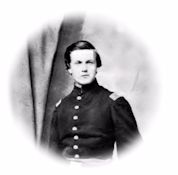
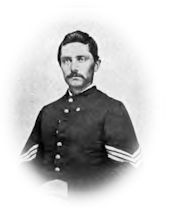
November 27—This morning we marched seven miles, halted a short time, and resumed our march. Got three miles further, and firing commenced in our front. We then counter-marched and formed in line of battle, in the edge of the woods. One corps of sharpshooters was sent out to find the enemy. Fought the enemy one-half hour and were forced back. My corps then went out as reinforcement. We fought then for four hours, and were called back to our command. I, at one time in this fight, was in a close place. Being in front, I did not hear the order to fall back, and being by myself was left a target for a dozen Yankees, but my Captain White saw what a fix I was in and sent a squad of our company to my relief, so I fell back with them. We then, that night went to Mine Run and formed our line of battle there.

Letter No. XXIV.

In Yankee Quarters,
Near Lenoir Station,
November 21st, 1863. )

My Precious Wife:

I am comfortably seated in some Yankee general’s or colonel’s quarters, by a stove, with a chair to sit in, and a table to write on. It is raining quite hard to-day, and has been since yesterday. It is just such a raw, damp and uncomfortable day as would have kept me at home if I were at Waco.

I have spent my time thinking of you and the little darlings, and wondering if you can possibly think of me as often as you are the subject of my thoughts. If you do your little school must suffer from neglect or absence of mind.

We, that is Longstreet’s corps, left Chattanooga on the 5th of November, and have passed through Cleveland, Athens, Charleston, Sweetwater, Philadelphia, Louden, etc., and are now at Lenoir Station, on the East Tennessee and Georgia Railroad, which runs from Dalton to Knoxville. We have passed through a rich and thickly settled country, which has made me wonder, as I did in Virginia, why any person ever left it to go to Texas or anywhere else. Most of the people whom I have seen were farmers, who were unable to leave home on the approach of the army, having no where to go. I saw Major Pear re yesterday. I came on him very unexpectedly seated by the roadside among his wagons and mules, and looking as fresh and as well as ever, and quite natural. He is brigade commissary, and I suppose he has his hands full, as the office is no sinecure. He informed me of the death of old father Harrison, of which I had not heard before. Longstreet pressed on to this place so rapidly that the Yanks had no time to destroy their stores. We captured sixty wagons besides large quantities of ammunition and medical stores. They had fixed themselves in winter quarters, and had built 500 or 600 cabins, nicer and more neatly arranged than most of the cabins on the prairies in Texas, reminding me very much of a well fixed plantation. They are all laid off into streets, with the regularity and precision of a city, with fire places, mantel pieces, bunks and stools, and the scoundrels have taken nearly all the sash out of the windows in the neighborhood, as well as cooking and parlor stoves, omitting nothing which would contribute to their comfort or convenience. Our quartermaster took possession of one of the largest and most comfortable.

The greatest curiosity which I have seen is a medical wagon, which is as complete as a drug store, having drawers, compartments and every conceivable size and shape of bottles, with little springs for each vial to rest upon to prevent concussion. There was also a regular cooking stove with utensils in the back part of the wagon; indeed everything which a sick man or a surgeon could want was there. I found a considerable quantity of coffee thrown out on the ground, and have picked up enough to last me some days. I drank a pint this morning, and wished you were here to share it with me. It excites me almost as much as whiskey. Billy Dunklin has found an India rubber ball and given it to me to take home to Stark. The road is strewn with shells and ammunition from here to Knoxville, and there are signs of burning everywhere. Longstreet has Knoxville surrounded and I trust we will capture the entire force.

Colonel Tom Harrison is about Knoxville, but I have not seen him yet.

November 22nd: I have no opportunity of sending this to the rear, where it might reach a regular postoffice, so will keep it until an opportunity offers. To-day I have taken a long walk into the country round about, and find that the Yanks have taken everything from the citizens in this neighborhood, chickens, ducks, turkeys, hogs, etc. I succeeded in getting two or three canteens of buttermilk, and gave the old lady three or four pounds of wool which I had taken from the hides of slaughtered sheep. I skinned one sheep and am sleeping on the hide.

November 25th: I have foraged a little to-day and got two or three canteens of molasses, which my mess enjoyed very much. The people seem to have been pretty well fixed up here. I never saw more beautiful women anywhere; nearly all of them very fair, with black eyes, black hair and pretty teeth. There are many handsome residences, but in a ruined condition, the owners being refugees to the south. I slept last night in somebody’s stable lot, under a large oak tree, with the moon straight over my head, and thought that perhaps you and the children might be looking at it and thinking of me. I find it was a good thing to keep my letter, as there is a member of the Fifth Texas who will start for home to-morrow, and will take letters for $1.00 a piece. Yesterday was a very bad and ugly day, but Burwell Aycock and myself concluded to try foraging among the Unionists about here, whom the Yanks have left unharmed, and they, consequently, have plenty of everything. We found very few willing to sell for Confederate money, but by walking six miles we got two chickens, two dozen apples and four canteens of molasses for which we paid $11.00, just one months wages. It rained very hard as we were going back, but getting wet and sleeping wet does not seem to make much difference. My blankets were quite wet last night, but I am all right this morning. I have on no flannels, and just half a foot on my last pair of socks, but will replace them to day with a new pair, which one of those fine looking, kind hearted women gave me yesterday. After Burwell and I got back to camp we could not help joking over the idea of walking six miles through rain and mud for a gallon or two of molasses and a chicken. It is pretty rough, and sometimes serious, but there is something ludicrous in it. We seem not to have Knoxville entirely surrounded. The Yanks have an outlet into Blount county, where they are obtaining provisions. I understand that we are to attempt to capture about 18,000 hogs which the Yanks have penned. There is continued skirmishing going on between our pickets. We had two men killed yesterday; N. P. Moore, of our company, one of the best men in the company, and another in Company D. We can see the stars and stripes waving over the Yankee breastworks. It is said that we will have two more divisions here to day, and if so we will have a hard fight to-morrow and capture the town. One of the Fifth Texas was killed this morning. There is a report that our brigade will be sent across the Mississippi this winter.

November 26th: Skirmishing still going on in front, and some of our brigade killed. Selman and Mullens had letters from home to day.

Your husband, faithfully ever,
John C. West.