
Friday, May 20. — Had our rifle-pits all finished this morning, and abattis placed in front. Men had a chance to rest. Heavy fogs during the night. Men were aroused at three A.M., expecting an attack. James came up with horses. Enemy attacked our supply trains on the right, and were repulsed by the Heavies.
May 2014

May 20 — We were inoperative to-day, but the battle lines are moving. General Grant is still changing base by the left flank, and is wriggling his great war machine toward tide-water.
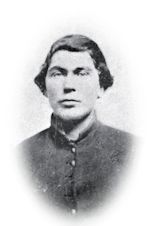
Huntsville, Friday, May 20. On guard, third relief. Gave the day up willingly for its duties by lying low all the time not on post, which was rather monotonous. No papers or mail. Large party went out on pass this afternoon with Sergeant Hauxhurst to visit friends in 14th, 17th, and 33rd Wisconsin Regiments.
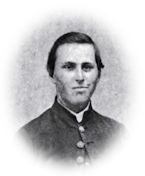
May 20th. Nothing important has transpired since the last date. Weather warm and fine. Getting rested. A soldier must obey orders, not ask questions, keep his eyes open, be on the alert ready for the call to duty. Our company, C, loss at New Market, twelve wounded, five prisoners. General Sigel relieved of the command. A good officer. Kind to the men under his command. From a soldier’s view we need more men in this, the Shenandoah, valley. Major-General David Hunter now in command. Dark complexion, black moustache, stern looking. We don’t like his looks. We are doing picket duty and drilling as the days come and go. Writing many letters. We manage to keep our writing paper dry.
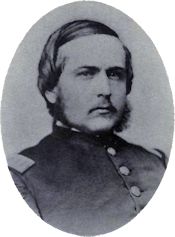
Friday, May 20th.
At daylight this morning I was informed that Sergt. Lock “got” his sharpshooter last night, but that the man was of no use to himself or anybody else after the Sergeant’s attentions. Getting my little squad in line, we moved by the flank in rather “open order” through the woods and across the fields to the camp which we had left the day before, where I found that many of my men had preceded me during the night. Lynch was most demonstrative in his welcome, announcing in stentorian tones that the Captain was not “kilted after all.” Upon mustering the Company for roll-call, I found that we had suffered severely, Sergt. Judson A. Smith, Artificer Gould R. Benedict and privates Joseph Housel, Jr. and William R. Mead having been killed, and First Sergt. Theben, Corp. Harned and privates Abbey, Adams, Brockelbank, Butler, Bullock, Cole, Phelps, Allen R. Smith, Sanford and Lyke, wounded, while Sergt. David B. Jones and privates Asa Smith and Charles M. Struble were missing. The day was spent caring for the wounded, burying the dead, our own as well as those of the enemy, and throwing up a line of rifle-pits where we were engaged the day before. Trenches were dug in the light soil some six feet wide and two or three feet deep, and the dead were laid side by side with no winding sheets but overcoats or blankets, though occasionally an empty box which had contained Springfield rifles did duty as a coffin. Care was taken to cover the faces of the dead with the capes of their overcoats or with blankets, and where the name, company, regiment, division or corps could be ascertained, the information was written in pencil on a board or smoothly whittled piece of wood, which was driven into the earth at the man’s, head, and the grounds about the Harris House presented the appearance of a cemetery. I particularly noticed among the rebel dead a handsome boy of perhaps eighteen years, who, though clad in the dirty butternut-colored uniform of a private, showed every indication of gentle birth and refined home surroundings. His hands and feet were small and delicately moulded; his skin white and soft as a woman’s, and his hair, where not matted by the blood from a cruel wound in the forehead, was fair and wavy as silk, and as I thought of the desolate home somewhere in the South, thus robbed of its pride and its joy, and of the loving mother who would never know where her darling was laid, tears actually came to my eyes, and I turned away leaving the poor boy to find a resting place at the hands of a burial party of a not ungenerous foe.
Later in the day, as Sergeant Jones did not report to camp, I went out on the field and opened the heads of a number of graves where there were no names, or where the identification of the occupant on the boards or stakes was incomplete, but was unable to find his body.
We learned to-day that the force which attacked us yesterday was Gen’l Ewell’s Corps, and that the repulse which it met was a signal one.
Such was the battle of Pine Grove or Harris Farm as it was called, so far as I personally saw or had anything to do with it, but in Gen’l Meade’s congratulatory order on the result, our battalion was not even mentioned though it lost seventy-four men.
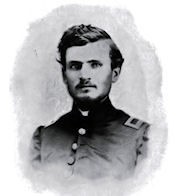
20th. Birge got in last night with oats. Went out to Regt. Considerable excitement on account of report that Ewell had flanked our army and was about to attack Fredericksburg.
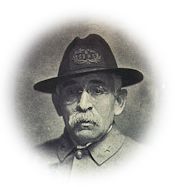
May 20—Three years ago to-day the Old North State left the Union, and we went to the front full of hopes to speedily show the Yankee Government that the South had a right to leave the Union; but to-day, how dark it looks!
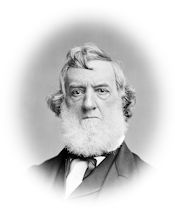
May 20, Friday. The Secretary of State is becoming very anxious in view of our relations with France. Wants the ironclad Dictator should be sent over soon as possible.
I told him she was yet in the hands of the contractor, and was likely to be for some time, and when we had her I was not certain that it would be best to send her across the Atlantic. But he was nervous; said it was the only way to stop the Rebel ironclads from coming out, unless Grant should happen to get a victory.
The recent arrest of a Spaniard (Arguellis) who was in New York, and who was abducted, it is said, by certain officials under instructions or by direction of the Secretary of State is exciting inquiry. Arguellis is accused of having, in some way, participated in the slave trade. But if the assertion be true, we have no extradition treaty with Spain, and I am therefore surprised at the proceeding. There is such hostility to the slave trade that a great wrong may perhaps be perpetrated with impunity and without scrutiny, but I hope not. Nothing has ever been said in Cabinet on the subject, nor do I know anything in regard to it, except what I see in the papers.
Mr. Seward sometimes does strange things, and I am inclined to believe he has committed one of those freaks which make me constantly apprehensive of his acts. He knows that slavery is odious and all concerned in slave traffic are distrusted, and has, it seems, improved the occasion to exercise arbitrary power, expecting probably to win popular applause by doing an illegal act. Constitutional limitations are to him unnecessary restraints.
Should there be an investigation instituted and mere denunciation of the act, the President will be called upon to assume the responsibility, yet I am persuaded he has nothing to do in this affair beyond acquiescing without knowledge in what has been done. Could the abduction by any possibility be popular, Mr. S. expects it to inure to his credit.

by John Beauchamp Jones
MAY 20TH.—Fog; then sunshine all day, but cool.
Troops have been marching through the city all day from the south side. I presume others take their places arriving from the South. Barton’s brigade had but 700 out of 2000 that went into battle last Monday. Our wounded amount to 2000; perhaps the enemy’s loss was not so large.
Col. Northrop is vehement in his condemnation of Beauregard; says his blunders are ruining us; that he is a charlatan, and that he never has been of any value to the Confederate States; and he censures Gen. Lee, whom he considers a general, and the only one we have, and the Secretary of War, for not providing transportation for supplies, now so fearfully scarce.
I read an indorsement to-day, in the President’s writing, as follows : “Gen. Longstreet has seriously offended against good order and military discipline in rearresting an officer (Gen. Law) who had been released by the War Department, without any new offense having been alleged.—J. D.”
Mr. Mallory, Secretary of the Navy, wrote a pungent letter to the Secretary of War to-day, on the failure of the latter to have the obstructions removed from the river, so that the iron-clads might go out and fight. He says the enemy has captured our lower battery of torpedoes, etc., and declares the failure to remove the obstructions “prejudicial to the interests of the country, and especially to the naval service, which has thus been prevented from rendering important service.”
Gen. Bragg writes a pretty tart letter to the Secretary of War to-day, desiring that his reports of the Army of Tennessee, called for by Congress, be furnished for publication, or else that the reasons be given for withholding them.
We have no war news to-day.
Mrs. Minor, of CumberlandCounty, with whom my daughter Anne resides, is here, in great affliction. Her brother, Col. Rudolph, was killed in the battle with Sheridan, near Richmond; shot through the head, and buried on the field. Now she learns that another brother, a cadet, just 18 years old, was killed in the battle of Gen. Breckinridge, in the valley, shot through the head; and she resolves to set out for Staunton at once, to recover his body. Her father and sister died a few months ago, and she has just heard of her aunt’s death.
A lady living next door to us had two brothers wounded on Monday, and they are both here, and will recover.
Gen. Breckinridge is now marching to reinforce Lee. It is said Butler will set sail to join Grant. If so, we can send Lee 20,000 more men, and Beauregard’s victory will yield substantial fruits.
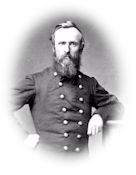
May 20. Friday. — Settled weather at last; cold nights. One of the most interesting and affecting things is the train of contrabands, old and young, male and female — one hundred to two hundred — toiling uncomplainingly along after and with the army. They with our prisoners and the trains left for Gauley this morning.


