May 8—We left this place at dark last night, but only got a distance of two miles, and it took us until 9 in the morning of the 9th.
May 2014
[May 8th] Warren did not get out of the way till early next morning, when our corps fell in, abandoned its position and stepped out in a very lively fashion, arriving at Todd’s tavern about nine o’clock. We immediately went into position, relieving Gregg’s division of cavalry, and commenced at once, as is usual now-a-days, to throw up a breastwork of logs and rails, and dug a ditch behind them. As soon as the connections were established, Miles’s brigade and a brigade of Greggs’s cavalry, with a battery of artillery were sent to Corbin’s Bridge, across the Po river, almost due south, where the enemy was discovered entrenched on the opposite shore and opened fire as soon as our party showed themselves, which was just what we desired to have them do. Line of battle was formed and our batteries replied, but made no further demonstration. I rode so much and so fast, traveling between Miles’s brigade and the rest of the division, that I ruptured my beautiful gray and was obliged to send him to the rear. The reconnoissance was very enjoyable, however. Derrickson and I rode out together in front of the skirmish line and cavalry videttes, and while exploring a narrow road running over a considerable hill caught sight of a rebel column hurrying along a wood road in front under cover of the wood. We dismounted, left our horses in rear of some bushes, and crept forward on the road until within a couple of hundred yards of them, then lay down and watched them passing for over half an hour. While we lay here a rebel battery suddenly pushed up on a hill to the right of the road, and getting sight of our horses fired several shots at them, so we quickly withdrew, galloped back, and reported what we had seen to Hancock.
This was the ride that broke the poor gray down. About 5 P. M. Miles was withdrawn, but was attacked while doing so, and had to do quite a little fighting before he reached the main body. Learned towards evening that the enemy had discovered our intentions and had got ahead of us and was in position near the court house. Nothing else of importance occurred during the day, and the night passed without disturbance.
Sunday, May 8th.
Took up our line of march about five o’clock in the morning and overtook the artillery train at about four P. M. The day was hot and the roads very dusty, and we were obliged to tie handkerchiefs over our mouths and noses in order to breathe. Smoke from forest fires filled the air and added to the misery caused by the dust. Marched about seven miles. Companies D and H were detailed to guard the Headquarters train, which was then near the Nye River, and K and E were sent to guard the ammunition train of the Corps. The artillery and musketry fire at 7 o’clock was very brisk, and was supposed to be near Spottsylvania Court House. In the evening Companies D and H were sent out on picket, and were marched about a good deal without any apparent object except exercise.
by John Beauchamp Jones
MAY 8TH.—Bright and hot.
The tocsin sounded again this morning. I learned upon inquiry that it was merely for the militia again (they were dismissed yesterday after being called together), perhaps to relieve the local battalions near the city.
The Secretary of War received a dispatch to-day from Gen. Lee, stating that there was no fighting yesterday, only slight skirmishing. Grant remained where he had been driven, in the “Wilderness,” behind his breastworks, completely checked in his “On to Richmond.” He may be badly hurt, and perhaps his men object to being led to the slaughter again.
There has been no fighting below, between this and Petersburg, and we breathe freer, for Beauregard, we know, has made the best use of time. It is said another of the enemy’s gun-boats has been destroyed by boarding and burning. We have three iron-clads and rams here above the obstructions, which will probably be of no use at this trying time.
A few days more will tell the story of this combined and most formidable attempt to take Richmond; and if it be the old song of failure, we may look for a speedy termination of the war. So mote it be!
Meantime my vegetables are growing finely, except the corn and lima beans (Yankee), Col. Gorgas’s importation, which have not come up.
A cow and calf now sells for $2500. My friend, Dr. Powell, has just sold one for a great price, he would not tell me what. But I told him that the greed for gain was the worst feature in our people, and made me sometimes tremble for the cause. I fear a just retribution may entail ruin on the farmers, who seem to think more of their cattle than of their sons in the field.
Saturday, May 7th.
I woke this morning just at daylight, probably aroused by the whizzing of a stray bullet now and then, and taking an observation from the stump behind which I lay, and which stood about fifty feet in rear of the breastworks, I discovered that .the pine trees in our front and just beyond the “slashing” were full of rebel sharpshooters. This discovery very much surprised me, and disabused my mind of the impression given me the night before that there were two lines of battle in our front, and as quietly as possible I got such of my men as were not already there, into the little trench close to the breastworks, and in the limited space allowed us we began to boil our coffee. This was rather a ticklish business, for the rebels “had us down,” as the situation is described in the army, that is, had the advantage of seeing, and the opportunity of shooting at, any head which might be raised above the top log of the breastworks, a condition of things which seriously embarrassed us in gathering fuel for our little fires. As illustrative of the advantage which accrues to the side which has the other side “down,” I may mention the following incident. One of my men named Michael Ryan, with more curiosity than discretion, looked over the top of the breastworks, thinking to locate a sharpshooter who was in a tree quite near us and was persistent in his attentions to any of us who was careless in exposing himself. Hardly had Ryan’s head reached the level of the log when the sharpshooter furrowed his cheek with a minie ball, and conferred upon him the distinction of being the second man in the company to be wounded. However, the shot had located the tree in which the rifle-man was perched, and borrowing a Springfield musket from one of my men, I crawled along the breastworks a little way, and taking off my hat poked the gun over the ten-inch pine log which topped the earthwork at that point, and gradually bringing the muzzle down in line with the tree, started to squint along the barrel for the chap in the butternut suit. Of course he saw the movement, and at once prepared for the head which he knew would appear at the breach of the gun, and before I could aim anywhere in his neighborhood, he sent a bullet into the log not three inches below my nose, and filled my eyes so full of pulverized pine bark that it took at least fifteen minutes to clear them out, and a much longer time than that to allay the smarting. It was a beautiful line shot, only a trifle low, and raised the man considerably in my estimation. When at length I had recovered my eyesight, I went a little further up the line where there was a green oak stake driven into the ground to support the logs which formed the inner wall of the breastworks. This stake projected a little above the upper log but was not fastened to it, and being some nine inches thick at the top and six inches thick at the bottom, I thought I could with reasonable safety rest my gun on the log alongside of the stake, and, shielding my head behind its wide upper end, get a fair chance for a shot. Hardly had I commenced to put my scheme in execution, when a minie ball struck that stake just opposite my left cheek bone with such precision and force that the blow it communicated sent me sprawling to the ground, where, upon reflection, I concluded that I did not want to kill such an excellent marksman and so returned the Springfield to its owner.
Soon after daylight the enemy, who seemed to suspect that there were some batteries of artillery somewhere on that line, though why they did not know it for a fact I cannot imagine, as their sharpshooters must have seen them, began shelling the line to draw their fire and so unmask their exact location, and as the six-pound rifle shells came in a straight line towards us, we could see them in the air after we knew at just what elevation to expect them, and they looked very much like pigeons coming at us. Some struck outside the breastworks and some passed over our heads, but no damage was done except the killing of one artillery horse and the wounding of some men in other regiments in our rear, and as our artillerists withheld their fire the cannonade did not enlighten the rebels. Shortly after the firing ceased, with the well-known “rebel yell,” the enemy came charging on us through the woods in a disordered mass, the trees having broken up anything like regular charging lines, and just as they were emerging from the timber and had nearly reached the “slashing” in front of the breastworks, not more than forty yards from our lines, our batteries, composed of eighteen guns, I think, opened with grape and canister, and in less time than it takes to tell it, what there was left uninjured of that force disappeared in the dense woods and over the hill in the rear, while the wounded were hiding behind trees as best they could and the dead were scattered about in full view.
About ten o’clock the 12th U. S. Infantry, starting from a point some distance to the left of my company, made a charge through the woods, but with what result I do not know. It was not, however, according to the notions of a volunteer, a very creditable affair so far as military formation and steadiness were concerned, for though all the men were going in the same general direction, they were scattered like a mob and were apparently firing from their hips into the tops of the trees.
Later in the day the 93rd Pennsylvania and the 2nd Michigan formed a line in a ravine in our rear preparatory to charging from our part of the works. This intended movement necessitated my drawing my company out of the ditch behind the breastworks, so that the charging line might pass through and jump the breastworks. As my men were moving out from under cover to the rear, and I was backing away as they approached me, my accomplished acquaintance of the early morning, who had stuck to his tree until this time, apparently drew another bead on me, for a shot came from his direction and passed through the top of the cap of one of my men named Barber, who was directly in front of and very close to me. His cap flew off and he dropped on one knee and raised his hand rather hesitatingly to the top of his head but, finding no blood nor any unusual depression there, he smiled rather a sickly smile, and rising to his feet stood up until all were ordered to lie down. Evidently my friend the enemy in the tree, did not at once grasp the significance of the movement on our side of the breastworks, for, as the picket line which preceded the changing line of the Pennsylvanians jumped the pine logs, he committed the indiscretion of shooting at one of them, thus attracting attention to his aerie, and almost instantly he came tumbling out of that tree as full of holes as a skimmer. After a time the charging troops returned, reporting that they had cleared out a very weakly-defended rifle-pit the holding of which would have been of no advantage to us.
At night we were relieved and ordered back to the wagon train, and moving out under fire we marched about six miles and overtook some of the artillery near Chancellorsville at about two o’clock in the morning. It was pitch dark, and we halted in line along the side of a plank road and laid down and went to sleep. A brigade of infantry was lying fast asleep on the plank road, and sometime before daylight there was a great commotion in that line, caused by a series of most unearthly yells not unlike the “rebel yell” greatly intensified, and by many of the men suddenly awakening and jumping over a fence into a woods filled with underbrush and thus carrying consternation to those farther down the line. When the road was pretty well cleared of everything but guns and old shelter tents, the cause of the stampede in the shape of an enormous mule, came trotting along, braying with all its might, thus illustrating for a second time the power and efficiency of the “jawbone of an ass.”
Saw classmate Capt. Van Marter with his cavalry drawn up beside a road on which we were marching.
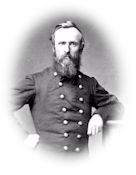
May 7. — A hard day’s march. Left Princeton at 4 A. M., crossed East River Mountain and passed through Rocky Gap. To cross roads nine miles, to Gap, eighteen — a twenty-mile march.
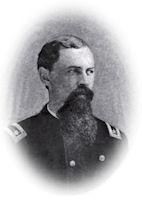
Two miles south of the Gordon’s Mills crossing of
the Chickamauga,
May 7, 1864, 12 m.
We started at 8 this morning and made this by 11. We are now waiting for two or more divisions of the 16th Corps to file into the road ahead of us. I think they are coming from Ringold. A circular of McPherson’s was read to us this morning before starting, telling us we were about to engage the enemy and giving us some advice about charging, meeting charges, shooting low, and telling us not to quit out lines to carry back wounded, etc., and intimating that he expected our corps to occupy a very warm place in the fight, and to sustain the fighting reputation of the troops of the department of the Tennessee.
The men talk about hoping that the divisions now going ahead will finish the fighting before we get up, but I honestly believe they’d all rather get into a battle than not. It is fun to hear these veterans talk. I guess that about two-thirds of them got married when they were home. Believe it will do much toward steadying them down when they return to their homes. They almost all say that they had furlough enough and were ready to start back when their 30 days were up.
It is hot as the deuce; two of our men were sun struck at Lookout Mountain on the 3rd.
Dust is becoming very troublesome. I am marching in a badly-fitting pair of boots, and one of my feet is badly strained across the instep, pains me a good deal when resting. That and my sprained wrist make me almost a subject for the Invalid Corps, but I intend to carry them both as far as Atlanta, after our “Erring Brethren,” if I have no further bad luck. One of my men, when he rolled up his blanket this morning, found he had laid on a snake, and killed him—poor snake!
Near LaFayette, Ga., 12 m., May 7, 1864.
Have just got into camp and washed my face. Four divisions filing into the road ahead of us, delayed us five whole hours, and their trains have made us seven hours marching 8 miles. Somebody says we are 19 miles from Rome. The boys have started a new dodge on the citizens. One of my men told me of playing it last night. When we camped for the night he went to a house and inquiring about the neighbors found out one who had relatives North; and something of the family history. Then he called on this party and represented himself as belonging to the northern branch of the family, got to kiss the young lady cousins, had a pleasant time generally, and returned with his haversack full of knicknacks, and the pictures of his cousins, with whom he had promised to correspond. At one house on the road to-day 10 or 12 women had congregated to see the troops pass. An officer stopped at the house just as our regiment came up, and the boys commenced yelling at him, “Come out of that, Yank;” you could have heard them two miles. Never saw a man so mortified. Colonel Wright tells me we are about seven miles from the Rebels at some ridge. We will get into position to-morrow and fight next day—that is, they would, if I were not present. We camped in a “whale” of a sweet potato patch, and the boys have about dug up the seed and gobbled it.
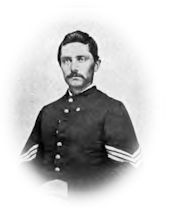
Saturday, 7th—Our new wedge tents were issued to us this morning by the quartermaster, and we worked all day pitching the tents and building bunks. I was on fatigue duty as corporal, in charge of a squad of men cleaning the grounds. We have a fine camp at this place with very good water. The health of the men is excellent and they are all in fine spirits. There was a flying report that the rebel general, Forrest, has been captured, but we don’t know as to the truth of it.
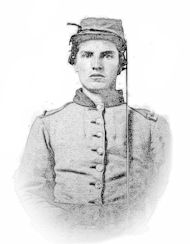
Saturday, 7th.—Moved out into ditches. Reported Federals in force at Tunnel Hill. Worked on fort until midnight.
May 7 — The infantry armies have been quiet nearly all day, but the cavalry was fighting and skirmishing from early morn until dewy eve. Early this morning the Yankee sharpshooters charged to within a hundred yards of my gun and fired a volley at us, but did no harm. I fired a shell at them, which broke their line and retired them in disorder. We fell back then about half a mile, out of the brush and woods, to a better and open position; we remained in battery there all day, but the enemy did not show fight nor advance after we drove their sharpshooters back this morning.
Late this evening there was some heavy musketry on the right of General Longstreet’s line, just to the left of our battery. Our orders to leave bivouac and hasten to the front this morning at daylight were urgent and pressing, and we had no time to prepare or eat any breakfast, which greatly ruffled some of our drivers. When we neared the enemy’s line we awaited orders, and one of our drivers was still going through with the baby act about something to eat and having no breakfast. Just then General Stuart and staff came along rather on the reconnoissance order, and halted a moment in the road right where we were, and heard the gallant grumbling and childish murmuring of our hungry man, and the General rode up to him and through pure magnanimity gave our driver two biscuits out of his own haversack.
This evening at dusk we left our position and moved a little distance to the rear, and bivouacked.


