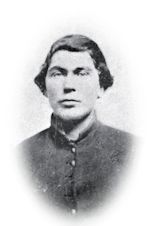
Huntsville, Saturday, May 7. A warm day but not oppressive. Sent on detail with Corporal Knapp outside picket lines after poles and brush to protect horses from the sun. Passed the infantry picket and cavalry videttes three miles from camp. While out on the hills, in the thicket, a party of guerrillas fired into our cavalry, wounding a captain about half a mile from here. Two were taken in citizen’s clothes. The prevailing idea is that they will be shot. I cannot hope so, although it would be but just retribution for the massacre of Fort Pillow.
May 2014
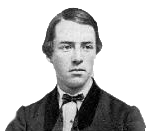
Saturday, May 7. — We were posted as a reserve for the brigade. Had no fighting in our front during the day. We held the Brock Road. Weather pleasant. Heavy firing on the right. I was placed in command of my brigade, being the senior officer present. All the wagons were sent to Chancellorsville last night. Sent out again to-day and found Colonel Griswold’s body, robbed of everything. He looked very natural. Had a coffin made and had Charley buried, as we could not send the body home. We started for Chancellorsville at one A.M.
[We regained the ground we had lost in the morning, and found Griswold’s body stripped of everything but the underclothing. I sent back at once to the headquarters wagon and got his valise, and opened a note I found in it, a facsimile of which is printed opposite page 280. Of course I could not find any black bag, but there is a curious sequel to this. Some five years after the War I was at a party in Boston, when a married lady whom I was talking to asked me if I was not with Colonel Griswold. I said I was, and after beating around the bush for some time she finally said, “Do you know whether anything was seen of a locket that he had around his neck?” I said no, it could not he found, but he asked me to get it and send it to his mother. She said, “My picture was in that locket.”]
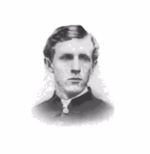
Diary And Memoranda, 1864
May 7th. Arriv’d home on vet. furlough.
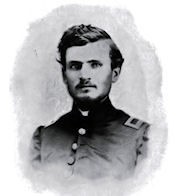
7th. At 1 o’clock, received orders to pull out. Followed some 3rd Div. trains. Went down near Chancellorsville and breakfasted. Firing commenced early. Very hot and sultry. Regt. still back at the Ford. Moved to Chancellorsville (the walls of a brick house mark the spot) and remained over night. A good many fortifications remaining of those thrown up a year ago. Firing has been incessant all day. Troops passing towards Spottsylvania all night.
May 7—We are still penned up as prisoners in the rear of the army, close by General Grant’s headquarters. A great many prisoners came in to-day. From some of them I heard that my brother was well.
May 7, Saturday. Some fragmentary intelligence comes to us of a conflict of the two great armies. A two days’ fight is said to have taken place. The President came into my room about 1 P.M., and told me he had slept none last night. He lay down for a short time on the sofa in my room and detailed all the news he had gathered.
Mr. Wing, a correspondent of the New York Tribune, called upon me this evening. He brings the first news we have had, but this is not full and conclusive.
Early May 7th we sent our a strong skirmish line to locate the enemy’s position and found that he had retired behind his entrenchments. During the day Custer’s cavalry division drove the rebel cavalry from Cartharpin furnace to Todd’s tavern, and Warren’s corps brought on a considerable picket engagement about noon in making a reconnoissance on his front, and so the battle of the Wilderness ended. Our losses are said to amount to at least fifteen thousand men, without other result then probably killing and wounding as many of the rebels. Grant has no idea of ceasing operations, however, but is said to be arranging for another move by the flank to get between Richmond and the rebel army. Hancock was ubiquitous, riding everywhere and sending staff officers in endless succession from one end to the other of the line to keep himself posted on the situation. Our division remained all day along the Brock road, but towards night were ordered to march to Todd’s tavern in the direction of Spottsylvania court house. As soon as it became dark Warren’s corps passed from the right, their original position, immediately in our rear on the Brock road, we remaining in position behind the works.
by John Beauchamp Jones
MAY 7TH.—Bright and warm. The following is Gen. Lee’s dispatch, received yesterday morning—the italics not his.
“HEADQUARTERS ARMY NORTHERN VIRGINIA,
“May 5th, 1864.
“HON, SECRETARY OF WAR.
“The enemy crossed the Rapidan at Ely’s and Germania fords. Two corps of this army moved to oppose him—Ewell by the old turnpike, and Hill by the plank-road.
“They arrived this morning in close proximity to the enemy’s line of march.
“A strong attack was made upon Ewell, who repulsed it, capturing many prisoners and four pieces of artillery:
“The enemy subsequently concentrated upon Gen. Hill, who, with Heth’s and Wilcox’s divisions, successfully resisted repeated and desperate assaults.
“A large force of cavalry and artillery on our right was driven back by Rosser’s brigade.
“By the blessing of God, we maintained our position against every effort until night, when the contest closed.
“We have to mourn the loss of many brave officers and men. The gallant Brig.-Gen. J. M. Jones was killed, and Brig.-Gen. Stafford, I fear, mortally wounded, while leading his command with conspicuous valor.
“(Signed) R. E. LEE.”
A dispatch from Gen. Lee this morning says Hill’s corps was thrown into confusion yesterday by an attack of the enemy when some of the divisions were being relieved. But afterward we recovered the ground, strewn with the dead and wounded of the enemy. Then we attacked their whole line, driving them behind their breastworks. He concludes by thanks for our ability still to withstand all assaults. No doubt Grant has overwhelming numbers, and Lee is under the necessity of sparing his men as much as possible, while his adversary leads into action a succession of fresh troops. Gen. Longstreet is wounded.
Gen. Beauregard is at Petersburg, charged with the defense of this city and the railroad. Troops have been marching toward Drewry’s Bluff during the day. If the attack be delayed 24 hours more, we shall be strong enough to repel even the then greatly superior numbers of the invader.
But there is more anxiety manifested to-day. Senator Hunter and Mr. Ould, the agent of exchange, have been in the office next to mine once or twice, to drink some of the good whisky kept by Mr. Chapman, the disbursing clerk of the department. Mr. H.’s face is quite red.
5 P.M. The tocsin is sounding, for the militia, I suppose, all others being in the field. It is reported that the attack on Drewry’s Bluff, or rather on our forces posted there for its defense, has begun. Barton’s brigade marched thither to-day. It is said the enemy have 40,000 men on the south side of James River—we, 20,000.
There is now some excitement and trepidation among the shopkeepers and extortioners, who are compelled by State law to shoulder the musket for the defense of the city, and there is some running to and fro preliminary to the rendezvous in front of the City Hall. The alarm, however, I learnt at the department, is caused by reports brought in by countrymen, that the enemy is approaching the city from the northeast, as if from Gloucester Point. It may be so—a small body; but Gen. Ransom, Gen. Elzey’s successor here, doubts it, for his scouts give no intelligence of the enemy in that quarter. But the 19th Militia Regiment and the Foreign Battalion will have the pleasure of sleeping in the open air to-night, and of dreaming of their past gains etc.
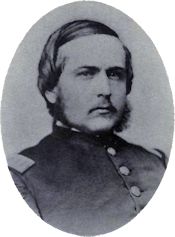
Friday, May 6th.
We were aroused at half-past two o’clock this morning by an officer who brought us orders to leave the Headquarters Train and to report at Corps Headquarters at once, which order we instantly obeyed. Arriving at Gen. Warren’s headquarters, which were then at the Lacy House, in a commanding position upon a hill from which a view could be had of the dense woods upon all sides forming part of the Wilderness in which the troops of the Fifth Corps now lay in line of battle, we halted on the southerly slope, and, stacking arms, began to boil our coffee, the favorite occupation of the soldiers upon all occasions when a halt is ordered, expecting every moment to be ordered into the line. Soon Company E, which had been ordered up from the ammunition train, joined us, and from the strenuous efforts made to bring every available man to the front, and the anxiety apparent on the faces of the officers about Headquarters, we were convinced that a crisis was approaching. Before daylight the ball was opened by the skirmishers, and about half-past four the artillery, such as could be efficiently used, joined in the chorus. As the day dawned the firing increased all along the lines, and the pattering of the skirmishes was soon lost in the deep and terrible roll of the musketry of the main lines. I never listened to a sound more thrilling than that of this morning’s engagement. The loudest and longest peals of thunder were no more to be compared to it in depth and volume, than the rippling of a trout brook to the roaring of Niagara. The Sixth New York and other regiments of Heavy Artillery left in the defenses of Washington when we were ordered out, passed us this morning going forward to fill a gap in the line through which the enemy is momentarily expected to pour its charging columns, and to repel which all the reserved artillery has been in position in front of Headquarters with the guns shotted and the cannoneers at their posts. Fortunately, the weak spot is not discovered by our adversaries, but the crowds of wounded surging from the woods in every direction and hastening to the rear, bear terrible witness to the desperate valor of the combatants, and show a gradual but certain weakening of the lines. Here again I am compelled to bear the mortification of being asked by a staff officer what Battery I command, and upon pointing out my company of foot soldiers, hearing the officer add apologetically, “Ah, you are one of the Heavies.” I shall never cease to condemn in the strongest terms the action of the Government in enlisting us for one branch of the service and then, without our consent, transferring us to another.
About three o’clock P. M., we were ordered to the front, and with many speculations as to our destination, we fell in line and marched across an open field into the woods. Entering the low pines and underbrush through which roads had been cut for the passage of artillery and ambulances, we moved noiselessly along until we emerged from the pines in a hollow, and formed line of battle beside a little brook just in rear of several batteries of artillery, which, being in position, connected the extreme right of the Fifth Corps with the left of the Sixth. Here, stacking arms until the engineers should complete the breastworks on the left of the batteries, the men unslung their knapsacks, built their little fires and improved the time boiling their coffee. About seven o’clock, and while we were still busy at our hard-tack and coffee, the firing opened very briskly to the right, and soon a mounted staff officer dashed wildly down upon us, shouting at the top of his voice that the Sixth Corps had broken and was retreating before the victorious Rebs, who in a few minutes would be upon us also and “gobble us up,” closing his remarks by ordering us forward into the unfinished rifle-pit. Such information calmly and quietly conveyed to veterans far in the rear, would hardly inspire them with martial ardor. What, then, must be the effect on green troops on the front line with arms stacked and belts laid aside? As might have been expected, the result was well nigh disastrous, for nearly every man in the battalion, with the natural instinct of self-preservation, seized his knapsack and started on the double-quick for the rear. Fortunately, however, the officers were in the rear of the line, and, with the assistance of the non-commissioned officers and a few cool-headed private soldiers, by threats and prayers, by words and blows, finally restored order, and, forming the line, the battalion moved into the rifle-pits. Joe, one of my bodyguards, however, would have distinguished himself on this occasion by gallantly retreating and carrying away my sword and revolver, which I had taken off a few moments before the stampede commenced, had I not caught him just in time to save my property, though he himself disappeared. Notwithstanding the terrible forebodings of the mounted officer referred to, and who by this time had no doubt reported at Headquarters, the firing gradually died away, and, being assured by the engineers that there were two lines of battle in the woods in front of us, we laid down to pleasant dreams in the rifle-pits,
merely stationing a picket to guard our slumbers. General Wadsworth, and Lieut. Walker of our Sixth Corps battalion, were killed, and private Washington Covert, of my company, was wounded to-day.
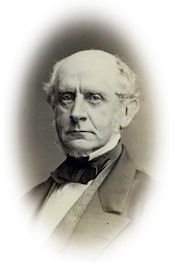
London, May 6, 1864
Meanwhile the specks of war are becoming bigger and bigger on this side. The Germans seem to have made up their minds, as we say, to gobble up little Denmark. Possibly it may stick in their throats a little, especially if the British should put the channel fleet into the dose. The conference from which so much was expected turns out a farce. Lord Russell and Lord Palmerston look before the world rather like greenhorns who have suffered themselves to be completely sold. John Bull is not fond of appearing ridiculous. You may abuse him as much as you like. He will give you as much as he gets. But if you laugh at him, he immediately becomes sheepish. He would rather fight than stay in that position. The fact is not to be disputed that the Germans have made a fool of him. So you may look out for breakers the moment he is fully made sensible of the fact. The conference will meet again on Monday, probably for the last time. . . .


