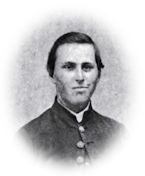
May 29th. Left camp early this hot morning. Pushing up the valley. Passed through Woodstock. Very few people to be seen. They still inform us that they hate the Yankees. Hope we will all be captured and be sent to Richmond. Came to a halt at Mount Jackson. Line of battle formed. The advance are having a hot time, as we can plainly hear the boom of the guns. Passing over the battle-field of the 15th, stopping near New Market. I am in the best of health. Rations running low. Would like more to eat. Hot, cloudy, muggy weather. Our march today covers twenty miles.
May 2014

29th. Sunday. Reached the 3rd Div. C. C. little before midnight. 1st Brigade Col. McIntosh. Camped near Hanovertown on the Pamunkey. Crossed the Mattapony today and passed through Dunkirk. Like to remain with the Regt.
by John Beauchamp Jones
MAY 29TH.—Bright and quite cold.
There was skirmishing yesterday evening on the Chickahominy.
The armies are confronting each other, but Grant is moving gradually to the right of us, as if with an intention to reach the James River; but probably it is with the view of enveloping us with his superior numbers, and the GREAT BATTLE may occur at any hour. The train of cars, laden, in Broad Street, destined a few days ago to transport provisions, etc. to Gen. Lee’s army, are visited hourly by wagons from the army, now in the immediate vicinity.
This morning the Secretary’s time is occupied in giving audience to citizens who have fled from the vicinity of the enemy, but whose exaggerated accounts really furnish no reliable information. Of what benefit, in such a crisis as this, is the tale of desolation in the track of Grant’s army, the destruction of crops, the robbery of children of their silver cups and spoons, etc.? And yet these are the things which occupy much time.
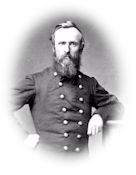
Meadow Bluff, Sunday, May 29, 1864.
Dearest: — Still here getting ready — probably delayed some by the change in Department commanders, but chiefly by rains and delays in obtaining supplies. All the brigade now here, camped in sight of where I now sit. We hardly know where we are to come out, but there is a general feeling that unless Grant succeeds soon, we shall turn up in his army.
You notice the compliment to Major Avery, “bravest of the brave.” A good many officers of [the] Twenty-third are talking of going out at the end of the original term, ten days hence. Major McIlrath bid us good-bye this morning. Major Carey is likely to take his place with the veterans of the Twelfth. . . .
My staff now is Lieutenant Hastings, adjutant-general, [Lieutenant William] McKinley, quartermaster, Lieutenant Delay, Thirty-sixth, commissary, and Lieutenant Wood, Thirty-sixth, aide — all nice gentlemen. I enclose Colonel Tomlinson’s photograph which he handed me today.
Well, this is a happy time with us. — You must not feel too anxious about me. I shall be among friends.
A flag of truce goes in the morning after our wounded left at Cloyd’s Mountain. There were four doctors and plenty of nurses left with them. . . Love to all the boys.
Affectionately ever,
R.
Mrs. Hayes.
Meadow Bluff, May 29, 1864.
Dear Uncle: — Contrary to my expectation when I wrote you a few days ago, we are still here. We are detained, I suppose, by different causes, but I suspect we shall move soon towards Staunton. We may drift into the army of Grant before a month. My proper brigade is now here and all of it camped in sight of where I now sit, viz., Twenty-third and Thirty-sixth Ohio, Fifth and Thirteenth Virginia. I have seen them all in line today. They form a fine body of troops. We are soon to lose the enlisted men of the Twenty-third who did not become veterans. I think a good many officers will leave at the same time. It is probable that the veterans of the Twelfth will go into the Twenty-third. If so it will make the regiment better and stronger than ever before.
We are not informed how Grant succeeds in getting into Richmond. You know I have always thought he must get the Western Army there before he can whip Lee. It looks a little now as if he might do it without Western help. We shall see,
Sincerely,
R. B. Hayes.
I hear from Lucy that she is settled in a good boarding-house at Chillicothe.
S. Birchard.
Sunday, [May] 29. — Heard preaching of Mr. Harper, Thirteenth, on the hill in front of [the] Thirty-sixth; so-so. Fine day. At night news that Grant had crossed the Pamunkey, fifteen miles from Richmond. Sherman at Dallas, Georgia.
Saturday, May 28th.
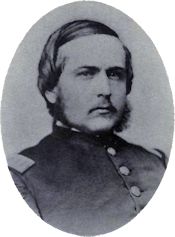
Started at 9 o’clock in the morning and marched all day, passing many attractive looking places, the plantation of John Carroll among others, and after making about twenty miles halted to boil coffee, but were ordered to cross the Pamunkey river, and did so at 5 o’clock at Old Ferry and camped on the heights beyond. During the day we came upon a Commissary, and those of us who could afford the luxury supplemented our usual and limited rations of hard-tack, brown sugar and coffee, with something equally bad but different in kind.
Saturday, 28th—We started at 7 o’clock this morning and dragging along slowly with our heavy trains, went into bivouac when we reached Somerville at 3 o’clock. Most of our road was over very rough country and besides we had to wade one river, the bridges being gone. Somerville is a mere village with a courthouse, a few stores and about twenty dwellings.
May 28, 1864, 9 a.m.
Still in rifle pits. We have been treated to a terrific storm of shells, spherical case, and solid shot. The batteries are in plain sight of each other, and the gunners call it a thousand yards between them. I don’t think either battery does very fine work, but they make it more than interesting for us. A conical shell from a 12 pound gun passed through a log and struck a Company C man on the leg, only bruising him. Two solid shot fell in my company works, but hurt no one. Seven p.m.—Talk about fighting, etc., we’ve seen it this p.m. sure, of all the interesting and exciting times on record this must take the palm. At about 3:45 p.m., a heavy column of Rebels rose from a brush with a yell the devil ought to copyright, broke for and took three guns of the 1st Iowa Battery which were in front of the works (they never should have been placed there); the 6th Iowa boys, without orders, charged the Rebels, retook the battery and drove them back. They came down on our whole line, both ours and the 16th A. C, and for two hours attempted to drive us out. We repulsed them at every point without serious loss to us, but I believe they are at least 3,000 men short. In our brigade Colonel Dickerman, Lieutenant Colonel 6th Iowa commanding, and Major Gilsey, commanding 46th Ohio, are wounded. Besides these I don’t think our brigade lost over 80. It was a grand thing. I did not lose a man and only three companies of our regiment lost any. When the musketry was playing the hottest, Logan came dashing up along our line, waved his hat and told the boys to “give them hell, boys.” You should have heard them cheer him. It is Hardee’s Corps fighting us, and he promised his men a “Chickamauga,” but it turned out a “Bull Run” on their part. It is the same corps our regiment fought at Mission Ridge. Our line is very thin along here, but guess we can save it now. I heard a 40th boy get off an oddity this evening, he said: “If they come again, I am going to yell if there’s any danger of their taking us, ‘Worlds by Nation Right into line Wheel!’ and if that don’t scare them, I propose going.”
Saturday, 28th.—Started marching rather in direction of Marietta; broke the main spring of my gun lock and had to hunt the ordinance train for another gun. Marched ten miles and came to where we passed this A. M. Reported Pat Cleaborn’s Division gained a complete victory yesterday.


