Following the American Civil War Sesquicentennial with day by day writings of the time, currently 1863.

May 2014

May 28 — We renewed our wandering march this morning and marched toward the Pamunkey. We crossed the Virginia Central Railroad, at Atlee’s Station, about eight miles from Richmond, then moved on a road that leads nearly due east through Hanover town to the Pamunkey. To-day the enemy crossed to the south side of the Pamunkey, with a large force of cavalry, infantry, and artillery. We saw the Yanks, and the whole country swarmed with them in our front; we had nothing to oppose their onward march but a small force of cavalry and two batteries of artillery.

General Hampton attacked the van of the enemy’s advance this afternoon at three o’clock near Old Church, about two miles from the Pamunkey. The fight was spirited, determined, and lasted till dark; the musketry was heavy at times on the Yankee side, as they had infantry engaged. Our cavalry fought gallantly and stuck to their position stubbornly, and repulsed two charges that the enemy made on our line, but late this evening we were forced to retire a short distance,— not more than three hundred yards,— as the enemy’s force was overwhelming and composed of a heavy force of infantry in addition to their cavalry. Our battery was under fire, but we did no firing, as the lay of the field and the peculiar conformation of the lines were unfavorable for artillery firing.

Late this evening we fell back to the south side of Tottapotamy Creek, a small stream just in rear of our line, and bivouacked for the night. General Breckinridge’s forces passed our bivouac at dusk this evening, going to the front; they won’t go very far before they will bump up against some lively game in the shape of Yankee infantry that General Hampton’s cavalry were fighting this afternoon.

The country along the Pamunkey in the lower part of Hanover County is mostly level. Weather sunny and hot.
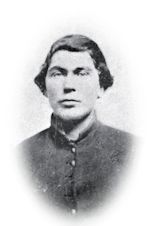
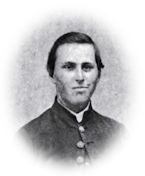
Huntsville, Saturday, May 28. A hot day. On detail to go outside pickets after wood. Reported in town 8 A. M. to go with division train. Train did not go, waited to see brigade guard. Loaded with forage and returned to camp. Drew two new mule teams to draw battery wagon and forge. Glorious news from Grant—within a day’s march of Richmond.

May 28th. Nothing important occurred last night. All quiet this morning. In an open country where we have a good view. We are located west of the pike. Ordered to keep a sharp lookout for the enemy’s cavalry and guerillas. Late this afternoon we were relieved from picket duty. This is a fine country as we continue to see.

28th. Saw Col. P. Train moved on to Newtown and camped. Regt. ordered to the cavalry corp. Made preparations to remain with the Regt.—Thede, Hank, Barb and I. Regt. captured nine reb wagons yesterday. Plenty of corn and bacon. Glee Club gave some music at F. F. V., reb family.

by John Beauchamp Jones

            MAY 28TH.—Showers and sunshine.

            Grant has crossed the Pamunky, and Lee is at the Yellow Tavern—not more than six miles from the city. The hostile armies are only a few miles apart, and the GREAT BATTLE may occur at any time, at any hour; and we shall hear both the artillery and musketry from my dwelling.

            All is quiet on the south side of the river. Nothing from Georgia, except a short address from Gen. Johnston to the army, stating that, having the enemy now where he wants him, he will lead the soldiers to battle.

            War and famine develop some of the worst instincts of our nature. For five days the government has been selling meal, by the peck, for $12: and yet those who have been purchasing have endeavored to keep it a secret! And the government turns extortioner, making $45 profit per bushel out of the necessities of the people!

            I saw a dispatch, to-day, from Gen. Johnston to his Chief Commissary, at Atlanta, ordering him, after reserving ten days’ rations, to send the rest of the stores to Augusta!

It is said Mr. Memminger and certain members of Congress have in readiness the means of sudden flight, in the event of Grant’s forcing his way into the city.

            It is thought, to-day, that Bragg will resign. If he does, then the President will be humiliated; for the attacks on Bragg are meant principally for Mr. Davis. But I doubt the story; I don’t think the President will permit Bragg to retire before his enemies, unless affairs become desperate by the defeat of our army in this vicinity.

Saturday, [May] 28.— Colonel Brown and [the] Thirteenth came up last night; seemed glad to be with the brigade all at one camp. I was certainly glad.

Friday, May 27th.

On reaching the Church fires were built and rations issued, and gradually the men left behind came straggling in, covered, like ourselves, with mud and wet to the skin. While trying to dry out and make ourselves reasonably comfortable under the circumstances, our morning naps were disturbed by rumors of another change of base and an impending long march. We were not actually routed out, however, until 9 o’clock A. M., when we formed line and marched steadily until 12 o’clock at night, covering twenty-five miles, but losing from the ranks more than two-thirds of the men, who fell out from sheer exhaustion but joined us later.

May 27th.—In all this beautiful sunshine, in the stillness and shade of these long hours on this piazza, all comes back to me about little Joe; it haunts me—that scene in Richmond where all seemed confusion, madness, a bad dream! Here I see that funeral procession as it wound among those tall white monuments, up that hillside, the James River tumbling about below over rocks and around islands; the dominant figure, that poor, old, gray-haired man, standing bareheaded, straight as an arrow, clear against the sky by the open grave of his son. She, the bereft mother, stood back, in her heavy black wrappings, and her tall figure drooped. The flowers, the children, the procession as it moved, comes and goes, but those two dark, sorrow-stricken figures stand; they are before me now!

That night, with no sound but the heavy tramp of his feet overhead, the curtains flapping in the wind, the gas flaring, I was numb, stupid, half-dead with grief and terror. Then came Catherine’s Irish howl. Cheap, was that. Where was she when it all happened? Her place was to have been with the child. Who saw him fall? Whom will they kill next of that devoted household?

Read to-day the list of killed and wounded.[1] One long column was not enough for South Carolina’s dead, I see Mr. Federal Secretary Stanton says he can reenforce Suwarrow Grant at his leisure whenever he calls for more. He has just sent him 25,000 veterans. Old Lincoln says, in his quaint backwoods way, “Keep a-peggin’.” Now we can only peg out. What have we left of men, etc., to meet these “reenforcements as often as reenforcements are called for?” Our fighting men have all gone to the front; only old men and little boys are at home now.

It is impossible to sleep here, because it is so solemn and still. The moonlight shines in my window sad and white, and the soft south wind, literally comes over a bank of violets, lilacs, roses, with orange-blossoms and magnolia flowers.

Mrs. Chesnut was only a year younger than her husband. He is ninety-two or three. She was deaf; but he retains his senses wonderfully for his great age. I have always been an early riser. Formerly I often saw him sauntering slowly down the broad passage from his room to hers, in a flowing flannel dressing-gown when it was winter. In the spring he was apt to be in shirt-sleeves, with suspenders hanging down his back. He had always a large hair-brush in his hand.

He would take his stand on the rug before the fire in her room, brushing scant locks which were fleecy white. Her ‘maid would be doing hers, which were dead-leaf brown, not a white hair in her head. He had the voice of a stentor, and there he stood roaring his morning compliments. The people who occupied the room above said he fairly shook the window glasses. This pleasant morning greeting ceremony was never omitted.

Her voice was “soft and low ” (the oft-quoted). Philadelphia seems to have lost the art of sending forth such voices now. Mrs. Binney, old Mrs. Chesnut’s sister, came among us with the same softly modulated, womanly, musical voice. Her clever and beautiful daughters were criard. Judge Han said…”Philadelphia women scream like macaws.” This morning as I passed Mrs. Chesnut’s room, the door stood wide open, and I heard a pitiful sound. The old man was kneeling by her empty bedside sobbing bitterly. I fled down the middle walk, anywhere out of reach of what was never meant for me to hear.


[1] During the month of May, 1864, important battles had been fought in Virginia, including that of the Wilderness on May 6th-7th, and the series later in that month around Spottsylvania Court House.

Friday, 27th—We remained in bivouac until 2 o’clock waiting for rations. After getting our rations we crossed the Tennessee river by pontoon bridges and started on our way for Rome, Georgia. The railroad bridge of the Memphis & Ohio, here at Decatur, was destroyed by our gunboats soon after the battle of Shiloh. It took seventy-two pontoon boats to make our bridge. Our road today lay through a large swamp which it took some time for the artillery and provision trains to cross; besides we had some very rough country to cross, and did not get into bivouac until midnight.

Near Dallas, Ga., May 27, 1864, 8 a.m.

There has been some very heavy fighting on our left this morning, and everywhere along the line. We have been moving in line since 6 o’clock, supporting skirmishers and the 3d Brigade. Have driven the Rebels about three-quarters of a mile. The 14th Corps must have had a severe fight about 6:30. The bullets have whistled pretty thick this a.m.

Skirmish line, 11 a.m.—Osterhaus and Smith (I think), have just had a big fight on our left. At 8:30 I was ordered to take Companies E, K, B and G, deploy them and relieve the 3d Brigade skirmishers. Deployed and moved forward over one-half mile through the very densest brush—couldn’t see six feet, expecting every minute to find the 3d Brigade skirmishers, but they had been drawn in, and we were right into the Rebels before we saw them. Three of my company were wounded in an instant and three of K’s taken prisoner, but our boys made the Rebels skedaddle, and all of them got away. Twenty-one Rebels came up in rear of Captain Smith and two of his men. Private Benson shot one of them, and Smith roared out for the rest to surrender, which they did. They (Rebels) said they would not have been taken if the Georgia brigade had not fallen back. I think that is doing pretty well for four companies of our regiment, running a whole brigade. Firing is very heavy all around us.

Twelve thirty m.—A chunk of Rebel shell lit 15 feet from me. Lively artillery firing right over head.

Four p.m.—At 2:15, after firing a few shells, the Rebels set up a yell along our whole front. I knew a charge was coming. At 2:30 another yell was much nearer. My men then commenced firing on them, but they came on yelling pretty well, but not as heartily as I have heard. They came jumping along through the brush more then, making the bullets rain among us. I think they could not fly much thicker. My men did nobly,but they were too many for us, and we had to fall back. I heard their officers halloo to them, “to yell and stand steady,” and they were right amongst us before we left. Our line of battle checked them and made them run. I lost A. Huffard—killed; Seth Williams—died in two hours; Wm. Gustine—severely wounded; E. Suydam—ditto; S. Hudson— ditto; H. Stearns—slight wound; J. H. Craig—ditto; F. Cary —ditto; W. Roberts—ditto; W. G. Dunblazier— captured.

Seven p.m.—I tell you this was exciting. My men all stood like heroes (save one), and some of them did not fall back when I wanted them to. The bush was so thick that we could hardly get through in any kind of line. Gustine and Suydam were about 20 feet on my left when they were shot, but I couldn’t see them. The Rebels were not 15 feet from them. I had 31 men on the line, and nine killed and wounded, and one prisoner, is considerable of a loss. They took six more of Company K prisoners, but three of them got off. I don’t think anyone can imagine how exciting such a fracas as that is in thick brush. As quick as our line started the Rebels running, I went back on the ground, and found a lot of dead and wounded Rebels. Every prisoner of the 20th Georgia had whiskey in his canteen, and all said they had all issued to them that they wanted. I never say such a dirty, greasy, set of mortals. They have had no rest since they left Dalton. On account of my skirmishers losing so heavily, we have been relieved from the line, and are now in rifle pits, and are supporting those who relieved us.