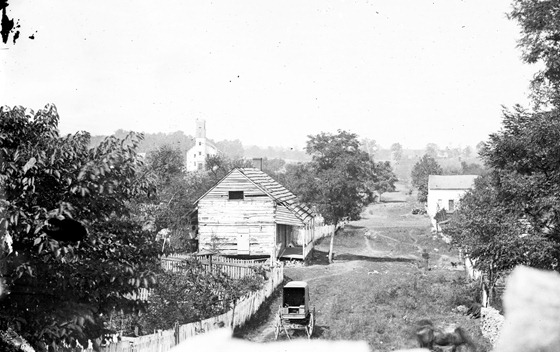
Sharpsburg, Md. View with Episcopal church in distance; photograph by Alexander Gardner.
Library of Congress image.
Sharpsburg, Md. View with Episcopal church in distance; photograph by Alexander Gardner.
Library of Congress image.
September 27th. The camp looks lonesome in the absence of so many familiar faces. If we could only get substitutes to take the places of those constantly dropping out through the casualties of war that would be some compensation, but as it is there is only a void, and the result is a general apathy, and loss of interest. War is not as romantic as it once seemed to me, the cruelty and suffering is incredible and worries one all the time, and the losses and destruction of human life, at all events in this war, are so enormous that it seems only a question of time, when all of us must be hors du combat.
September 27.—The Thirty-first regiment of New-Jersey volunteers, under the command of Colonel A. P. Berthoud, left Flemington to-day for Washington, nine hundred and seventy-seven strong, armed with Enfield rifles.
— Two infantry and one cavalry regiment, under command of Colonel Toland, of the Thirty-fourth Ohio regiment, made an ineffectual attempt to capture Jenkins’s rebel cavalry, in camp at Buffalo, on the Kanawha River, Va. His troops advanced in three directions from Point Pleasant. The centre column surprised Jenkins’s cavalry, five hundred strong, before the other columns arrived, drove the rebels out of their camp, and captured and destroyed all their camp equipage, killing seven, and capturing nine. They pursued them about one and a half miles, when they were reenforced by two regiments of infantry and three pieces of artillery. The National force then fell back without the loss of a man.
— Major John J. Key was dismissed from the service of the United States for having replied to the question propounded to him—”Why was not the rebel army bagged immediately after the battle near Sharpsburgh?” — that it was “not the game; that we should tire the rebels out and ourselves; that that was the only way the Union could be preserved, we come together fraternally, and slavery be saved.”
— Augusta, Ky., was captured by a force of rebel guerrillas, under Captain Basil Duke. The home guard, under the command of Colonel Bradford, vigorously attacked the rebels from the houses; but, being outnumbered, they were compelled to surrender, but not before killing and wounding a large number of their enemies.— (Doc. 212.)
26th.—Another quiet day in camp. I applied to-day for a furlough, which I doubt not will be granted. I have worked hard and constantly for sixteen months, and as I am now for a time disabled, I can conceive of no reason why I may not be relieved for a few weeks. No attempted solution yet of the question “Why did not McClellan crush or capture the rebel army after the battle of Antietam?” This question is made peculiarly pertinent by the fact, now ascertained, that we had on the ground the morning after the battle, a force of men (not one of whom had been in the battle of the day before) nearly if not quite equal to Lee’s entire army.
Sarah Morgan. X.
September 26th, Friday.
My mark finds me at Linwood, though I had not the slightest idea that it would. Wonder where twenty pages beyond will find me? At home, I hope and pray, though I am as happy here as I could possibly be in any place on earth.
Stirring news from our armies comes pouring in. Sunday, Colonel Breaux told me of Wool’s defeat, and the great number of prisoners, cannon, and the large supplies of stores and ammunition that we had captured. Then Tuesday we heard of three great battles in Maryland, the third one still continuing; but no particulars of any of them. Yesterday came tidings of our having recrossed the Potomac, and to-day we hear that McClellan’s army has been cut to pieces; but whether it is the same old fight or a new one, I cannot as yet learn; for reliable information is not easily obtained in America at this period.
Did I ever record how little truth there was in any of that last Clinton news? It speaks for itself, though. Not a boat lay at Baton Rouge; Camp Moore was not even threatened; Ponchatoula Station was burned, but the one battery was retaken by our men the same night.
But still these false reports cannot equal the Yankees’. Take, for instance, the report of the Captain of the Essex. I give General Carter as my authority. The Captain reports having been fired on by a battery of thirty-six large guns, at Port Hudson, some weeks ago, when he opened fire and silenced them, one after the other, from the first to the last. Not a shot from the “rebel” batteries reached them, and not a casualty on their side occurred. But the loss of the Confederates must have been awful. He came within — I forget how many — yards from the shore, and there was not a live man to be seen. He did not mention if there were any dead ones! Now for the other side. There were but four guns mounted there at the time. Shot and shell from those four certainly reached something, for one was seen to enter a porthole, from whence issued frightful shrieks soon after, and it is well known that the Essex is so badly injured by “something” as to be in a sinking condition, and only kept afloat by a gunboat lashed on either side. If she is uninjured, why did she not return and burn Natchez as she announced? In leaving Port Hudson, where “not a live man was to be seen” (nor a dead one to be found), she stopped at Mr. Babin’s, just below Dr. Nolan’s, where she remained the rest of the day. After she left, being curious to discover the reason of her short stay, Mr. Babin walked to the place where she had been, and discovered sixteen fresh graves on the bank. If they buried them as they did at Baton Rouge and Vicksburg, four in a grave, how many would they be? But granting there were but sixteen, would that prove the veracity of the Captain? Poor man! Perhaps he is related to Pope, and cannot help himself.
September 26, Friday. At several meetings of late the subject of deporting the colored race has been discussed. Indeed for months, almost from the commencement of this administration, it has been at times considered. More than a year ago it was thrust on me by Thompson and others in connection with the Chiriqui Grant, a claim to title from the Government of Central America of a large part of Costa Rica. Speculators used it as a means of disposing of that grant to our Government. It was a rotten remnant of an intrigue of the last administration. The President, encouraged by Blair and Smith, was disposed to favor it. Blair is honest and disinterested; perhaps Smith is so, yet I have not been favorably impressed with his zeal in behalf of the Chiriqui Association. As early as May, 1861, a great pressure was made upon me to enter into a coal contract with this company. The President was earnest in the matter; wished to send the negroes out of the country. Smith, with the Thompsons, urged and stimulated him, and they were as importunate with me as the President. I spent two or three hours on different days looking over the papers, — titles, maps, reports, and evidence, — and came to the conclusion that there was fraud and cheat in the affair. It appeared to be a swindling speculation. Told the President I had no confidence in it, and asked to be released from its further consideration. The papers were then referred to Smith to investigate and report. After a month or two he reported strongly in favor of the scheme, and advised that the Navy Department should make an immediate contract for coal before foreign governments got hold of it. Mr. Toucey had investigated it. Commodore Engle had been sent out to examine the country and especially in relation to coal. The President was quite earnest in its favor, but, satisfied myself it was a job, I objected and desired to be excused from any participation in it. Two or three times it has been revived, but I have crowded off action. Chase gave me assistance on one occasion, and the scheme was dropped until this question of deporting colored persons came up, when Smith again brought forward Thompson’s Chiriqui Grant. He made a skillful and taking report, embracing both coal and negroes. Each was to assist the other. The negroes were to be transported to Chiriqui to mine coal for the Navy, and the Secretary of the Navy was to make an immediate advance of $50,000 for coal not yet mined, — nor laborers obtained to mine it, nor any satisfactory information or proof that there was decent coal to be mined. I respectfully declined adopting his views. Chase and Stanton sustained me, and Mr. Bates to an extent. Blair, who first favored it, cooled off, as the question was discussed, but the President and Smith were persistent.
It came out that the governments and rival parties in Central America denied the legality of the Chiriqui Grant and Thompson’s claim, — declared it was a bogus transaction. The President concluded he ought to be better satisfied on this point, and determined he would send out an agent. At this stage of the case Senator Pomeroy appeared and took upon himself a negro emigrating colonization scheme. Would himself go out and take with him a cargo of negroes, and hunt up a place for them, — all, professedly, in the cause of humanity.
On Tuesday last the President brought forward the subject and desired the members of the Cabinet to each take it into serious consideration. He thought a treaty could be made to advantage, and territory secured to which the negroes could be sent. Thought it essential to provide an asylum for a race which we had emancipated, but which could never be recognized or admitted to be our equals. Several governments had signified their willingness to receive them. Mr. Seward said some were willing to take them without expense to us.
Mr. Blair made a long argumentative statement in favor of deportation. It would be necessary to rid the country of its black population, and some place must be found for them. He is strongly for deportation, has given the subject much thought, but yet seems to have no matured system which he can recommend. Mr. Bates was for compulsory deportation. The negro would not, he said, go voluntarily, had great local attachments but no enterprise or persistency. The President objected unequivocally to compulsion. Their emigration must be voluntary and without expense to themselves. Great Britain, Denmark, and perhaps other powers would take them. I remarked there was no necessity for a treaty, which had been suggested. Any person who desired to leave the country could do so now, whether white or black, and it was best to leave it so, — a voluntary system; the emigrant who chose to leave our shores could and would go where there were the best inducements.
These remarks seemed to strike Seward, who, I perceive, has been in consultation with the President and some of the foreign ministers, and on his motion the subject was then postponed, with an understanding it would be taken up to-day. Mr. Bates had a very well prepared paper which he read, expressing his views. Little was said by any one else except Seward, who followed up my suggestions. But the President is not satisfied; says he wants a treaty. Smith says the Senate would never ratify a treaty conferring any power, and advised that Seward should make a contract.
The Governors of the loyal States called to-day on the President. They have had a meeting at Altoona, for what purpose I scarcely know. It was an unauthorized gathering of State Executives, doubtless with good intent; but I dislike these irregular and extraordinary movements. They must tend to good or evil, and I see no good. These officials had better limit their efforts within their legitimate sphere.
Admiral Gregory came to see me in relation to the ironclads which are being constructed under his superintendence. Enjoined upon him to have them completed by November at farthest. A demonstration is to be made on Charleston, and it will not do to depend upon the army even for cooperation there.
It is now almost a fortnight since the battle near Sharpsburg [Antietam]. The Rebels have recrossed the Potomac, but our army is doing nothing. The President says Halleck told him he should want two days more to make up his mind what to do. Great Heavens! what; a General-in-Chief!
Friday, 26th—I was on fatigue duty down in town today, helping to dismount the guns and load them with the ammunition upon the cars to be shipped to Corinth. We are preparing to leave Iuka as soon as possible, but it is slow work, as the railroad is in bad shape, and there is only one train a day.
Middletown, Maryland, September 26, 1862.
Dear Uncle : — Lucy is here and we are pretty jolly. She visits the wounded and comes back in tears, then we take a little refreshment and get over it. I am doing well. Shall, perhaps, come home a little sooner than I expected to be able to. I am now in a fix. To get me for the Seventy-ninth, some of its friends got an order to relieve me from the Twenty-third from the War Department. So I am a free man, and can go or come as I see fit. I expect, however, to stay with [the] Twenty-third.
Shall probably start home in ten days or so. I got your letter of the 18th. You need have no anxiety about me. I think I shall come home by way of Cleveland and Fremont, stopping a few days with you. Love to all.
H.
S. BIRCHARD.
Friday, 26th. Renewed our march at sunrise after breakfast. Our course lay mostly through the woods, a little over rough prairie. After 25 miles march, reached Mt. Vernon at 4 P. M. Gen Brown’s command here mostly Mo. troops, one Arkansas regiment. Made requisition and drew corn. Pretty little town. Took supper with teamsters. Sold my old overcoat to Noah Long for $4, to be paid pay day. News came from Sarcoxie about a fight. Gen. Salomon. Good prospects ahead for a fight. Order to muster out staff has come.
Written from the Sea islands of South Carolina.
[Diary] 26th.
“Secesh” spies have been taken lately on Port Royal Island, and it is said there is every probability of an attack some fine night.
I have patients from Cat Island and all about. My hands are full indeed.
 Follow on facebook
 RSS
RSS email
email