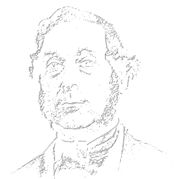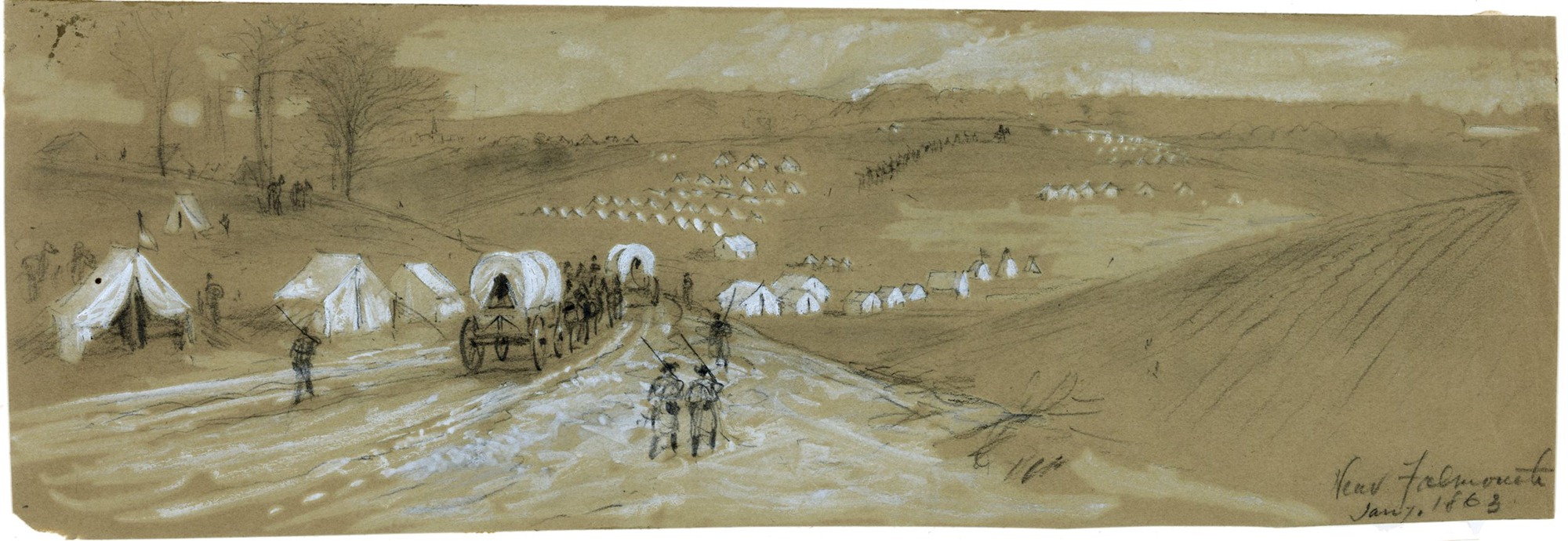
drawing on olive paper : pencil and Chinese white ; 11.9 x 35.8 cm.
Library of Congress image.
by John Beauchamp Jones
JANUARY 20TH.—The rumor of fighting on the Rappahannock is not confirmed. But Gen. Lee writes that his beeves are so poor the soldiers won’t eat the meat. He asks the government to send him salt meat.
From Northern sources we learn that Arkansas Post has fallen, and that we have lost from 5000 to 7000 men there. If this be true, our men must have been placed in a man-trap, as at Roanoke Island.
Mr. Perkins, in Congress, has informed the country that Mr. Memminger, the Secretary of the Treasury, has hitherto opposed and defeated the proposition that the government buy all the cotton. Mr. M. should never have been appointed. He is head-strong, haughty, and tyrannical when he imagines he is dealing with inferiors, and he deems himself superior to the rest of mankind. But he is no Carolinian by birth or descent.
We see accounts of public meetings in New Jersey, wherein the government at Washington is fiercely denounced, and peace demanded, regardless of consequences. Some of the speakers openly predicted that the war would spread into the North, if not terminated at once, and in that event, the emancipationists would have foes to fight elsewhere than in the South. Among the participants I recognize the names of men whom I met in convention at Trenton in 1860. They clamor for the “Union as it was, the Constitution as it is,” adopting the motto of my paper, the “Southern Monitor,” the office of which was sacked in Philadelphia in April, 1861. Our government will never agree to anything short of independence. President Davis will be found inflexible on that point.
There was a rumor yesterday that France had recognized us. The news of the disaster of Burnside at Fredericksburg having certainly been deemed very important in Europe. But France has not yet acted in our behalf. We all pray for the Emperor’s intervention. We suffer much, and but little progress is made in conscription. Nearly all our resources are in the field. Another year of war, and _____!
January 20.—John A. Andrew, Governor of Massachusetts, was authorized by the National War Department, “until further orders, to raise such numbers of volunteer companies of artillery for duty in the forts of Massachusetts and elsewhere, and such corps of infantry for the volunteer military service as he may find convenient, and may include persons of African descent, organized into separate corps.”—War Department Order.
—The rebel steamer Oreto arrived off Havana, Cuba, and was allowed to enter and proceed up the harbor to an anchorage.—Major-General Peek, in orders from his headquarters at Suffolk, Va., expressed his satisfaction at the soldierly qualities exhibited by Colonel Alfred Gibbs, of the One Hundred and Thirtieth N. Y. S. V., and his confidence in his disposition and ability to discharge whatever duties might fall to him, with credit to himself and the National service.
Buntyn Station, Tuesday, Jan. 20. Still rainy and muddy. Orderly Jenawein gone to town. Sergeant Hauxhurst acting. Health good.
Monday Jan’y 19th 1863
This has been another cold day but clear and pleasant. I did not have much to do in the office after making out my weekly report. All seems to be in uncertainty in regard to the movements of the Army of the Potomac. But I think it is again over the Rappahannock. Went up to Georgetown after office hours with a view of going out to Fort Gaines, but was too late, so I came back to Browns the (“Metropolitan”) where I met John C Adams. He is a “Chip of[f] the old Block.” Also met Capt Swan there. We agreed to go up to the 138th Regt tomorrow. He intends to return to the Army in a day or two. Important news (which seems to be official) from the Arkansas River. Seven Regts of rebels taken prisoners and a great amount of Stores and Ammunition. Genl McClernand in command of our troops. I called at Charleys and staid an hour and then went to Odd Fellows Hall to hear readings or recitations from “Madame Lizzy Bell.” Her recitations were very good. He had quite a good house. James E Murdoch and George Vanderhoff both read tonight, the former in the Senate Chamber and the latter in “Willards Hall.” I must hear Vanderhoff tomorrow night. I do get lonesome sometimes, but not often. With my Books and my writing in my room with a good fire I enjoy myself tolerably well. I go into the Hotels almost every night but do not often sit down. Always meet old friends and acquaintances there. “Shoulder Straps” are rather more scarce since a late “order” ordering all officers to their commands. Sent three newspapers home today, got no letters.
Monday, 19th.—Passed DeKalb 4 P. M. Very shabby-looking place. Cold, wet and muddy; only marched ten miles to-day. Our mess got old house to cook in and church to sleep in. Getting plenty to eat and have had plenty during all this march. Never had been any soldiers here before.
To the Parsonage in B.
Dear P.,—We are lucky fellows. For a time, you know, Ed. and I were perfectly well and hearty; and, now that Ed. has had to give up for a while, he is probably better off than any sick man in the regiment, and is doing as well as we can expect. I wrote a day or two ago, that Ed. was sick; thinking he would be better at once. It turned out differently; and now he is slipping smoothly through a fever,—just about as comfortably off as he needs to be, with every thing so far going well. It does seem at a distance an awkward thing to be sick in camp, and generally, I suppose, it is a hard thing for a soldier to be taken down; but Ed. is singularly fortunate. The chaplain offered him a place in his room, which he thought would be more comfortable than the hospital; but the officers of the company were so urgent in their invitation, that Ed. decided to go to their room. So here we are to-night,—he playing patient; and I, nurse.
Grosvenor is sick too, — fine fellow,—the graduate of Amherst, whom I mention sometimes. He and Ed. have the room together; and the colonel has detailed me temporarily for hospital-service, to have special charge of this pair of sergeants. You know I am an old hand at nursing. I find I take to it again with real zest, like a fish to its pond. Ed. and Grosvenor are both sleeping quietly now, each on his bunk comfortably fitted up with a soft mattress of moss and all necessary coverings. The surgeon is skilful, and close at hand all the time; the hospital-stores contain all the necessary medicines; and, for comforts, you ought to see the pile of oranges and lemons on this table here! Oranges, not such half-ripened, pale fellows as you see North, but the “raal” article, pumpkins in color, and almost in size. Ed. has just been smacking his lips over some cold lemonade sucked up through a mint-julep straw, and is looking forward to beef-tea; a cupful of which, nicely made as can be by old Winders, the hospital cook, who takes an interest in us, stands on the bench yonder. Moreover, there is toast-water, fine loaf-sugar, choice tea, right here at hand, and gruel whenever it is wanted. Ed. sleeps on a feather pillow which I managed to get; and, as I said, sucks his nourishment through a mint-julep straw: not because he is obliged to, but because he prefers to take it easy, — lie flat on his back, or any way, and take his dinner, which, under the persuasion applied by means of the mint-julep straw, will pliantly mount any hill, or turn any corner, to find that “right spot” to which we like to have things go exactly. So you see Ed. is about as well off as he could be anywhere, all things considered; and, in some respects, better: for he has the mint-julep straw, — an article which savors of the “enemy,” and which, therefore, never did profane, and I presume would never be allowed to profane, the virtuous precincts of the manse; and yet an article (O our friends!) to be cherished for its magic mastery over lemonade and beef-tea. So you see Ed. is well doctored and well nursed. I am not afraid to say it. For myself, my health is perfect; and I take precautions to keep it so, so far as I can.
Ed. has waked up. He sends much love, and talks about Mark Tapley, the “jolly man;” who, when he was too sick to speak, wrote “jolly” on a piece of paper. That appears to be about his frame of mind.
Monday, January 19th.
That blessed Mr. Halsey like an angel of mercy sent me “Kate Coventry” yesterday, just when I was pining far a bonne bouche of some kind, I did not care what, whether a stick of candy or an equally palatable book. It is delightful to have one’s wishes realized as soon as they are made. I think it rather caused me to relent towards Mr. Halsey; I did not feel half so belligerent as I did just the Sunday before. At all events, I felt well enough to go down in the evening when he called again, though I had been too indisposed to do so on a previous occasion. (O Sarah!)
Wheeled into the parlor, there I beheld not my friend alone, but several other individuals whose presence rather startled me. I found myself undergoing the terrors of an introduction to a Colonel Locke, and to my unspeakable surprise, Major Buckner was claiming the privilege of shaking hands with me, and Colonel Steadman was on the other side, and—was that Mr. Halsey? O never! The Mr. Halsey I knew was shockingly careless of his dress, never had his hair smooth; let his beard grow as it would, and wore a most ferocious slouched hat. This one had taken more than one look at the glass, a thing I should have imagined the other incapable of doing. He had bestowed the greatest care and attention on his dress, had brought his beard within reasonable limits, had combed his hair with the greatest precision, and held lightly in one hand an elegant little cap that I am sure must be provokingly becoming. Why, he was handsome! Ah ça! some mistake, surely, I cried to myself. My Mr. Halsey was not, certainly! “If it be I, as I hope it may be, I’ve a little dog at home who will surely know me,” I kept repeating. I resolved to test the little dog’s sagacity, so I pretended to know this apparition, and thanked him for the pleasure he had afforded me by sending me “Kate Coventry.” He looked conscious and pleased! The “little dog” had found out his identity! I was more puzzled than ever. How account for this wondrous change? . . . But metaphorphosed “John” talked! He was expatiating at a most extraordinary rate, and had been doing so for an hour after supper, when Gibbes drew his chair near me (Gibbes likes to hear what visitors say to his little sister); whereupon timid Mr. Halsey drew his slightly back, and very soon after asked for his horse. O Gibbes! you wretch! what an amusing tête-à-tête you spoiled, you innocent! And the General, of course, only waited for his exit before beginning to tease me unmercifully. I must put an end to this; they shall not bring such unjust charges against him. Yet how am I to make them see reason?
Night.
I am more pleased to-night than I could well express. I have been talking to an old and dear friend, no other than Will Pinckney! His arrival was as unexpected as it was agreeable. The cry of “Here comes Will Pinckney” sent me back to August, ‘6o, when the words were always the forerunner of fun and frolic. . . . He told me what he called his secrets; of how he had been treated by the War Department (which has, indeed, behaved shockingly towards the Colonel).
January 19, Monday. Sent a letter to the two naval committees on the subject of filling vacancies in the Naval School. Members of Congress are disposed to evade all responsibility, and yet to carp at and criticize those of us who under imperious public necessity are compelled to act. The school should be full now if ever. I propose to fill it. The Members individually with few exceptions urge it. I ask them to give me at least the expression of their official, Senatorial opinion, but they shrink.
Received a telegraphic dispatch from Admiral Porter via Cairo of the capture of Dunnington and force at Arkansas Post. It is dated the 11th of January, — a long and protracted transit.
Baldwin of the Vanderbilt came up to-day from Hampton Roads, where he arrived yesterday from an unsuccessful cruise for the Alabama, his vessel having been detained by Wilkes, which defeated the Department’s plan.
There are rumors of the movement of the army at Falmouth. Incipient steps have doubtless been taken, but the storm has retarded operations.
(W. E. Doster To W. T. Lusk)
Washington, Jan. 19th, 1863.
My dear Lusk:
Yours was received this morning. I spread myself on the subject of unrequited merit accordingly and went in person to the War Department. Asst. Secy. Watson promised to let me have it to-morrow, but as you are impatient I write to-night. Of course it must receive the approbation of Stanton also, but altogether you have good reason to hope.
Very truly,
Meanwhile,
Doster.
 Follow on facebook
 RSS
RSS email
email