Following the American Civil War Sesquicentennial with day by day writings of the time, currently 1863.

January 2013

January 14th [1863]. Just this moment got a letter from Mrs. Chilton; it came from Vicksburg, where she has been to attend Miss Emanuel’s wedding. She went by boat with a flag of truce. She writes enigmatically, but informs us, who understand her, that all is safe in that region for our Confederate arms; she has just heard from our dear Claude, whom she calls Claudine, who writes with his poor left hand from Texas. All well and all safe there. She has just written to our dear sister there that we are well; I wish she could have said happy. I feel grateful to hear even through others when so many here are cut off entirely. Mrs. Stone has lost her young son in the army; so also has Mrs. Prentiss. How my heart aches for the poor desolate mothers in this cruel war. Mr. Brink came up with a few lines from Mr. Brown, written without date or signature; all are in fine spirits beyond the lines and Bragg’s fight with Rosecranz in Tennessee is considered a victory to our side in the Confederacy, though here the Yankees dole it out to us in the papers as a defeat. An order of Banks’ today enjoins on all of us a most respectful treatment of Federal soldiers; parents are to be held responsible for the behavior of the children. I had no idea rulers could descend to such trifles, for my part I consider it beneath me to treat anyone with rudeness, least of all would I treat with indignity these wretched privates who have been induced to leave their homes by thousands of pretenses, and are uncomfortable and miserable enough without our jeers. They all have a serious, heavy-hearted aspect; men fighting for home and fireside feel differently; our Confederate knights have at least this consolation to support them under all their trials. The wind blew a perfect hurricane all day; I thought of the poor soldiers at sea. Spent the evening at Mrs. Dameron’s; got an old music book containing many songs which are among my first recollections, when my father’s guitar and his melodious voice seemed to me the finest music. As I recalled one by one the friends whose voices are forever stilled, who used to sing those songs, I felt a pang like that of a new parting for each and all; my heart would cry out, “What is life after all?”

An order to-day tempting planters to bring down their produce. The earnest desire to open the river is made known by other means than those used at Port Hudson and Vicksburg. These places both hold out, though it is represented in Northern papers that both have fallen. This is a deliberate falsehood gotten up to prevent recognition. By the fall of either we would lose the supplies from Red River and Texas, upon which a large portion of our people depend, and by the seizure of the railroad which would follow, the Confederacy would be cut in half. The fleet has all left Vicksburg, being threatened from above. A large force is drilling here daily for an attack on Port Hudson. We hear that our people are killing the enemy rapidly in various portions of Louisiana, where they have been burning houses, stealing negroes and all other property, and committing frightful depredations. We Confederates of New Orleans consider that Louisiana has been neglected by our Government; Mississippi gets the credit of holding out better against the foe, but as soon as she was threatened the Government made haste to help her with tried soldiers from all parts of the Confederacy. Louisiana and Kentucky bled in defense of Vicksburg, coward “New Orleans” is the cry. There were no troops left to defend New Orleans, though such an important point. We had no soldiers except the ”Confederate Guard,” a sort of holiday regiment composed of the well-to-do old gentlemen of the city, who were anxious to show their patriotism on the parade ground, but who never expected to fight. The pomp and circumstance they kept up finely. They had beautiful tents, too, on their camping-out excursions, to which they transported comfortable bedsteads, sundry boxes and demijohns’. I have no doubt that the idea of being of immense service to a grateful country, gave quite a flavor to their expensive wines; these were our defenders, and General Lovell was given to feasting with them. They were called his pets. When the forts fell the most valiant of these gentlemen returned with General Lovell to Camp Moore, and others, using much discretion, made haste to pack away their epaulettes and became the most unassuming of citizens on a moment’s notice. We had no tried men at the forts. Congress was appealed to again and again, but the President and House seemed to keep up a hardened blindness as to its condition. I am told that Davis said that two guns could defend New Orleans, and that Benjamin laughingly said that “Timbuctoo would be attacked as soon.” Well, well, here am I writing, nearly a year after its fall, running out to look at Yankee cavalry instead of the Confederate Guards, while, more serious matter still, the poor, surprised plantations are defended by hastily gotten up guerrilla bands. There is a fight at Baton Rouge, in Yankee possession, nearly every night; no Yankee boat dares go beyond a certain distance up the river. The guerrillas, not infrequently, fire on them and sometimes capture or burn them. To what a dreadful condition is our dear country reduced—our country which once lay in happy security.

Every wile is used to obtain cotton; when it can be seized, it is, of course. Men are going round constantly buying even the smallest parcels of this now precious commodity—mattresses and small samples—offering fabulous prices for the same. On our old plantation, with what little reverence I regarded this beautiful staple! Now it seems to represent so much that it appeals to my fancy almost like a matter of poetry. “King Cotton dethroned must mount again.” How the working world is suffering for his aid. A letter has recently arrived from Mrs. Roselius’ sister, who is English and in England; she dwells much on the suffering of the people near her; she had had no idea that the world could contain such distress; she never saw anything like it in America, where she lived so long. The Government is allowing the starved operatives five cents per day. Food is as dear there as here, and I am sure that no American, no negro slave, could support life on such a sum. Ah, if men would only grow wise enough to let the evils of other countries alone until they had remedied those near them! “The Greeks are at our door,” said John Randolph once, when called on to contribute to their assistance.
Wednesday, 14th—It rained all night and much of the day. Our tents failed to turn the water, as the strong wind blowing literally drove the rain through the canvas, making it as wet where we lay as on the outside. There is no hay or straw to lie on at night and no lumber to be had for floors, but the quartermaster is providing us with plenty of cordwood, and having the Sibley tents we build fires in the center of them to warm ourselves and dry our clothes. A great many of the boys got permission to go down town to spend the night. We signed the payrolls for two months’ pay and were expecting to receive our pay today, but for some reason it failed to come.

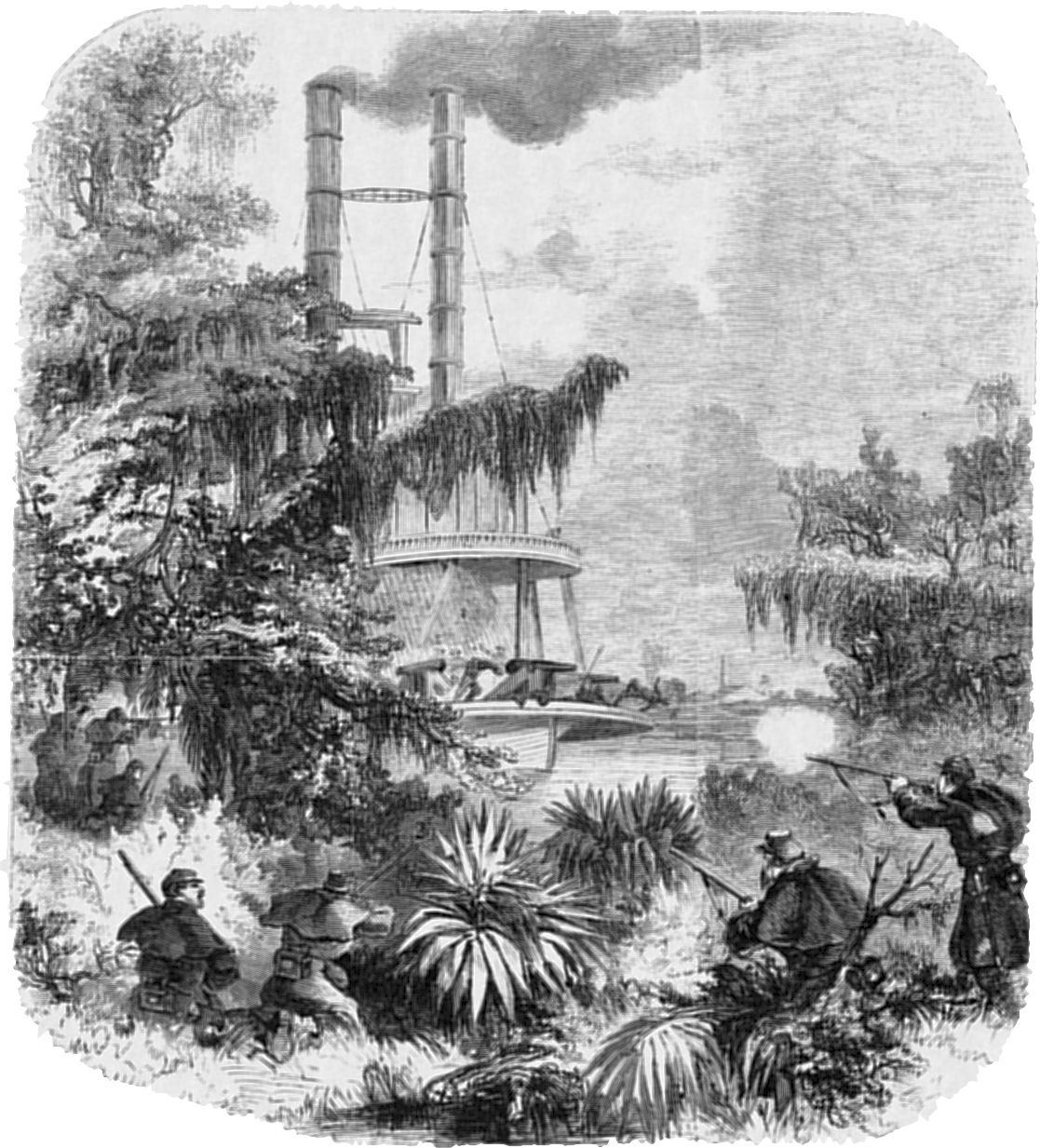
Sharpshooters of the 75th New York Vol., Picking off the Gunners on the Rebel Gunboat J. A

Sharpshooters of the 75th New York Vol., Picking off the Gunners on the Rebel Gunboat J. A. Cotton, in the Action at Bayou Teche, January 14.  (Published in Frank Leslie’s Illustrated Newspaper, February 21, 1863)

by John Beauchamp Jones

JANUARY 14TH.—Gen. Beauregard, some of whose forces have been taken from him and sent to the defense of Wilmington, is apprehensive that they may be lost, in the event of the enemy making a combined naval and land attack, and then Charleston and Savannah would be in great peril. Gens. Smith and Whiting call lustily for aid, and say they have not adequate means of defense.

Some 4000 more negroes have been called for to work on the fortifications near Richmond. I believe 10,000 are at work now.

A letter “by order” of the Secretary of War to Col. Godwin, in King and Queen County, written by Judge Campbell, says that blockaders are allowed to run through, provided they be not suspicious parties. The government takes what it wants at seventy-five per cent. and releases the rest. The parties are liable to have their goods confiscated by the Secretary of the Treasury, who, however, the letter proceeds to say, has never molested any one in the illicit trade—smuggling.

In Congress, yesterday, Mr. Foote called for a committee to investigate the commissary’s contract with Haxhall, Crenshaw & Co., and was particularly severe on Major Ruffin, in the commissary’s office, whom he understood was a partner in the flour concern.

Mr. Foote introduced a series of resolutions to-day, tempting the Northern States to make peace with us separately, excluding the New England States, and promising commercial advantages, etc. But we must treat as independent States, pledging a league with those that abandon the United States Government—offensive and defensive—and guaranteeing the navigation of the Mississippi River to the Northwestern States. They were referred to the Committee on Foreign Relations, of which he is the chairman. This is nothing. [click to continue…]

January 14.—To-day an engagement took place on the Bayou Teche, La., between four Union gunboats, under the command of Commodore Buchanan, assisted by a force of troops, under General Weitzel, and the iron-clad rebel steamer J. A. Cotton, assisted by a body of rebel troops, under the command of Colonel Gray, resulting, after a contest of several hours’ duration, in the destruction of the rebel iron-clad. Commodore Buchanan was killed in this action by a rebel sharp-shooter.—(Doc. 106.)

—The steamer Forrest Queen was captured and burned by guerrillas at Commerce, Miss., this evening.—The National gunboat Queen of the West, under the command of Colonel Charles E. Ellet, commanding the ram fleet in Western waters, while on a reconnoissance on the Red River, was fired on, near Gordon’s Landing, by a battery of four guns, and subsequently captured by the rebels.—(Doc. 105.)

Buntyn Station, Wednesday, Jan 14. This morning, while it was yet dark, Sergeant Hamilton came to our door, calling upon Evans to harness and hitch up team. I being on guard, coupled the horses, stood until 8 o’clock, when they were unhitched and unharnessed. Marched from 2 o’clock. Roll call. After [marched] to the headquarters of the 48th Indiana to be paid off, the boys having two months’ pay. I received none. Raining heavy all day. Five months in the service of Uncle Sam.

Tuesday, 13th.—Passed Clinton at 10 o’clock this morning. Citizens proposed to give regiment a dinner, but Colonel McConnell would not wait until they could get it ready; too bad.

Tuesday Jan’y 13th 1863 (My Birth day) 57 years.

The first thing that I hear in the morning is the cry of the News Boys, “Baltimore Sun & Clipper,” “Morning Chronicle,” “Northern Battle.” At 3 o’clock the “Star.” About 4 o’ck it is “Star 2nd Edition,” “Northern Union Victory.” After the N York mail gets in which is about 6 o’clock, the boys run through the Streets crying “N York Herald, Tribune, and Times.” The Baltimore papers and the Washington papers are sold at three cents, the NY at 5 cts, which are about three times the size of the “Sun” or Star. The old “Inteligencer” is distributed without any Noise. It stands on its dignity. Treads where it trod forty years ago, never radical or very divided in anything, trimming its sails to suit the breeze as far as prudence allows. It has lived through all administrations for half a Century and almost always enjoyed the patronage of the Govt until now. The Globe and the Republican are also daily papers. Nothing New today, all quiet. The Govt seems waiting (like Mr McCawber) “for something to turn up.” If it could only hatch out a Military genius who could lead our troops to Victory in Virginia, it would pay for sitting still. Victory is what we want now with gold at forty per cent over Treasury notes. I have not labored very hard today on the “Board,” have not had much to do. Was down to “Willards” awhile, saw Genl McDowell and Genl Heintzelman there. Qr Master Knowles called upon me today at the office. The hundreds of officers around the City have got what (in former times) was a Paradise to the southern employees in the Departments of the Govt, that is, “High Salaries and nothing to do.”

January 13, Tuesday. Received this A.M. from Admiral Du Pont an intercepted mail captured off Charleston. Reed Saunders, who had the mail in charge, threw it overboard, as he supposed, but the master of the vessel, once a volunteer acting master in our service whom I had dismissed for drunkenness, practiced a deception, and Saunders threw over something else than the mail, which the master secreted, retained, and delivered, and thereby saved his bacon. The mail was not forwarded to its destination, as Seward directed it should be, but opened. Numerous and important dispatches from Mallory, Memminger, Benjamin,[1] etc., etc., disclose important facts. Took some of the more interesting to Cabinet council.

Was waited upon by a large committee composed mostly of old friends and associates sent here by Connecticut to procure the location of a navy yard at New London. Mr. Speaker Carter was chairman and chief spokesman; wanted a navy yard at New London for defensive purposes, for the benefit to be derived from a large establishment located in the State; but little had been expended in Connecticut by the Federal Government; thought it a duty to look out for our own State; if the Union should be broken up, it would be well to have such an establishment as I had proposed in our own limits, etc. Assured the committee if Congress decided to establish a navy yard at New London I should not oppose but would heartily cooperate to make it what was wanted and what it should be. That the small yard at Philadelphia was totally insufficient, and if, in removing it, Congress should decide to go to New London instead of remaining on the Delaware, I should submit to the decision, but I could not, in honesty, sincerity, and as an American citizen acting for all, recommend it. That I had never supposed that the true interest of the country would be promoted by such a transfer; that, much as I loved my native State, I could not forget I was acting for the whole country and for no one locality. That League Island on the Delaware possessed some peculiar advantages that belonged to no other navy yard nor to New London; that it had been tendered, a free gift, by the city of Philadelphia as a substitute for the present contracted wharfage in the city; that I had conscientiously advised its acceptance, and I could not do otherwise than to still act in accordance with my convictions of what I deemed best for the whole country by continuing to recommend its acceptance, whatever might be determined in regard to a navy yard at New London, which was an altogether different matter.

_______________________________________

[1] Heads respectively of the Navy, Treasury, and State Departments in the Confederate Government.

13th. Tuesday. Spent the day very quietly at home. Worked as usual. Last night Chester treated to the oysters. Buglers expect to be mustered out, very jubilant over it. Wrote a letter home.