25th. After reading some in the morning, went down to Minnie’s. Heard Ellie sing. Beat Minnie a game of chess. John beat me twice. Stayed to dinner. Did some chores and went down N. P. in the evening. Read and visited. Happy enough. How glorious it will be when war ceases, we victors and peace comes again. F. sang so sweetly.
March 2013
On Yazoo Pass, Wednesday, March 25. Awakened by the bell which indicated that we were about to start. Curiosity soon found me on deck after a good night’s sleep. A beautiful morning. The was set to work trying to extricate us, and after an hour’s tug we swung loose. Passed the wreck of “Luella” a small screw propeller. She was nearly all under water. Barrels and boxes of commissary stores all around, floating.
9 A. M. passed a plantation with inhabitants, the first seen since we started. A neat log house and spring in door-yard reminded me of the home of my childhood
“How dear to my heart are the scenes of my childhood,
When fond recollections present them to view.”
Evening. Saw considerable dry land to-day on the right. Passed some plantations, apparently wealthy. Colonel Putnam sent a detail out in the yawl at 3 P. M. Brought in seven sheep, also in the evening brought in a good beef. Gave a piece to the Battery boys. Tied up near the plantation of the rebel General Elkhorn who had been paroled. Only twelve miles from Helena by road yet. Six to Coldwater. Heavy picket thrown out.

Letter from Colonel Lyon to Isaac Lyon.
March 25,1863.—We live in a house now and have a large room with a fireplace. We have partitioned off a bedroom in one corner, and are building a kitchen near by for our colored folks. We live mostly on the usual rations, with eggs and butter added. We pay twenty cents for eggs. Have bought no butter yet. We live in constant expectation of a paymaster. The Government owes me now over $1,000. I only expect to get about $450 at the next payment.
At present we are not menaced with an attack here, and we have the means with which to make a stout defense should we be attacked; but a movement of the rebels against the right flank of General Rosecrans’ army would be very apt to strike us. If, as is now reported, the rebels are evacuating Vicksburg and reinforcing Bragg, we shall have stirring times in this vicinity before spring is gone.
I suppose you have heard the report that Fort Donelson was taken and the 13th had gone the way of the 22d. The story was made out of whole cloth by some lying telegraph operator.

Md. Heights, March 25, 186.3.
Dear Friends:
Glad to hear the Capt. is improving. We are well. Affairs are the same as the other day. The Lieuts. are still under arrest; some are at the naval guard house, took them out of the magazine on account of their health.
The signal Officer at this post received a dispatch from Martinsburg that we have Vicksburg in our possession, it has not got out yet. Tonight’s paper had no news, but the report is they are evacuating Vicksburg and are going to throw their whole force on Rosecrans; Burnside is at Cincinati on his way to the army of the south west. I do hope that we shall be able to give them a severe whipping all round before long. It is about time something was done. I want you to send me two boxes of salt mackerel A. no 1. I can get ten cts. a piece for them by keeping them till pay day. I am sure if you will get them for me, that I can get out whole with a little over. I shall expect all the butter you can send, as we need it very much, having nothing to eat but our bread, coffee and beef. “I must have my butter!” What do you think the prospect is of our getting home? Of course you know it can not be till the war is over. The general opinion is that six months will see all the fighting over. One thing more, we must not give them peace, unless honorable to our arms: there must be no squeezeing out place, keep them until they submit to our terms. The end greatly depends upon our success at Vicksburg, port Hudson, and Charleston. If we whip them at these places I think Joe Hooker will start them and will drive them till they get some thing very strong to hide behind. About influence, I don’t urge my case hard, but just mention the thing, and if any thing should turn up, you might put it to use in my case, as I am in the army. I think not to use any bragadocio, that I am as capable as a great many others. Jere will write next Sunday. Much love to all.
Yours &c.
L. Bradley. Jr.
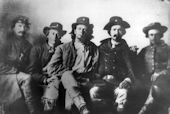
Wednesday, 25th—Roll call five times a day, arms and horses inspected in the morning and dress parade in the evening is the order of the day.

Wednesday, 25th [March]. Did not sleep again last night, and only dozed near morning. Dreamed quantities—of being at Shepley’s house and refusing to eat at his table; saw thousands of people, all under unpleasant circumstances; wrote a savage letter to Mayor Miller, and made myself conspicuous generally. Heard Mrs. Norton talking early to Jane; called her in and asked the question which had been lying on my mind, “Has Mary gone?” “No, Miss.” Greatly relieved, I turned over to get a nap, for I felt weak, nervous and sleepy. Presently I heard Jane say, “Aunt Mary has gone and taken Jake.” No more sleep—got up and dressed; I felt desolate and oppressed and it was quite cold. I felt quite as sorry as I did when Julie Ann left us. Mrs. Norton is quite cut up, though she says that she knew that Mary was going. Her first words were, “Now you know whether I know nothing or not, don’t you?” This was a cut at us for having taken Mary’s part. Indeed, I know all—that the woman would not have left but for her having taken too much liquor, and in that state passed the boundary too far for return. She took Jake along. We have both advised Mrs. Norton to move to her daughter’s, Mrs. Dameron’s, and we would go to Mr. Randolph’s. We could board with them. After much entreaty, he would board us instead of receiving us as visitors. She was angry at the mere mentioning of such a thing—said that nothing could make her live in a house full of children, and moreover, she says that if she goes to Mrs. Dameron’s all the servants would leave, as they do not like her. This I am afraid is true, as Mrs. Norton sees defects in the servant world very keenly, and she does not keep silence afterward. Mrs. Dameron’s house-full of servants have been too long indulged to allow of any interference, especially now that they can go to the Yankees with any story they please. This Yankee soldier’s wife at the corner keeps the servants of this neighborhood miserable. Hers are as well clad as she is, and have quite as much time to themselves, but they look sour and anxious. Those who are innocently inclined and are really attached to their mistresses are reproached by others and these low Yankees. I feel very sorry for Mrs. Norton. She did not believe that Mary would leave her, though she said so often. I think that Mary Jane, who is deceitful, I think, had much to do with Mary’s conduct. How long her ladyship may remain, no one knows. This flitting has caused quite a commotion in this household, and, indeed, I must say that I can never get over my sorrowful feeling for a blow of this sort. I had expected better things of Mary. She had always talked of being fond of her mistress’ family, and letters were read to her only a few days ago from every member of it, in which she was spoken of with much attachment. Charley and Mrs. Brown both spoke of what they intended to do to reward her for her faithfulness.
The Yankees have undermined every good feeling which at one time existed between these poor people and their owners. I am almost afraid to see the Confederates, though I long for their coming. So many people have been betrayed by pet servants. Strange that some of the most severe mistresses and masters have kept their servants through all this trying year. Mrs. Roselius came over as soon as she heard of Mary’s flight, and proposed to send over a girl of her sister’s who had been left with her while her sister was in Europe. She is an ugly, half-dazed looking creature—innocent, though, I think. She came in evidently much frightened, having been told alarming tales by Mrs. Roselius’s other servants. She seemed to revive after having been spoken to kindly. Her name is Kitty; I like the poor thing, somehow. I do not expect her to be honest, though, and will try to remember to lock up. I laid $1.50 on the bureau one morning and it disappeared in a very short time. This locking up and watching is perfectly hateful to me. But what can one do? One is obliged to be honest oneself and to pay one’s debts. But negroes have no mercy and will take one’s last cent if you keep it unlocked. I would hate them if I considered them responsible and developed beings. They are not quite men and women yet. I think the Yankees must be of the same mind, for they are catching up the negroes as if they were animals, to put them on the Government plantations. Judge Ogden and Mrs. Waugh passed the morning with us. The Judge was mysterious, and evidently smiles all over him. He is quite brilliant with some secret political information. He would tell nothing, but told us with much emphasis to fear nothing; that all our troubles (political) would be over in a week or two. He was in the depths of gloom not long ago. He does not know that Mary has told us about the spy. I suppose that this spy story, at least, must be true, because the Ogdens have heard from Billy that his captain (Tucker) has been on detached service for some time, and that he (Billy) being first lieutenant, is acting in his place. Judge Ogden saw Captain Tucker in Virginia on service—knows that he has been sent on this mission, so I suppose there can be no deception in this case. He told Judge Ogden that he had been sent here for information as to the position of things generally here. He says that Stonewall Jackson is outside at Camp Moore, and that this city is to be attacked as soon as the Port Hudson affair is over. When will it be over? we constantly ask ourselves. The varied reports one hears are enough to confuse one’s intellect, fraught, as they are, with our dearest interests. All conversation now is a medley of what this spy or that has told, or what some returned prisoner has reported, or that Colonel This or Lieutenant That or Captain So and So has said. We have heard again for the hundredth time that Weitzel has been surrounded and cut to pieces. Brashear is now reported to have been captured by the Confederates. Provisions and artillery sent in that direction for Weitzel have been brought back. Some muddy, soiled and tired cavalry have ridden into town.
We took dinner at Mrs. Dameron’s. Practiced on the piano a good deal—the first time for months. I regret that I have so neglected my music, but have had no heart for anything. Between three and four we heard cannon in the distance—listened with our hearts for some time. We concluded it to be a general clearing out of guns at Camp Parafet. Meant to take a walk, but calling in here for my gloves found so much company that I could not get away. We sat upon the gallery. Mary Waugh came; sent by her father to learn what we knew of a Jackson paper of the 20th, said to be in town, and of which Judge Ogden had told us. These papers are contraband, but they get in sometimes in reality, but oftener by report. We often hear of wonderful victories of ours, said to be detailed by this paper, but the search after it often proves hopeless. You never find anyone who has read it with his own eyes. It is quite a common question, “Did you see it yourself?” Generally some very reliable person has been told by some other reliable person who would not deceive anyone in small matters or great. So many of these stories are proved false by time that the “reliable” man or woman has fallen into bad repute. Three rumors now bring any tale under the ban. This paper of the 20th, the reliable man said, confirmed the capture of Farragut and the Hartford. Great rumors of the cutting to pieces of Rosecrans prevail. The existence and non-existence of the Indianola are as much matters of discussion now as ever the lamented Arkansas gave rise to. We hear “reliable” proofs of both. I am somewhat confused myself by opposite statements, but some people walk with sublime faith through the labyrinth. Mrs. Harrison, whose husband is confined here so long, and whom she is still allowed to visit, sat on the gallery with us and told us many things she had heard the day before from the Confederate prisoners who had been brought in. Colonel Frank Gardiner’s Signal Corps, near Port Hudson, were captured; Captain Youngblood and others. The passing of Farragut, at Port Hudson, and the crippling and the return of the other vessels, and the burning of the Mississippi presented a sublime and awful spectacle. It all took place at night, and the roar of the guns, both from the ships and shore, must have been deafening and terrible to hear. The crew of the Mississippi were all captured or killed. Many a wounded man silently lay upon the decks and was devoured by the flames as she floated. My blood seems to curdle, and I believe my heart does really bleed. It seems strange that we can eat, drink, sleep and array ourselves while such horrors are enacting daily. This evening I sat on the gallery and listened while Mrs. H—— told prison tales and showed Annie Waugh how to make some rose-trimming that she had seen Ginnie wear and especially admired. I do not feel like a trifler, I know.

March 25. — Captain Rasdereschen[1] came here today, to see about his new trestle bridge. The general had some spikes and hooks made according to his plans. An order was sent to Captain Slosson to furnish chess to General Birney for use on Friday. Day cool and pleasant, and very windy. Cloudy at night. General selected a place for Major Spaulding’s command to encamp.
[1] Captain Rasdereschen, if I remember right, was a Russian who had invented some new kind of bridge. He was currently reported to feed on candles and nothing else.

by John Beauchamp Jones
MARCH 25TH.—We have no news to-day, excepting the falling back of Rosecrans from Murfreesborough, and a raid of Morgan and capture of a train of cars. Rosecrans means, perhaps, to aid in the occupation of the Mississippi River. It will be expensive in human life.
Although our conscription is odious, yet we are collecting a thousand per week. The enemy say they will crush the rebellion in ninety days. In sixty days half their men will return to their homes, and then we may take Washington. God knows, but man does not, what will happen.
March 25.—The United States rams Lancaster and Switzerland undertook to run the batteries at Vicksburg. As soon as they came within range, the rebels opened a tremendous fire. The Lancaster was struck thirty times. Her entire bow was shot away, causing her to sink immediately, turning a complete somerset as she went down. All the crew except two escaped. The Switzerland was disabled by a sixty-four-pound ball penetrating the steam drum. She floated down; the batteries still firing and striking her repeatedly, until finally the Albatross ran alongside, and towed her to the lower mouth of the canal. Both these gunboats were improvised from light-built wooden river steamers, and not calculated to sustain a heavy fire.
—Brentwood, Tenn., garrisoned by a force of National troops, numbering five hundred men, under the command of Colonel Bloodgood, was this day captured and sacked by the combined rebel forces of Wheeler, Forrest, Armstrong, and Stearns. After the capture, the rebel forces were pursued by a body of Union troops, under the command of General Green Clay Smith, and overtaken near Franklin, Tenn. The Nationals were inferior in numbers to their opponents, who were drawn up in line prepared to receive them, but they immediately made the attack, and, after a brief contest, they routed and drove them for a distance of five or six miles, killing and wounding great numbers of them. In their flight the rebels abandoned the whole of the plunder captured in Brentwood a few hours previous.—(Doc. 147.)
—This citizens of Savannah, Ga., were suffering greatly for the want of an adequate supply of provisions. Even corn-meal could be had only in small quantities. The railroads were forbidden to carry any food out of the town.
—Governor Brown, of Georgia, sent a message to the Legislature of that State, recommending the passage of an act restricting the planting of cotton to a quarter of an acre to each hand, under a heavy penalty. He also recommended that further restrictions should be put upon the distillation of spirits, so as to prevent the use of potatoes, peas, and dried peaches for that purpose. He was in favor of giving a cordial support to the rebel government.
—The Union fleet of iron-clad monitors and gunboats under the command of Admiral Du Pont, “left Hilton Head, S. C, to-day.
—The rebel schooner Clara was this day captured, while trying to run the blockade at Mobile, Ala., by the United States gunboat Kanawha.
—The British steamer Dolphin, laden with contraband of war, was captured by the United States gunboat Wachusett off Porto Rico.
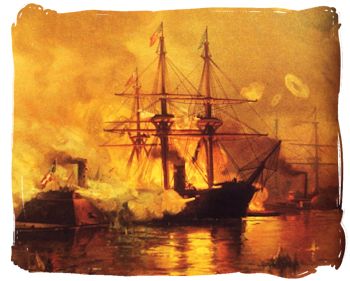
March 24th. Everything continues quiet. This afternoon it cleared up, and the sun made its appearance once more, which made things in general assume a more lively appearance. Tonight we are expecting one or two boats down from the upper fleet. I think that if they succeed in passing by the batteries at Vicksburg they will be very fortunate, as it is almost a matter of impossibility for a vessel to pass their casemates without being sunk, or at least very materially damaged; however, it is very probable that an attempt will be made, as it is highly necessary that we should have some assistance with us, in order to succeed in our object here. Our men have been engaged to-day erecting a barricade of sails on port side of poop deck; also building a breastwork of hammocks around the wheel.


