Thursday, 26th—Drill two hours and dress parade. A document from Gov. Lubbock of Texas read, giving an account of presentation of flags of 4th and 5th Texas Infantry of Virginia to the State. Also one or two captured by our Regiment.
March 2013

Thursday, 26th [March]. Mrs.Dameron,Ginnie, Mrs. White, Mrs. Waugh and myself paid a visit to the establishment of Mr. Burnside. He is very rich and an old bachelor and ladies are often asked to view his gardens and pictures. The house is built and furnished after the European fashion (on a small scale),and is really a bijou of comfort inside, though homely without. The pictures disappointed me, except in two instances. The china-closet had nothing old in it. I have seen a far more beautiful collection of the real antique in my dear mother’s closet at “Portland Manor,” before we sold out in Maryland. Mr. B made his money himself, and I would not in the least object to being as rich as he. Whether new blood or old, I respect blood, but three generations of extreme poverty, with all the mean cares and roughening labors which surely accompanies it, changes its promptings as well as its color. The proud noble, warded off from every detrimental influence, may imagine himself formed by high heaven of the rarest porcelain, but he is a money production after all. And the famous blue blood is but a compound of the best of food and influences, relieved from commonness. I am observer enough to be thus far a materialist. Came home from the tour tired enough. We were desired to leave our names, and as I left that of Mrs. Dameron, the sister-in-law of Mr. Shepherd Brown, the richest man in town, and in whose house General Shepley is now living, I felt sure of being recommended by the servants at least; they were vastly polite and attentive. Mary Ogden and Rose Wilkinson took dinner with us. The latter hopes to get out of town soon. General Sherman has promised her mother a pass and a passage out. This officer has been very kind to the Wilkinsons. When Mrs.W—— was imprisoned he offered to do her shopping for her. Found out that the small round silk capes that we women folk are now wearing are called “Beauregards.” Mrs. White says that that story of the hero which depressed me so, is not true. I hope not—yet, he is a Creole. I have not faith in their domestic relations. Doctor Fenner was up to-day; he is clever, but I do not fancy him somehow. Anything outside of the common path would disturb and shock him. He is well-bred and amiable, however. Mr. Dudley was up with him; we all walked over to Mrs. Dameron’s. Ginnie and I then paid a visit to Mrs. Wells and Mrs. Montgomery. They were very glad to see us.
Mrs. M—— is not long for this world, I think.
The Judge looks rosy and hale as an Englishman. He will live to get another wife, I expect—this is his second—but he is devotedly attached to her.
Heard much report. Read Jeff Davis’ proclamation respecting the day appointed for fasting and prayer. It is to be celebrated to-morrow in the Cathedral in the lower part of the city. The Catholics are bolder here than others; ’tis said that they wish to provoke the Federals to attack them. Even Butler could never awe Father Mullen, who, when summoned to his presence, answered him boldly; when being accused of having refused to bury a Federal, replied fearlessly, “No, sir, I would bury you all with pleasure.” He told Butler that his soul was his own, also his lips, and that he would pray for the Southern Confederacy, and whatsoever he pleased. “Do you know,” said Butler, “that I can send you to Fort Jackson?” “Do you know,” returned Father Mullen, “that I can send your soul to hell?” Butler pronounced Doctor Stone and Father Mullen the boldest and bravest men in town. The first he sent to prison; the latter he never touched. This was because he feared to excite the indignation of his Catholic troops. We will go to the Cathedral if the weather and our health permit. Met Mrs. Miller, a sweet woman, returning from a visit to us in our absence. Found Mr. Waugh, Mrs. Waugh and Annie and Mrs. Evans when we reached home. The burning of the Bio Bio, which took place at the wharf on Sunday, was much discussed. The ladies were discussing whether the damaged silks would not be better and cheaper to wear than the now royal calico. Cotton seems really king at last. We hear daily of the burning of this valuable ware by the Confederates to prevent its falling into Federal hands. The Yankee Era reports the capture of three schooners laden with it at Manchac; also the taking of Pontchatoula by them. There was a great cannon on the newspaper, though no fight had taken place. Our Camp was some miles from Pontchatoula. This cannon belongs to the old press of the Delta, which was taken from its editors among other printing paraphernalia. I remarked that the Yankees had fired this cannon with more effect than any other since the war commenced. They often have it stuck in for a fancied victory. Farragut has been heard of. He is not captured, the Era says, but is on his way to Vicksburg for coal. Barges of it will be brought to him through the famous canal. What can our boats be about if Farragut is free to run our batteries?
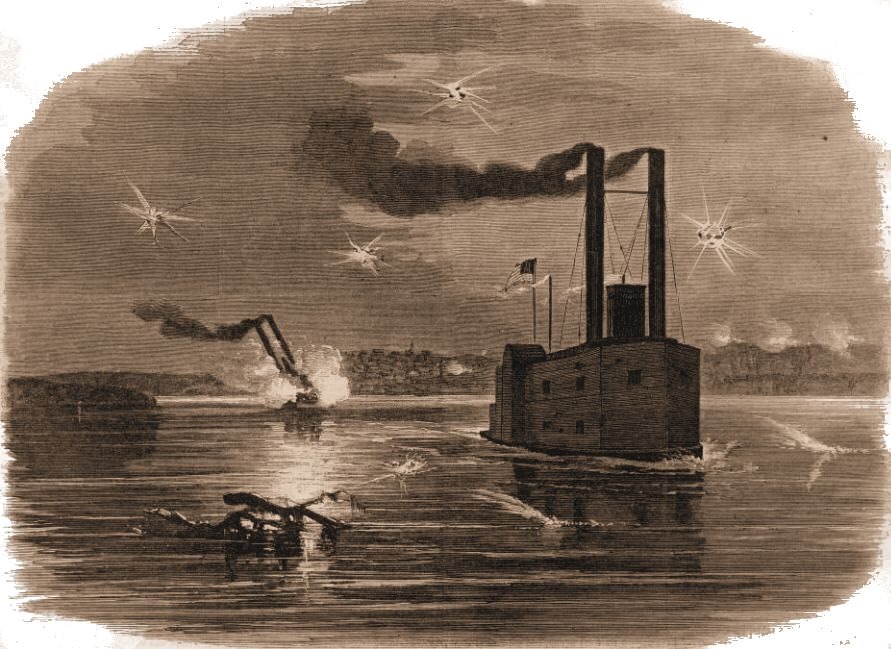
WE publish on this page a drawing from a sketch by our special artist, Mr. Theodore R. Davis, representing the unsuccessful effort of the rams Switzerland and Lancaster to run the Vicksburg batteries on the night of 25-26th March. A rebel account mentioned the attempt of the rams, and stated that both were disabled and one sunk. A Union account says:
“Last Wednesday evening the rams Lancaster and Switzerland undertook to run the batteries at Vicksburg. As soon as they came within range the rebels opened a tremendous fire. The Lancaster was struck thirty times. Her entire bow was shot away, causing her to sink immediately, turning a complete somersault as she went down. All the crew except two escaped. The Switzerland was disabled by a 64-pound ball penetrating the steam-drum. She floated down, the batteries still firing and striking her repeatedly, until finally the Albatross ran alongside and towed her to the lower mouth of the canal. The loss of life on her is not ascertained.”
Our correspondent mentions an interesting circumstance. The Lancaster had just sunk under the terrible hail of shot and shell from the rebel batteries. The Switzerland was badly injured, the smoke and steam filling her completely. At that moment Colonel Ellet remembered or perceived that the flag was not in its right place. Instantly ascending to the deck, he caught the halyards and hoisted the bunting in the face of the cheering rebels, while the shower of lead and iron whistled round him. A very gallant exploit. (Harper’s Weekly, April 18, 1863)
March 26. — Captain Strang went to Washington and Captain Bowers left to report to General Woodbury. One lieutenant and 4o men reported to Captain Rasdereschen for trestle-bridge drill. Colonel Stuart spent the night here. Snowing in the morning. Cloudy most of the day. Went over to headquarters of the Army of the Potomac in the evening with Colonel Stuart. Saw General Williams in regard to the Adjutant-General, Captain Williams. The general said that Captain Williams wished very much to remain where he was. Said that the general might nominate any one he chose for the place. Lieutenant Perkins and Van Brocklin went up to Bank’s Ford. Issued an order to Captain Slosson to furnish balks to General Birney.
by John Beauchamp Jones
MARCH 26TH.—We have dispatches (unofficial) from the West, Stating that one of the enemy’s gun-boats has been sunk in attempting to pass Vicksburg, and another badly injured. Also that an engagement has occurred on the Yazoo, the enemy having several gun-boats sunk, the rest being driven back.
It snowed a little this morning, and is now clear and cold.
Mr. Seddon is vexed at the unpopularity of the recent impressments by his order. It was an odious measure, because it did not go far enough and take all, distributing enough among the people to crush the extortioners.
March 26.—A large and enthusiastic Union meeting was held this evening at Buffalo, N. Y. Resolutions firmly and decidedly for the support of the Government and the prosecution of the war until a peace was conquered, were unanimously adopted.—The Legislature of Maine adjourned, having adopted concurrent resolutions fully indorsing President Lincoln’s emancipation proclamation, approving the use of negroes in the military service of the United States, and opposing all suggestions of compromise.—An expedition sent to Rome, Tenn., by Gen. George Crook commanding at Carthage, Tenn., returned tonight, having captured twenty-eight prisoners, among them a rebel captain named Rice, together with seven wagons and thirty horses.—General Burnside issued an order assuming command of the Department of the Ohio.
[Diary ] March 25.
This morning about a dozen of the black soldiers came armed into our church in school-time, and hid there. They were on the watch for some man who was to be taken as a soldier. They suddenly rushed out of church, to the great alarm of our children, clashing their arms. They looked at our boys to see if they were old enough to seize, but Tony and Aaron were not there. The children screamed in terror. We shall complain. The colored soldiers ought not to be left to manage this business alone. They do not understand yet the proper restrictions of their authority. To-day they have caught many. Robert, of Oaklands, afraid of being taken, asked my advice what to do. I told him that if he remained at home he could only lead a skulking life and never have any peace. But that if he went and volunteered, or let the soldiers take him quietly, as the island was picketed and he could not go now and volunteer at Beaufort, he would soon be discharged, for I knew him to be quite unfitted for service by rheumatism. He, however, took to the marsh when he saw the soldiers approach Oaklands, and he has not since been heard of.
Mr. Pierce came and examined our school. He asked the children questions which they answered pretty readily. To-night I had a long talk with him about Miss Ruggles’ school. She complains that the children will not go to her and will come to us. She thinks we ought to forbid them. We maintain that they were our scholars long before she came down here, that they are attached to us and we to them, that they complain of having no regular school, and no such advantages as slates and copy-books.
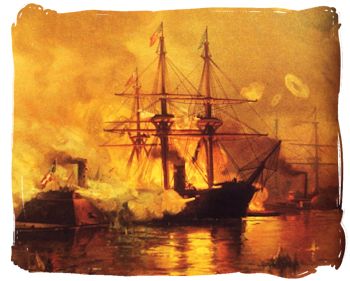
March 25th. This morning, at five thirty, heard heavy firing up the river in the direction of Vicksburg, which continued until six A. M., at which time we got under way and steamed up the river, beat to quarters, and shelled the rebel earthworks at Warrenton. The rebels returned our fire with rifled field pieces and musketry. At seven fifteen A. M., passed the batteries and discovered ahead the U. S. ram Switzerland and Lancaster, both having just passed the batteries at Vicksburg. The former vessel received a shot through one of her boilers, and the latter sunk from injuries received in the action. Three of the Switzerland’s men were very badly scalded; the crew of the Lancaster were all saved. At seven thirty A. M. brought ship to anchor above Warrenton. This afternoon Mr. Gabaudan, the Admiral’s Secretary, returned.
Wednesday, 25th—A division of troops passed our camp going down the river, while General Logan’s Division came back again going on up the river.
Wednesday, March 25th.
Early last evening the tremendous clatter of a sword that made such unnecessary noise that one might imagine the owner thereof had betaken himself to the favorite pastime of his childhood, and was prancing in on his murderous weapon, having mistaken it for his war steed, announced the arrival of Captain Bradford, who with two friends came to say adieu. Those vile Yankees have been threatening Ponchatoula, and his battery, with a regiment of infantry, was on its way there to drive them back. The Captain sent me word of the distressing departure, with many assurances that he would take care of “my” John.
Scarcely had he departed, when lo! John arrives, and speaks for himself. Yes! he is going! Only a moment to say good-bye . . . sunset approaches. Well! he must say good-bye now! Chorus of young ladies: “Oh, will you not spend the evening with us? You can easily overtake the battery later.” Chorus of married ladies: “You must not think of going. Here is a comfortable room at your service, and after an early breakfast you can be on the road as soon as the others.” No necessity for prayers; he readily consents. And yet, as the evening wore on, when we laughed loudest I could not help but think of poor little Mrs. McPhaul sitting alone and crying over her brother’s departure, fancying his precious bones lying on the damp ground with only the soldier’s roof — the blue vault of heaven — above, while two miles away he sat in a comfortable parlor amusing himself.
About sunrise, while the most delightful dreams floated through my brain, a little voice roused me exclaiming, “Sady! Sady! John Hawsey say so! Say give Sady!” I opened my eyes to see little Gibbes standing by me, trying to lay some flowers on my cheek, his little face sparkling with delight at his own importance. A half-opened rosebud with the faintest blush of pink on its creamy leaves — a pink, and a piece of arbor vitae, all sprinkled with dew, this was my bouquet. The servant explained that Mr. Halsey had just left, and sent me that with his last good-bye. And he has gone! “And now there’s nothing left but weeping! His face I ne’er shall see, and naught is left to me, save” — putting away my book and all recollections of nonsense. So here goes!


