Following the American Civil War Sesquicentennial with day by day writings of the time, currently 1863.

March 2013

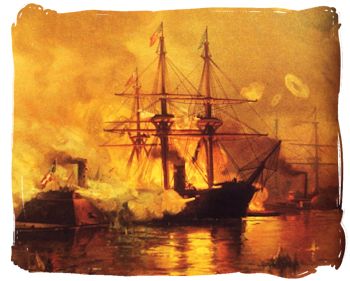
March 19th. This morning we were taken a little by surprise. Not expecting to meet with any opposition along here, we were not altogether prepared for it, as we have been on all former occasions. As no fighting had been anticipated the watch below was allowed to sleep in their hammocks, while the watch on deck got the ship under way. At five A. M. weighed and started ahead, steaming along slowly, and at six forty-five, as we came within range of the enemy’s guns, which they had mounted on high cliffs at this place, known as G rand Gulf, the enemy opened fire upon our ship, causing great excitement as a matter of course. We beat to quarters immediately; as soon as our guns could be brought to bear, we fired our broadside into the enemy’s batteries, and not until we had fired our broadside guns did the watch below know of what was going on. The excitement of those below sleeping, being awakened from their sound slumbers by the report of guns right over their heads, and the enemy’s shots striking the ship in many places, may be more easily imagined than described. We steamed ahead as rapidly as possible, and before our guns could be reloaded we had passed beyond range, although not altogether out of range of the enemy’s guns. We endeavored to train our guns so as to pay them back in their own coin for the damage they had done us, but we were not able to do them any, as our ship had by this time passed too far beyond. The enemy continued to shell us at long range, and the only retaliation we could make was with one heavy rifled gun which we had mounted on the poop deck. The battle was of short duration, lasting altogether about thirty minutes. Our casualties were two killed, and five slightly wounded, while our ship sustained much damage. If we had been aware of the fact that the enemy had fortified this place, we would have been prepared for them, and it is quite probable that we would have done them much more damage than what we did. The enemy got the best of us this time; but as our sailors say it was not a square fight, and when we go down the river again we will show them what are the fighting qualities of the old Hartford. It is quite evident that they know something of them already, as Forts Jackson and St. Philip, the Chalmette batteries and Vicksburg, and lastly, Port Hudson can testify to this fact. However, we continued on our course up the river. We met with no further opposition, and at three forty-five P. M., brought ship to anchor twelve miles below Vicksburg, or three miles below Warrenton.

As soon as we came to anchor a small boat was seen approaching from ashore; soon ascertained that the boat contained four men, one of them a Lieutenant, the other a private belonging to our army; they were on picket duty. Seeing our ship approach they knew who we were, so accordingly they came on board to inform our Admiral of what they knew. We were very happy indeed to meet with friends. The Admiral immediately dispatched his secretary, Mr. Gabaudan, to communicate with Admiral Porter’s fleet above Vicksburg. It is reported that we have an army of two hundred thousand men in the vicinity of Vicksburg. It is very probable that an attack will be made upon this place very soon. It is doubtful, however, whether we participate in the attack, as we are alone.

At five thirty P. M., called all hands to bury the dead; read the funeral services over the bodies of Charles Sweeney, seaman, and Dennis Driscoll, landsman; sent an officer on shore in charge of bodies to see them interred. The Lieutenant who came off to the ship in the small boat brought with him two prisoners; placed them in confinement on suspicion of being in rebel employ.
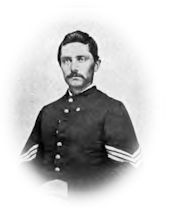

Thursday, 19th—I was again on duty today. Company drill at 9 o’clock and battalion drill at 2 o’clock. The troops which were in camp at the south side of the lake are on the move, going aboard transports to go down the river to find higher camping ground.

March 19 — This morning we renewed our march up the Valley. At New Market we turned off on the Sperryville pike and moved toward Luray, crossing the Massanutten Mountain and fording the Shenandoah River. Camped quarter of a mile west of Luray.

Snowed all afternoon, which makes it very disagreeable for outdoor sport and renders the bosom of Mother Earth a little unfavorable for sleeping purposes.

19th. In the morning cared for Rowena and gave out the bread. Read “Thirteen Months in the Rebel Service” by Stevenson, very interesting. No lesson in the evening. Capt. and Lt. Case gone home. Studied mine but did not care much about reciting. Wish I could go home now, too.

Mrs. Lyon’s Diary.

March 19, 1863.—The 83d gives a grand party on the Ewing tonight in honor of Colonel Harding. We shall go.

Thursday, 19th—Came on picket this morning.

March 19. Heavy northeast storm blowing this morning. Steamer starts down the river and enters the sound about 10 o’clock, wind increases, the sound grows rough, the boat rolls, the boys grow sick, the water breaks on deck and many of them get wet; altogether the passage is rather unpleasant. We arrive at the north end of the sound, near the entrance to Croaton sound, about 9 p. m., and anchor for the night.

19th.—My birthday. While in Richmond, this morning, brother J. and myself called on some friends, among others our relative Mrs. H., who has lately been celebrating the marriage of her only son, and took us into the next room for a lunch of wine and fruit-cake. We had never, during two years, thought of fruit-cake, and found it delightful. The fruit consisted of dried currants and cherries from her garden, at her elegant James River home, Brandon, now necessarily deserted. She fortunately was enabled to bring her furniture to Richmond, and is the only refugee that I know who is surrounded by home comforts.

by John Beauchamp Jones

MARCH 19TH—Snowing. It is estimated that we lost 250 men, killed, wounded, and taken, in the fight on the Rappahannock; the enemy’s loss is not known, but certainly was heavy, since they were defeated, and fled back, hotly pursued.

Confederate money still depreciates, in spite of the funding act. Some of the brokers are demanding ten dollars Confederate notes for one in gold! That is bad, and it may be worse.

The enemy are advancing from Corinth, and there are not sufficient troops to resist them. Gen. Johnston says if men are taken from Bragg, his army may be destroyed; and none can be ordered from Mobile, where there are only 2500 for land defense.

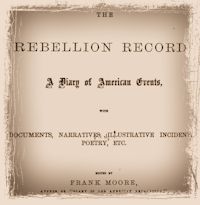
March 19.—The British steamer Georgianna, with a cargo of medicines, dry goods, and six pieces of field artillery of the Whitworth and Blakely patterns, was disabled and subsequently destroyed by the National blockading fleet off Charleston, S. C.—The Union gunboat Chenango was launched at Greenpoint, N. Y.—A party of soldiers sent to Rush County, Ind., to arrest deserters, succeeded in capturing six, but while on their way to the cars the deserters were rescued by a large party of mounted “Southern sympathizers,” who were armed with rifles. Two companies of infantry were then sent from Indianapolis, and the deserters were again taken into custody.—A skirmish occurred on Duck River, near Franklin, Tenn.—The schooner Fanny Lewis arrived at London, from Wilmington, N. C, having run the blockade with a cargo of cotton and turpentine.—London News.