Following the American Civil War Sesquicentennial with day by day writings of the time, currently 1863.

March 2013

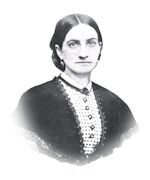
Letter from Mrs. Lyon.

Fort Donelson, March 17, 1863.—The dangers that surround us have made us appreciate every hour together. Our train went over to Fort Henry day before yesterday, and on coming back yesterday they saw a number of rebels, who probably meant to attack the train but saw it so strongly guarded that they let it alone.

Mrs. Lyon’s Diary.

March 17, 1863.—We all went out to see the dress parade. The ground has been so muddy and broken that they have not had a parade lately. The Thirteenth Regiment surpasses them all.

In the night the telegraph operator came to say that Colonel Harding was promoted to Brigadier-General. Most of his regiment, the 83d, came down here to congratulate him. They serenaded him, sang all kinds of war songs, and tried to get into his room, but all in vain. A boat came by with a band on it that played beautifully.

Tuesday, 17th—I listened to some delightful music this morning by Miss Stern, particularly the Texas Rangers, dedicated to Mrs. Gen’l Wharton. I started back to Camp but met the Regiment going out on picket. I fell in and went out and had to come back or go back and get my blankets. Came out half a mile from D. and camped.

March 17th, 1863.

We have just received orders to be ready to march at a minute’s notice, with two days’ rations in our haversacks. The quiet of repose is suddenly disturbed by war’s alarms; the Rebels attacked our forces today at Suffolk, about twenty miles from Norfolk. The supposition is we go to support our forces at that place. Our men are excited to the highest pitch of enthusiasm. As I write I hear their shouts and joyful exclamations. The Seventeenth has recovered its old-time energy, and is eager for the fray.

March 17th. This being St. Patrick’s day, or the 17th of Ireland, as the men call it, General Meagher and staff celebrated by giving a steeplechase on the parade ground of the division. A course was carefully laid out, ditches dug, hurdles erected, and valuable prizes offered to the contestants. The conditions were simply that none but commissioned officers of the division could ride, which was sufficiently liberal. A crowd of officers presented themselves aspirants for honors, as well as prizes. Meagher, glorious in fancy undress uniform liberally covered with gold braid, and followed by a jolly lot of staff officers, rode about the course, master of all he surveyed. He is a very good horseman. Most of the general officers of the army, with their many lady friends, were invited, resulting in a magnificent crowd. Amongst many notables riding in the train of the commander-in-chief, was the Princess Salm Salm, a beautiful and fearless horse woman. When she first came on the ground, she rode her horse up to a five foot hurdle and nonchalantly took a standing jump, clearing it handsomely. Hooker looked superb, followed by a great crowd of staff officers and retinue of mounted ladies.

The race was a great success, there being many falls, many horses injured and a lot of riders. Wilson, of Hancock’s staff, rode, and although getting one or two bad falls, managed to pull through, and win one of the prizes. Jack Garcon the O’Malley dragoon aide, won first prize and was fully entitled to it. The course was surrounded by thousands, kept in order by guards posted entirely around the field. In the evening General Meagher gave a reception, and of course, all the brigade and other commanders, with their staffs, were invited. Zook, Broom, and I attended, but the pace was too fast for Zook and so we retired early, leaving Broom, who is quite equal to every emergency of this sort, to do the honors.

Within a large hospital tent, mounted upon a table in the center, stood an immense punch bowl filled to the brim with the strongest punch I ever tasted. All were invited to partake and such a gathering of jolly, handsomely dressed fellows, I never saw before. The Irish brigade was in its glory. It understood the situation, was master of it, and quite immortalized itself.

There was the inevitable quarrel. How could it, otherwise, have been complete? The general and the brigade surgeon ended in challenging each other to mortal combat, and for a time matters assumed a threatening aspect. The following morning, however, when the effects of the nectar had subsided, the surgeon apologized in due form, and peace resumed her loving sway.

Mitchell, of Hancock’s staff, was in high feather, and might easily have been mistaken for one of the festive brigade.

March 17.—A detachment of National troops under the command of Colonel Spear, attacked the rebel breastworks on the Black Water, near Franklin, Va., but without being able to carry them. The fight lasted for more than an hour, in which Colonel Spear had one man killed, and sixteen men wounded.—Baltimore American.

—A spirited cavalry engagement occurred at Kelly’s Ford, on the Rappahannock River, Va., between a strong reconnoitring force of Union troops under the command of Gen. Averill, and a body of rebel cavalry under Gen. Fitz-Hugh Lee, in which the latter, after a most desperate struggle, of four hours’ duration, were repulsed, and finally routed and pursued for a distance of six miles.—(Doc. 139.)

—By order of the War Department, Colonel James B. Fry was detailed as Provost-Marshal General of the United States, in pursuance of section five of the act approved March 3, 1863, for enrolling and calling out the National forces, and for other purposes.—The British steamer Calypso ran the blockade of Charleston, S. C, and arrived at her wharf in that city without receiving any damage from the blockading fleet.— Charleston Courier.

—Rear-admiral Farragut, from the flag-ship Hartford, lying off Natchez, Miss., sent a letter to the Mayor of that city, stating that if the United States boats were fired on by the people of Natchez or by guerrillas, he would bombard the city.—Gold was quoted in Richmond, Va., at four dollars and twenty-five cents premium.

Headquarters Army Potomac,

Camp near Falmouth, March 16, 1863.

Dear Father, — . . . I was very glad to hear General Sedgwick speak so highly of General Benham as he did. He said that he considered him the smartest man in the army, although he thought he did not possess so much general information as some others. General S., General Hooker, and General Benham were classmates at West Point. I think General B. may have a corps, although I do not want you to say anything about this. I see no chance of any move for some time.

I tried to get Henry Ropes on General B.’s staff, but he did not wish to leave his regiment. I do not know whom to get now. Almost all my friends are captains. . . .

I have very little to do at present, except read and write, and ride about to see my friends. I am reading a French book, among other things.

I have got a cook and everything in regard to our mess fixed. We take two meals a day, breakfast at eight, and dinner at five. . . .

I hear that General Porter is to be made Street Commissioner in New York. I hope it is true.

I called on General Barnes the other day, and also on my regiment. I am glad I did not get on Meade’s staff. From what I can learn, I do not think he is a very pleasant man to be with. . .

March 16th. This morning at five thirty got under way, and steamed up the river in charge of the pilot. At seven A. M. two men came on board, and reported themselves as belonging to the original crew of the Queen of the West, having escaped from her after her capture by the rebels, since which time they have been concealed in the woods. At nine A. M. weighed and started on up, weather having cleared up so as to be able to see our way. At eleven thirty A. M. brought ship to anchor off the mouth of Red River. It is quite evident that there are a number of the enemy’s gunboats up this river. This afternoon the ship’s company have been engaged at target practice.

Monday, 16th—The Eleventh Iowa turned their old Sibley tents over to the quartermaster and drew wedge tents in their stead. They finished cutting the levee today and let the water through from the river to the lake. The roar of the water rushing through the canal can be heard a mile.

April 16.—We have had trouble in the wash-house; some one told Dr. Patterson that the three girls who came from Mobile had been dancing with some negroes, and that last Sunday they walked to the graveyard with one.

The first I have been told is positively a falsehood; the second, I had heard before. When told of it, I laughed, and said I expected it was another case of “Dame Blaize,” “whom the king himself did follow as she walked on before.” I suppose the girls were walking, and the negro happened to be going the same road; as I feel confident, from what I have seen of them, they would not knowingly do a wrong of that kind. Dr. P. had dismissed them. When I told him I did not believe any of the stories, he said he sent them off out of respect to the ladies in the hospital, and if we wished he would countermand the order. The girls were sent back, but in a little while came and told me that one of the non-commissioned officers in the hospital had gone into the wash-house, and spoken insultingly to them on the subject. I sent for Dr. P. and told him the circumstance; he was very angry, and said he would dismiss the man, as he would have no one in the hospital who did not behave properly. These are a few of the trials of hospital life, and I think they are serious ones; but I feel sure we shall have no more trouble on that score, as Dr. P. will not permit it.

Miss G.’s health has been so feeble that she has been compelled to leave for home; she left yesterday; I went as far as Atlanta with her. Dr. O’Neal, an assistant surgeon of the Gilmer Hospital, accompanied us. He gave me an account of the death of Captain De Graffenread, the Tennessean.

He had been moved to the Gilmer Hospital, as it belongs to Polk’s corps; he died very suddenly; a blood-vessel ruptured, and alarmed him so much that Dr. O’Neal thinks he died from fright. He was about fifty years of age. From all I have been told, I do not expect we had a braver man in the army; his men fairly idolized him, and the negro servant who nursed him cried like a child when he informed me of his death. His sister and brother-in-law came to see him; but too late, as he was dead and buried before they reached here. I have been told that they were indignant at his treatment in our hospital. They said: “To think that a man of his means should have been kept in a ward like any other soldier!” If they had come to me about him, I should have informed them, I was certain he was too good a soldier to have wished to be any place else. His own people could not have taken better care of him than he had from every one here. He had the best of medical attention, and as his case was a bad one, I prepared his food myself. He got the very best of what we had in the hospital—which was a good deal, as at that time we had the box of things sent from Mobile. Poor fellow! all these things do not trouble him now. He was not religious. “Leaving his sins to his Savior,” let us think of him only as the hero he was.

“Then on rapturous bosoms let gratitude swell,

For this son of renown, who so gloriously fell,

And while fancy leads on to his cold, hallowed grave,

We shall echo a sigh to the manes of the brave.”

Dr. O’Neal met with a lady and gentleman going to Mobile, who kindly consented to take charge of Miss G. We put up at a hotel; I do not know its name. We remained there about two hours, for which we paid one dollar each.

In the cars, on my way back, I met a Mr. Pritchard from New Orleans. He related some of his trials before being sent out of that city. He also told me about a dinner given in Montreal, Canada, and that at it President Davis, Generals Lee and Jackson, had been highly complimented. I wonder the people there are not afraid to commit such a breach of international law!

Mrs. Dr. Turner was on the train, going to pay her husband another visit. She had just come from Alabama. She told me her brother had never got his coat and shawl from the Trout House. We met Colonel McNair of the Fourth Mississippi Cavalry. He had just come from Mississippi.

The cars were loaded with troops from Mobile, going to reinforce Bragg; among them were some Georgia regiments; their relatives were at the different depots to meet and take a look at them before they went up to the army. The banks all the way along were lined with ladies, waving their handkerchiefs, and throwing bouquets to the soldiers, greeting them with much enthusiasm, which the soldiers seemed to appreciate by cheering the ladies in return.

I was informed that the Thirty-sixth and Thirty-eighth Alabama Regiments were on the train; as I had some friends in them, I tried to see them, but failed; the train they were on stopped a half mile from the depot, so I was unable to see them at that time.

I noticed the country through which we passed was barren and poor-looking, and the people had a sickly appearance.